
 en
en
 Español
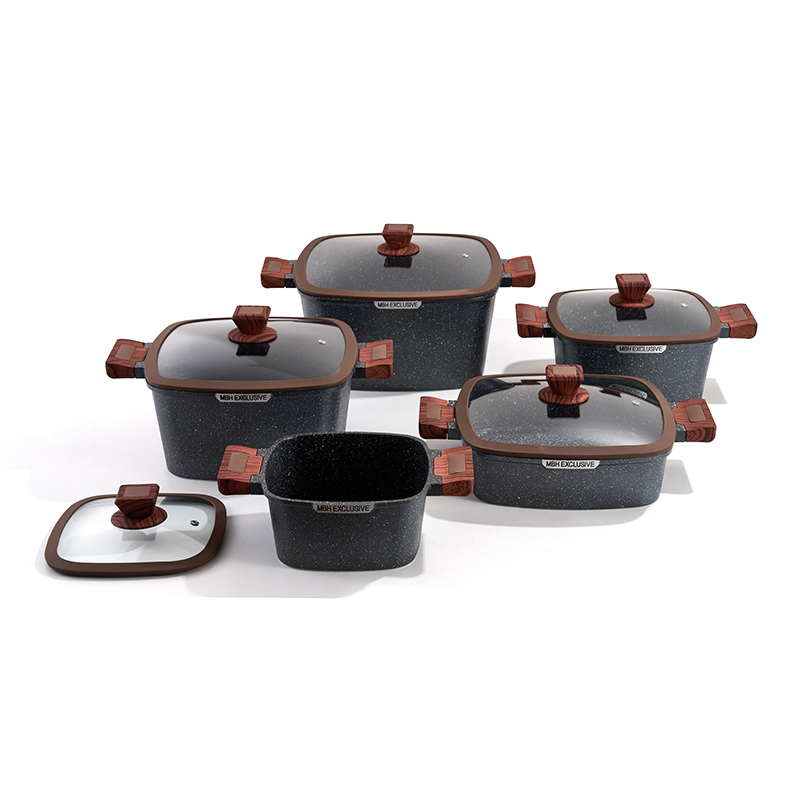
This cookware set features a non-stick coating, even heat conduction, and multi-...
See Details
Are the non-stick coatings in multi-function cookware sets safe for everyday use?
Date:May 27, 2026
Non-stick coatings have been a source of consumer concern. Understanding what the coating is made of and how it behaves at different temperatures helps clarify the risks.
PTFE (polytetrafluoroethylene, brand name Teflon). This is the common non-stick coating. PTFE itself is chemically inert and non-toxic. The concern historically was PFOA (perfluorooctanoic acid), a processing aid used in manufacturing PTFE. PFOA was phased out by major manufacturers globally around 201Today, PTFE coatings sold in North America, Europe, and Japan are labeled "PFOA-free." However, PTFE begins to break down when heated above 260°C (500°F). At 300°C (572°F), the coating releases fumes (perfluoroisobutylene and other fluorocarbons) that can cause polymer fume fever (temporary flu-like symptoms) in humans. Birds are much more sensitive; PTFE fumes can kill a pet bird within minutes at temperatures above 280°C. For cooking, most stovetop cooking (simmering water at 100°C, frying eggs at 130–150°C) is well below 260°C. The danger occurs when an empty pan is left on high heat (e.g., preheating for 5+ minutes). An empty PTFE-coated pan on a gas stove can reach 350–400°C within 3–4 minutes. To use PTFE safely: never preheat an empty non-stick pan; always have oil or food in the pan before turning on the heat; use low to medium settings; never use PTFE-coated cookware under a broiler (temperatures exceed 300°C).
Ceramic non-stick (sol-gel coating). This coating is made from silicon dioxide (silica, essentially glass) with a silicone oil or other non-stick agent. It contains no PTFE, PFOA, or other fluorocarbons. It is safe up to 400–450°C (higher than PTFE). However, ceramic coatings are less durable than PTFE. They lose their non-stick properties after 6–12 months of regular use (compared to 2–5 years for PTFE). The coating may develop micro-cracks from thermal shock (e.g., running cold water into a hot pan). These cracks are not a safety hazard (they are silica) but food will stick. Ceramic-coated pans are also more expensive. For a user who wants "no chemicals" and does not mind replacing the pan every 1–2 years, ceramic is a good choice.
Seasoned cast iron (natural non-stick). This is not a coating but a polymerized layer of oil (a form of natural plastic) built up on the iron surface through seasoning. It is entirely safe if the pan is used properly. However, the non-stick property is not as good as PTFE; eggs may stick. Also, cast iron is heavy (a 30cm skillet weighs 2.5–3.5 kg, vs. 0.8–1.2 kg for aluminum non-stick). Multi-function cookware sets that include cast iron pieces often label them as "enameled cast iron," which has a glass coating (enamel) that is non-reactive and moderately non-stick (but not as non-stick as PTFE).
Our recommendation for most users: If you are cooking on medium heat, use silicone or wooden utensils, and never heat an empty pan, a PTFE-based non-stick coating is safe and effective. The "PFOA-free" label is now standard. If you still have concerns, choose ceramic non-stick (shorter lifespan) or learn to cook with stainless steel (requires more fat for non-stick effect). Do not buy "granite" or "marble" coatings; these are ceramic-based with colored speckles—not actual stone—and they perform similarly to standard ceramic.
Can all pieces of a multi-function cookware set go into the oven? And up to what temperature?
This is a common point of confusion. Not every piece in a set is oven-safe. The limiting factors are the handles (materials that melt) and the lid knobs (often plastic).
Stainless steel pieces (with stainless handles, no plastic). Oven-safe up to 260–300°C (500–570°F). The metal handles will get very hot (you must use oven mitts). However, some stainless steel pans have a "capsule bottom" (a layer of aluminum encapsulated between steel layers). The capsule may separate at temperatures above 260°C if the pan is empty (differential expansion). For oven use, fill the pan with food to keep the base temperature uniform. Also, check if the lid knob is metal or plastic. A plastic knob (even "heat-resistant" plastic like nylon) will melt at 200–240°C. If the knob is removable (screw off), you can cover the lid hole with foil. If the knob is riveted, the lid is not oven-safe above 180–200°C.
Enameled cast iron (heavy pieces, usually a Dutch oven). Oven-safe to 260°C (500°F) for the pot itself. However, the lid knob is often plastic or coated metal. A plastic knob melts above 180–200°C; a metal knob (stainless) is safe to 260°C. Many enameled cast iron pots come with a plastic knob that can be unscrewed and replaced with a metal knob (purchased separately, $5–15). Check the manufacturer's specification. Enameled cast iron can handle broiler temperatures (260°C) because it is heavy and holds heat well, but sudden temperature changes (e.g., moving from a 260°C oven to a cold counter) can crack the enamel. Place the hot pot on a wooden board or a dry cloth, not on a cold metal or stone surface.
Anodized aluminum (non-stick or plain). Most anodized aluminum pans have plastic or silicone handles. The aluminum itself can tolerate 400°C, but the handles (often made of bakelite or nylon) melt at 180–220°C. Check the handle. If the handle is hollow metal (stainless steel riveted to the pan), the pan may be oven-safe to 200–220°C. However, some handles have a "stay-cool" plastic insert—that plastic will melt. A good rule: if the handle is not clearly all-metal, assume the pan is not oven-safe above 180°C.
Non-stick PTFE or ceramic coated pans with metal handles. The coating limits the oven temperature to 180–200°C (356–392°F). At 260°C, PTFE begins to degrade (as noted earlier). Check the manual; most manufacturers state "oven safe to 180°C" for non-stick pans. Do not use non-stick under a broiler (broiler temps 250–300°C). The coating will be damaged.
Glass lids. Tempered glass lids (common in multi-function sets) are usually oven-safe to 180–220°C (350–425°F). The rubber or silicone rim around the lid may be safe to 200°C, but the plastic knob in the center may melt. If you need to use the lid in the oven, remove the plastic knob and cover the screw hole with foil. Some glass lids are marked "oven safe to 180°C" on the underside. If not marked, assume 180°C is the maximum.
Practical advice: Keep a separate oven-safe baking dish or a cast-iron skillet for high-temperature roasting (e.g., 230°C chicken). Most multi-function cookware sets are not designed for high-heat oven use; they are for stovetop cooking with occasional oven finishing (e.g., keeping a dish warm at 150°C). Check the manual for each piece; if the manual is lost, assume a maximum of 180°C for any piece that has a non-metal handle or a plastic knob.
Recommended Articles
Product Category
Related products
-
-
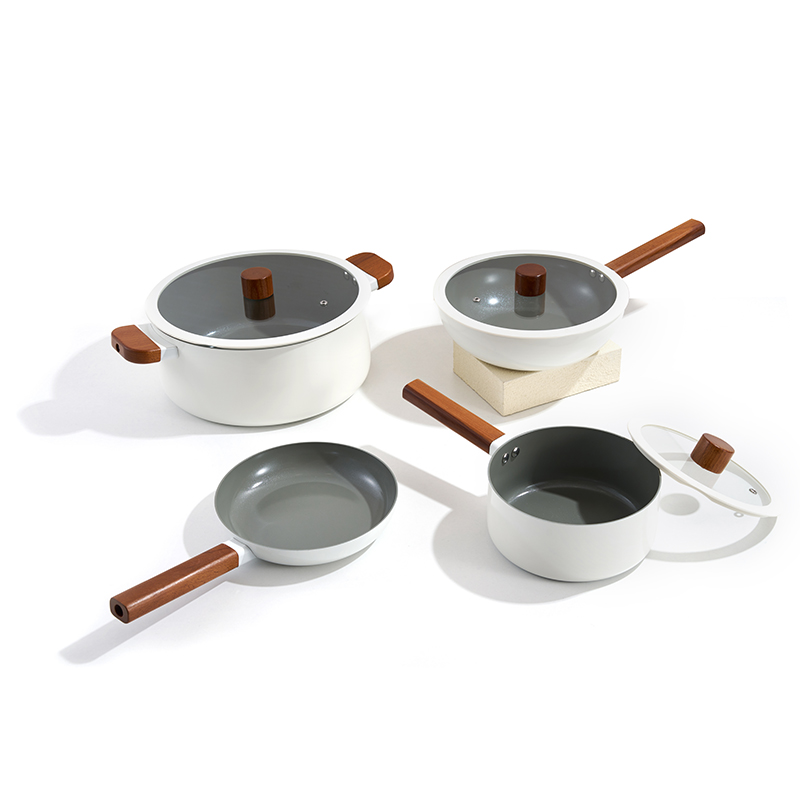
This cookware set has a ceramic non-stick inner liner, a heat-resistant wooden h...
See Details -
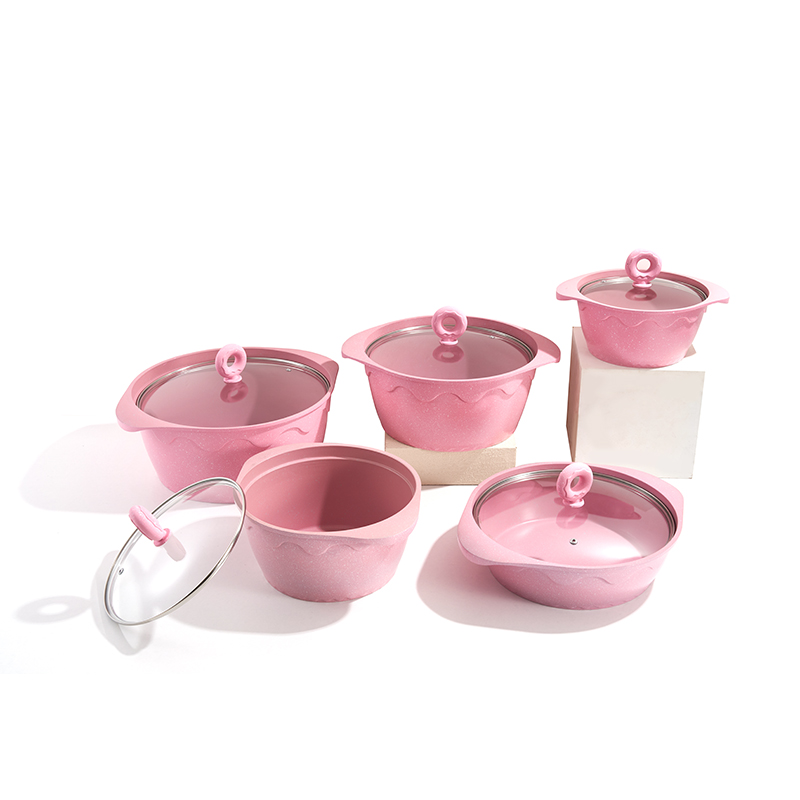
This cookware set is made of food-grade non-stick material, with a unique eye-ca...
See Details -
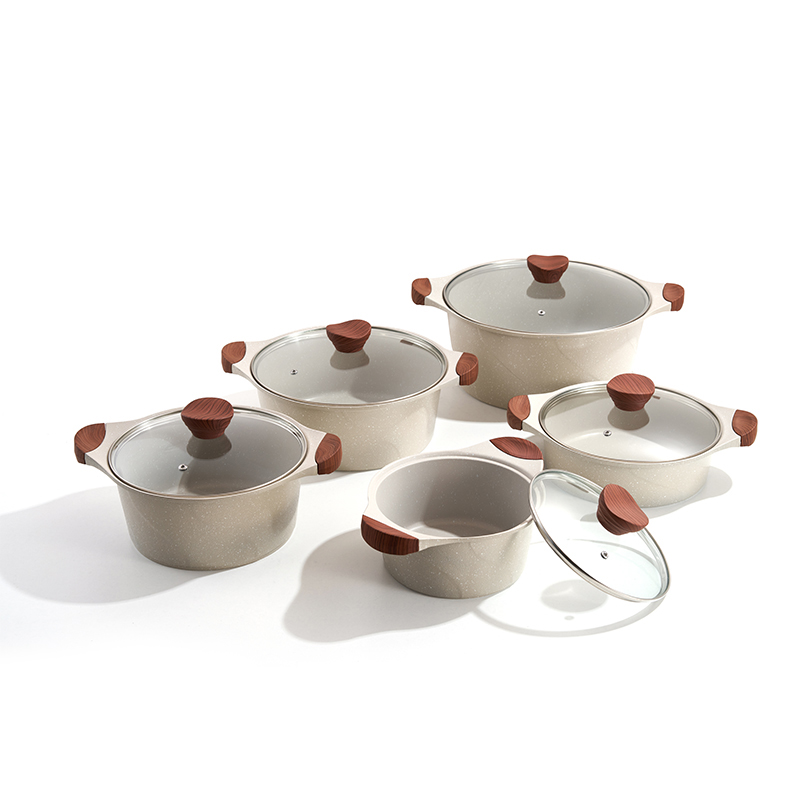
This off-white cookware set is made of wear-resistant non-stick material, with w...
See Details
Whether you're looking for bulk purchases or have any custom requirements, We are here to offer the best
solutions for you.
tiffany.zhong@echocn-trading.com
PHONE
+86-19561173975
+86-19557020621 (Hazel Wu)
ADD
Room 301, Unit 3014, No. 175 Qifeng Avenue, Wenqiao Town, Taizhou, Zhejiang, China
Fill Out the Form for More Information
Copyright © Zhejiang Echo Industry And Trade Co., Ltd.
All Rights Reserved.

China Cookware Set Manufacturer