
 en
 Español

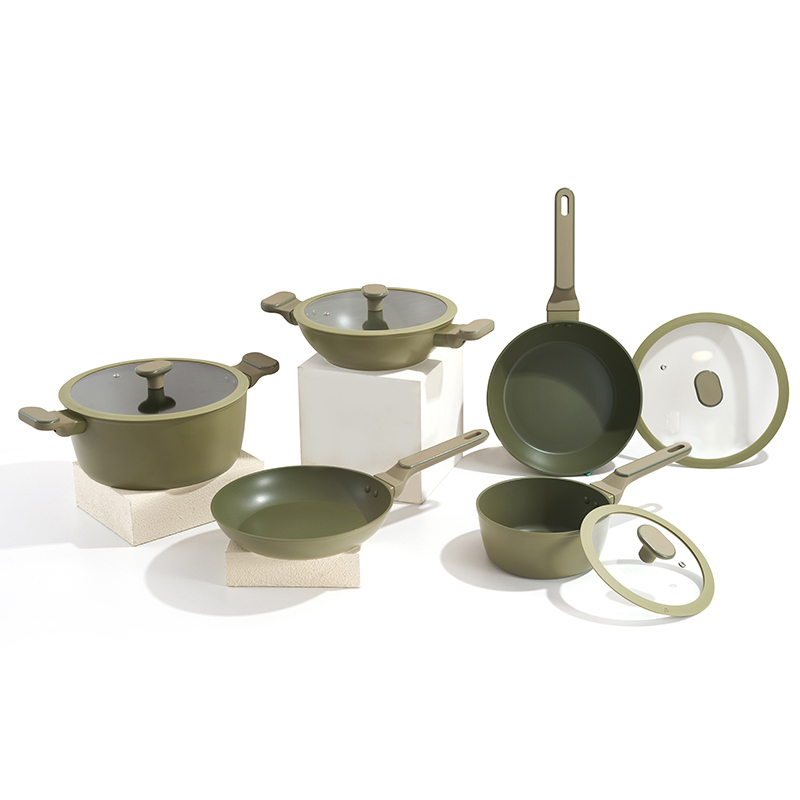
This cookware set features a non-stick coating, even heat conduction, and multi-...
See Details
Why Two-Tone Silicone Utensil Sets Are Becoming Essential in Modern Kitchens
Date:Nov 08, 2026
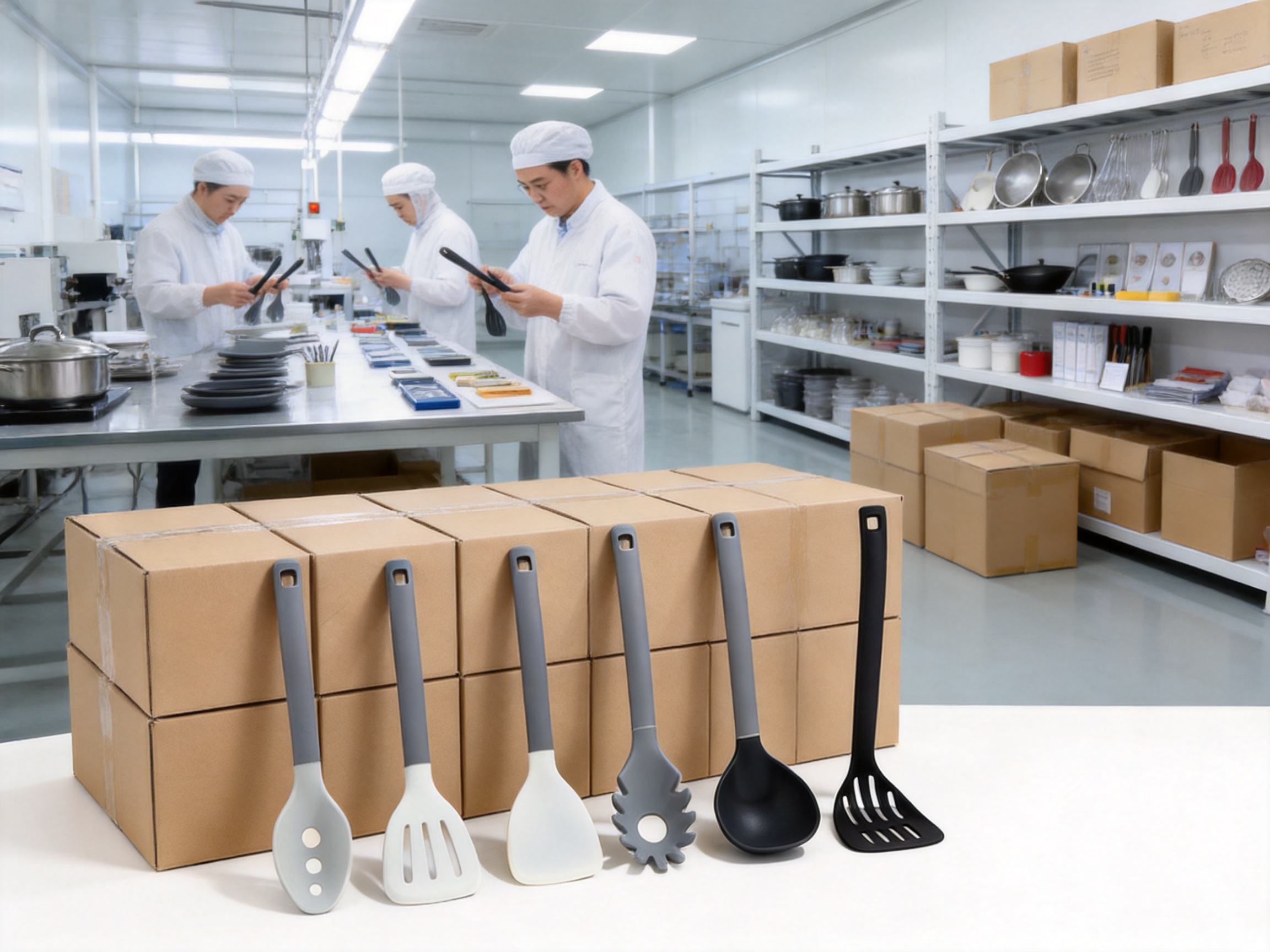
Kitchen tools are no longer judged only by whether they can stir, scoop, or turn food. Modern buyers expect utensils to be safe for non-stick cookware, comfortable to hold, easy to clean, attractive enough to display, and durable enough for regular household or commercial use. A well-designed utensil set must also provide practical value by covering several cooking tasks without filling a drawer with unnecessary tools.
The 6pcs Two-Tone Non-Slip Silicone Kitchen Utensil Set is designed around these changing expectations. Made from food-grade silicone and developed with a seamless two-tone construction, the set combines cookware protection, heat resistance, ergonomic handling, and coordinated visual design. Its six specialized pieces support everyday cooking activities ranging from stirring and serving to turning, straining, and preparing pasta.
Beyond the product itself, the set reflects the strengths of an experienced kitchenware supply chain. Zhejiang Echo Industry And Trade Co., Ltd. operates from Zhejiang, China, a major manufacturing and export region for household goods and kitchen products. Through product variety, OEM and ODM services, certification assistance, flexible minimum order quantities, and one-stop sourcing, the company is positioned to support importers, retailers, distributors, hospitality buyers, and private-label brands.
This article examines the set in detail, explains its advantages over ordinary utensil collections, and explores how a professional manufacturing and supply partner can help buyers achieve dependable quality, efficient procurement, and stronger product positioning.
1. The Changing Role of Kitchen Utensils
Cooking utensils used to be treated as simple accessories. A household might buy a turner, ladle, or spoon individually, often choosing products based on the lowest price available. Today, consumers have more demanding expectations. They want utensils that protect expensive cookware, remain comfortable during extended cooking, coordinate with the rest of the kitchen, and withstand repeated washing and heating.
This change has created a growing market for complete utensil sets. A coordinated set offers better convenience than collecting unrelated tools one by one. It also gives retailers a clearer product story: the customer is purchasing a complete solution rather than a single item with limited use.
Material selection is particularly important. Metal utensils can be strong and highly heat resistant, but they may scratch delicate non-stick surfaces when used carelessly. Wooden tools can provide a natural appearance, yet they may absorb moisture, develop stains, or require more careful drying. Low-quality plastic utensils may soften or deform when exposed to high temperatures.
Silicone addresses many of these concerns. High-quality food-grade silicone can provide a soft, flexible, cookware-safe working surface while maintaining useful heat resistance. It is suitable for stirring, scraping, turning, scooping, and serving. When combined with a comfortable grip and a well-planned assortment of tools, silicone becomes a practical material for modern kitchen environments.
The 6pcs Two-Tone Non-Slip Silicone Kitchen Utensil Set responds to these trends by combining six frequently used utensils in a visually consistent collection. The set is not limited to one cooking style. It is suitable for daily home cooking, apartment kitchens, family kitchens, rental properties, gift programs, culinary starter packages, and hospitality supply applications.
2. Product Overview
The product is a six-piece silicone kitchen utensil set identified by SKU CS09. It is made from food-grade silicone and features a two-tone seamless design. The stated heat resistance reaches up to 230℃, making the utensils suitable for use with many common cooking temperatures and for everyday work around non-stick cookware.
The set includes a slotted ladle, turner, spatula, pasta server, soup ladle, and fry spatula. Each piece has a specific function, but the assortment is also designed to work as a unified cooking system. The tools can be used for mixing, lifting, serving, draining, flipping, scooping, and portioning.
| Product Feature | Details | Buyer Benefit |
|---|---|---|
| Material | Food-grade silicone | Suitable for regular food-contact applications and gentle on cookware |
| Set size | Six pieces | Covers common cooking and serving tasks |
| Heat resistance | Up to 230℃ | Supports everyday stovetop cooking and hot-food handling |
| Design | Two-tone seamless construction | Creates a coordinated appearance and simplifies cleaning |
| Grip | Non-slip handle design | Improves control and comfort during use |
| Storage | Built-in hanging hole | Allows wall storage and saves drawer space |
| Color direction | Gray, white, and black minimalist palette | Complements modern and Nordic-style kitchens |
| Packaging quantity | 12 sets per carton | Supports efficient wholesale handling |
| Carton size | 44.5 × 38 × 48.5 cm | Provides a reference for logistics and warehouse planning |
For buyers, the combination of specific product information and organized carton data makes the set easier to evaluate for import planning. The SKU, carton quantity, and carton dimensions can be used when preparing quotations, calculating freight, planning warehouse space, and comparing product assortments.
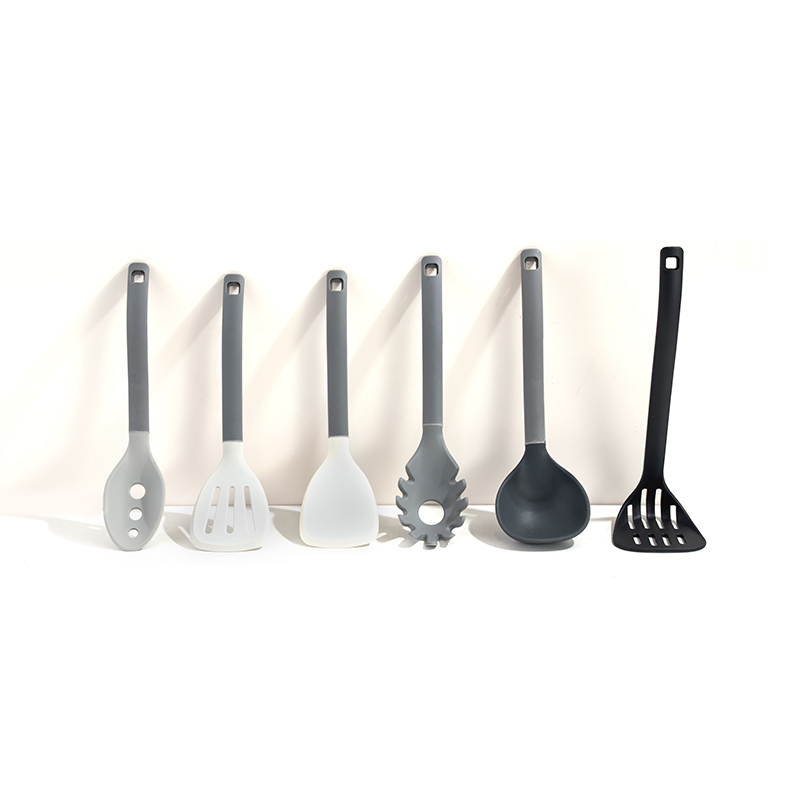
6pcs Two-Tone Non-Slip Silicone Kitchen Utensil Set
3. Functional Value of the Six-Piece Assortment
3.1 Slotted Ladle
The slotted ladle is designed for lifting food while allowing excess liquid or oil to drain away. It can be used for vegetables, dumplings, pasta, fried foods, and other ingredients that need to be transferred from a pot or pan without carrying a large amount of liquid.
For households, this tool reduces the need to use a separate spoon and strainer during everyday cooking. For retailers, it adds visible functionality to the set because customers can immediately understand its purpose. A specialized utensil also makes the collection appear more complete and thoughtfully designed than a basic assortment of generic spoons.
3.2 Turner
The turner is useful for flipping foods such as pancakes, eggs, fish, vegetables, and burgers. A silicone working surface can help reduce the risk of scratching coated cookware compared with rigid metal edges. Its flexibility can also help the user slide beneath food more gently.
Non-stick cookware is now common in domestic kitchens, and many buyers actively seek accessories compatible with coated pans. The inclusion of a turner therefore strengthens the commercial appeal of the complete set. It demonstrates that the product has been designed around actual cookware use rather than simply assembled as a collection of unrelated tools.
3.3 Spatula
The spatula is one of the most versatile tools in a kitchen. It can be used for mixing, folding, scraping, spreading, and transferring food. It is suitable for preparing sauces, batters, vegetables, and other dishes that require a flexible edge.
A seamless silicone structure is especially valuable for a spatula because food particles can become trapped in joints when separate materials are assembled poorly. A smooth, easy-to-clean form supports better kitchen hygiene and reduces the maintenance required after cooking.
3.4 Pasta Server
The pasta server is shaped for lifting and serving noodles while helping separate strands. Its specialized form allows it to perform a task that a standard spoon or turner cannot handle as effectively. It can also be used with other long or textured foods that benefit from controlled lifting.
Including a pasta server broadens the set’s appeal to customers who prepare pasta, noodles, and similar dishes regularly. It also gives retailers an additional feature to highlight in product descriptions and packaging copy.
3.5 Soup Ladle
The soup ladle is intended for serving broth, soup, stew, curry, gravy, and other liquid-based foods. A dedicated ladle makes portioning easier and helps prevent spills when transferring hot food from a pot to a bowl.
Since soup and liquid dishes are common across many cuisines, a soup ladle is a high-value addition to a general-purpose utensil set. It increases the set’s usefulness for family meals, batch cooking, and entertaining.
3.6 Fry Spatula
The fry spatula is designed for lifting, turning, and serving foods prepared in a frying pan. Its use extends beyond frying because it can also assist with shallow-fried vegetables, breakfast foods, meat portions, and other items that need careful handling during cooking.
By including both a standard turner and a fry spatula, the collection gives users more flexibility. This distinction can be important in practical cooking, where one shape may be more suitable for broad foods while another is more useful for smaller or more delicate pieces.
4. Advantages of Silicone Compared with Competing Materials
4.1 Protection for Non-Stick Cookware
One of the clearest advantages of silicone utensils is their gentle interaction with coated cookware. Non-stick pans are valued for easy cooking and cleaning, but their surfaces can be damaged by unsuitable tools. Scratches may reduce performance and shorten the usable life of the pan.
The silicone working surfaces in this set are designed for use with non-stick pans. Their flexibility and softer contact help create a safer cooking experience when compared with rigid metal tools. This advantage is attractive to consumers who have invested in coated cookware and want accessories that help preserve it.
4.2 Heat Resistance for Everyday Cooking
The utensils are heat resistant up to 230℃. This temperature rating supports many common cooking applications, including stirring hot food, turning ingredients in a heated pan, and serving food shortly after cooking.
Heat resistance is an important product differentiator because buyers want confidence that utensils will not quickly soften, warp, or become unusable during normal preparation. The stated rating also gives retailers a clear technical specification to communicate to customers.
As with all kitchen utensils, users should follow suitable handling practices. The tools should not be placed directly on an open flame or used outside their intended temperature range. Clear care guidance can help buyers achieve the best long-term performance from the product.
4.3 Comfortable Non-Slip Handling
Cooking often involves wet hands, oily ingredients, steam, and repetitive movements. A handle that is difficult to control can make cooking uncomfortable and increase the risk of spills. The non-slip grip of this set is intended to provide more stable handling during stirring, lifting, and serving.
Grip comfort is especially relevant for consumers who cook frequently. It also matters in professional or semi-professional environments where tools may be used repeatedly throughout the day. A reliable handle can make the product feel more refined and more valuable than a low-cost utensil with a smooth, slippery surface.
4.4 Seamless Construction
Many inexpensive utensils are assembled from multiple parts, creating joints where moisture, oil, and food residue can collect. These hidden areas may be difficult to clean and can contribute to unpleasant odors or mold growth when the tool is not dried properly.
The seamless two-tone design of this collection minimizes hidden crevices. The smoother structure supports easier cleaning and helps the utensils remain hygienic during long-term use. It also creates a more integrated visual appearance, which can improve shelf presentation and online product photography.
4.5 Visual Coordination
The gray, white, and black color direction is intentionally restrained. These neutral tones can fit a broad range of kitchen interiors, including modern, minimalist, monochrome, and Nordic-inspired spaces. The set does not depend on bright colors to attract attention; instead, it communicates order and simplicity.
Coordinated color is commercially useful because consumers increasingly treat kitchen tools as part of their home décor. Utensils may be stored in a visible container or hung on a wall rather than hidden in a drawer. A consistent appearance makes the product more suitable for open-kitchen environments and lifestyle-oriented retail displays.
4.6 Improved Storage Efficiency
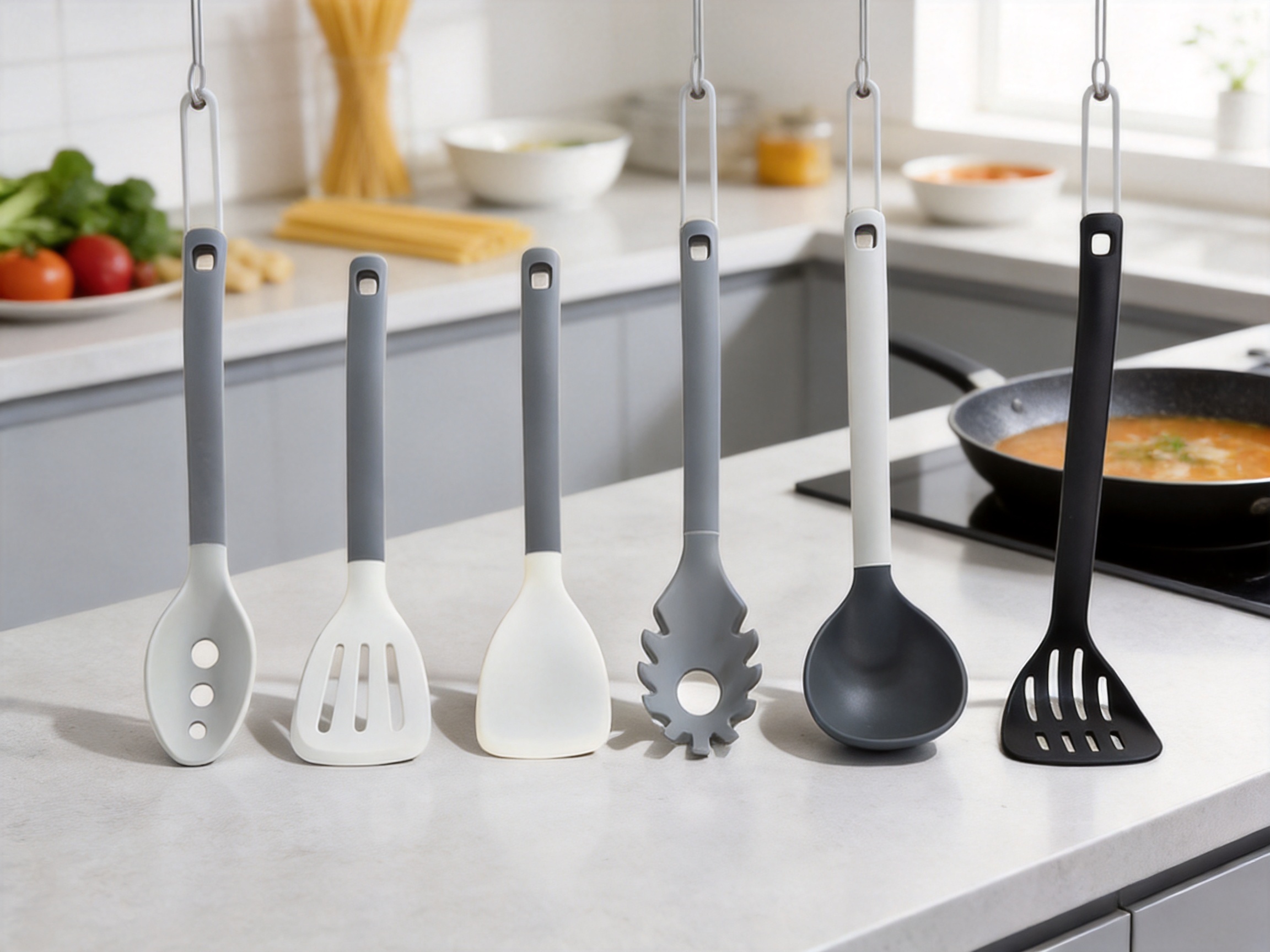
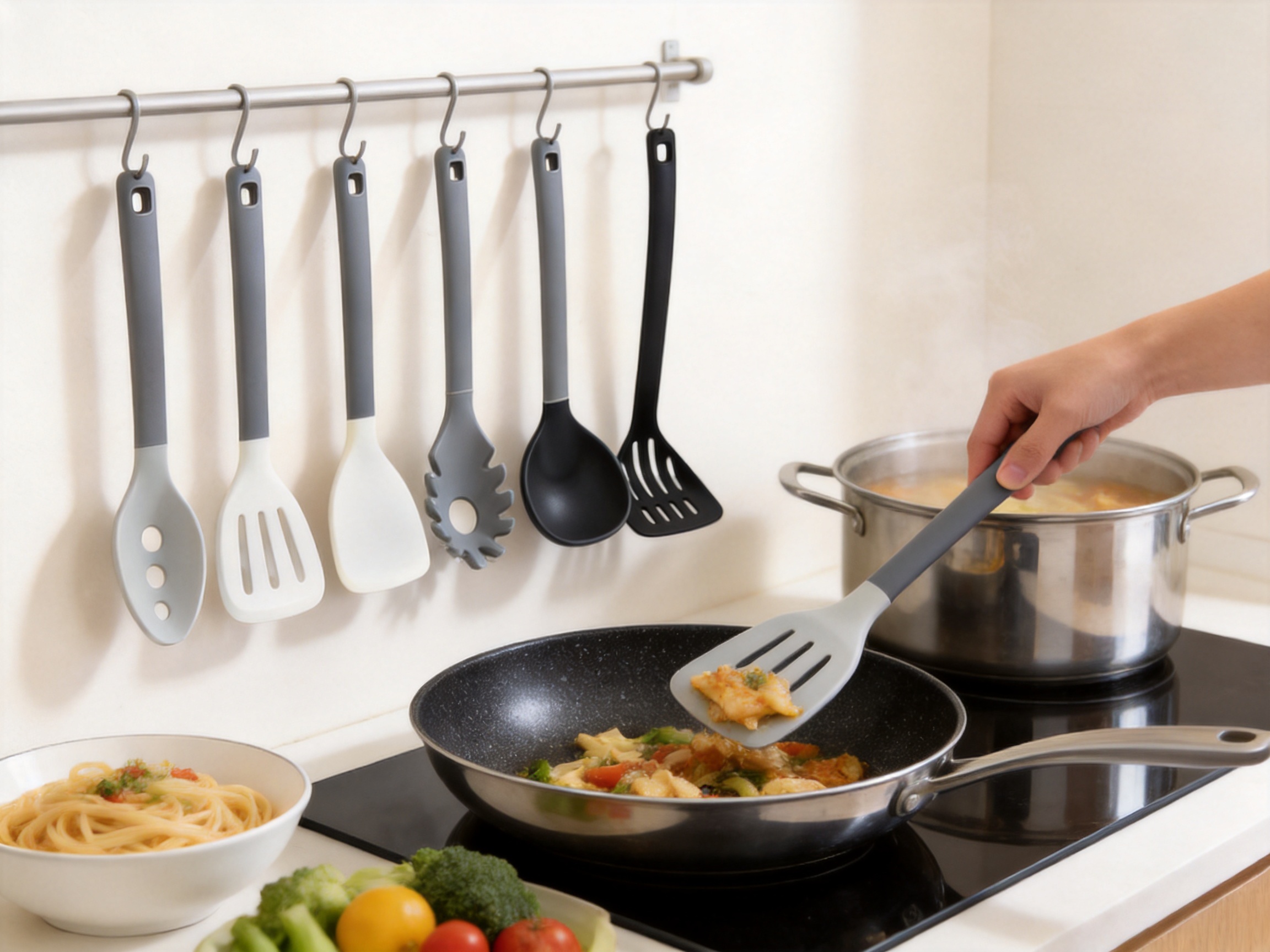
Each utensil includes a built-in hanging hole. This allows the user to place the tools on hooks, rails, or other wall-mounted storage systems. Hanging storage can free up drawer space and make frequently used utensils easier to access.
The storage feature adds practical value without requiring an additional rack or holder. For smaller kitchens, apartments, dormitories, and compact food-preparation areas, the ability to store tools vertically may be a meaningful advantage over utensils that must remain in a drawer.
5. Design and User Experience
A successful kitchen utensil set must work well in the hand as well as on the shelf. The non-slip grip supports a more secure hold, while the silicone material offers a pleasant tactile experience compared with hard, cold metal. These details influence whether consumers continue using a product after the initial purchase.
The two-tone seamless form also contributes to product identity. Instead of presenting six visually unrelated utensils, the set creates a unified collection. This improves the sense of completeness and can help a retailer position it as a lifestyle product, housewarming gift, wedding gift, or practical upgrade for a new kitchen.
The minimalist palette offers broad market compatibility. Some customers prefer bright colors, but neutral shades generally work across more interior styles and age groups. Gray, white, and black can appeal to customers who want a professional appearance, a Nordic aesthetic, or a clean modern kitchen.
At the same time, the design is functional rather than decorative. The hanging holes, specialized shapes, heat resistance, cookware-safe surfaces, and easy-clean structure all respond to practical household needs. This balance between appearance and performance helps the set compete against both basic utility products and more expensive design-led alternatives.
6. Hygiene and Maintenance Benefits
Kitchen hygiene depends on more than the material itself. Shape, construction, surface condition, and cleaning habits all influence how easy a utensil is to maintain. Tools with deep joints, porous surfaces, or complicated assemblies can require additional care.
The seamless construction of this silicone set is intended to reduce hidden areas where food residue can remain. A smooth surface is easier to wipe, rinse, and wash after use. Since the tools are designed without unnecessary crevices, users can spend less time inspecting and cleaning difficult corners.
The product description emphasizes that the utensils are easy to clean and designed to stay mold-free during long-term use when properly cared for. This is a strong benefit for households that want low-maintenance kitchen accessories. It is also relevant to retailers and hospitality buyers who need products that can withstand frequent cleaning routines.
For best results, utensils should be cleaned after each use, especially after contact with oils, sauces, dairy products, or acidic ingredients. They should be allowed to dry fully before being placed in a drawer or storage container. Wall hanging through the built-in holes can help improve air circulation and support more effective drying.
Buyers should also request or provide final care instructions appropriate to the confirmed production specification. Cleaning methods, dishwasher suitability, packaging information, and temperature guidance should be communicated clearly so that end users understand how to protect the product over time.
7. Manufacturing and Supply Chain Strengths
7.1 Zhejiang Manufacturing Expertise
Zhejiang is widely recognized as an important Chinese manufacturing and export region. The province includes industrial clusters that serve international buyers across household goods, kitchenware, hardware, consumer products, and related categories. Operating from this environment gives a supplier access to manufacturing resources, component networks, logistics services, packaging providers, and export infrastructure.
Zhejiang Echo Industry And Trade Co., Ltd. is based in Taizhou, Zhejiang, and focuses on cookware and kitchen accessories. Its product coverage includes aluminum cookware, stainless steel cookware, cast iron cookware, and kitchen utensils. This category breadth allows buyers to explore multiple product lines through one business relationship.
7.2 One-Stop Product Sourcing
One of the company’s important strengths is its one-stop cookware solution. Instead of working with separate suppliers for cookware, utensils, and accessories, a buyer can review a broader assortment from one supply partner. This can simplify communication, quotation management, sample coordination, packaging discussions, and shipment planning.
One-stop sourcing is particularly valuable for importers building a complete kitchenware collection. A retailer may need aluminum pans, stainless steel pots, cast iron products, and silicone tools in the same seasonal program. A supplier with experience across these categories can help create a more coordinated product strategy.
Consolidated sourcing may also reduce administrative work. Buyers can establish clearer quality expectations, centralize documentation, and coordinate production schedules more efficiently. The exact commercial benefits depend on the order structure and confirmed factory arrangements, but the underlying principle is valuable: fewer disconnected supplier relationships can create a more manageable procurement process.
7.3 OEM and ODM Customization
Many kitchenware buyers do not want to sell completely generic products. They may require a private label, custom color, modified packaging, exclusive assortment, or differentiated product specification. The company provides OEM and ODM customization services to support these needs.
OEM cooperation may involve producing a product according to a buyer’s approved design, branding, packaging, and specification. ODM cooperation may allow a buyer to select and adapt an existing product concept with changes to appearance, color, materials, functions, or presentation.
For the six-piece silicone utensil set, potential customization discussions could include color combinations, logo application, packaging style, insert cards, barcode labeling, set composition, and market-specific product information. Any modification should be confirmed through technical review and pre-production samples before mass manufacturing.
Customization can help buyers avoid direct price competition. A distinctive set design or packaging concept may support stronger brand recognition and improve shelf differentiation. It may also allow a retailer to align the utensil set with an existing cookware collection.
7.4 Certification Assistance
International kitchenware buyers often need documentation related to material safety, product compliance, packaging, and market entry. The company provides product certification assistance, which can help buyers organize the information required for their target markets.
Certification requirements vary according to destination, product claims, materials, food-contact rules, retailer standards, and local regulations. Buyers should identify these requirements at the beginning of a project rather than waiting until production is complete. The supplier can then help clarify which tests, declarations, samples, and documents may be needed.
Certification support does not replace the buyer’s responsibility to verify legal requirements in the destination market. However, early cooperation between the buyer and supplier can reduce avoidable delays and help ensure that the product, packaging, and documentation are aligned before shipment.
7.5 Flexible Minimum Order Quantities
Flexible MOQs can be important for small and medium-sized buyers. Large retailers may place substantial orders, but emerging brands, regional distributors, online sellers, and specialty stores may need to test demand before committing to high volumes.
A flexible MOQ structure may make it easier to introduce the utensil set in a controlled market trial. Buyers can evaluate customer response, packaging performance, return rates, and repeat purchase potential before expanding the program.
MOQ flexibility must always be confirmed for the specific color, packaging, customization, and production arrangement. Nevertheless, the company’s stated willingness to support flexible MOQs aligns with the needs of buyers who value lower-risk product development.
8. Advanced Production Considerations for Silicone Utensils
Although the provided product information does not disclose a detailed factory process, professional silicone utensil manufacturing generally requires careful control at several stages. The material must be selected for the intended food-contact application, and the production specification must match the required heat resistance, flexibility, color, and surface finish.
Tooling and molding accuracy are important because each utensil has a different working shape. A turner must have a useful edge and sufficient flexibility. A ladle must maintain its bowl shape during scooping. A pasta server requires correctly positioned features to lift food effectively. Inconsistent molding can affect performance, appearance, and user confidence.
Color control is another important consideration for a two-tone product. The gray, white, and black palette requires consistent shade matching across the six pieces. Buyers developing private-label products should approve color samples and define acceptable variation before bulk production.
Seam quality and surface finishing also deserve attention. A seamless appearance should be supported by clean molding, controlled transitions, and inspection for visible defects. Smooth surfaces help reinforce the easy-clean claim and improve the product’s perceived quality.
Heat resistance should be evaluated against the agreed specification. Material testing, dimensional checks, appearance inspections, and practical usage assessments can help confirm that the utensils are appropriate for their intended application. Buyers should request relevant quality records or testing documentation according to their market and project requirements.
Packaging production is equally important. The product must be protected from deformation, staining, abrasion, and damage during handling and shipment. Packaging should also present the six-piece assortment clearly, communicate care information, and provide any required branding or regulatory details.
A capable supplier coordinates these elements as part of a broader quality management process. Product development, material selection, mold preparation, sampling, inspection, packaging, and logistics should not be treated as isolated activities. They should be connected through an agreed specification and a clear approval process.
9. Quality Control Priorities for Buyers
Buyers evaluating silicone utensil sets should establish quality checkpoints before placing a purchase order. The following areas are especially relevant:
Material Verification
The material should match the agreed food-grade silicone specification. Buyers should clarify the applicable food-contact standards for the destination market and request supporting documentation where appropriate.
Heat Performance
The stated heat resistance of up to 230℃ should be linked to a defined test method or supplier specification. Buyers should understand whether the rating applies to continuous use, short-term exposure, or a particular component of the utensil.
Dimensional Consistency
Each piece should be checked for consistent size, shape, weight, and balance. Uniformity is especially important when the set is sold as a coordinated product.
Surface and Seam Inspection
Products should be inspected for burrs, flash, cracks, discoloration, uneven transitions, surface contamination, and other defects. A clean surface supports both hygiene and visual quality.
Grip and Hanging Hole Function
The non-slip handle should feel secure and comfortable. The hanging hole should be open, cleanly formed, and large enough for the intended storage hook or rail.
Set Completeness
Every carton and retail package should contain the correct six pieces: slotted ladle, turner, spatula, pasta server, soup ladle, and fry spatula. Packaging checks should confirm that no tool is missing or substituted.
Carton and Packaging Strength
The stated carton quantity is 12 sets, with a carton size of 44.5 × 38 × 48.5 cm. Buyers should verify the final packing arrangement and confirm that the packaging can withstand ordinary export handling, stacking, and transportation.
10. Commercial Applications
The six-piece silicone utensil set can serve several market segments. Its broad functionality makes it suitable for household retail, kitchen specialty stores, department stores, online marketplaces, homeware boutiques, gift distributors, and hospitality supply programs.
For retailers, the set can be positioned as a practical starter collection for new homeowners, students, newly married couples, or customers upgrading from mismatched tools. Its neutral color palette supports a wide target audience and reduces the risk of being limited to one decorative trend.
For online sellers, the product offers multiple visual and functional selling points. Product pages can highlight the six-piece assortment, cookware-safe silicone, 230℃ heat resistance, non-slip grip, hanging holes, seamless construction, easy cleaning, and modern color scheme.
For private-label brands, the set can serve as a foundation for a broader kitchen collection. Buyers may coordinate its colors with cookware, storage containers, bakeware, towels, or other kitchen accessories. A coherent range can create stronger brand recognition than isolated products from unrelated suppliers.
For hospitality and rental property operators, the utensils provide a practical selection of common cooking tools in one package. The silicone material and easy-clean construction may be suitable for kitchens that require regular turnover and straightforward maintenance, subject to the buyer’s own usage and compliance requirements.
11. Positioning the Product Against Competitors
Competition in the utensil market often comes from three directions: low-cost generic sets, single-material premium collections, and highly decorative lifestyle products. The two-tone silicone set occupies a useful middle position by combining practical performance with coordinated appearance.
Compared with low-cost generic sets, it offers a clearer design concept, a non-slip grip, specialized six-piece functionality, heat resistance up to 230℃, seamless construction, and wall-storage capability. These features provide meaningful reasons for a customer to choose the product beyond price alone.
Compared with metal-only collections, the silicone working surfaces are more compatible with non-stick cookware and less likely to create concern about scratching coated pans. The lighter, softer handling experience may also appeal to home users who prefer comfortable everyday tools.
Compared with wooden collections, silicone generally offers easier cleaning and does not depend on the same level of drying and maintenance. The neutral two-tone design also creates a more contemporary appearance for modern kitchens.
Compared with highly decorative utensil sets, this product emphasizes restrained colors and practical usability. It can therefore appeal to customers who want attractive kitchen tools without excessive ornamentation or a narrow seasonal style.
The strongest competitive position comes from the combination of several moderate advantages rather than one exaggerated claim. A customer receives a complete set, safe cookware interaction, heat resistance, secure handling, convenient storage, easy cleaning, and a contemporary look in one coordinated product.
12. Recommended Buyer and Supplier Workflow
A successful sourcing project begins with a clear product brief. The buyer should define the intended market, target customer, color requirements, packaging format, branding needs, estimated order volume, delivery expectations, and compliance requirements.
The supplier can then provide product details, samples, quotation information, customization options, and preliminary production guidance. At this stage, the buyer should review the actual sample carefully rather than relying only on photographs or general descriptions.
Once the sample is approved, the parties should confirm a written specification. This document may include material requirements, heat-resistance claims, dimensions, color references, logo details, packaging artwork, carton information, inspection standards, and shipping marks.
For customized orders, pre-production samples should be approved before bulk manufacturing. Color, packaging, logo placement, and set composition should all be checked. Changes made after production begins may cause additional cost or delay.
During production, quality monitoring should focus on materials, molding, appearance, assembly, packaging, and quantity. A final inspection can help identify missing pieces, packaging errors, visible defects, or carton inconsistencies before shipment.
After delivery, buyers should collect market feedback. Information about customer reviews, preferred colors, common complaints, packaging damage, and repeat-purchase behavior can guide future orders. A supplier that supports product development over time can become a long-term sourcing partner rather than a one-time vendor.
13. Sustainability and Long-Term Product Development
Sustainable product development in kitchenware involves more than selecting a single material. It also includes product lifespan, packaging efficiency, shipping utilization, maintenance requirements, and the ability to avoid premature replacement.
A durable utensil that remains useful for a long period can reduce the need for frequent repurchasing. Easy cleaning and cookware-safe performance may help users maintain both the utensils and their pans more effectively.
Packaging should be reviewed to balance protection with material efficiency. The final choice depends on the product’s vulnerability, retail presentation requirements, shipping conditions, and applicable regulations. Buyers can discuss recyclable or reduced-material packaging options during the OEM or ODM development stage.
The company’s stated focus on sustainable and healthy product development provides a foundation for future discussions about material selection, packaging, product durability, and responsible sourcing. Any sustainability claim should be supported by specific documentation and clearly defined criteria.
14. How to Present the Product to End Customers
Effective product communication should focus on benefits that customers can understand immediately. Instead of listing technical terms alone, retailers can explain how each feature improves everyday cooking.
The food-grade silicone material can be presented as a cookware-friendly choice for non-stick pans. The 230℃ heat-resistance specification can communicate suitability for common hot-food preparation. The non-slip grip can be linked to improved comfort and control.
The six-piece assortment should be shown clearly, with each utensil labeled by name and function. Customers should understand that the set includes tools for stirring, flipping, serving, draining, scooping, and pasta preparation.
The hanging holes should be presented as a space-saving feature, especially for small kitchens. The seamless construction can be connected to easy cleaning and reduced accumulation of residue in hidden joints.
Visual merchandising should emphasize the gray, white, and black color scheme. The set can be photographed against modern kitchen surfaces, open shelving, or neutral countertops to demonstrate how the tools complement contemporary interiors.
Retail packaging should avoid unsupported claims and should include appropriate care information. Clear, accurate communication builds trust and helps reduce misunderstanding after purchase.
15. Frequently Asked Questions
Q1: What material is used for the utensil set?
The set is made from food-grade silicone. The material is designed for practical food preparation and is gentle on non-stick cookware when used correctly.
Q2: How many pieces are included?
The collection includes six utensils: a slotted ladle, turner, spatula, pasta server, soup ladle, and fry spatula.
Q3: What is the heat-resistance rating?
The stated heat resistance is up to 230℃. Buyers should follow the final care instructions and avoid exposing the utensils to direct flame or temperatures beyond the confirmed specification.
Q4: Is the set suitable for non-stick pans?
Yes. The silicone working surfaces are designed to be cookware-safe and suitable for use with non-stick pans. Users should still avoid cutting food directly on the utensil surface or using the tools improperly.
Q5: Is the grip designed to reduce slipping?
Yes. The handles feature a non-slip design intended to improve control and comfort during stirring, turning, scooping, and serving.
Q6: Does each utensil have a storage hole?
The product includes built-in hanging holes for space-saving wall storage. Buyers should confirm the exact storage-hole details in the approved production sample and specification.
Q7: Why is the seamless design important?
A seamless structure reduces hidden crevices where food residue and moisture may collect. This makes the utensils easier to clean and supports better long-term hygiene when the tools are properly washed and dried.
Q8: What colors are used in the set?
The product uses a minimalist gray, white, and black color direction. These neutral tones are intended to complement modern and Nordic-style kitchens.
Q9: Can the set be customized for private-label sales?
OEM and ODM customization services are available. Possible discussions may include colors, packaging, branding, set composition, and other product presentation details. Final options depend on technical review, order quantity, and production confirmation.
Q10: What is the wholesale carton quantity?
The listed carton quantity is 12 sets per carton. The listed carton size is 44.5 × 38 × 48.5 cm. Buyers should confirm the final packing data before shipment.
Q11: Can buyers request certification support?
Certification assistance is part of the company’s stated service offering. Since requirements differ by country and application, buyers should identify their destination-market standards early and confirm the relevant documentation with the supplier.
Q12: Is this product suitable for small and medium-sized buyers?
The company offers flexible MOQ support, which may be suitable for emerging brands, specialty retailers, regional distributors, and online sellers. The exact MOQ should be confirmed for the required colors, packaging, branding, and customization.
Q13: How should the utensils be maintained?
Clean the utensils after use, remove oils and food residue promptly, and allow them to dry fully before storage. The built-in hanging holes can support ventilation and convenient drying. Buyers should follow the final care instructions supplied with the confirmed product.
Q14: What makes this set different from a basic utensil collection?
The set combines six specialized tools with food-grade silicone, a non-slip grip, heat resistance up to 230℃, seamless construction, cookware-safe performance, hanging storage, and a coordinated modern appearance. Together, these features provide a more complete and refined solution than a simple assortment of generic tools.
Conclusion
The 6pcs Two-Tone Non-Slip Silicone Kitchen Utensil Set is designed to meet the practical and aesthetic requirements of contemporary kitchens. Its food-grade silicone construction supports cookware-safe use, while the heat resistance up to 230℃ provides confidence for everyday cooking. The non-slip grip improves handling, the seamless design simplifies cleaning, and the hanging holes support efficient storage.
The six-piece assortment is commercially strong because it covers the essential tasks that customers perform regularly. The slotted ladle, turner, spatula, pasta server, soup ladle, and fry spatula create a complete collection rather than a narrow single-purpose product. The gray, white, and black palette further expands its appeal by matching modern and Nordic-style interiors.
For buyers, the product is supported by the broader strengths of Zhejiang Echo Industry And Trade Co., Ltd. These include a Zhejiang-based kitchenware supply network, broad category coverage, one-stop sourcing, OEM and ODM customization, certification assistance, flexible MOQs, and a stated focus on sustainable and healthy product development.
As competition increases in the kitchenware market, products that combine useful performance, clear design, reliable sourcing, and adaptable branding have a stronger opportunity to succeed. This silicone utensil set offers a balanced solution for retailers, distributors, private-label brands, hospitality buyers, and consumers seeking practical tools for modern cooking.
References
1. Product specification for the 6pcs Two-Tone Non-Slip Silicone Kitchen Utensil Set, SKU CS09.
2. Supplier information for Zhejiang Echo Industry And Trade Co., Ltd., including product categories, services, and company capabilities.
3. General food-contact material evaluation principles for kitchen utensils and household cookware accessories.
4. General consumer product quality-control practices for molded silicone kitchenware.
5. General guidance on non-stick cookware protection and the selection of cookware-safe utensils.
6. General supply-chain planning principles for OEM, ODM, packaging development, certification support, and export kitchenware procurement.
Product: 6pcs Two-Tone Non-Slip Silicone Kitchen Utensil Set
Recommended Articles
Product Category
Related products
-
-
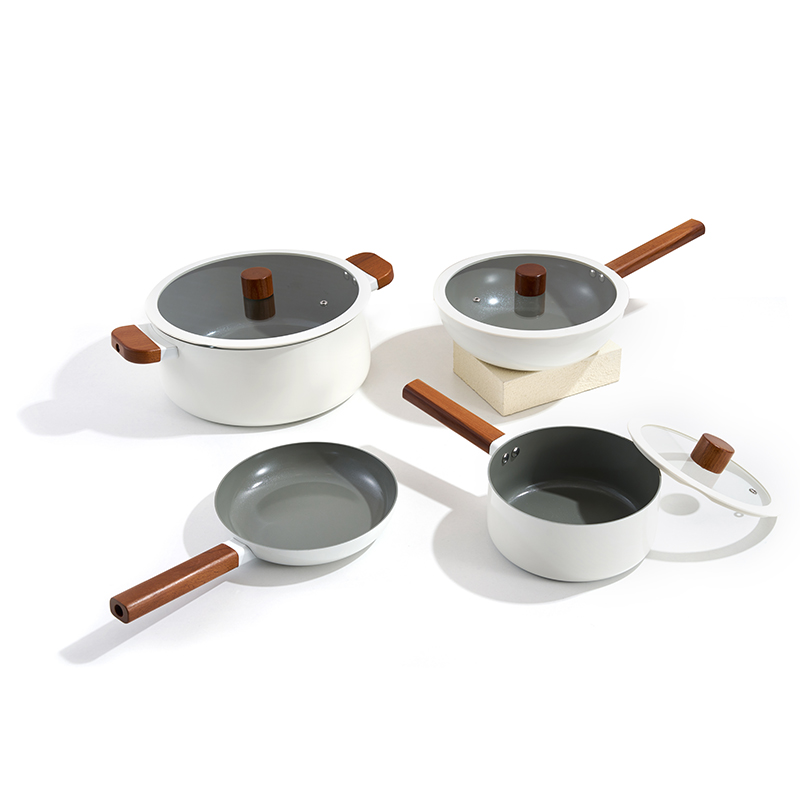
This cookware set has a ceramic non-stick inner liner, a heat-resistant wooden h...
See Details -
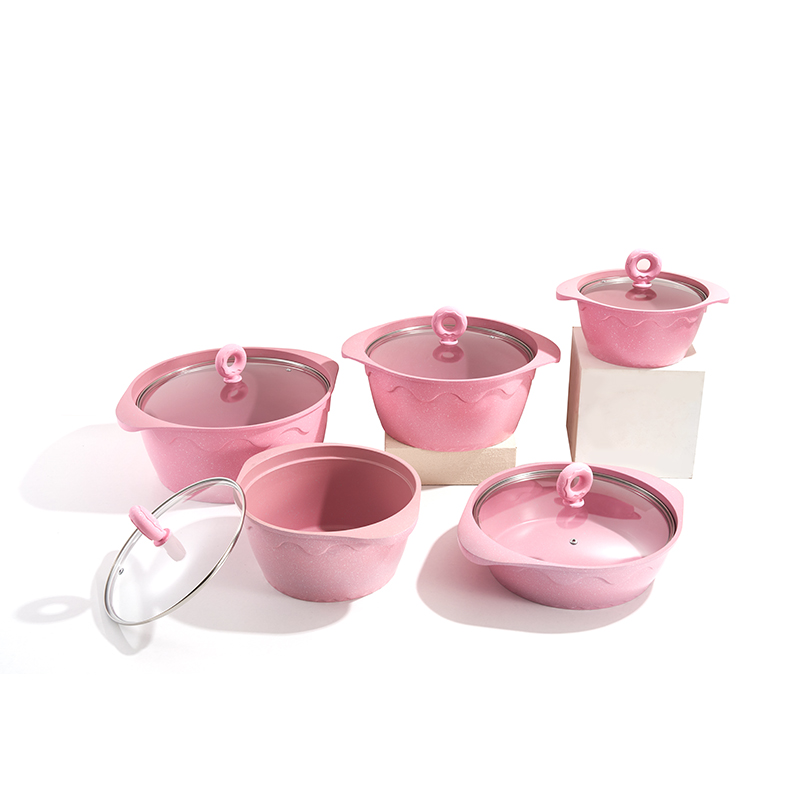
This cookware set is made of food-grade non-stick material, with a unique eye-ca...
See Details -
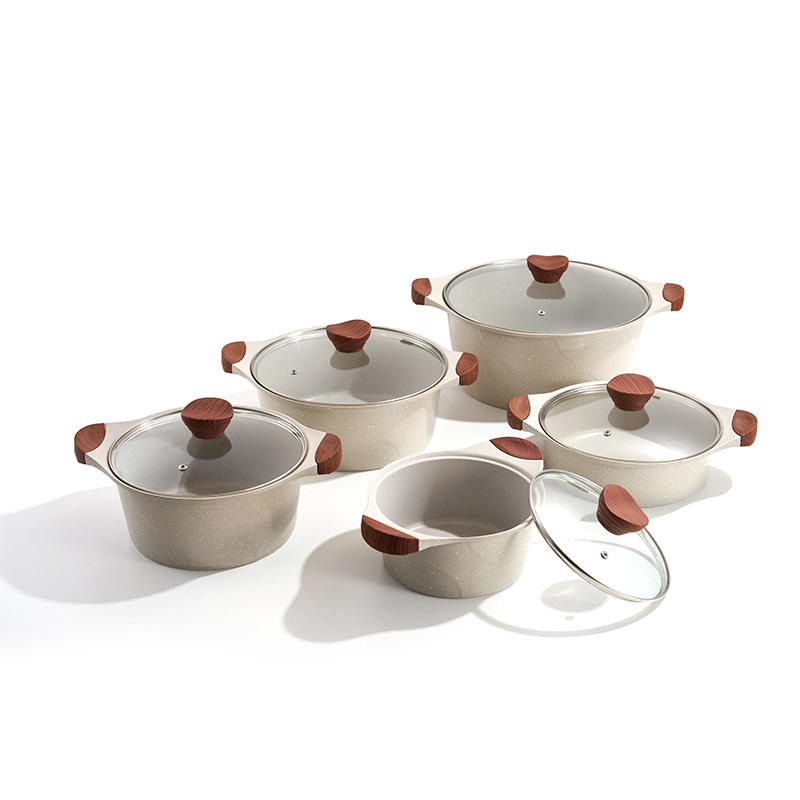
This off-white cookware set is made of wear-resistant non-stick material, with w...
See Details
Whether you're looking for bulk purchases or have any custom requirements, We are here to offer the best
solutions for you.
tiffany.zhong@echocn-trading.com
PHONE
+86-19561173975
+86-19557020621 (Hazel Wu)
ADD
Room 301, Unit 3014, No. 175 Qifeng Avenue, Wenqiao Town, Taizhou, Zhejiang, China
Fill Out the Form for More Information
Copyright © Zhejiang Echo Industry And Trade Co., Ltd.
All Rights Reserved.

China Cookware Set Manufacturer