
 en
 Español

This cookware set features a non-stick coating, even heat conduction, and multi-...
See Details
12-Piece Granite-Textured Aluminum Cookware Set: Performance, Design, and Supply Advantages
Date:Nov 06, 2026

Introduction
Modern kitchens require cookware that can perform several jobs without occupying every shelf and cabinet. Families increasingly look for a coordinated set that can fry, simmer, stew, reheat, and prepare everyday meals while remaining easy to clean and comfortable to use. The 12-Piece OatGrain Aluminium Cookware Set is designed around this practical need. It combines a fast-heating aluminum body, a light beige granite-textured finish, wooden heat-resistant handles, silicone utensils, and a cleaning sponge in one coordinated package.
Rather than offering a single frying pan or a limited two-piece combination, this set is intended to support a complete cooking routine. Different casserole sizes provide flexibility for individual portions, side dishes, family meals, soups, sauces, and stews. A shallow casserole adds another useful format for frying, sautéing, reducing sauces, and preparing foods that benefit from a broader cooking surface.
The set also reflects the changing expectations of cookware buyers. Customers want attractive products that suit contemporary kitchens, but appearance alone is not enough. They also expect even heating, dependable non-stick performance, comfortable handles, simple cleaning, efficient storage, and consistent manufacturing quality. For importers, retailers, hospitality buyers, and private-label brands, the reliability of the factory and its ability to support customization are equally important.
This article examines the product’s design, cooking performance, user advantages, care requirements, manufacturing strengths, and suitability for different markets. It also explains how the set compares with ordinary aluminum cookware, basic non-stick pan combinations, and heavier multi-material alternatives.

12pcs OatGrain Aluminium Cookware Set
Product Overview
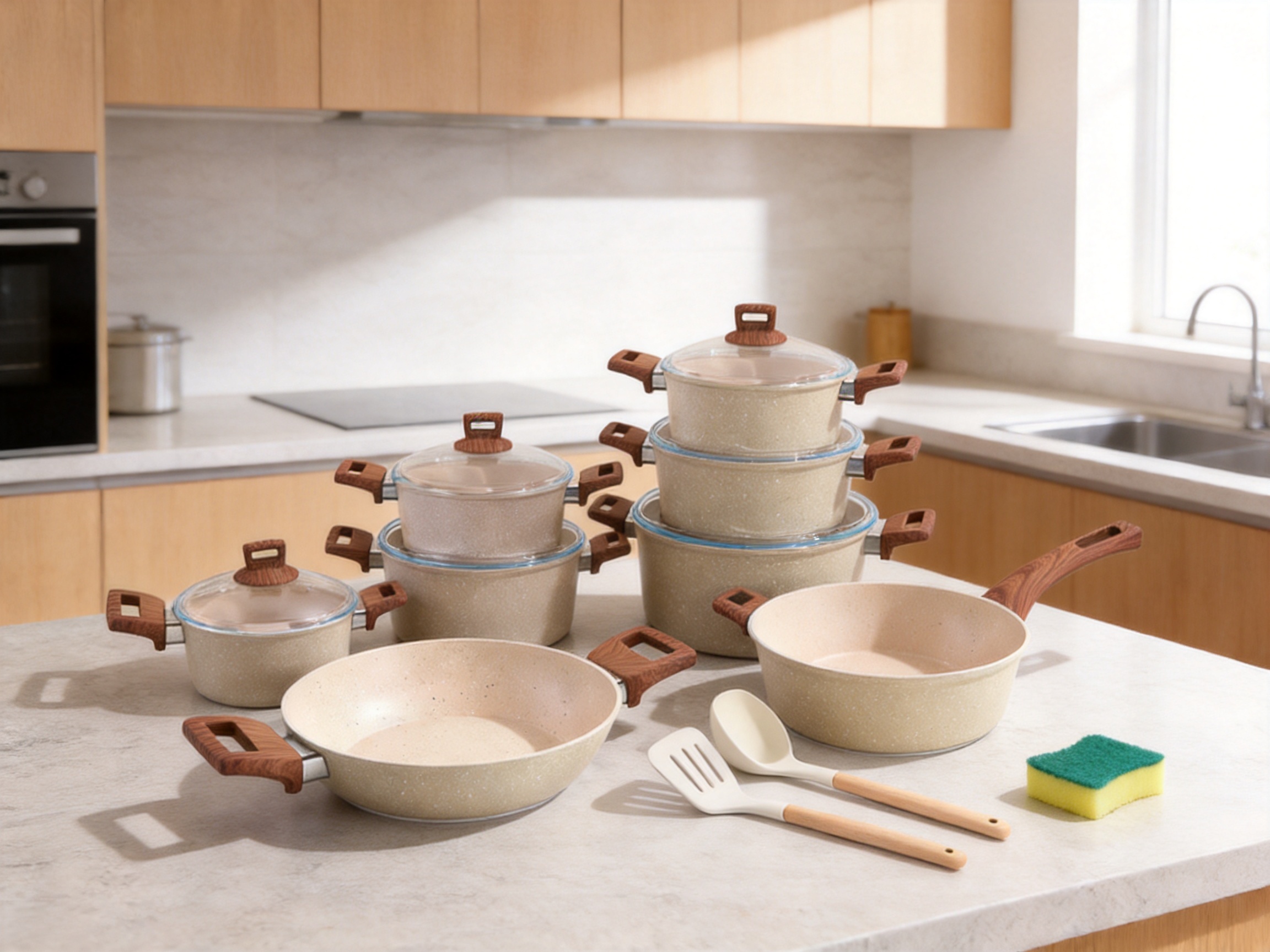
The 12-Piece OatGrain Aluminium Cookware Set belongs to the aluminum cookware category and is identified by SKU XC01. Its visual identity is based on a light beige granite-textured body. This neutral color can complement modern, Scandinavian, farmhouse, and minimalist kitchen styles. Unlike highly polished cookware, the granite-inspired exterior is intended to create a softer and more contemporary appearance while helping the set stand out on retail shelves.
The product package includes multiple cookware sizes together with silicone cooking utensils and a cleaning sponge. The available information lists casserole sizes of 16 cm, 18 cm, 22 cm, and 26 cm, along with an additional 22 cm casserole specification and a 26 cm shallow casserole. Because product counting conventions can vary between cookware bodies, lids, utensils, and accessories, buyers should confirm the final packing list and exact piece composition before placing a production order.
The central cooking material is aluminum. Aluminum is widely used in cookware because it transfers heat quickly and responds rapidly when the cooking temperature is adjusted. This characteristic is especially useful for frying, sautéing, simmering, and other cooking methods that require frequent heat changes. Compared with some heavier materials, aluminum cookware can also be easier to lift, move, and handle during daily cooking.
The cooking surface is designed to provide non-stick convenience. Food can be released more easily when the pan is used correctly, and routine cleaning can be completed with hot soapy water and a soft cloth or sponge. The included silicone utensils are an important part of this concept because they help users avoid metal tools that may scratch or damage a non-stick surface.
Wooden heat-resistant handles add a warmer visual character than conventional bare metal handles. They are also intended to provide a comfortable grip during ordinary stovetop use. As with all cookware handles, users should follow the stated heat limitations and avoid placing the cookware in an oven unless the manufacturer has specifically confirmed that the complete product, including the handle, is oven safe.
Why Aluminum Remains a Practical Cookware Material
Aluminum has a strong position in the cookware market because it offers an effective balance between thermal response, weight, manufacturing flexibility, and cost. When a cook turns a burner up, the aluminum body can react quickly. When the heat is reduced, the pan can also cool more promptly than a much heavier construction. This responsiveness gives users greater control over delicate sauces, shallow frying, vegetables, and everyday family meals.
Fast heat conduction can help reduce the waiting time before cooking begins. It can also support more consistent heat distribution across the base when the cookware has been designed and finished properly. A well-prepared aluminum body spreads heat efficiently, helping reduce the risk that one small area becomes significantly hotter than the rest of the cooking surface.
Compared with cast iron, aluminum generally requires less physical effort to lift and move. This difference is valuable for users who regularly transfer pans from the stove to the counter or serve food directly from the cookware. It is also relevant for retailers seeking products that are easier to package, transport, and position as accessible family cookware.
Compared with basic thin stainless steel, aluminum can provide faster heat response. Stainless steel is valued for strength and appearance, but a cookware body made only from stainless steel may not respond as quickly unless it includes an aluminum core or bonded base. The aluminum construction of this set is therefore a practical advantage for consumers who prioritize responsive cooking and manageable weight.
The aluminum body also allows manufacturers to create a variety of coordinated shapes and sizes. This flexibility supports a set that can include compact saucepans, medium casseroles, larger family vessels, and a wide shallow pan. Buyers do not need to purchase each item separately or mix cookware with unrelated colors and handle designs.
Granite-Textured Exterior and Contemporary Shelf Appeal
The light beige granite-textured finish is one of the product’s most visible differentiators. Many cookware sets use black, gray, or metallic finishes. A warm beige tone gives retailers another visual option and can appeal to consumers who prefer neutral, soft, and home-oriented colors. The textured appearance suggests durability and modern design without relying on an overly glossy surface.
A coordinated exterior is particularly valuable when cookware is stored on open shelves, hanging racks, or visible kitchen displays. The pieces can create a consistent appearance instead of looking like a collection assembled from different sources. This design advantage matters in direct-to-consumer retail, where product photography and first impressions strongly influence purchasing decisions.
The granite-style appearance should not be confused with a solid stone cooking surface. The cooking performance depends on the aluminum body and the applied non-stick system, while the textured visual effect is part of the product’s finish. Clear product communication is important so that consumers understand how to use and care for the cookware correctly.
The beige color also creates opportunities for coordinated product lines. Buyers may combine this set with matching kitchen utensils, bakeware, storage products, or serving accessories. For private-label customers, the color can become part of a wider kitchen collection supported by customized packaging and visual merchandising.
Non-Stick Performance and Everyday Cooking Convenience
The non-stick function is intended to reduce food adhesion and make cooking more convenient. Less food sticking can mean easier turning when frying eggs, vegetables, pancakes, fish, or meat. It may also allow users to cook with less oil, depending on the recipe and the condition of the coating.
Non-stick performance depends on several factors rather than one feature alone. The aluminum body provides fast heat transfer, while the surface preparation and coating system create the release properties. A smooth and properly prepared substrate helps the coating bond to the cookware body. A multi-stage coating process can provide a stronger and more consistent surface than a poorly applied single layer.
Correct temperature management is equally important. Non-stick cookware should not be left empty over high heat for long periods. Extreme overheating can reduce surface performance and may permanently damage the coating. Users should begin with an appropriate heat setting, add ingredients promptly, and avoid treating the pan like an uncoated metal vessel.
Food release is also affected by the condition of the cooking surface. Metal spatulas, knives, forks, and other sharp tools can create scratches. Once a non-stick surface has been damaged, food may begin to adhere more easily. The supplied silicone utensils are therefore more than decorative accessories; they are practical tools for protecting the intended cooking experience.
Soft cleaning materials also contribute to long-term performance. A soft sponge or cloth can remove normal residue without creating unnecessary abrasion. Strong scouring pads, abrasive powders, and harsh scraping should be avoided. When these basic practices are followed, the cookware can maintain smooth release and a clean appearance for longer.
Size Variety for Different Cooking Tasks
A cookware set becomes more useful when its sizes are meaningfully different. A small 16 cm casserole can be suitable for heating a single portion, preparing sauces, melting ingredients, warming milk, or cooking a small side dish. Its compact size may also be convenient for households with limited cooking space.
An 18 cm casserole provides additional capacity without becoming difficult to handle. It can serve one or two people, prepare grains, heat leftovers, or cook a modest amount of vegetables. The 22 cm size is more versatile for daily family cooking, including pasta sauces, soup portions, braised vegetables, and medium-sized side dishes.
A 26 cm casserole is intended for larger quantities. It can support family meals, stews, curries, larger batches of vegetables, and recipes that need room for stirring. The 26 cm shallow casserole offers a broader and lower format, which is useful for frying, sautéing, searing, reducing liquid, and arranging ingredients in a single layer.
The combination of deep and shallow cookware gives users more control over cooking methods. Deep vessels are useful when liquid, volume, or simmering is important. Shallow vessels are often better when surface contact, evaporation, browning, or easy access to food is required. Together, they cover more cooking situations than a set containing only similar-sized pans.
For commercial buyers, a multi-size set can also increase perceived value. The consumer receives a complete cooking solution rather than one isolated item. This can support gift sales, new-home packages, seasonal promotions, and kitchen starter collections. Retailers should confirm the final dimensions, lid configuration, and carton arrangement so that the online product description accurately reflects the delivered set.
Handle Design and User Comfort
Handles influence both safety and comfort. The wooden heat-resistant handles used with this cookware are designed to offer a secure and pleasant grip during normal stovetop cooking. Wood also gives the set a natural visual accent that contrasts with the beige granite-textured body.
A comfortable handle can make it easier to stir food, lift a pan, or transfer a dish from one burner to another. The grip should remain stable in the hand, and users should always hold cookware carefully when it contains hot oil, boiling liquid, or heavy food. Handle connections should be inspected periodically to ensure that they remain secure.
Wooden components require reasonable care. They should not be soaked unnecessarily, exposed to prolonged high heat, or placed in a dishwasher unless the manufacturer specifically confirms that the complete handle construction can withstand dishwasher conditions. Users should keep handles away from direct flame and avoid allowing heat to extend beyond the base of the pan.
The handle design also creates a product distinction compared with all-metal cookware. Metal handles may be more suitable for some oven applications, while wooden handles can provide a warmer appearance and more comfortable stovetop handling. The best choice depends on the intended market and the customer’s cooking habits. For this set, the recommended positioning is everyday stovetop cooking rather than unrestricted oven use.
Included Silicone Utensils and Cleaning Sponge
Including silicone utensils increases the practical completeness of the package. Consumers purchasing a non-stick cookware set should also have tools that are compatible with the surface. Silicone utensils are generally softer than metal and can help reduce the possibility of scratching when used correctly.
The utensils can support common tasks such as stirring, turning, serving, and scraping food gently from the cooking surface. They also reinforce the product’s complete-kitchen positioning. Instead of requiring customers to purchase safe utensils separately, the set provides a useful starting collection.
The cleaning sponge supports the same convenience-oriented concept. A soft sponge is suitable for removing ordinary cooking residue when combined with warm water and mild dish soap. Consumers should still avoid abrasive cleaning materials and should allow cookware to cool before washing it.
Accessories also create opportunities for private-label customization. Importers may request a particular utensil color, branded packaging, insert card, barcode label, or instruction leaflet. These options can help retailers present the cookware as a more complete and considered product rather than a generic pan set.
Product Advantages Compared with Competing Cookware
Compared with Basic Aluminum Pans
Basic aluminum pans may offer fast heating, but they are often sold individually and may not provide a coordinated range of sizes. The 12-piece set offers broader household utility, a consistent appearance, compatible accessories, and a more structured product presentation. The granite-textured finish and wooden handles also create stronger visual differentiation.
Compared with Heavy Cast Iron Sets
Cast iron is known for heat retention and durability, but it is substantially heavier and may require seasoning or more specialized care. Aluminum cookware is easier to lift and generally heats more quickly. For consumers who want practical weeknight cooking rather than maximum heat retention, the aluminum set can be more convenient.
Compared with Stainless Steel Sets
Stainless steel cookware can provide a durable exterior and a professional appearance, but food may adhere more readily if the user does not control temperature and oil correctly. Aluminum cookware with a non-stick surface offers easier food release and simpler cleanup. It may also be lighter and more responsive during rapid temperature changes.
Compared with Small Non-Stick Starter Sets
Small starter sets can be affordable, but they may contain only two or three pieces and may not serve larger households effectively. The 12-piece configuration provides more cooking formats and supports multiple dishes at the same time. The included utensils and sponge further improve the value proposition.
Compared with Premium Multi-Layer Cookware
Premium bonded cookware can offer excellent structural performance, but it often comes at a higher price and may be heavier. The aluminum set focuses on accessible daily performance: rapid heating, easy handling, non-stick convenience, coordinated styling, and a broad selection of sizes. This balance can be attractive to a wider consumer market.
| Feature | 12-Piece Aluminum Set | Basic Aluminum Pan | Cast Iron Set | Uncoated Stainless Steel Set |
| Heat response | Fast and responsive | Generally fast | Slow to heat and cool | Moderate unless an aluminum core is used |
| Weight | Relatively manageable | Light to moderate | Heavy | Moderate to heavy |
| Food release | Designed for non-stick convenience | Depends on surface treatment | Depends on seasoning and technique | Requires cooking skill and temperature control |
| Size variety | Multiple casseroles and shallow casserole | Usually one size | Often limited by weight | Varies by set |
| Cleaning convenience | Simple with soft sponge and mild soap | Usually simple | More involved | Can require soaking or scrubbing |
| Visual style | Beige granite-textured finish and wooden handles | Often basic metallic or dark finish | Traditional heavy appearance | Metallic professional appearance |
Manufacturing Process and Quality Priorities
The performance of aluminum cookware depends heavily on the quality of manufacturing. A well-designed product can lose its advantages if the body is uneven, the coating is inconsistent, the base is unstable, or the handle connection is weak. Professional production therefore requires control at several stages, from material preparation through final packing.
Material Preparation
Manufacturing begins with aluminum material selected for cookware production. The material must be suitable for forming a stable body with a consistent wall and base structure. Correct material preparation helps support thermal performance, dimensional accuracy, and resistance to ordinary deformation.
The production team must also control the condition of the material before forming. Clean surfaces and consistent thickness reduce the risk of visual defects, uneven coating adhesion, or variations between pieces. For a coordinated set, matching the appearance and dimensions of every size is especially important.
Forming the Cookware Body
The aluminum body is formed into the required casserole and shallow casserole shapes. Forming equipment and tooling must be maintained carefully so that the rim, sidewall, base, and overall profile remain consistent. A stable body is easier to coat, easier to package, and more reliable on a stovetop.
Dimensional control is essential when cookware is sold as a set. Pieces must fit the intended lids, stack correctly if designed for nesting, and maintain enough clearance to reduce unnecessary contact between surfaces. Proper stacking can save cabinet space and improve carton efficiency during shipping.
Surface Preparation
Before the non-stick coating is applied, the aluminum surface requires appropriate preparation. Cleaning, degreasing, and surface treatment help remove contaminants and improve the foundation for coating adhesion. A properly prepared surface supports more consistent coating performance across the base and sidewalls.
The textured exterior and interior functional surface must be managed according to their different requirements. The outside appearance should remain visually uniform, while the cooking surface must be smooth and suitable for food contact. Process discipline at this stage helps reduce uneven color, pinholes, rough patches, and weak bonding.
Coating Application
Non-stick coatings are generally applied in controlled stages. The coating system may include a base layer, functional intermediate layers, and a final release layer. Each stage must be applied at the correct thickness and cured under controlled conditions. Excessive or insufficient coating can both affect performance.
Proper curing helps the coating develop its intended hardness, release properties, and adhesion. Temperature and time must be managed consistently so that one production batch performs similarly to another. Visual inspection and sample testing can identify irregularities before products are packed.
Handle Assembly
Wooden heat-resistant handles are attached after the cookware body has completed the relevant surface processes. Assembly workers must ensure that the handle is aligned, stable, and securely fixed. The connection should be inspected for movement, visible gaps, sharp edges, or other defects.
Handle assembly is also an important presentation stage. A slightly misaligned handle can make an otherwise attractive product look unfinished. Consistent positioning across all sizes improves the appearance of the complete set and supports a stronger retail presentation.
Accessory and Set Assembly
Silicone utensils and the cleaning sponge are checked and organized with the cookware pieces. Set assembly requires attention to quantity, color, packaging protection, and instruction materials. Missing accessories can create customer complaints even when the cookware itself is satisfactory.
Packaging must protect the non-stick surfaces, handles, and exterior finish during handling and transportation. Separators, sleeves, protective films, and appropriate carton design can help reduce scratches and impact marks. The factory’s listed carton information for this product includes two cartons, a carton size of approximately 66.5 by 37 by 50.5 centimeters, and a total carton weight of 21 kilograms. Buyers should confirm final packing details against the approved production sample.
Factory Strengths and Supply Chain Capabilities
The supplier behind this cookware line is Zhejiang Echo Industry And Trade Co., Ltd., based in Taizhou, Zhejiang, China. Zhejiang is widely recognized as an important manufacturing and export region for household products, hardware, kitchenware, and related consumer goods. Operating in this environment provides access to an established industrial network and experienced export infrastructure.
The company focuses on cookware and kitchen accessories, including aluminum cookware, stainless steel cookware, cast iron cookware, and kitchen utensils. This product breadth is valuable for buyers who want to consolidate sourcing. Instead of managing separate suppliers for every material category, a customer may be able to develop a broader kitchenware assortment through one supply partner.
The supplier presents itself as an R&D-oriented supply chain partner rather than only an order-taking business. This positioning is important for buyers seeking product improvement, market-specific adaptations, and longer-term cooperation. The ability to discuss design, material, accessories, packaging, and product positioning in one supply relationship can reduce communication complexity.
OEM and ODM services provide further flexibility. OEM production allows a buyer to apply its own brand identity to an existing product structure, subject to agreed specifications and minimum order requirements. ODM cooperation can involve adjustments to color, handle style, utensil combination, packaging, dimensions, or product features.
Flexible minimum order quantities can be particularly useful for small and medium-sized importers. A buyer may wish to test a new color or cookware configuration before committing to a very large volume. The final MOQ, lead time, tooling requirements, sample policy, and packaging conditions should always be confirmed during commercial negotiations.
The company also offers product certification assistance. Certification requirements vary by destination, product construction, coating system, packaging claims, and applicable food-contact regulations. Professional support can help buyers identify the documentation required for their market, although importers remain responsible for confirming local legal and compliance obligations.
Sustainable and healthy product development is another stated area of focus. In cookware, this may involve material selection, coating development, packaging optimization, product durability, and reducing unnecessary replacement. Buyers should request specific technical documents and test reports when sustainability or food-contact claims are used in marketing.
Quality Control for International Buyers
International buyers should evaluate cookware through a structured quality-control process. Product approval should begin with a detailed specification sheet covering dimensions, weight, wall thickness, base construction, coating type, color, handle materials, utensil materials, lid configuration, packaging, and labeling.
Samples should be inspected for dimensional consistency. The pan should sit steadily on a flat surface without excessive rocking. Rims should be even, handles should align correctly, and the coating should appear consistent without obvious bubbles, scratches, exposed metal, or irregular patches.
Functional testing should include basic heating evaluation, food-release testing according to an agreed method, handle stability checks, and cleaning trials. If the product is marketed as dishwasher safe, the buyer should request supporting test information and clarify whether the claim applies to the entire set, the cookware bodies only, or particular components.
This point is especially important for the present product. The marketing information refers to a dishwasher-safe cookware set, while the care instructions recommend hand washing to preserve appearance and cookware life. These statements are not necessarily impossible to reconcile: a product may tolerate selected dishwasher cycles while hand washing remains the preferred method for long-term surface and handle preservation. However, the final retail claim should be based on verified testing and clearly worded instructions.
Packaging inspection is also essential. The buyer should confirm carton markings, barcode placement, product quantity, country-of-origin information, instruction leaflets, warning labels, and protection against movement inside the carton. International transportation can expose cookware to vibration, impact, humidity, and repeated handling, so packaging quality directly affects arrival condition.
Care and Use Instructions
Wash the cookware before its first use. This removes dust or residue from manufacturing and packaging. Use warm water, mild dish soap, and a soft cloth or sponge.
Use wooden, nylon, or silicone utensils. Do not use metal knives, metal spatulas, forks, or other sharp tools on the non-stick cooking surface.
Do not heat the cookware while it is empty for an extended period. Empty overheating can damage the coating and may affect the appearance of the pan.
Do not use the cookware in a microwave oven. The aluminum body is not suitable for microwave use.
Keep the flame or heat source within the area of the cookware base. Heat extending beyond the base can discolor or damage the sidewalls and may expose the handle to excessive heat.
If the pan becomes severely overheated, do not touch it immediately. Turn off the cooker and allow the cookware to cool completely. Do not pour cold water into a severely overheated pan because a sudden temperature change can stress the material and coating.
Hand washing is recommended to preserve the appearance and surface condition of the cookware. If a dishwasher claim is used for a particular market, consumers should follow the approved dishwasher instructions, use a suitable cycle, and understand that frequent exposure to strong detergents and high temperatures may shorten the life of the coating or wooden components.
Allow cookware to cool before washing. Placing a very hot pan under cold water may create thermal shock and can contribute to distortion or surface stress.
Store the pieces carefully if they are nested. Where possible, place a soft separator between cookware surfaces to reduce rubbing and scratching. Avoid dragging one pan across another.
Retail and Private-Label Opportunities
The product is suitable for a broad range of sales channels. Supermarkets can position it as a family cookware solution. Online retailers can emphasize the multi-size configuration, coordinated design, fast heat response, and included accessories. Homeware stores can display the beige granite-textured finish alongside neutral kitchen collections.
The set can also be marketed for new-home buyers, wedding gifts, apartment kitchens, student accommodation, and seasonal household promotions. Its combination of everyday sizes and practical accessories makes it understandable to consumers who may not have extensive cookware knowledge.
Private-label buyers can develop a more distinctive market offer by selecting packaging colors, instruction formats, accessory combinations, and product photography. They may also create a broader collection using matching frying pans, utensils, stockpots, or stainless steel products from the same supplier.
For online listings, accurate wording is essential. Product pages should explain the material, sizes, included items, heat-source compatibility, non-stick care, and dishwasher guidance. Buyers should avoid claiming universal induction or oven compatibility unless the specific product has been designed and tested for those applications.
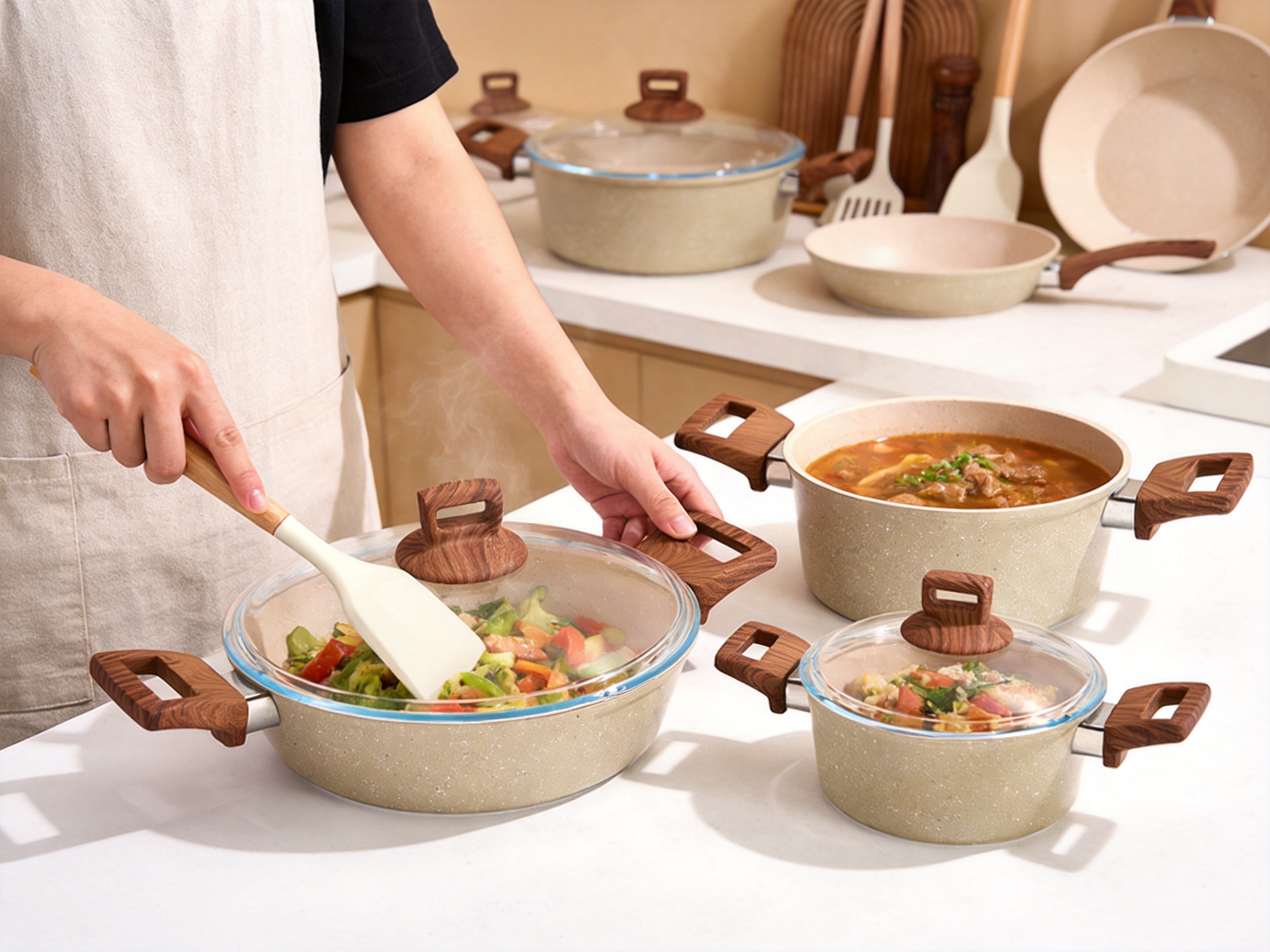
High-quality lifestyle photography can show the set in a practical kitchen environment, while close-up images can present the granite-textured surface, wooden handle, utensil set, and nesting arrangement. Clear images help customers understand the product better and can reduce returns caused by unrealistic expectations.
Environmental and Long-Term Value Considerations
Cookware that remains useful for a longer period can offer better value than an inexpensive product that must be replaced quickly. Durability depends on the body, coating, handle, user care, and manufacturing consistency. A set that includes several functional sizes can also reduce the need to purchase additional cookware later.
Fast heat response may help users cook efficiently, although actual energy consumption depends on the stove, recipe, cooking time, pan size, and user habits. Matching the pan size to the burner and keeping the heat within the base area can reduce wasted heat.
Packaging efficiency is another consideration. A stackable multi-size set can use space more effectively during transport and storage than separate individual packages. Buyers should work with the supplier to review packaging materials, carton utilization, protective components, and opportunities to reduce unnecessary packaging without compromising product protection.
Responsible marketing should avoid exaggerated lifetime claims. Terms such as “long-lasting” should be supported by appropriate construction, testing, care instructions, and warranty terms. Retailers can build customer trust by explaining that non-stick cookware requires correct utensils, reasonable heat control, and suitable cleaning methods.
Q&A
What is included in the 12-piece cookware set?
The set includes multiple aluminum casseroles in several sizes, a 26 cm shallow casserole, silicone utensils, and a cleaning sponge. The exact count of cookware bodies, lids, and accessories should be confirmed against the final packing list because product-counting methods can differ between markets.
What material is used for the cookware body?
The cookware body is made from aluminum. Aluminum provides fast heat conduction, relatively low weight, and responsive temperature control for everyday frying, sautéing, simmering, and stewing.
Is the cookware non-stick?
Yes. The cookware is designed with a non-stick cooking surface that supports easier food release and cleaning. Users should avoid metal utensils, overheating, abrasive cleaning tools, and sudden temperature changes to help preserve the coating.
Can metal utensils be used?
No. Wooden, nylon, or silicone utensils are recommended. The included silicone utensils are suitable for helping protect the cooking surface during normal use.
Is the set dishwasher safe?
The product information references dishwasher-safe cookware, but the care instructions recommend hand washing to preserve appearance and surface life. Buyers should verify the exact dishwasher claim for the final model and market. Hand washing with hot soapy water and a soft sponge is the safest general recommendation, particularly for wooden handles and long-term non-stick maintenance.
Can the cookware be used in a microwave?
No. The aluminum cookware should not be used in a microwave oven.
Can the cookware be used in an oven?
Oven use should not be assumed. The wooden handles may have temperature limitations, and the complete set should only be used in an oven if the supplier has specifically confirmed oven compatibility for the exact model and temperature range.
What type of food can be prepared in the set?
The set can support frying, sautéing, simmering, stewing, reheating, sauce preparation, vegetables, grains, soups, and many everyday family recipes. The shallow casserole is useful for foods requiring a broad cooking surface, while the deeper casseroles are suitable for liquid-based dishes and larger portions.
What are the available sizes?
The listed specifications include 16 cm, 18 cm, 22 cm, and 26 cm casseroles, together with a 26 cm shallow casserole. The supplied information also lists an additional 22 cm casserole entry, so buyers should request a confirmed size chart and final piece list before production.
Why are aluminum pans lighter than cast iron cookware?
Aluminum has a lower density than cast iron, so cookware made from aluminum is generally easier to lift and move. This makes it practical for daily cooking, especially when users need to transfer pans or handle them with one hand.
What makes the set attractive for retailers?
The set combines a contemporary light beige granite-textured appearance, useful size variety, non-stick convenience, wooden handles, silicone utensils, and a cleaning sponge. These features create a complete product story for online and physical retail displays.
Can the product be customized?
The supplier offers OEM and ODM services. Potential customization areas may include colors, packaging, labels, instruction materials, utensil combinations, and other agreed product details. Buyers should discuss tooling, MOQ, sample approval, testing, and lead times before confirming a customized order.
Does the supplier provide other kitchenware?
Yes. The supplier’s product scope includes aluminum cookware, stainless steel cookware, cast iron cookware, and kitchen utensils. This broader range may help importers develop a one-stop kitchenware assortment.
Where is the supplier located?
The supplier is located in Taizhou, Zhejiang, China, an established manufacturing and export region for kitchenware and household products.
How should the cookware be cleaned?
Allow the cookware to cool, then wash it with hot or warm soapy water and a soft cloth or sponge. Avoid abrasive pads, harsh scraping, and metal tools. Hand washing is recommended for preserving the coating, exterior appearance, and wooden handles.
What should a buyer confirm before ordering?
A buyer should confirm the exact piece count, dimensions, lid configuration, coating specification, heat-source compatibility, dishwasher guidance, handle construction, packaging, carton quantity, MOQ, lead time, test documents, labeling, and any required destination-market certifications.
Conclusion
The 12-Piece OatGrain Aluminium Cookware Set offers a practical combination of fast-heating aluminum construction, non-stick convenience, multi-size flexibility, coordinated styling, and useful accessories. Its light beige granite-textured body gives it a distinctive appearance, while the wooden handles and silicone utensils support a comfortable and surface-conscious cooking experience.
Its primary advantage over basic cookware is not a single feature but the way several features work together. Consumers receive cookware for small and large meals, deep and shallow cooking, frying and stewing, together with tools that support correct non-stick care. Compared with heavier cast iron, it is easier to handle. Compared with uncoated stainless steel, it offers more straightforward food release. Compared with small starter combinations, it provides a more complete household solution.
For professional buyers, the supplier adds value through a broad product range, OEM and ODM support, flexible sourcing options, certification assistance, and a stated focus on research-driven supply chain cooperation. Manufacturing quality remains central, so importers should approve samples, verify technical claims, inspect packaging, and establish clear testing and quality-control requirements.
When used according to the care instructions, this cookware set can serve as an attractive and functional foundation for everyday kitchens. Its balance of design, performance, accessories, and supply flexibility makes it suitable for retailers, private-label brands, distributors, and consumers seeking a coordinated aluminum cookware collection.
References
1. Product specification sheet for the 12-Piece OatGrain Aluminium Cookware Set, SKU XC01.
2. Manufacturer-provided care and use instructions for non-stick aluminum cookware.
3. Manufacturer-provided information on cookware sizes, carton dimensions, packaging weight, and accessory configuration.
4. General principles of aluminum cookware design, heat conduction, surface preparation, and non-stick coating application.
5. General consumer guidance for non-stick cookware cleaning, utensil selection, temperature control, and storage.
6. International cookware quality-control practices covering dimensional inspection, coating appearance, handle stability, packaging, and sample approval.
7. General food-contact product compliance and documentation principles for cookware intended for international markets.
Product: 12pcs OatGrain Aluminium Cookware Set
Recommended Articles
Product Category
Related products
-
-
This cookware set has a ceramic non-stick inner liner, a heat-resistant wooden h...
See Details -
This cookware set is made of food-grade non-stick material, with a unique eye-ca...
See Details -
This off-white cookware set is made of wear-resistant non-stick material, with w...
See Details
Whether you're looking for bulk purchases or have any custom requirements, We are here to offer the best
solutions for you.
tiffany.zhong@echocn-trading.com
PHONE
+86-19561173975
+86-19557020621 (Hazel Wu)
ADD
Room 301, Unit 3014, No. 175 Qifeng Avenue, Wenqiao Town, Taizhou, Zhejiang, China
Fill Out the Form for More Information
Copyright © Zhejiang Echo Industry And Trade Co., Ltd.
All Rights Reserved.

China Cookware Set Manufacturer