
 en
 Español

This cookware set features a non-stick coating, even heat conduction, and multi-...
See Details
TRUE COLOR Aluminium Non-Stick Cookware Set: A Practical Guide to Pressed Aluminum Performance, Design, and Everyday Cooking
Date:Sep 07, 2026
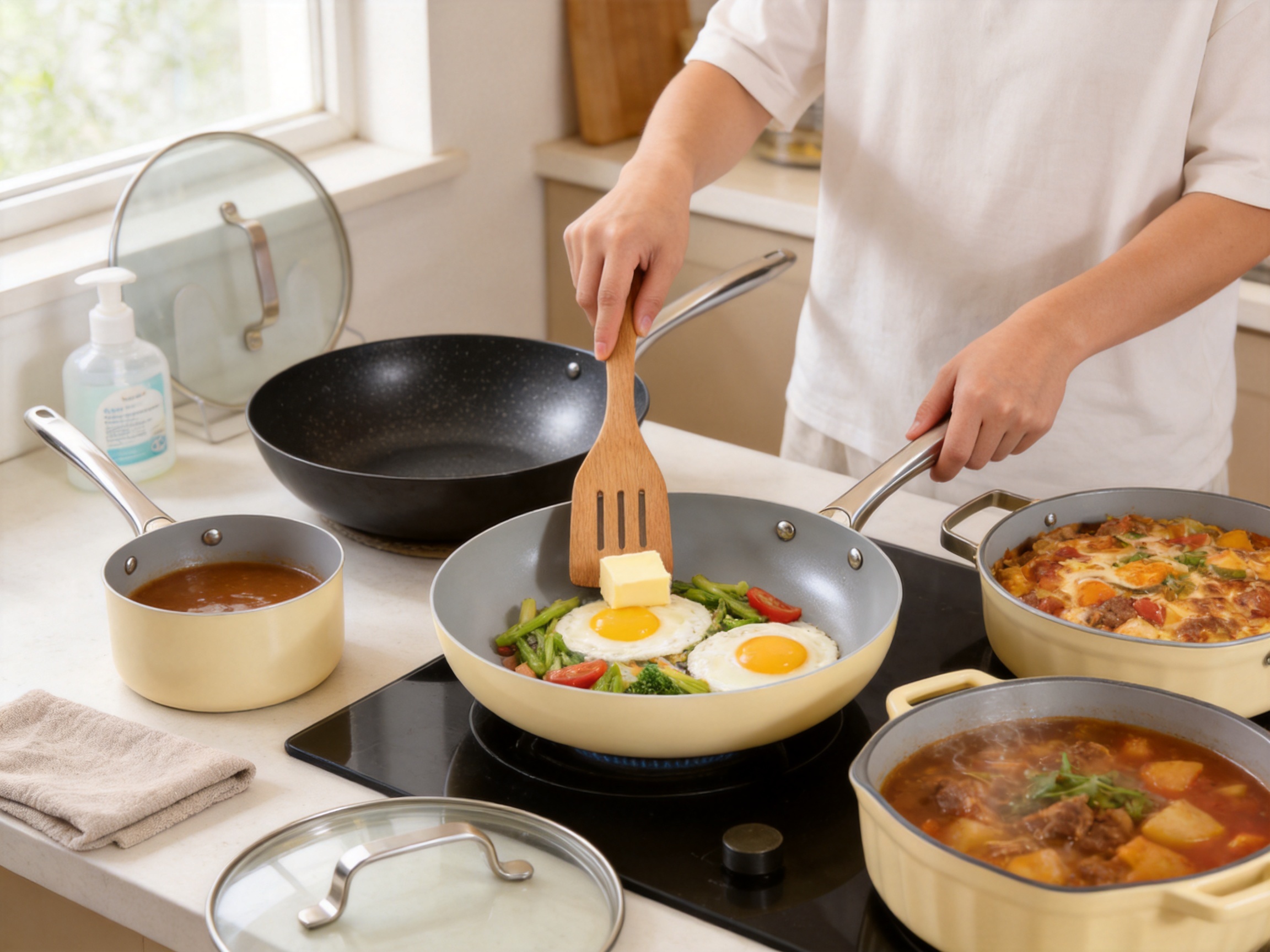
Choosing a cookware set involves more than comparing the number of pieces in a box. The material, manufacturing process, surface treatment, handle design, heating behavior, maintenance requirements, and supplier capabilities all influence the value of the final product. For households, retailers, hospitality buyers, and kitchenware distributors, a cookware set must combine practical performance with consistent quality, attractive presentation, and reliable production support.
The TRUE COLOR Aluminium Non-Stick Cookware Set is designed around these requirements. It combines a lightweight pressed aluminum body with a light grey non-stick interior, a butter-yellow exterior, stainless steel handles and lid knobs, and a selection of pan and pot sizes for frying, boiling, stewing, and general kitchen preparation. Its seamless construction creates a clean appearance, while the coordinated design gives the set a modern and recognizable identity on the retail shelf.
This article examines the product in detail, including its construction, manufacturing process, cooking performance, advantages over competing cookware, maintenance requirements, product specifications, and the manufacturing strengths of Zhejiang Echo Industry And Trade Co., Ltd. It also explains how buyers can evaluate pressed aluminum cookware and how this set may fit household, retail, hospitality, and private-label programs.
1. Product Overview
The TRUE COLOR Aluminium Non-Stick Cookware Set is a multi-purpose cookware collection developed for everyday cooking. Its core material is aluminum, selected for its low weight and efficient heat transfer. The cooking surfaces are finished with a non-stick coating, while the exterior uses a butter-yellow color that gives the set a warmer and more distinctive appearance than conventional black, grey, or metallic cookware.
The light grey cooking interior creates visual contrast with the exterior and makes the food easier to see during preparation. This can be particularly useful when cooking eggs, pancakes, vegetables, sauces, fish, and other foods where browning and surface changes need to be monitored closely. The color combination also supports a minimalist design language that can appeal to modern homes and lifestyle-oriented kitchenware collections.
Stainless steel handles and lid knobs add a durable visual and functional element. They are coordinated with the aluminum bodies while providing a firm grip for moving pans and lifting lids. The seamless appearance reduces visual clutter and supports easy cleaning because there are fewer exposed joints or decorative elements that can collect residue.
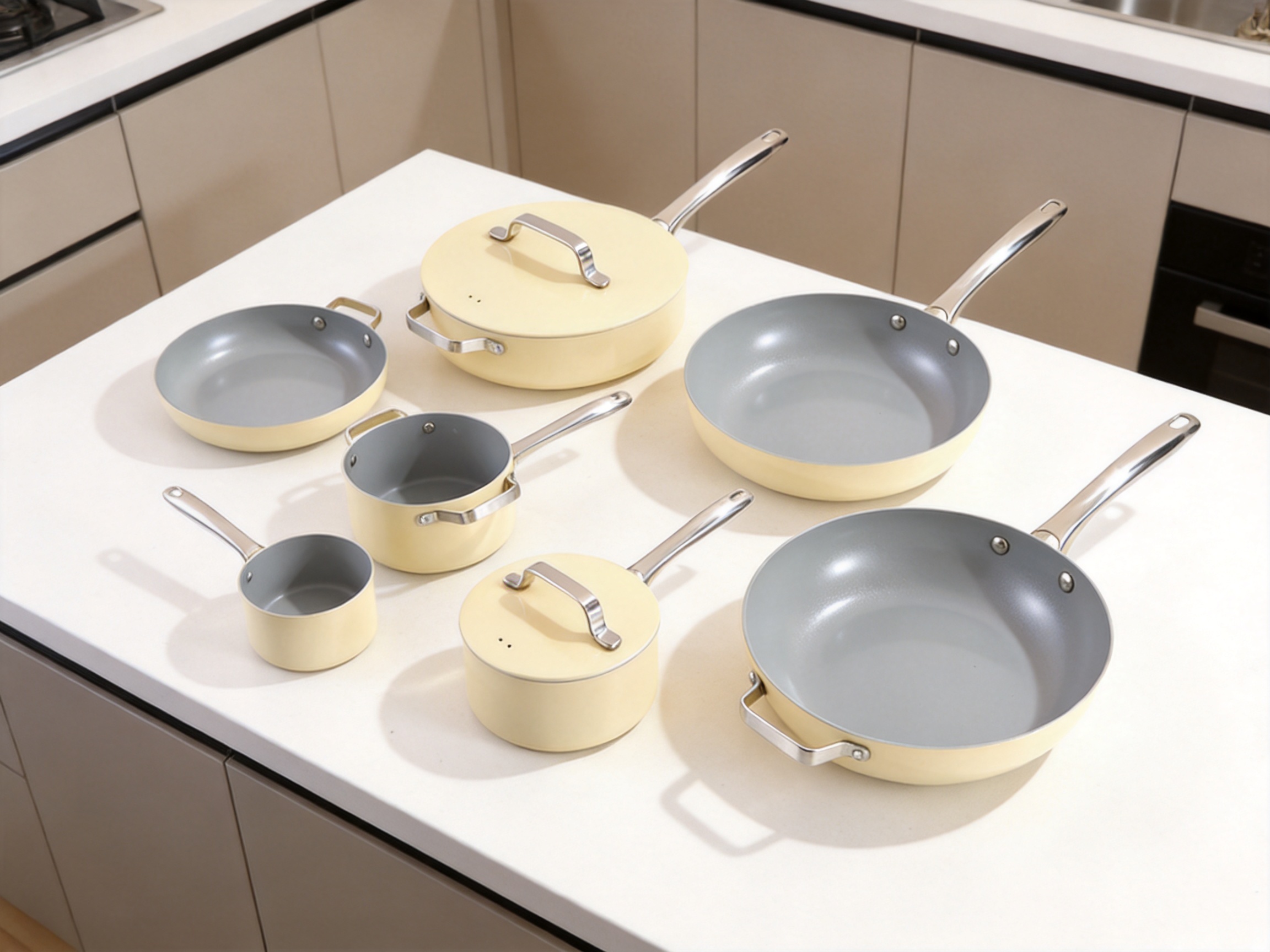
The set includes multiple cookware formats, including frying pans, a milk pan, deep frying pans, a casserole, and a wok-style piece. This variety enables users to prepare breakfast foods, quick stir-fries, sauces, milk-based recipes, soups, braised dishes, and other daily meals without purchasing each item separately.
For distributors and retailers, the set also offers a complete product story. Instead of selling a single pan with limited use, buyers can present a coordinated cookware solution with a clear material identity, a recognizable color scheme, and multiple sizes suitable for different cooking tasks.
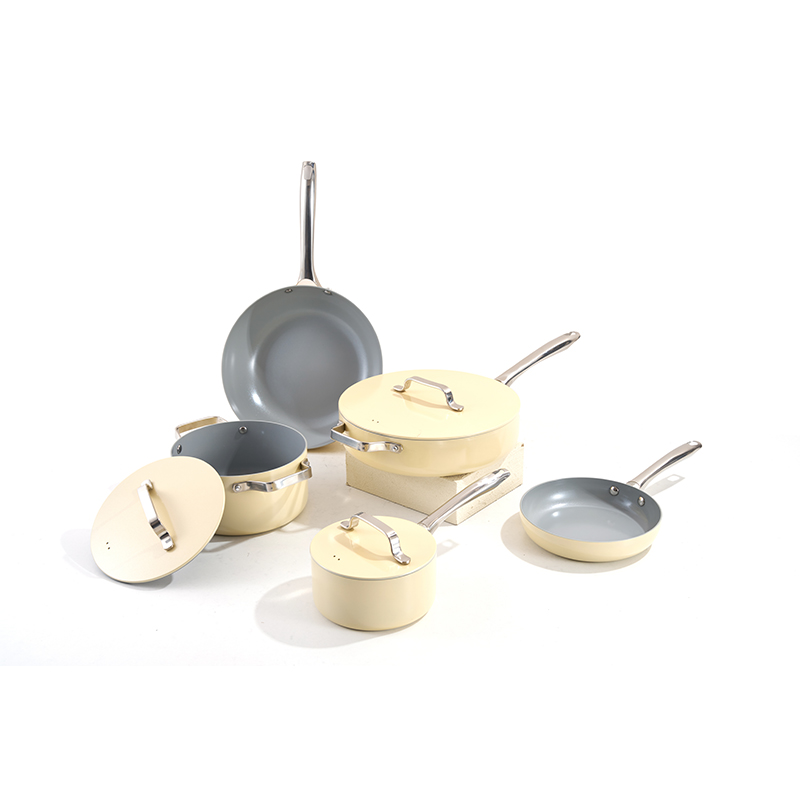
TRUE COLOR Aluminium Non-Stick Cookware Set
2. Main Product Features
2.1 Pressed Aluminum Construction
Pressed aluminum cookware is produced by shaping aluminum sheet material under high pressure. This manufacturing method creates a pan or pot body with a consistent form and relatively low weight. Compared with heavier cast aluminum cookware, pressed aluminum is easier to lift, store, pack, and transport.
The reduced weight is valuable in everyday kitchens. A user can move the cookware from the stovetop to the counter without the effort associated with thick cast iron or heavy multi-layer cookware. It is also easier for older users, students, busy families, and commercial kitchens that frequently move pans between cooking stations.
Aluminum also transfers heat efficiently. It responds quickly when the cooking temperature is adjusted, making it useful for foods that require rapid heating or controlled changes. This responsiveness supports tasks such as frying eggs, sautéing vegetables, reheating leftovers, preparing sauces, and making quick stir-fried dishes.
2.2 Non-Stick Cooking Interior
The non-stick cooking interior is one of the main performance features of the set. A smooth non-stick surface can reduce the amount of oil needed for many recipes and help food release more easily from the pan. It can also simplify cleaning because fewer food particles remain attached to the cooking surface.
The light grey interior offers a practical alternative to very dark coatings. The user can more easily observe the color of oil, sauces, batter, and food during cooking. The lighter surface can also make residue more visible during washing, helping users check whether the pan has been properly cleaned.
Non-stick performance depends on both the coating quality and the way the cookware is used. The set is intended for wooden, nylon, or other non-metal utensils. Sharp or metal tools can scratch the coating, potentially reducing its release performance and shortening the service life of the pan.
2.3 Butter-Yellow Exterior
The butter-yellow exterior gives the cookware a distinctive retail identity. Many cookware products use dark neutral colors, so a warm yellow finish can help a collection attract attention in physical stores, online product photography, and lifestyle-oriented kitchen displays.
Color is not only a visual feature. A coordinated exterior can help a supplier develop a recognizable product family across different pan sizes and related kitchen accessories. Retailers may use the set as a centerpiece for seasonal kitchen promotions, home organization campaigns, gift collections, or modern cooking displays.
2.4 Stainless Steel Handles and Lid Knobs
The stainless steel handles and lid knobs provide a clean contrast with the colored aluminum body. Stainless steel is widely used in cookware hardware because of its recognizable metallic appearance and resistance to ordinary kitchen wear.
The handles are designed to support stable handling when the cookware is moved, while the lid knobs make it easier to lift and replace the lids during cooking. A firm grip is important when the pan contains hot food, although users should always handle cookware carefully and follow normal heat-safety practices.
The hardware also contributes to the set’s premium appearance. Even when the cookware is manufactured using an efficient pressed aluminum process, stainless steel fittings can make the final product look more refined than basic low-cost cookware with simple plastic components.
2.5 Seamless Construction
The seamless visual construction gives the cookware a smooth, uncluttered appearance. Fewer visible interruptions make the products easier to coordinate with contemporary kitchen interiors and improve the overall perception of quality.
A smooth exterior and interior design can also simplify routine cleaning. Food and grease are less likely to remain around complicated decorative joints. However, users should still wash the cookware carefully with hot soapy water and a soft cloth or sponge, especially after cooking oily or sugary foods.
3. The Cookware Set and Its Practical Functions
The product information identifies a broad range of sizes and formats within the collection. The exact assortment may be organized according to buyer requirements, packaging configuration, and order specifications, but the listed products cover many of the most common household cooking tasks.
| Cookware Type | Listed Size Information | Typical Applications |
|---|---|---|
| Fry pan | 20 x 4.5 cm, 24 x 5 cm, 26 x 5.5 cm, 28 x 5.5 cm | Eggs, pancakes, sautéing, shallow frying, breakfast foods |
| Milk pan | 16 x 8 cm, 18 x 9.5 cm | Milk, sauces, oatmeal, small portions, reheating |
| Deep fry pan | 20 x 10.5 cm, 24 x 13 cm | Deep sautéing, braising, frying, one-pan meals |
| Casserole | 28 x 8 cm | Stews, soups, simmered dishes, family portions |
| Wok | Listed as part of the assortment | Stir-frying, vegetables, noodles, rice dishes, quick cooking |
The fry pans are suited to fast cooking. The smaller sizes can be useful for individual portions, breakfast dishes, and compact kitchens, while the larger diameter options provide more room for family meals. The lower sidewalls make it easier to turn food and monitor browning.
The milk pans are convenient for small-volume cooking. They can be used for warming milk, preparing sauces, melting ingredients, making porridge, or reheating a single serving. Smaller pans are also valuable in households that want to avoid using a large pot for minor cooking tasks.
The deep fry pans provide additional capacity and taller sidewalls. These characteristics make them suitable for cooking foods with more liquid, oil, or ingredients. They can bridge the gap between an ordinary frying pan and a full-size saucepan.
The casserole and wok extend the versatility of the assortment. A casserole can support stewing and simmering, while a wok can be used for fast cooking at moderate heat. Together, these items allow the set to cover both Western and Asian-inspired cooking styles.
4. How Pressed Aluminum Cookware Is Manufactured
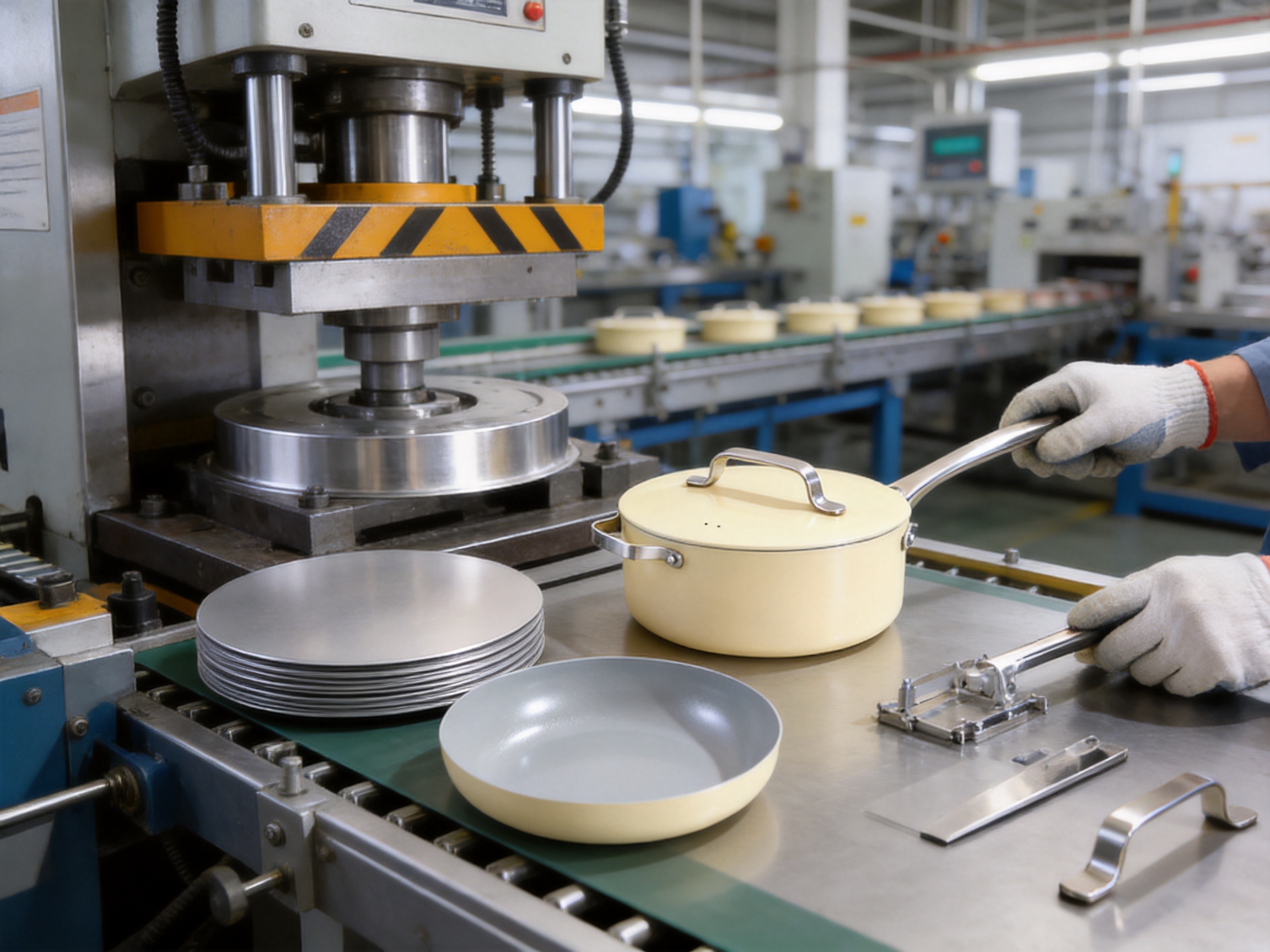
The manufacturing process is central to the performance and commercial value of a pressed aluminum cookware set. The process generally begins with aluminum sheet material selected according to the required thickness, diameter, strength, and product structure. Material consistency is important because uneven sheet quality can affect forming, shape accuracy, and heating behavior.
4.1 Material Preparation
Before forming, aluminum material is inspected and prepared for production. The material may be cut into blanks that correspond to the diameter of the finished cookware. The blank size must allow sufficient material for the sidewalls, rim, base, and forming movement required by the specific product design.
Material preparation affects both efficiency and appearance. A properly prepared blank can reduce unnecessary waste and help maintain consistency from one production batch to the next. For a multi-size collection, controlled preparation also supports accurate matching between pans, lids, handles, packaging inserts, and product labels.
4.2 High-Pressure Forming
During pressing, the aluminum blank is shaped using forming tools and controlled pressure. The metal is forced into the required pan or pot profile. The tool design determines the cookware’s diameter, depth, curve, rim, base geometry, and overall appearance.
Pressed forming is efficient for repeated production because the same tooling can create consistent shapes across a large quantity of products. This is particularly useful for cookware sets, where several products must look like part of one coordinated collection.
The method also allows manufacturers to produce cookware with relatively thin walls compared with cast products. This contributes to low weight and fast heat response. The trade-off is that pressed aluminum generally has less structural mass and thermal stability than thick cast aluminum, so correct heat use is important.
4.3 Surface Preparation
After forming, the cookware bodies require surface preparation. Edges, rims, and external surfaces are checked and finished to remove sharp points, irregularities, or forming marks. A clean and even surface is necessary before applying the non-stick interior and exterior finish.
Surface preparation influences coating adhesion. If the substrate contains contaminants, excessive roughness, or uneven areas, the final coating may not perform consistently. A professional cookware factory therefore needs suitable cleaning, inspection, and process control before coating operations begin.
4.4 Non-Stick Coating Application
The non-stick interior is applied to the prepared aluminum body through a controlled coating process. Depending on the specific coating system, production may include cleaning, spraying or other application steps, drying, curing, and inspection.
Coating thickness, surface coverage, curing conditions, and handling practices all affect the finished result. The coating should cover the intended cooking area evenly and maintain a smooth texture. Inconsistent application may lead to differences in release performance, appearance, or durability.
The light grey color is part of the product’s visual specification. Consistency is important because cookware sets are often purchased as a coordinated group. A noticeable variation between pieces can reduce the perceived quality of the collection, especially in retail packaging or online photography.
4.5 Exterior Finishing
The butter-yellow exterior requires its own finishing controls. Color matching, surface smoothness, edge coverage, and resistance to ordinary discoloration are important considerations. A quality finish should support the intended appearance while remaining suitable for normal kitchen use.
Exterior finishing also affects the product’s competitive position. A cookware set with a distinctive and consistent color can stand apart from products that use generic black or silver finishes. For retailers, this provides an opportunity to create more attractive displays and target customers who value both function and kitchen aesthetics.
4.6 Hardware Assembly
After coating and finishing, stainless steel handles and lid knobs are installed. Assembly must be secure, aligned, and visually consistent. The connection between the cookware body and its hardware is important for user confidence, particularly when the pan is full.
Assembly inspections may include checking fasteners, alignment, movement, surface condition, and the absence of sharp edges. The lid knob should be stable and comfortable to lift. The handle should provide adequate clearance from the heated body and maintain a balanced feel during use.
4.7 Final Quality Inspection
Finished cookware should be examined for coating defects, color inconsistency, dents, deformation, sharp edges, hardware problems, and packaging damage. For a cookware set, inspection must also confirm that the correct items and sizes are grouped together.
Quality control is especially important for export products because cookware may pass through multiple logistics stages before reaching the customer. Proper packing helps protect the surfaces, handles, lids, and colored exteriors during storage and transportation.
5. Advantages Compared with Competing Cookware
5.1 Lower Weight Than Cast Iron and Many Cast Aluminum Products
One of the clearest advantages of pressed aluminum is its manageable weight. Cast iron is well known for heat retention, but it is heavy and requires more effort to move, clean, and store. Cast aluminum is lighter than cast iron but may still have more material and weight than a pressed aluminum product.
The TRUE COLOR set is positioned for users who prioritize easy handling and everyday convenience. A lighter pan is easier to use for quick meals, easier to place in cabinets, and more economical to ship. For distributors, reduced product weight can also help control logistics costs, depending on packaging and order volume.
5.2 Faster Heat Response
Aluminum generally heats quickly and responds promptly when the heat setting changes. This is useful for cooking tasks that require rapid temperature adjustment. A user preparing a sauce, sautéing vegetables, or frying an egg can lower the heat and receive a relatively fast response from the cookware.
Heavy cookware can provide stronger heat retention, but it may also take longer to heat and cool. The pressed aluminum set is better suited to convenience cooking, fast meal preparation, and ordinary household routines where responsiveness is more important than extended thermal mass.
5.3 Easier Food Release and Cleaning
The non-stick surface provides an advantage over uncoated aluminum, basic stainless steel, and some untreated cookware. Foods such as eggs, pancakes, fish, and delicate vegetables can be easier to release when the pan is used correctly.
Cleaning can also be more convenient. Instead of using vigorous scrubbing, the user can normally wash the pan with hot soapy water and a soft cloth or sponge. This reduces cleaning time and helps preserve the surface.
5.4 More Distinctive Appearance
The butter-yellow exterior and light grey interior create a coordinated appearance that is unusual within the mass-market cookware category. Compared with generic dark cookware, the set can make a stronger impression in product photography, store displays, and kitchen environments.
A distinctive color is especially useful for private-label and lifestyle retailers. It can help a product collection become recognizable without relying solely on a printed logo. It may also appeal to customers who want cookware that contributes to the appearance of the kitchen rather than remaining visually neutral.
5.5 Broad Cooking Coverage
The assortment includes multiple pan formats, allowing one collection to support several cooking methods. A single frying pan may be useful, but a coordinated set offers greater practical value because it reduces the need for additional purchases.
The combination of fry pans, milk pans, deep fry pans, casserole cookware, and a wok supports both small and large meals. This makes the set suitable for starter kitchens, wedding and housewarming gifts, family cooking, and retail bundles.
5.6 Efficient Manufacturing and Competitive Pricing Potential
Pressed aluminum production is generally more efficient for repeated shapes than heavy casting processes. It can support higher-volume production with consistent dimensions and a comparatively economical material structure.
This manufacturing efficiency can give distributors access to a product with a more premium appearance without the full cost and weight associated with heavier cookware. Actual pricing depends on coating, hardware, packaging, order quantity, certification, and customization requirements, but the process creates a practical foundation for competitive product development.
6. Comparison with Other Cookware Materials
| Material or Product Type | Main Strengths | Limitations Compared with Pressed Aluminum | Best Use Profile |
|---|---|---|---|
| Pressed aluminum with non-stick coating | Lightweight, fast heating, easy food release, convenient cleaning | Requires careful utensil and heat management; less heat retention than heavy cookware | Daily cooking, quick meals, starter kitchens, retail sets |
| Cast aluminum | More rigid, thicker construction, good heat distribution | Usually heavier and more expensive; slower to handle and ship | Users seeking greater structure and moderate heat retention |
| Stainless steel | Durable surface, strong appearance, suitable for high-temperature cooking | Food may stick without proper technique; often heavier; no inherent non-stick release | Searing, boiling, professional-style cooking |
| Cast iron | Excellent heat retention and long service potential | Very heavy, slower to heat, requires special care, may rust if neglected | High-heat searing, baking, long-term heavy-duty use |
| Basic coated cookware | Low initial cost and simple operation | May have less consistent coating, weaker hardware, or less distinctive design | Budget-focused purchasing |
This comparison shows that no cookware material is ideal for every cooking method. The strength of the TRUE COLOR set lies in its balance. It is not intended to replace heavy cast iron for maximum heat retention or uncoated stainless steel for every high-temperature technique. Instead, it is designed to provide lightness, responsiveness, non-stick convenience, and coordinated appearance for normal everyday cooking.
7. Food-Contact Safety and Responsible Use
Questions about aluminum cookware safety are common. High-end or better-finished aluminum cookware is generally designed with a protective surface treatment rather than leaving raw aluminum as the direct cooking surface. In this set, the non-stick coating separates food from the underlying aluminum body during normal use.
The practical meaning of “non-toxic” should be understood carefully. No cookware description should imply that a product is risk-free under every possible condition. Food-contact safety normally refers to meeting relevant requirements when the product is manufactured, coated, tested, and used according to its intended purpose.
Normal use includes avoiding empty-pan overheating, using moderate cooking temperatures, selecting suitable utensils, and replacing cookware when the cooking surface is seriously damaged. A coating that is scratched, peeling, or severely worn should not be treated as if it were new.
Buyers importing cookware should confirm the appropriate documentation for their target market. Depending on the destination, this may include food-contact declarations, coating information, material documentation, testing reports, packaging requirements, and other compliance records. Zhejiang Echo Industry And Trade Co., Ltd. provides product development and product certification assistance as part of its broader supply-chain support.
Compared with raw aluminum, a coated product is better suited to regular cooking with acidic or strongly seasoned foods because the food-contact surface is the coating rather than the exposed base metal. Even so, users should follow the care instructions and avoid using damaged cookware.
8. Cooking Performance in Everyday Kitchens
The set is especially suitable for quick and moderate-heat cooking. Frying eggs is one example. The non-stick interior can help the egg release from the pan, while the light grey surface makes it easier to observe the white and yolk as they cook.
Pancakes and flatbreads are another suitable application. The broad frying surface provides room for spreading batter, while the smooth coating can make flipping easier. Users should avoid cutting directly on the pan or using sharp tools to lift food.
Vegetable stir-fries can be prepared in the wok or deep fry pan. Aluminum’s quick response helps the cookware heat efficiently, while the higher sidewalls help contain ingredients during stirring. Medium heat is recommended rather than excessive heat, particularly when the pan is empty or contains very little food.
The milk pan is suitable for sauces, warm drinks, porridge, and small servings. Its smaller capacity can help reduce energy use and avoid the inconvenience of heating a large pot for a small amount of food.
The casserole is appropriate for simmering soups, braised vegetables, stews, and other one-pot recipes. Because pressed aluminum is lighter than many heavy casserole materials, it is easier to move after cooking. However, long periods of high heat should be avoided, and the cookware should not be overheated without food or liquid inside.
The set is therefore best understood as a convenience-oriented cookware solution. It supports the cooking tasks performed most frequently in homes rather than being designed exclusively for extreme temperatures, open-fire cooking, or heavy commercial abuse.
9. Care and Maintenance Instructions
9.1 Before First Use
Wash each piece before its first use. Use warm or hot water, a mild dishwashing detergent, and a soft cloth or sponge. Rinse thoroughly and dry the cookware before storing or cooking.
9.2 Use Suitable Utensils
Use wooden, nylon, silicone, or other utensils intended for non-stick cookware. Do not use metal forks, knives, spatulas, or sharp tools directly on the cooking surface. Even a small scratch can become more significant if the same area is repeatedly exposed to friction.
9.3 Avoid Empty-Pan Overheating
Do not overheat an empty pan. Aluminum responds quickly to heat, and an empty non-stick pan can reach a high temperature faster than expected. Add food, oil, or liquid as appropriate before extended heating.
9.4 Control the Heat Source
Do not allow the flame or heat source to extend beyond the base of the cookware. Excessive side heat can discolor the exterior, affect the handles, and expose the coating or surrounding components to unnecessary thermal stress.
9.5 Respond to Severe Overheating
If the cookware becomes severely overheated, turn off the cooker and leave the pan in place until it has cooled completely. Do not touch the cookware immediately, do not pour cold water into a very hot pan, and do not attempt to move it without suitable protection.
9.6 Wash Gently
Use hot, soapy water with a soft cloth or sponge. Avoid abrasive powders, steel wool, harsh scouring pads, and aggressive cleaning tools. Hand washing is recommended to help preserve the appearance of the exterior and the condition of the non-stick surface.
9.7 Storage
Store the cookware in a way that prevents hard objects from rubbing against the coating. If pans must be stacked, place a soft protective layer between them. Keep lids, utensils, and metal accessories from sliding across the cooking surfaces.
9.8 Microwave Use
Do not use the cookware in a microwave. Aluminum and metal components are not intended for microwave use. Transfer food to an appropriate microwave-safe container when reheating in a microwave oven.
10. Product Longevity and Performance Expectations
The useful life of a pressed aluminum cookware set depends on frequency of use, cooking temperature, utensil choice, cleaning methods, storage, and coating quality. A lightly used pan in a household may maintain its appearance for a long time, while cookware used several times a day in a busy kitchen may show wear sooner.
The most common signs of aging are gradual rather than sudden. The exterior may lose some visual brightness, the coating may become less slippery, or the body may show marks from repeated handling. Excessive heat, empty-pan heating, metal utensils, and abrasive cleaning can accelerate these changes.
Pressed aluminum is designed more for convenient daily cooking than for continuous heavy-duty thermal stress. Compared with cast aluminum, it is lighter and more economical, but it may be less rigid if exposed to long periods of very high heat. Users should avoid using the cookware beyond its intended conditions.
A responsible product description should therefore present the set accurately. It offers a useful balance of lightness, heating speed, non-stick convenience, and visual appeal. It should not be represented as indestructible or as a substitute for every specialized cookware material.
11. Manufacturing and Supply-Chain Strengths
Zhejiang Echo Industry And Trade Co., Ltd. is based in Taizhou, Zhejiang, China, a region known for manufacturing and export activity. The company focuses on kitchenware supply, including aluminum cookware, stainless steel cookware, cast iron cookware, and kitchen utensils.
The company’s product range supports one-stop sourcing. A buyer can investigate several cookware materials and complementary kitchen products through one supplier rather than coordinating every category separately. This can simplify communication, sampling, packaging development, purchasing, and shipment planning.
11.1 Product Variety
A broad product range allows the company to serve different market positions. Some buyers may need lightweight non-stick aluminum cookware, while others may require stainless steel products, cast iron items, or kitchen accessories. This variety helps retailers develop coordinated collections across different price levels.
11.2 ODM and OEM Support
ODM and OEM services are valuable for buyers that want to develop products under their own brands or adapt existing designs. Possible customization areas may include color, coating, handle style, lid configuration, packaging, logo placement, product combinations, and labeling, subject to technical and order requirements.
The TRUE COLOR set demonstrates how product identity can be created through the combination of exterior color, interior coating, hardware, shape, and assortment. A similar development process can be adapted for buyers seeking a different color palette or market-specific product configuration.
11.3 Flexible MOQ Discussions
Flexible minimum order quantity discussions can benefit small and medium-sized kitchenware buyers. Smaller companies may want to test a product before committing to a large-scale program, while established retailers may require higher volumes and customized packaging.
Actual MOQ depends on product configuration, color, coating, packaging, tooling, and production planning. However, the ability to discuss flexible purchasing arrangements can make product development more accessible to emerging brands and regional distributors.
11.4 Product Certification Assistance
International cookware sales require attention to food-contact safety and market-specific documentation. The supplier’s certification assistance can help buyers identify the records and testing information needed for their intended sales region.
Compliance responsibility should be clearly discussed between supplier, importer, retailer, and relevant testing organizations. Requirements may differ between countries and product categories, so buyers should confirm current rules before placing commercial orders.
11.5 Sustainable and Healthy Product Development
The company states that it is developing sustainable and healthy product solutions. In practical terms, this direction may involve improving product durability, reducing unnecessary packaging, selecting suitable materials, increasing manufacturing efficiency, and supporting safer food-contact surfaces.
For responsible buyers, sustainability should be evaluated through specific information rather than general language. Useful questions include the expected product life, coating durability, packaging materials, production waste controls, shipping efficiency, and available compliance documentation.
11.6 R&D-Oriented Supply-Chain Positioning
The company aims to become an R&D-driven supply-chain partner rather than merely an order-taking business. This positioning is relevant to buyers who need assistance with product concepts, assortment planning, design adaptation, material selection, testing, and commercialization.
A cookware supplier with development capabilities can help turn a general product idea into a more complete program. For example, a retailer may begin with a request for a yellow non-stick frying pan and later develop a full family of coordinated pots, pans, utensils, packaging, and promotional content.
12. Why the Set Is Suitable for Retail and Distribution
The set offers several characteristics that can support retail sales. First, it has a strong visual identity. The butter-yellow exterior is easy to recognize and can be shown clearly in product images. Second, the assortment is broad enough to communicate value. Customers are not purchasing one isolated pan but a coordinated cooking solution.
Third, the product has a simple benefit story: lightweight aluminum, non-stick cooking, fast heating, easy cleaning, stainless steel hardware, and multiple sizes. These benefits are straightforward for sales staff, catalog writers, and online retailers to explain.
Fourth, the product can fit several consumer segments. Young households may value its manageable weight and easy cleaning. Families may appreciate the range of cooking sizes. Gift buyers may respond to the color and coordinated appearance. Retailers may use it in housewarming, wedding, seasonal, or kitchen-upgrade promotions.
The product can also serve as a foundation for a broader collection. Matching kitchen utensils, storage accessories, trivets, or complementary stainless steel and cast iron items could be developed to create a complete kitchenware line.
13. Buyer Evaluation Checklist
Before purchasing or importing the cookware set, buyers should confirm the product configuration. The listed sizes include several fry pans, milk pans, deep fry pans, a casserole, and a wok. The buyer should verify exactly which pieces are included in each set, how many lids are provided, and whether the stated dimensions refer to the rim diameter, base diameter, or overall product size.
Buyers should also confirm the coating specification, color reference, handle attachment method, lid material, packaging design, carton quantity, and shipping dimensions. The product information lists CTN as 4CTN, but commercial buyers should clarify the precise carton arrangement and the number of complete sets per carton.
For export programs, buyers should request available test reports and food-contact documentation relevant to the target market. They should also confirm labeling requirements, care instructions, barcode options, warranty policies, spare-part availability, and inspection procedures.
| Evaluation Area | Questions for Buyers |
|---|---|
| Product assortment | Which pans, pots, lids, and accessories are included in one set? |
| Dimensions | Are measurements taken at the rim, base, or total height? |
| Coating | What coating system is used, and what care instructions apply? |
| Hardware | How are the stainless steel handles and knobs attached and inspected? |
| Packaging | How many sets fit in each carton, and what protection is used? |
| Compliance | Which food-contact and market-specific documents are available? |
| Customization | Can color, logo, packaging, or assortment be modified? |
| Order planning | What are the MOQ, lead time, sample policy, and inspection arrangements? |
14. Recommended Positioning for Different Markets
14.1 Household Retail
For household retail, the set can be positioned as an everyday non-stick cookware collection for modern kitchens. The key messages are light weight, easy cleaning, coordinated design, and broad cooking coverage.
14.2 Online Retail
For online marketplaces, clear photography should show the butter-yellow exterior, light grey interior, stainless steel hardware, and complete assortment. Product descriptions should explain dimensions, intended uses, care requirements, and the difference between pressed aluminum and heavier cookware.
14.3 Gift and Housewarming Channels
The coordinated color and multi-piece assortment make the set appropriate for housewarming and wedding gift channels. Retailers may emphasize that the collection provides several essential cooking tools in one package.
14.4 Hospitality and Rental Housing
Small hospitality properties, furnished apartments, and rental housing providers may value a lightweight set that covers basic cooking requirements. For these applications, buyers should assess expected usage frequency and ensure that the care instructions are communicated clearly.
14.5 Private-Label Programs
Private-label buyers can use the existing design as a starting point for a branded cookware collection. Custom color, packaging, logo application, assortment planning, and marketing materials may help create a stronger connection with the intended market.
15. Q&A: Frequently Asked Questions
Q1: What is the main material of the cookware set?
The main body is made from aluminum formed through a pressing process. The interior includes a non-stick cooking surface, while the handles and lid knobs are made from stainless steel according to the product description.
Q2: Is pressed aluminum the same as cast aluminum?
No. Pressed aluminum is formed from aluminum sheet using pressure, while cast aluminum is produced by pouring molten aluminum into molds. Pressed aluminum is generally lighter and more economical, while cast aluminum is usually thicker and more rigid.
Q3: What are the main advantages of the set?
The main advantages are low weight, quick heat response, a non-stick cooking interior, easy cleaning, a distinctive butter-yellow exterior, stainless steel hardware, and multiple pan and pot formats for different recipes.
Q4: Can metal utensils be used?
Metal and sharp utensils should not be used on the non-stick cooking surface. Wooden, nylon, silicone, or other non-abrasive utensils are recommended to help protect the coating.
Q5: Can the cookware be washed in a dishwasher?
The provided care instructions recommend hand washing to preserve the appearance and condition of the cookware. Buyers should confirm any dishwasher guidance with the supplier before making a commercial claim.
Q6: Can the cookware be used in a microwave?
No. The cookware should not be used in a microwave because it includes aluminum and stainless steel components.
Q7: What heat level should be used?
Moderate heat is generally appropriate for this type of non-stick pressed aluminum cookware. Users should avoid empty-pan overheating and should ensure that the flame or heat source does not extend beyond the base.
Q8: Is the cookware suitable for acidic foods?
The non-stick cooking surface provides a barrier between food and the aluminum body during normal use. Users should still follow the care instructions, avoid damaging the coating, and consult the supplier’s technical documentation for detailed food-contact information.
Q9: How long will the cookware last?
Service life depends on usage frequency, temperature, utensils, cleaning, storage, and coating condition. Proper care can help maintain performance, while overheating, metal tools, abrasive cleaning, and stacking without protection may shorten the useful life.
Q10: What makes the product different from basic low-cost cookware?
The set combines a distinctive exterior color, light grey non-stick interior, stainless steel hardware, a coordinated multi-size assortment, and a seamless minimalist appearance. Its manufacturing and supply-chain support also provide opportunities for customization and certification assistance.
Q11: Can the set be customized for a private brand?
The supplier offers ODM and OEM customization services. Potential options may include color, packaging, logo, assortment, and other design details, subject to technical feasibility, minimum order quantity, and production planning.
Q12: Who manufactures the product?
The product is supplied by Zhejiang Echo Industry And Trade Co., Ltd., a Zhejiang-based kitchenware supplier offering aluminum cookware, stainless steel cookware, cast iron cookware, kitchen utensils, OEM and ODM services, and product certification assistance.
Q13: What should a buyer confirm before ordering?
A buyer should confirm the exact set composition, dimensions, coating details, hardware construction, packaging, carton quantity, sample approval, minimum order quantity, production lead time, inspection procedure, and required compliance documents.
16. Final Assessment
The TRUE COLOR Aluminium Non-Stick Cookware Set is designed to balance practical cooking performance with attractive product presentation. Its pressed aluminum body keeps the cookware relatively light and responsive, while the non-stick interior supports easy food release and straightforward cleaning. The butter-yellow exterior gives the collection a clear visual identity, and the stainless steel handles and lid knobs add a durable, contemporary appearance.
Compared with heavy cast iron, the set is easier to handle and transport. Compared with uncoated stainless steel, it offers more convenient food release for many everyday recipes. Compared with basic low-cost coated cookware, it provides a more coordinated design, a broader assortment, and stronger opportunities for branded retail presentation.
The product is best suited to moderate-heat household cooking, quick meals, family kitchens, starter homes, gift programs, and retailers seeking a visually distinctive cookware collection. Its performance depends on responsible use, especially avoiding empty-pan overheating, excessive heat, metal utensils, sharp tools, abrasive cleaning, and improper storage.
For commercial buyers, Zhejiang Echo Industry And Trade Co., Ltd. adds value through its multi-category product range, ODM and OEM capabilities, certification assistance, flexible supply-chain discussions, and stated focus on research and development. These strengths can help transform a single cookware product into a complete kitchenware program adapted to different markets.
Overall, the set represents a practical pressed aluminum solution for customers who want lightweight cookware, non-stick convenience, fast heat response, easy maintenance, and a more expressive kitchen design. Its strongest competitive position comes from the combination of material efficiency, surface treatment, hardware selection, color coordination, multi-function assortment, and supplier support.
References
1. General technical principles of pressed aluminum cookware manufacturing, including sheet preparation, high-pressure forming, surface finishing, coating, assembly, and quality inspection.
2. General food-contact cookware safety principles concerning coated aluminum surfaces, normal cooking conditions, utensil selection, overheating prevention, and coating maintenance.
3. Product information supplied for the TRUE COLOR Aluminium Non-Stick Cookware Set, including dimensions, materials, color features, care instructions, assortment, and product positioning.
4. Product development information supplied by Zhejiang Echo Industry And Trade Co., Ltd., including aluminum cookware, stainless steel cookware, cast iron cookware, kitchen utensils, OEM and ODM services, certification assistance, and supply-chain support.
5. General comparative cookware principles relating to pressed aluminum, cast aluminum, stainless steel, cast iron, non-stick surfaces, heat response, weight, durability, and maintenance.
Product: TRUE COLOR Aluminium Non-Stick Cookware Set
Recommended Articles
Product Category
Related products
-
-
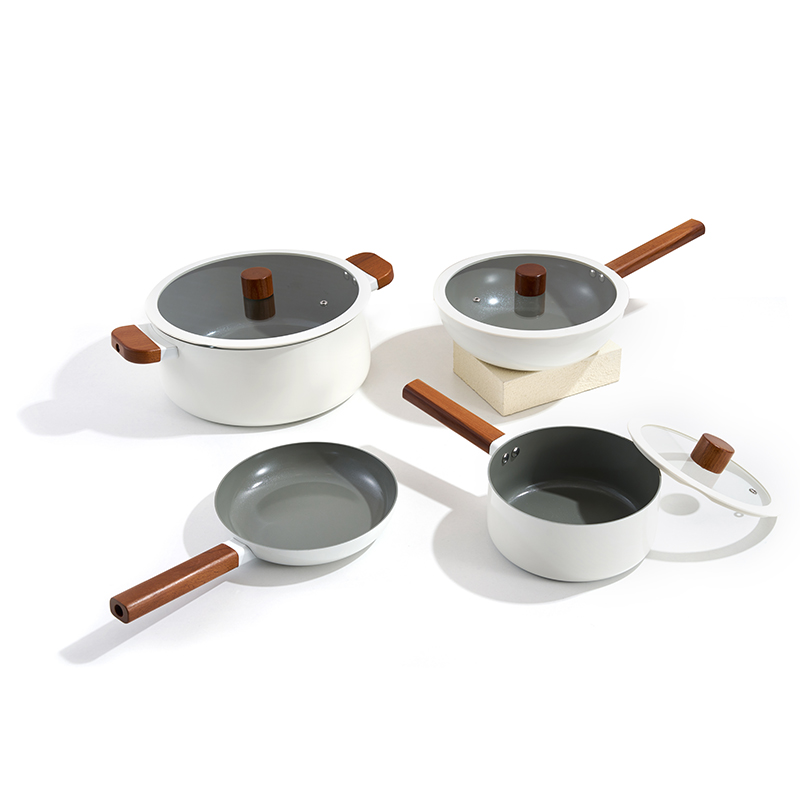
This cookware set has a ceramic non-stick inner liner, a heat-resistant wooden h...
See Details -
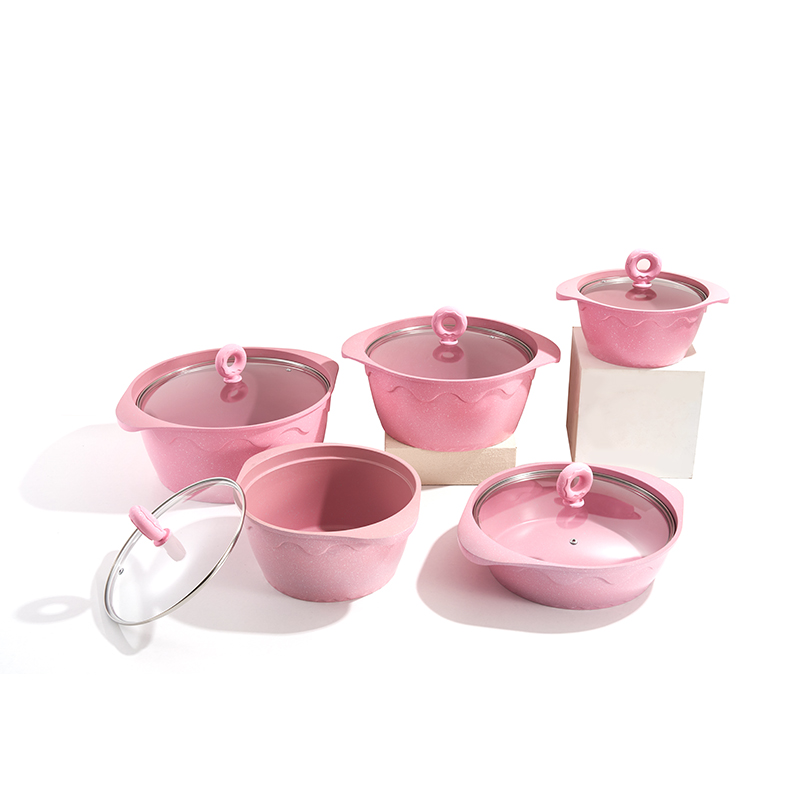
This cookware set is made of food-grade non-stick material, with a unique eye-ca...
See Details -
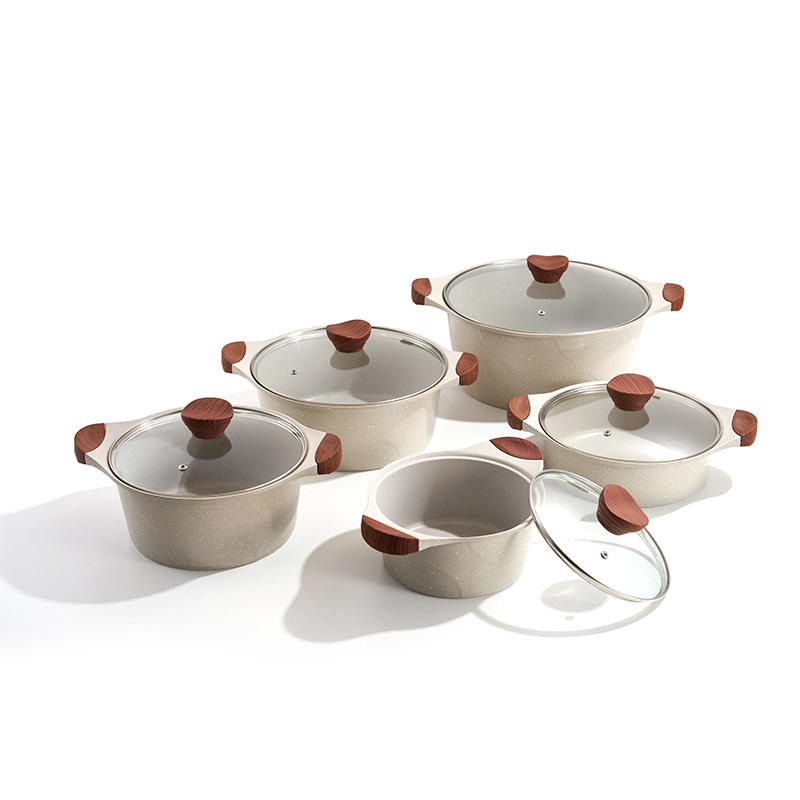
This off-white cookware set is made of wear-resistant non-stick material, with w...
See Details
Whether you're looking for bulk purchases or have any custom requirements, We are here to offer the best
solutions for you.
tiffany.zhong@echocn-trading.com
PHONE
+86-19561173975
+86-19557020621 (Hazel Wu)
ADD
Room 301, Unit 3014, No. 175 Qifeng Avenue, Wenqiao Town, Taizhou, Zhejiang, China
Fill Out the Form for More Information
Copyright © Zhejiang Echo Industry And Trade Co., Ltd.
All Rights Reserved.

China Cookware Set Manufacturer