
 en
 Español

This cookware set features a non-stick coating, even heat conduction, and multi-...
See Details
Multi-Function Aluminum Cookware Set for Modern Home Kitchens
Date:Aug 16, 2026
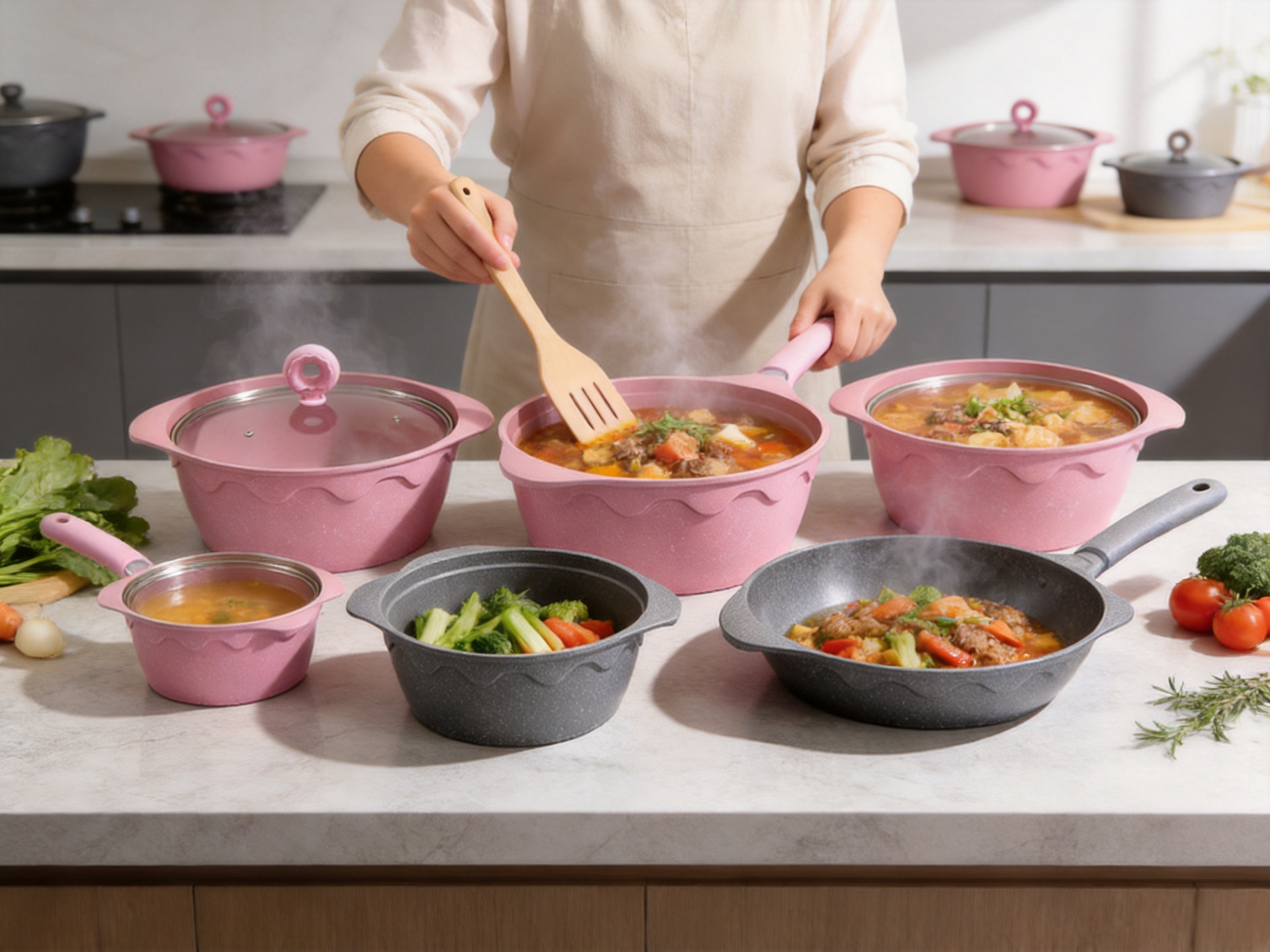
Choosing a cookware set is an important decision for households, restaurants, hospitality businesses, retailers, and professional kitchen suppliers. A good set should combine practical cooking performance, attractive appearance, reliable construction, convenient cleaning, and consistent manufacturing quality. The 10pcs SweetDonut Aluminum Pot Set is designed around these requirements. It brings together die-cast aluminum construction, granite-style non-stick coatings, a distinctive donut-inspired appearance, and several cooking capacities for everyday food preparation.
The set belongs to the aluminum cookware category and is intended for common cooking tasks such as stewing, boiling, simmering, and preparing family-size meals. Its coordinated sizes make it suitable for both small portions and larger servings, while its decorative exterior gives it a visual identity that distinguishes it from conventional cookware. For importers and distributors, it also offers the advantages of a coordinated product line, centralized sourcing, flexible customization possibilities, and packaging suitable for international trade.
Manufactured by Zhejiang Echo Industry And Trade Co., Ltd. in Taizhou, Zhejiang, China, the product reflects the capabilities of a regional kitchenware manufacturing and export supply chain. Zhejiang is widely recognized for its manufacturing experience, component networks, tooling resources, and export-oriented production. These conditions are valuable for buyers seeking cookware that can be developed, produced, inspected, packaged, and shipped through one coordinated supplier.
Product Overview
The 10pcs SweetDonut Aluminum Pot Set uses die-casting aluminum as its substrate. Die-cast aluminum is formed by injecting molten aluminum into a prepared mold under controlled pressure. Compared with simple stamped construction, this method can create a more substantial body, consistent wall geometry, smooth transitions, and distinctive shapes that are difficult to produce through basic sheet-metal forming alone.
The cookware has granite coating on both the exterior and interior treatment surfaces. The interior coating is intended to provide a smoother cooking surface and support easier release of food during normal use. The exterior granite-style finish contributes to the product’s appearance while adding a coordinated surface treatment that supports the visual concept of the set.
The available size information lists casserole pieces in 20 cm, 24 cm, 28 cm, and 32 cm sizes, together with a 28 cm shallow casserole. This range allows users to select a vessel according to the quantity and type of food being prepared. A smaller casserole can be used for sauces, side dishes, reheating, and compact household portions. Medium sizes are suitable for routine family cooking, while the larger casserole is appropriate for soups, stews, vegetables, pasta dishes, and shared meals.
The product title identifies the set as a 10-piece cookware set. Because the supplied specification lists the principal casserole and shallow casserole sizes rather than every individual component, buyers should confirm the final retail configuration, accessory count, lid arrangement, handle configuration, and packing list before placing an order. This verification is especially important for private-label projects and retail packaging, where the declared piece count must match the physical contents precisely.
| Product Attribute | Specification | Practical Importance |
|---|---|---|
| Product name | 10pcs SweetDonut Aluminum Pot Set | Provides a coordinated multi-piece cookware solution |
| Product category | Aluminum cookware | Suitable for household, retail, hospitality, and sourcing applications |
| Substrate | Die-casting aluminum | Supports a shaped, stable, and substantial cookware body |
| Exterior treatment | Granite coating | Creates a decorative and coordinated appearance |
| Interior treatment | Granite coating | Supports easier food release and cleaning when correctly maintained |
| Listed casserole sizes | 20 cm, 24 cm, 28 cm, and 32 cm | Covers small, medium, and large cooking quantities |
| Listed shallow casserole | 28 cm | Useful for shallow frying, sautéing, braising, and serving |
| Carton arrangement | 2 cartons | Useful for shipment planning and warehouse handling |
| Carton size | 72 × 36.5 × 32.5 cm | Supports freight calculation and storage planning |
| Carton weight | 18 kg | Important for logistics, palletization, and manual handling |
The listed carton information indicates a commercial product prepared for wholesale or export distribution rather than only direct household sale. Two cartons, a defined carton size, and a declared carton weight help buyers calculate shipping requirements, warehouse capacity, packaging density, and landed cost. Before shipment, commercial buyers should still request final packing drawings, carton marks, inner-box dimensions, gross weight, net weight, and loading quantity.
Distinctive SweetDonut Design
One of the most visible characteristics of the cookware is its donut-inspired design concept. Many cookware sets compete primarily through color, coating, or handle details. A recognizable shape can create a stronger product identity, especially in crowded retail categories where numerous aluminum pots look similar at first glance.
The rounded visual language gives the set a friendly and contemporary appearance. It can appeal to consumers who want cookware that performs routine cooking functions while also looking attractive when displayed on an open shelf, kitchen island, or dining table. For retailers, a distinctive silhouette can improve product recognition in showroom displays, online product photography, catalog pages, and social media campaigns.
Design differentiation is not only a matter of decoration. A carefully developed shape may also influence the relationship between the cooking surface, side walls, handles, lids, and storage space. The mold must be designed so that the exterior profile remains attractive without compromising the internal cooking area. The production team must also consider wall thickness, draft angles, coating coverage, demolding, heat distribution, and compatibility with the intended cooking environment.
The SweetDonut concept therefore offers a potential advantage over plain, standardized cookware. It gives distributors a product story that is easier to communicate: a coordinated aluminum set with a decorative rounded profile, multiple capacities, and a non-stick granite-style treatment. This story can be adapted for modern kitchen collections, wedding and housewarming gifts, seasonal retail programs, and curated cookware ranges.
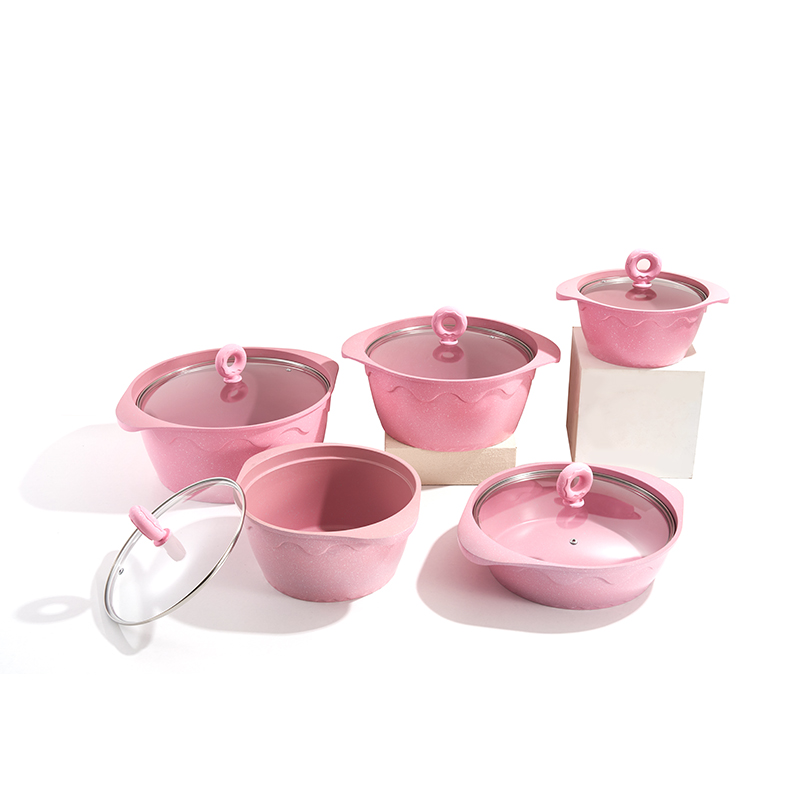
10pcs SweetDonut Aluminum pot Set
Die-Cast Aluminum Construction
The main body material is die-cast aluminum. Aluminum is widely used in cookware because it is relatively lightweight, easy to form, and capable of transferring heat efficiently. When formed through die casting, the material can support more complex shapes than many conventional stamping processes. The resulting body can be designed with controlled contours and a smooth visual finish before surface treatment is applied.
Die casting begins with the preparation of a metal mold based on the approved product design. Molten aluminum is introduced into the mold cavity under pressure. After the material fills the cavity and solidifies, the cast body is removed, trimmed, and prepared for subsequent operations. The exact parameters depend on the alloy, equipment, mold design, wall thickness, and product requirements.
For cookware, mold quality is particularly important. A poorly prepared mold can create dimensional variation, incomplete filling, rough edges, or inconsistencies that become more visible after coating. A properly maintained mold helps production teams obtain repeatable shapes across batches. It also supports more reliable fitting between the cookware body and any matching accessories, such as lids, handles, or packaging inserts.
After casting, the body normally requires finishing operations. These may include removing flash, smoothing edges, correcting surface irregularities, cleaning, and preparing the metal for coating. The goal is to create a stable foundation for the interior and exterior granite treatments. Surface preparation is an essential stage because coating adhesion and final appearance depend heavily on the cleanliness and condition of the aluminum substrate.
Compared with lightweight stamped cookware, die-cast construction can provide a more substantial feel in the hand. This can improve the perceived value of the product at retail. It may also allow the cookware to maintain its decorative profile more consistently than a thin sheet body. However, cookware performance depends on the complete design, not only the casting method. Buyers should evaluate heating behavior, base flatness, coating durability, handle attachment, lid fit, and compatibility with the intended cooker type during product approval.
Material Advantages for Everyday Cooking
Aluminum’s heat-transfer characteristics make it suitable for a broad range of ordinary cooking applications. The cookware can be used for heating liquids, simmering sauces, preparing soups, boiling vegetables, and cooking stews. The different listed sizes allow the user to choose a vessel that matches the volume of food instead of using one oversized pot for every task.
A 20 cm casserole can be convenient for compact meals, small portions, sauces, or side dishes. The 24 cm size provides additional capacity for regular household use. A 28 cm casserole can support larger family meals, while the 32 cm size is appropriate when preparing food for several people or cooking in larger batches. The 28 cm shallow casserole creates a different cooking format, offering a broader and lower surface for shallow preparations, sautéing, braising, and dishes that benefit from easier stirring.
Using the correct size is also helpful for cooking control. An oversized vessel may require more energy and may not heat food as efficiently for a small portion. A vessel that is too small can lead to crowding, uneven cooking, or splashing. A multi-size set gives households greater flexibility and reduces the need to purchase individual pans separately.
Granite-Style Non-Stick Coating
The cookware includes granite coating on both the interior and exterior. The interior coating is the surface most directly involved in cooking performance. Its smooth finish can help food release more easily than from an untreated metal surface, provided that the cookware is used within the recommended temperature range and cared for correctly.
Non-stick performance is affected by several factors, including coating formulation, substrate preparation, application thickness, curing conditions, cooking temperature, utensil selection, cleaning methods, and frequency of use. A granite appearance alone does not determine the technical quality of a coating. For this reason, responsible product evaluation should include adhesion testing, abrasion testing, release testing, thermal cycling, and inspection for pinholes, bubbles, uneven coverage, and edge defects.
The exterior granite treatment gives the set a coordinated appearance. This can help the product occupy a more premium position than basic single-color cookware. The finish may also make ordinary cooking vessels more visually suitable for open storage or table presentation. For retailers, the combination of a decorative exterior and functional interior creates a straightforward value proposition: the product is designed to look appealing while supporting practical cooking and cleaning.
Because the coating is a functional surface, users should avoid metal or sharp utensils. Wooden, nylon, silicone, or other utensils specifically intended for non-stick cookware are more appropriate. Metal tools can scratch the coating, particularly when used with force or at sharp angles. Once a coating is damaged, continued use may reduce release performance and make cleaning more difficult.
The recommended cleaning method is hot, soapy water with a soft cloth or sponge. Abrasive pads, harsh scouring powders, and aggressive scraping should be avoided. Hand washing is recommended to help preserve the appearance and condition of the cookware. Although some retailers may wish to promote convenience features such as dishwasher compatibility, no such claim should be made for this product unless it has been verified through the manufacturer’s testing and approved specification.
Coating Quality and Manufacturing Control
Reliable coating production requires more than spraying a decorative layer onto a metal body. The aluminum surface must first be cleaned and prepared. Any oil, dust, oxidation, residue, or loose material can interfere with adhesion. The coating must then be applied evenly to the intended interior and exterior areas. Curing conditions must be controlled so that the finish develops the required hardness, adhesion, appearance, and resistance.
Manufacturers may use visual inspection and process checks to monitor coating consistency. Important inspection points include color uniformity, surface smoothness, edge coverage, absence of visible craters or blisters, and correct treatment of the cooking surface. Samples can also be retained for laboratory or third-party testing according to the destination market and customer requirements.
For international buyers, coating documentation is an important part of supplier evaluation. Buyers may request information about the coating system, food-contact compliance, applicable test standards, restricted substances, and recommended care instructions. Certification assistance is identified as part of the supplier’s wider service capability, which can help importers organize documentation for their target markets.
Advantages Compared with Conventional Cookware Sets
More Distinctive Than Basic Utility Designs
Many entry-level cookware sets use plain cylindrical bodies and limited visual differentiation. The SweetDonut set takes a more recognizable design approach. Its rounded, eye-catching profile can help a retailer offer something different from standard black or gray cookware collections. This is particularly valuable in online retail, where product images and immediate visual appeal strongly influence customer interest.
More Flexible Than a Single-Pot Purchase
A single pot may serve one cooking purpose, but a coordinated set offers broader coverage. The listed 20 cm, 24 cm, 28 cm, and 32 cm casseroles provide options for different quantities. The shallow casserole adds another cooking format instead of simply repeating the same vessel shape in multiple dimensions. This variety can make the set more useful for families and can increase its perceived value compared with a one-piece purchase.
More Visually Coordinated Than Mixed Cookware
When consumers purchase cookware one piece at a time, they may end up with different colors, finishes, handles, and proportions. A coordinated set creates a unified kitchen appearance. Matching exterior treatment and related shapes are beneficial for home users who value visual consistency and for retailers who want a complete collection that can be displayed as a single product family.
More Practical Than Highly Specialized Cookware
The cookware is designed around common cooking activities rather than a narrow specialty. Stewing and boiling are explicitly identified applications, while the range of casserole sizes and the shallow casserole format also support simmering, braising, reheating, sautéing, and serving. This broad use profile helps reduce the risk that a consumer will purchase a product that remains unused because it is suitable for only one recipe or cooking method.
Suitable for Private-Label and Wholesale Programs
For business buyers, a product’s commercial advantages are as important as its household features. The supplier provides one-stop cookware solutions covering aluminum cookware, stainless steel cookware, cast iron cookware, and kitchen utensils. This broader category coverage can help importers consolidate sourcing, develop coordinated collections, and reduce the number of separate supplier relationships they must manage.
The company also identifies ODM and OEM customization, flexible minimum order quantities, product certification assistance, and sustainable and healthy product development as service capabilities. These services can be useful for brands that need specific colors, packaging, logos, market documentation, or product variations. All customization details should be confirmed through a written quotation and approved sample before mass production.
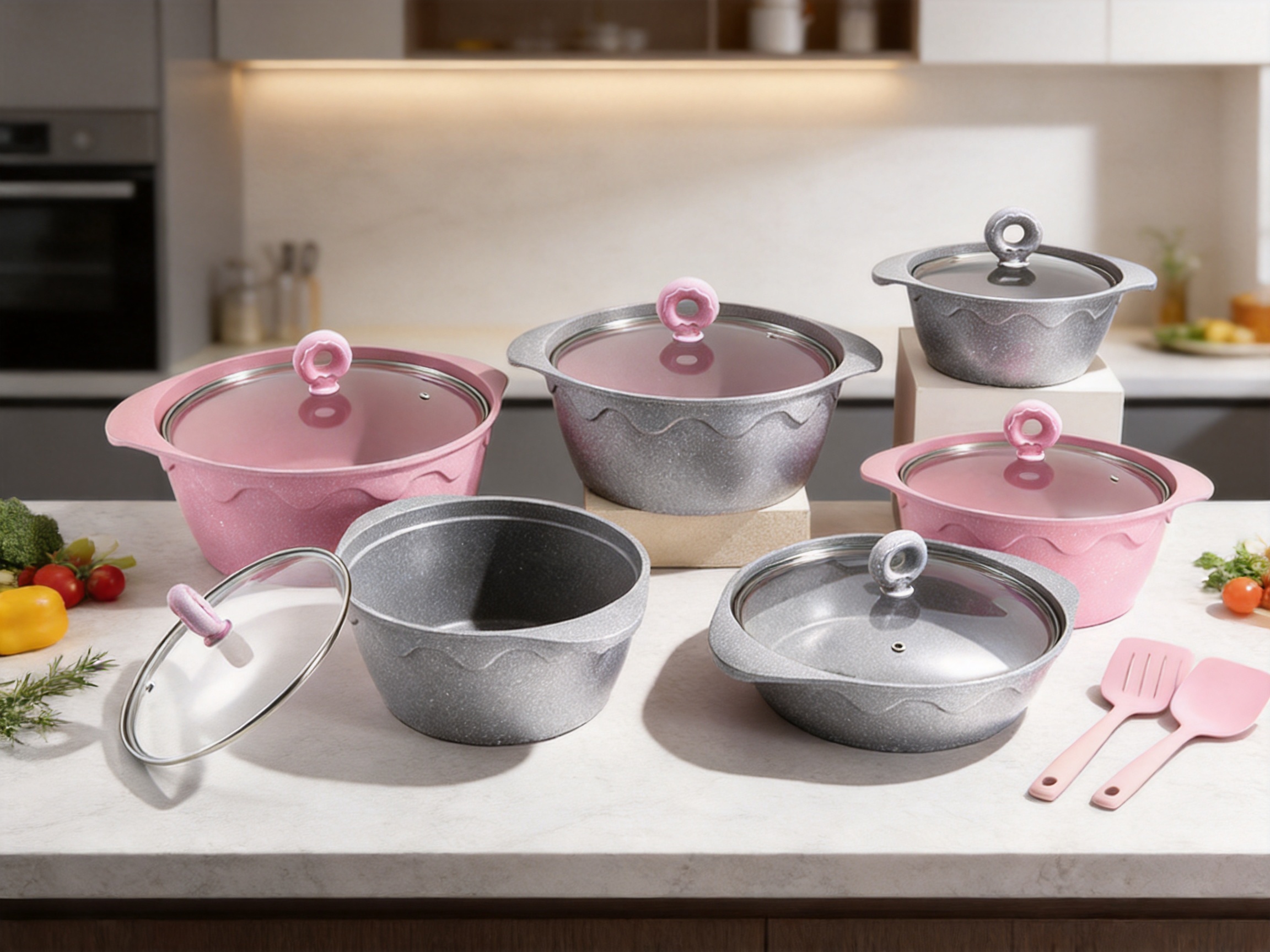
Manufacturing Process from Concept to Finished Product
1. Product Design and Engineering
Production begins with a product concept. For the SweetDonut set, the design must combine an attractive rounded appearance with practical cooking proportions. Engineers and designers consider the diameter and depth of each casserole, the relationship between the base and side walls, the visual transition around the body, the location of any handles, and the space required for packaging.
Computer-aided design can be used to create dimensional drawings and three-dimensional models. These files support mold development, prototype review, and communication between the buyer and manufacturer. At this stage, the parties should confirm the exact piece count, dimensions, wall thickness, coating color, accessory specifications, logo placement, packaging style, and intended cooker compatibility.
2. Mold and Tooling Preparation
The die-casting mold determines the basic shape of the cookware body. Tooling quality affects repeatability, surface quality, dimensional accuracy, and production efficiency. The mold must allow the aluminum to fill the cavity correctly and must provide suitable draft angles for removal after solidification.
Tooling preparation may also consider the design of the base, edge transitions, and any structural features. If a product includes separate components, corresponding tools or fixtures may be required for those parts. For customized orders, tooling ownership, modification costs, maintenance responsibilities, and sample approval procedures should be clearly documented.
3. Aluminum Die Casting
During die casting, aluminum is heated until molten and injected into the mold under pressure. The pressure helps the metal fill the designed cavity and reproduce the intended profile. Process variables such as metal temperature, injection speed, holding pressure, cooling time, and mold temperature affect the final result.
After the body has cooled and solidified, it is removed from the mold. Excess material and casting flash are trimmed. The body is then checked for visible defects, distortion, incomplete filling, sharp edges, or other conditions that could affect the next production stage. Consistent casting is important because uneven surfaces can create coating problems and can affect the appearance of the final cookware.
4. Grinding, Deburring, and Surface Preparation
Finishing operations prepare the cast body for coating. Workers or automated equipment may remove sharp edges, smooth rough areas, and refine the rim and base. The body is cleaned to remove residues from casting and finishing. Surface preparation must be sufficiently thorough to support coating adhesion while preserving the intended dimensions.
This stage also provides an opportunity to inspect the cooking surface. Any defect that is not corrected before coating may become more difficult to resolve later. A structured quality-control process can identify recurring defects and allow production teams to adjust tooling, casting, or finishing procedures.
5. Interior and Exterior Coating
The prepared aluminum body receives the specified granite coating on the interior and exterior. Application methods depend on the coating system and factory equipment. Uniformity is important for appearance and performance. The interior surface should be smooth and continuous, while the exterior should display an even decorative finish without visible runs, bare spots, or excessive buildup.
Coating application is followed by curing or baking under controlled conditions. Correct curing helps the coating develop its expected properties. The manufacturer’s process control should cover oven temperature, curing duration, handling procedures, and cooling. Incorrect curing can result in poor adhesion, discoloration, softness, or premature wear.
6. Component Assembly
After coating, the cookware bodies may be assembled with handles, knobs, lids, or other components included in the approved configuration. Assembly must be performed carefully to avoid scratching the freshly finished surface. Fasteners should be secure, and attached parts should be checked for alignment, stability, and safe handling.
If glass lids are included in the final package, they should be checked for chips, cracks, edge damage, and correct fit. If handles are included, the manufacturer should verify that they remain stable during normal lifting and movement. Since the supplied product information does not list every accessory, buyers should approve the final assembly specification before production.
7. Inspection and Packing
Finished products are inspected for appearance, dimensions, coating condition, assembly quality, and packaging accuracy. A typical inspection plan may include visual checks, measurement of key dimensions, coating adhesion tests, surface examination, and functional checks of assembled components. The inspection standard should be agreed with the buyer in advance.
The cookware is then protected with suitable packaging materials. Separators, bags, molded inserts, cartons, and printed boxes may be selected according to the product’s shape and the requirements of the destination market. Good packaging should prevent impact, abrasion, movement, and moisture-related damage during handling and transportation.
The stated shipment information of two cartons measuring 72 × 36.5 × 32.5 cm and weighing 18 kg provides a starting point for logistics planning. However, the final carton data should be confirmed after the packaging design is completed. Packaging changes, accessories, and retail boxes can affect both volume and weight.
Quality Assurance for Export Buyers
International cookware buyers should evaluate quality at several stages rather than relying only on a final visual inspection. Pre-production approval confirms that the factory is working from the correct design and material requirements. During production, inspections can identify casting, coating, assembly, or packaging problems before the full order is completed. Final inspection verifies that the finished goods match the approved sample and commercial documents.
A practical quality-control checklist may include the following points:
• Confirmation of aluminum substrate and approved construction method.
• Verification of the number of pieces and included accessories.
• Measurement of casserole diameters, depths, rim dimensions, and base dimensions.
• Inspection for casting cracks, deformation, sharp edges, pinholes, and surface irregularities.
• Inspection of interior and exterior granite coating for uniformity, adhesion, and visible defects.
• Confirmation that logos, labels, color, and packaging match the approved artwork.
• Testing of handles, knobs, lids, and other components where included.
• Verification of carton quantity, carton markings, gross weight, net weight, and packing list.
• Review of food-contact and destination-market documentation where required.
Buyers should also request a production sample or golden sample. The sample should represent the approved commercial design and should be stored for comparison during future production runs. If the product is reordered in a different color or with a new accessory, a new approval sample may be necessary.
Cooking Applications
The set is designed for broad kitchen use. The casserole format is naturally suited to stewing, boiling, simmering, and preparing liquid-based dishes. Users can prepare soups, broths, sauces, pasta, vegetables, rice dishes, beans, curries, and family-style stews, subject to the instructions for the intended cooking surface.
The shallow casserole offers a broader cooking area with less depth. It can be useful for sautéing aromatics, browning ingredients, reducing sauces, shallow frying, preparing braised dishes, or cooking foods that need to be stirred and turned easily. Its form also makes it suitable for serving certain dishes directly at the table, provided that safe handling procedures are followed.
The multiple sizes support different household routines. A person cooking for one or two people may use the smaller pieces more frequently, while larger families may rely on the 28 cm or 32 cm casseroles for batch cooking. Retailers can present the set as a flexible kitchen foundation rather than a collection intended for one specific meal type.
Cooking results depend on the heat source, burner size, recipe, ingredients, and technique. The heat source should not extend beyond the base of the cookware. Oversized flames or heating elements can damage exterior surfaces, handles, or coatings and may create unnecessary hot spots. The exact stove compatibility should be confirmed with the supplier before making claims about gas, electric, ceramic, halogen, or induction use.
Care and Safety Instructions
The cookware should be washed before first use. This removes dust or residues that may have accumulated during production, packing, or transport. A gentle hand wash with warm or hot soapy water and a soft cloth or sponge is recommended.
Metal and sharp cooking utensils should not be used. Wooden, nylon, silicone, or other non-stick-safe utensils are more suitable. Utensils should not be dragged forcefully across the interior surface. Cutting food inside the cookware should also be avoided because knives can damage the coating.
The cookware should not be overheated while empty. Empty heating can cause the body and coating to reach a high temperature quickly, especially on a powerful burner. Users should add ingredients or liquid before heating whenever the recipe permits and should remain attentive during cooking.
The cookware should not be placed in a microwave oven. It should also be positioned so that the flame or heat source does not extend beyond the base. The exterior coating and attached components may be affected by excessive side heat.
If the pan becomes severely overheated, the cooker should be turned off and the cookware should be left to cool completely. Users should not immediately pour cold water into a very hot pan because sudden temperature change can stress the cookware and create a safety hazard from steam or splashing.
Hand washing is recommended to preserve the appearance of the cookware. After washing, the cookware should be dried thoroughly before storage. Stacking should be done carefully, particularly if several coated pieces are stored together. Soft separators can help reduce contact between surfaces and minimize cosmetic wear.
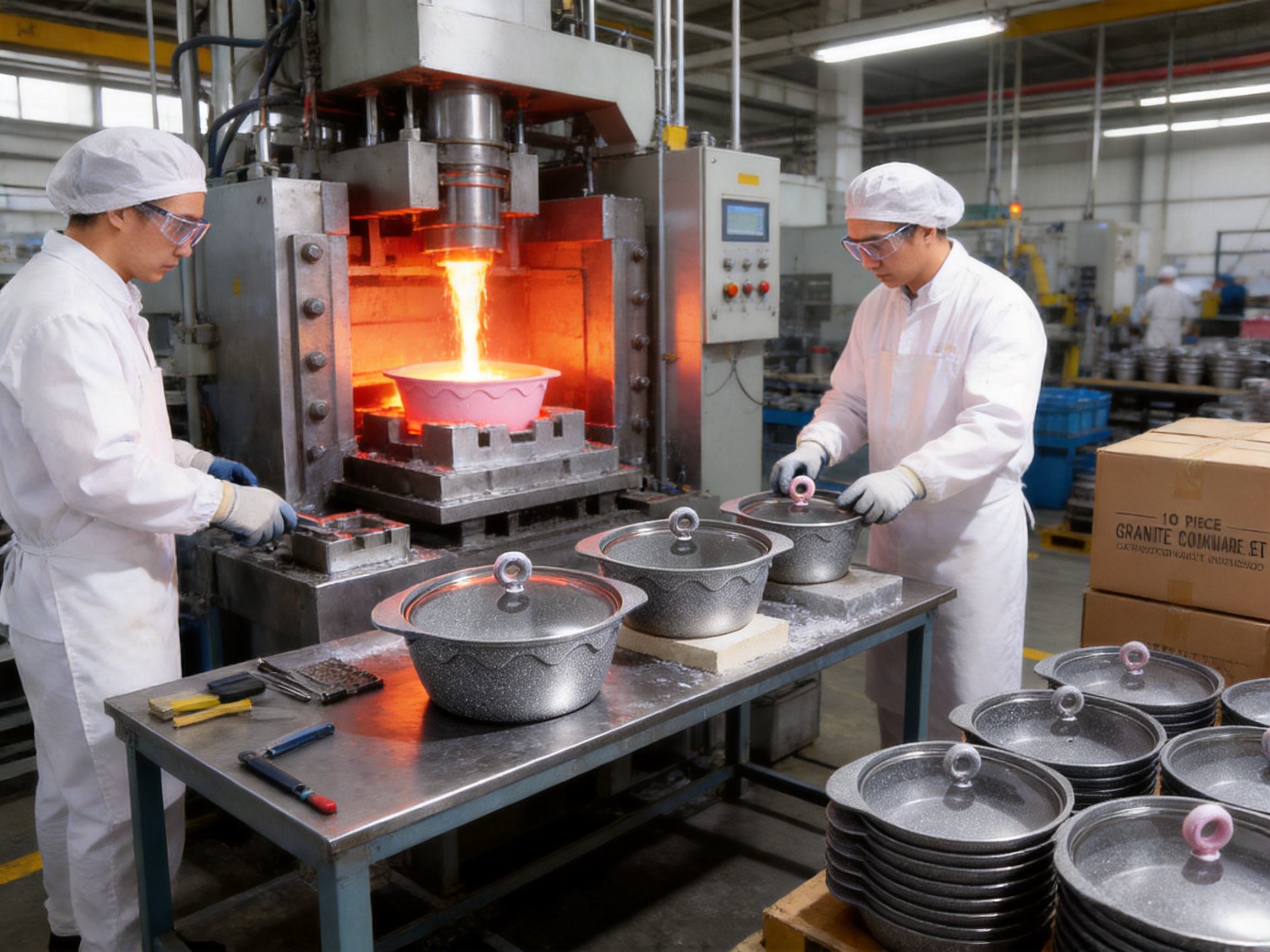
Commercial Value for Distributors and Retailers
The cookware’s commercial value comes from the combination of product differentiation and broad usability. A distributor does not have to position it only as a basic aluminum pot. It can be introduced as a coordinated multi-function set with a decorative design, several cooking capacities, and granite-style interior and exterior treatments.
The product can fit multiple retail channels. Home and kitchen stores may display it as a complete cookware solution. Online sellers can emphasize the rounded shape, size variety, and everyday applications. Hospitality suppliers may consider it for selected accommodation or food-service programs, subject to confirming the required durability, heat-source compatibility, and commercial-use testing. Gift retailers may position it for new homes, weddings, holidays, or kitchen upgrades.
For private-label customers, the set offers a foundation for brand development. Packaging can be adapted to a retailer’s visual identity, and product colors may be reviewed for different market preferences. Buyers can also explore matching utensils, stainless steel cookware, cast iron items, or additional aluminum products to create a broader collection.
Flexible minimum order quantities can be particularly valuable for small and medium-sized buyers. A smaller importer may wish to test demand before committing to a very large program. An established distributor may require larger production volumes and multiple colors. The appropriate order structure, color quantity, tooling requirements, and lead time should be negotiated according to the project.
Supplier and Factory Strengths
Zhejiang Echo Industry And Trade Co., Ltd. presents itself as a professional kitchenware supplier based in Zhejiang, China. Its product scope includes aluminum cookware, stainless steel cookware, cast iron cookware, and kitchen utensils. This category breadth can simplify sourcing for buyers that want to build a complete kitchenware portfolio rather than purchase one isolated item.
The company’s stated services include one-stop sourcing, ODM and OEM customization, product certification assistance, flexible minimum order quantities, and sustainable and healthy product development. These capabilities are relevant to international buyers because cookware projects often involve more than manufacturing. They may also require design adaptation, packaging development, market documentation, sample coordination, inspection, shipment planning, and after-sales communication.
An R&D-driven supply-chain approach can help move a product from a basic catalog concept toward a market-specific solution. For example, a buyer may require a different color palette, revised packaging language, a regional cooking guide, a special logo position, or a coordinated set of kitchen utensils. These requests should be assessed through technical drawings, samples, cost calculations, and documented approval procedures.
The company’s location in Taizhou provides access to a manufacturing environment with experience in metal products and export operations. A local supplier network can support mold development, metal processing, surface finishing, packaging, and logistics coordination. The strength of such a network ultimately depends on actual factory controls, subcontractor management, inspection procedures, and the supplier’s ability to maintain consistent standards across production batches.
Buyers should therefore assess the supplier through samples, factory communication, documentation, production records, and independent inspection where appropriate. A professional relationship is strengthened when both parties clearly define specifications, tolerances, approval stages, corrective-action procedures, and shipping responsibilities.
How to Present the Product to End Consumers
Effective product communication should focus on verified benefits rather than exaggerated claims. A retailer can explain that the cookware uses die-cast aluminum construction, has granite-style coating on the interior and exterior, includes several casserole sizes, and is designed for stewing and boiling as well as other everyday cooking tasks.
Visual presentation is especially important for this product. High-quality images should show the full set, individual sizes, interior coating, exterior finish, shallow casserole, and scale in a kitchen setting. Dimension graphics can help consumers understand the difference between 20 cm, 24 cm, 28 cm, and 32 cm cookware. The final packaging should clearly state the piece count and contents.
Care information should be visible and easy to understand. Consumers should be told to use non-metal utensils, avoid overheating empty cookware, keep flames within the base area, avoid microwave use, and wash by hand with a soft sponge or cloth. Clear care instructions can reduce misuse and support customer satisfaction.
Retailers should avoid claiming that the cookware is suitable for induction, dishwasher use, oven use, or high-temperature cooking unless those characteristics have been confirmed. Accurate descriptions protect both the retailer and the consumer. They also help build trust in the product line over time.
Purchasing Checklist for Importers
Before purchasing the 10pcs SweetDonut Aluminum Pot Set, an importer should request a complete technical and commercial file. The file should identify the final product name, piece count, dimensions, material, coating specifications, accessories, color references, packaging details, and carton information.
The buyer should confirm whether the listed sizes refer to external diameter, internal diameter, or nominal size. The buyer should also confirm the depth and capacity of each piece. These details are important for product descriptions, freight calculations, consumer expectations, and compliance labels.
The coating specification should be reviewed carefully. Buyers may ask for the coating type, food-contact declaration, test reports, recommended temperature range, abrasion or adhesion results, and cleaning limitations. If the product will be sold in a regulated market, the relevant national or regional requirements should be identified before mass production.
The final configuration should be confirmed in writing. The title describes a 10-piece set, while the listed information names five primary cookware bodies. The remaining pieces may consist of lids, handles, knobs, or other accessories, but this should not be assumed without an approved packing list. The retail box, product photography, instruction leaflet, and purchase order must all use the same confirmed contents.
Packaging should be evaluated for both protection and presentation. Export cartons must withstand stacking, handling, and transportation. Retail packaging should protect coated surfaces from scratches and should provide sufficient information for the target customer. Carton marks should include the purchase order reference, product code, quantity, gross weight, net weight, and destination details where required.
Finally, the buyer should establish a realistic production and inspection schedule. A sample approval deadline, packaging-artwork deadline, production window, inspection date, and shipping date should be agreed before the order is released. This approach reduces misunderstandings and provides a clear framework for corrective action if a problem is discovered.
Frequently Asked Questions
What material is used for the cookware body?
The cookware body is specified as die-casting aluminum. This construction method supports shaped cookware bodies and provides the product with a substantial, coordinated form. The exact aluminum alloy should be confirmed through the technical specification for the intended market and application.
What coating is used?
The supplied information specifies granite coating for both the interior and exterior treatment. The interior is intended to support easier food release and cleaning when used correctly, while the exterior provides a decorative finish. Detailed coating test data and food-contact documentation should be requested for commercial orders.
What sizes are included?
The listed casserole sizes are 20 cm, 24 cm, 28 cm, and 32 cm. A 28 cm shallow casserole is also listed. Since the product is identified as a 10-piece set, the buyer should confirm the complete contents, including any lids or accessories, before ordering.
What cooking methods are suitable?
The product is described as suitable for stewing and boiling. The shallow casserole may also be useful for simmering, sautéing, braising, reheating, and shallow cooking. Compatibility with specific heat sources must be confirmed before making claims about gas, electric, ceramic, halogen, induction, oven, or other use.
Can metal utensils be used?
No. Metal or sharp utensils should be avoided because they can scratch the non-stick coating. Wooden, nylon, silicone, or other utensils designed for coated cookware are recommended.
How should the cookware be cleaned?
Use hot or warm soapy water with a soft cloth or sponge. Hand washing is recommended to help preserve the appearance and condition of the cookware. Abrasive cleaners and scouring pads should not be used.
Can the cookware be used in a microwave?
No. The product instructions specify that it should not be used in a microwave oven.
Can the cookware be heated while empty?
No. Empty cookware should not be overheated. If severe overheating occurs, turn off the cooker and allow the cookware to cool completely before handling or cleaning it.
Does the product support private labeling?
The supplier identifies OEM and ODM customization among its services. Buyers can discuss logos, colors, packaging, product combinations, and other project requirements. Final customization availability, minimum order quantity, tooling, cost, and lead time must be confirmed for each order.
Is certification assistance available?
Product certification assistance is identified as part of the supplier’s service offering. The exact documents and tests depend on the destination market, product configuration, coating system, and customer requirements. Buyers should provide the target-market compliance list at the beginning of the project.
How is the product packed for shipment?
The supplied information indicates two cartons, with a carton size of 72 × 36.5 × 32.5 cm and a carton weight of 18 kg. These figures should be reconfirmed against the final retail packaging, accessory configuration, and shipping documentation.
What makes this set different from ordinary aluminum cookware?
Its main differentiators are the donut-inspired visual design, coordinated multi-size configuration, die-cast aluminum body, granite-style interior and exterior treatment, and suitability for one-stop sourcing programs. These features give the product both functional and merchandising value.
Conclusion
The 10pcs SweetDonut Aluminum Pot Set combines the practical advantages of aluminum cookware with a distinctive design and coordinated size range. Its die-cast aluminum body supports a shaped and substantial construction, while the granite-style interior and exterior coatings contribute to food release, cleaning convenience, and visual appeal when the cookware is properly used and maintained.
The product is positioned for more than basic household use. Its range of casserole sizes and shallow casserole format can support different cooking quantities and techniques. Its unusual appearance can help retailers stand apart from standard cookware collections. Its declared export carton information, OEM and ODM capabilities, certification assistance, flexible sourcing services, and wider kitchenware category coverage make it relevant to importers, distributors, and private-label buyers.
The strongest purchasing decision will be based on detailed confirmation. Buyers should approve the exact 10-piece configuration, dimensions, accessories, heat-source compatibility, coating documentation, packaging, testing requirements, and shipment specifications. With these details clearly defined, the product can serve as a practical and visually distinctive addition to modern cookware programs.
References
1. Supplier-provided product specification for the 10pcs SweetDonut Aluminum Pot Set, including material, coating, dimensions, carton information, and care instructions.
2. Supplier-provided company profile describing aluminum cookware, stainless steel cookware, cast iron cookware, kitchen utensils, OEM, ODM, certification assistance, and one-stop sourcing services.
3. General manufacturing principles for aluminum die casting, including mold preparation, molten-metal injection, trimming, deburring, surface preparation, and dimensional inspection.
4. General guidance for the use and care of coated cookware, including utensil selection, temperature control, hand washing, and storage practices.
5. General principles of cookware quality assurance, including sample approval, coating inspection, component testing, packaging verification, and pre-shipment inspection.
Product: 10pcs SweetDonut Aluminum pot Set
Recommended Articles
Product Category
Related products
-
-
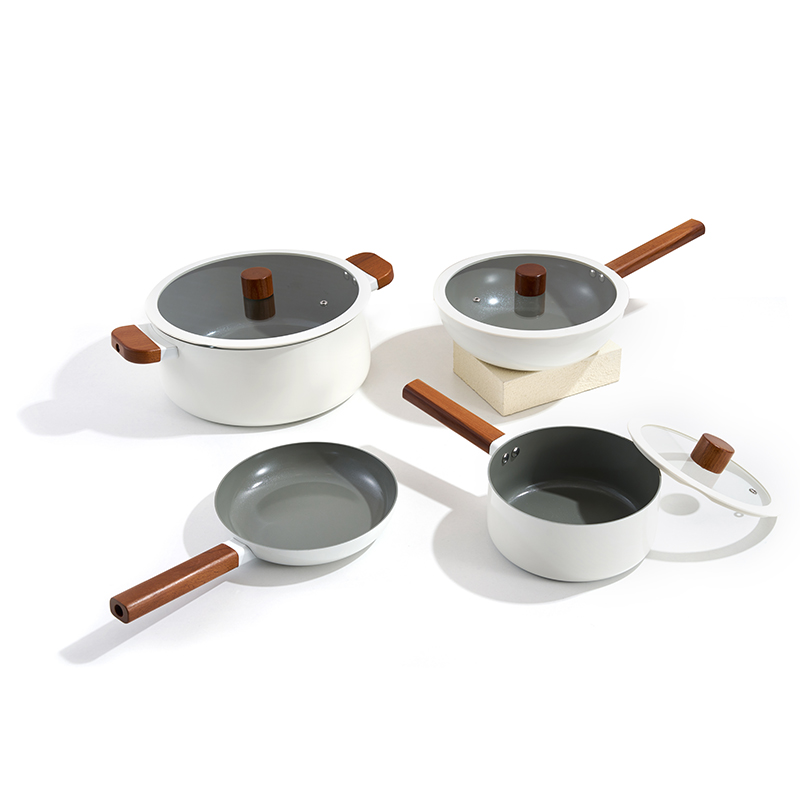
This cookware set has a ceramic non-stick inner liner, a heat-resistant wooden h...
See Details -
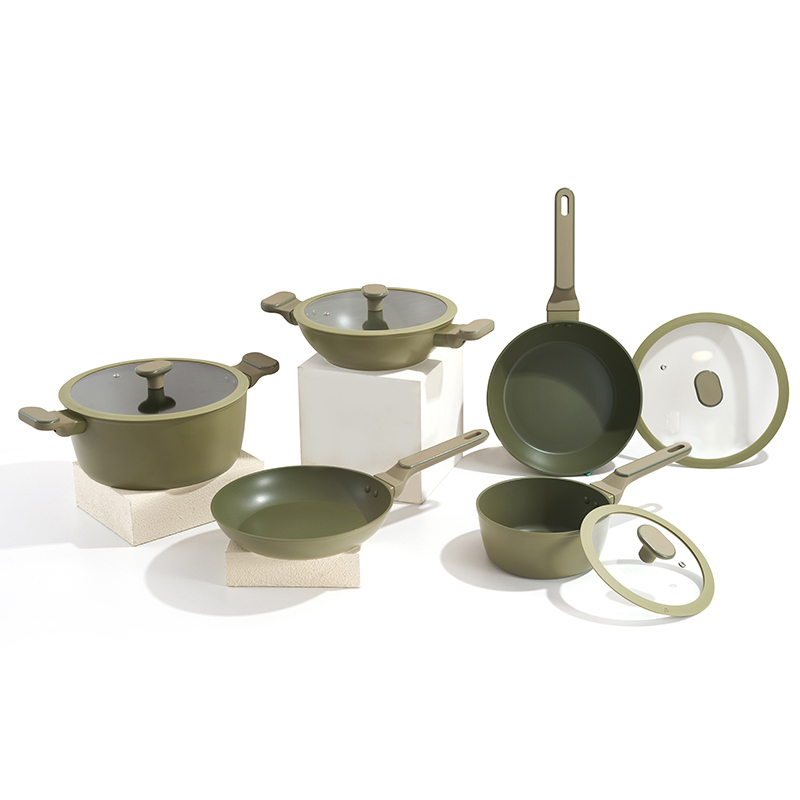
This cookware set is made of food-grade non-stick material, with a unique eye-ca...
See Details -
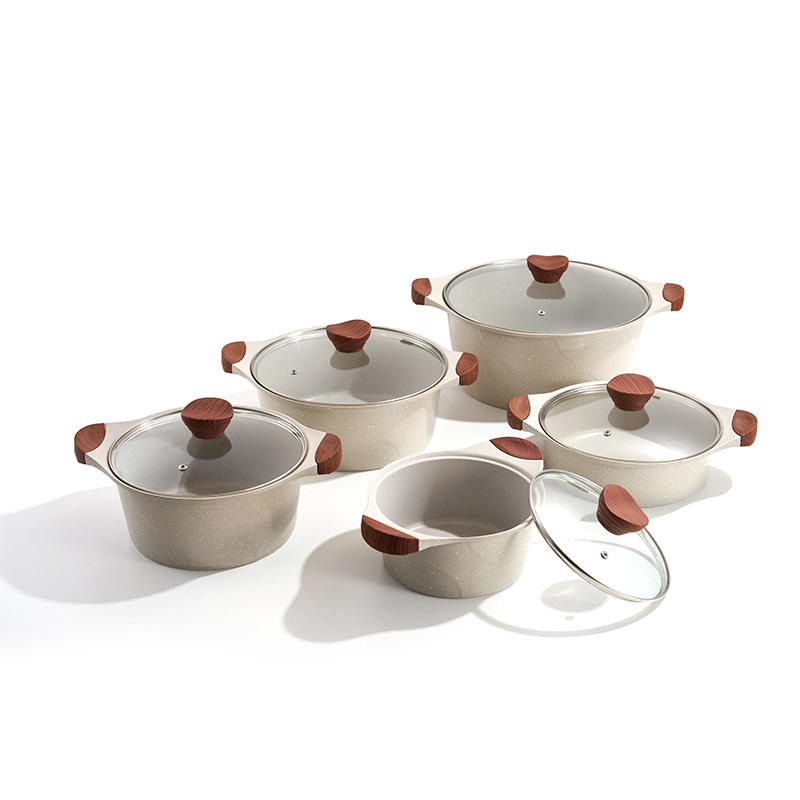
This off-white cookware set is made of wear-resistant non-stick material, with w...
See Details
Whether you're looking for bulk purchases or have any custom requirements, We are here to offer the best
solutions for you.
tiffany.zhong@echocn-trading.com
PHONE
+86-19561173975
+86-19557020621 (Hazel Wu)
ADD
Room 301, Unit 3014, No. 175 Qifeng Avenue, Wenqiao Town, Taizhou, Zhejiang, China
Fill Out the Form for More Information
Copyright © Zhejiang Echo Industry And Trade Co., Ltd.
All Rights Reserved.

China Cookware Set Manufacturer