
 en
 Español

This cookware set features a non-stick coating, even heat conduction, and multi-...
See Details
15-Piece Graphite Grain Aluminum Cookware Set: A Practical Guide to Performance, Safety, and Everyday Cooking
Date:Aug 18, 2026
A well-designed cookware set should do more than fill a kitchen cabinet. It should make everyday cooking easier, use space efficiently, distribute heat consistently, remain comfortable to handle, and provide enough pieces for a wide range of meals. The 15-piece Graphite Grain Aluminum Cookware Set is designed around these practical requirements. It combines a dark grey ribbed aluminum body, wooden heat-resistant handles, a stackable structure, cooking accessories, and compatibility with all stovetops in one coordinated collection.
For households, furnished apartments, hospitality projects, retailers, and professional buyers, a complete cookware set can be more efficient than purchasing individual pots and pans. A coordinated set offers visual consistency, simplified sourcing, and a broader cooking range from a single product line. The different casserole sizes support family meals, sauces, soups, stews, and batch cooking, while the shallow casserole provides a wider cooking surface for frying, browning, simmering, and serving.
The set also reflects the growing demand for cookware that balances performance and appearance. Consumers increasingly want products that look attractive enough to remain visible in the kitchen while still offering dependable daily function. The graphite-inspired ribbed finish gives the cookware a distinctive appearance, and the wooden handles add a warmer visual contrast than an entirely metal design.
This article examines the product in detail, including its design, construction, cooking performance, storage benefits, safety considerations, care requirements, factory capabilities, customization potential, and advantages compared with ordinary aluminum cookware and less coordinated cookware collections.
Product Overview
The 15-piece Graphite Grain Aluminum Cookware Set is an aluminum cookware collection developed for multi-purpose household cooking. Its central design idea is simple: provide several useful vessels and accessories in one space-conscious package, while combining practical cooking performance with a refined appearance.
The main cookware features a dark grey ribbed body. The ribbed surface creates a recognizable graphite-grain visual effect and helps the product stand apart from plain, smooth aluminum pots. Rather than relying only on decoration, the surface treatment contributes to the cookware’s tactile character. It gives the exterior a structured appearance that can help conceal minor marks from normal handling better than a completely flat, highly reflective finish.
Wooden heat-resistant handles are another important design element. Wood provides a natural, comfortable grip and gives the collection a less industrial appearance. The handles are intended to improve handling during normal stovetop use, although users should always remember that any handle can become warm depending on cooking time, burner position, heat level, and proximity to the flame.
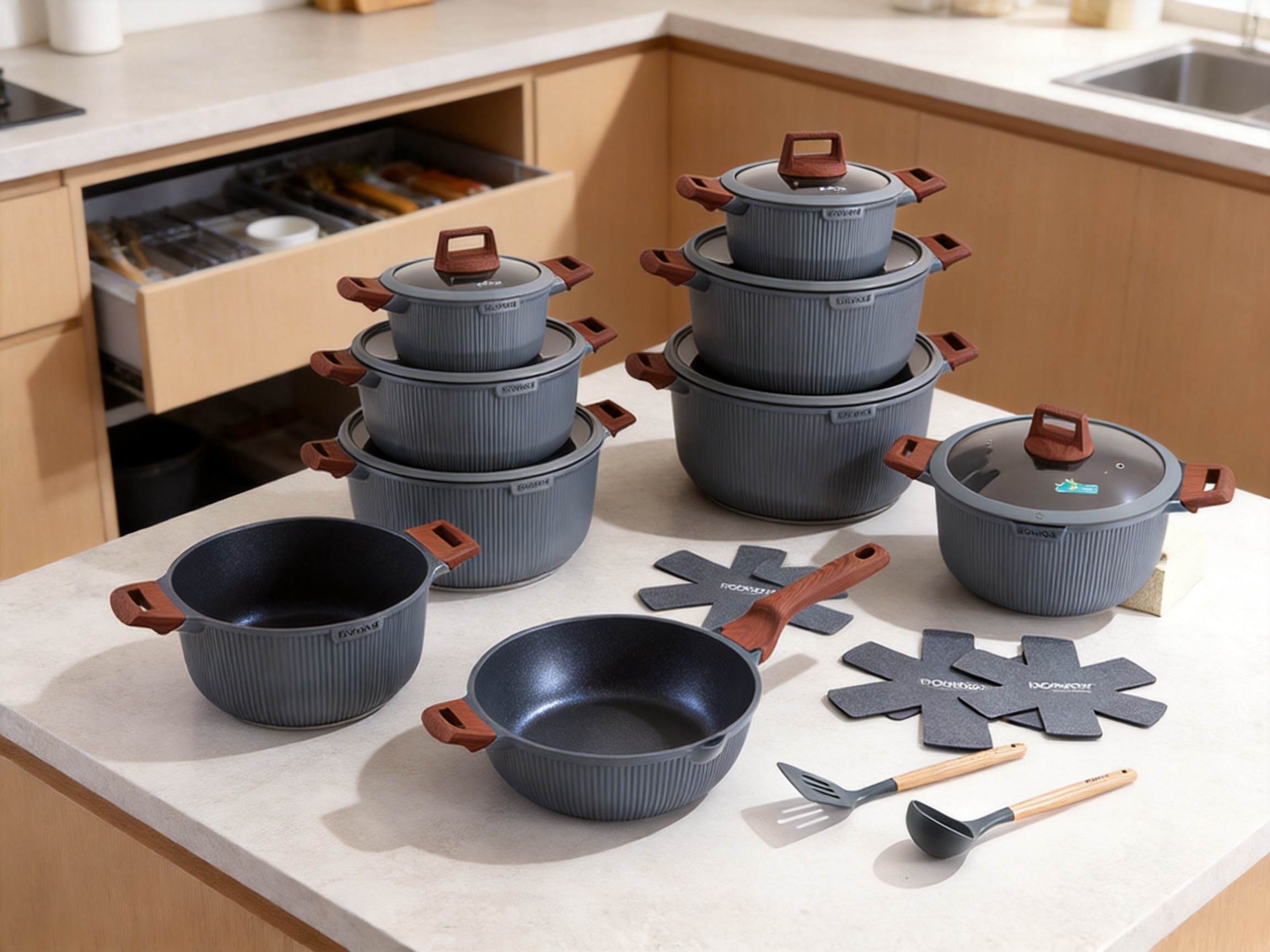
The set is stackable, which is particularly valuable in smaller kitchens. The pieces can be arranged in a compact vertical footprint rather than occupying separate cabinet shelves. This reduces storage pressure and makes the collection suitable for apartments, dormitories, vacation homes, rental properties, and commercial housing projects.
The product is supplied with trivets and utensils, creating a more complete cooking solution. Trivets help protect countertops and dining surfaces from hot cookware, while the utensils support food preparation without requiring the buyer to purchase separate accessories immediately after receiving the set.
The listed cookware sizes include casseroles in 20 cm, 24 cm, 28 cm, and 32 cm, together with a 28 cm shallow casserole. This size range supports both individual and family cooking. Smaller vessels are useful for side dishes, sauces, and modest portions, while the larger casseroles are suitable for soups, stews, pasta, vegetables, and shared meals.
| Product Feature | Practical Benefit | Typical Use |
|---|---|---|
| Aluminum cookware body | Fast heat response and manageable weight | Everyday frying, boiling, simmering, and stewing |
| Dark grey ribbed exterior | Distinctive appearance and textured handling surface | Modern home kitchens and retail collections |
| Wooden heat-resistant handles | Comfortable grip and warm visual appeal | Stovetop handling during normal cooking |
| Stackable construction | Reduced cabinet and warehouse space | Small kitchens, apartments, and organized storage |
| Multiple casserole sizes | Supports different portion sizes and recipes | Individual meals, family meals, and batch cooking |
| Shallow casserole | Broad cooking surface | Frying, browning, shallow cooking, and serving |
| Trivets and utensils | More complete package for the purchaser | Cooking, serving, and surface protection |
| All-stovetop compatibility | Broad household usability | Different kitchen configurations and markets |
Why Aluminum Remains a Popular Cookware Material
Aluminum continues to be widely used in cookware because it offers a useful combination of low weight, rapid heat response, and manufacturing flexibility. Compared with heavier materials such as cast iron, aluminum is easier to lift, move, wash, and store. This is especially important when cookware is used several times a day or by people who prefer lighter kitchen equipment.
Aluminum also responds quickly when the heat setting changes. When a cook raises the flame or reduces the power, aluminum cookware generally reacts faster than very thick, heavy materials. This responsiveness is useful for recipes that require frequent temperature adjustment, including sauces, sautéed vegetables, pan-fried foods, and simmered dishes.
The material is also suitable for different forming and finishing processes. Manufacturers can shape aluminum into useful cooking vessels, apply exterior textures, create coordinated sizes, and produce large quantities with consistent dimensions. These advantages help make aluminum cookware accessible to a broad range of consumers and commercial buyers.
However, not all aluminum cookware performs or ages in the same way. Body thickness, forming quality, surface treatment, handle attachment, base design, coating performance, and quality control all influence the final product. A low-cost aluminum pan with inconsistent thickness and poor finishing may develop hot spots, distort more easily, or lose its appearance quickly. A carefully engineered set can provide a more balanced experience.
The Graphite Grain set is positioned as a coordinated aluminum collection rather than a collection of unrelated basic pots. Its value comes from the combination of material selection, visual design, storage efficiency, accessories, and size variety. Buyers are not simply receiving aluminum vessels; they are receiving a complete cooking system designed to function together.
Hard-Anodized Aluminum and Regular Aluminum: Understanding the Difference
One of the important search topics associated with this product category is the difference between hard-anodized aluminum and ordinary aluminum cookware. Hard anodizing does not replace aluminum with another material. Aluminum remains the core metal, while an electrochemical surface treatment creates a harder, more durable oxide layer on the exterior or cooking surface, depending on the product design.
A hard-anodized aluminum cookware set can therefore provide a tougher surface than untreated or lightly finished aluminum. This may improve resistance to visible wear, discoloration, and surface marking during normal use. It can also give the cookware a more stable feel after repeated cooking and cleaning.
Regular aluminum cookware has its own advantages. It is usually lightweight, responsive, economical, and easy to replace. For occasional cooking or budget-focused purchasing, ordinary aluminum can be a practical option. The question is not whether one material is universally correct, but whether the product’s expected service life, appearance, cooking frequency, and price position match the buyer’s needs.
For frequent cooking, a tougher finish can become more valuable over time. A cookware surface that maintains its appearance and resists everyday wear may offer a better ownership experience than a very basic pan that begins to show dull spots, scratches, or discoloration after repeated use.
The following comparison explains the practical difference.
| Comparison Point | Regular Aluminum Cookware | Hard-Anodized Aluminum Cookware |
|---|---|---|
| Heat response | Generally quick | Generally quick because aluminum remains the core material |
| Surface durability | Depends on finish and thickness; may mark more easily | Usually offers a harder, more wear-resistant surface |
| Appearance over time | May develop dull spots or visible wear sooner | Often maintains a more stable appearance with proper care |
| Weight | Usually light | Usually remains lighter than cast iron, though construction varies |
| Price | Often more economical | May cost more because of additional processing |
| Daily cooking suitability | Good for general use | Strong option for frequent cooking and long-term use |
The food-grade safe cookware positioning of this product category should always be supported by appropriate documentation for the target market. Buyers should distinguish between general marketing language and verified testing. When a product is described as compliant with a specific standard, the manufacturer or supplier should be able to provide relevant test reports, declarations, or technical documentation when required.
Heat Distribution and Cooking Control
Even heat distribution is one of the most important performance characteristics in cookware. When heat concentrates in one small area, food can burn in the center while remaining undercooked around the edges. Uneven heating can also make sauces difficult to control and force cooks to move or rotate food continuously.
Aluminum has a strong foundation for heat responsiveness because it conducts heat efficiently compared with many other common cookware materials. Nevertheless, conductivity alone does not guarantee perfectly even cooking. The shape of the vessel, wall thickness, base construction, contact with the stovetop, heat source, and cooking temperature all influence performance.
A well-formed cookware body helps spread heat across the cooking surface instead of allowing excessive concentration in isolated areas. The shallow casserole in this set is especially useful for recipes that require a broad and relatively even cooking area. It can be used for browning ingredients, frying vegetables, reducing sauces, or preparing dishes that benefit from greater surface exposure.
Even heat distribution does not mean that users can ignore cooking technique. Preheating should be controlled, the burner should match the base size, and empty cookware should not be overheated. Food should be added at an appropriate time, and heat should be reduced when a recipe reaches a simmer. These habits help preserve the cookware and improve the final cooking result.
Compared with very basic thin aluminum pots, a better-designed set can feel calmer and more predictable during cooking. The difference may not be dramatic during the first use, but it becomes more noticeable when preparing delicate sauces, eggs, milk-based dishes, tomato recipes, or meals that require longer simmering.
Cooking Applications Across the Set
Small Casserole: 20 Centimeters
The 20 cm casserole is suited to smaller portions, side dishes, sauces, reheating, and meals for one or two people. It can also be useful for preparing ingredients separately before combining them in a larger vessel. Its smaller size helps reduce unnecessary energy use when the quantity of food is limited.
Medium Casserole: 24 Centimeters
The 24 cm casserole offers a practical middle size for daily cooking. It can accommodate vegetables, grains, soup, pasta portions, and family side dishes. This is often the size that receives frequent use because it balances capacity with manageable weight and storage requirements.
Large Casserole: 28 Centimeters
The 28 cm casserole is suitable for larger portions, shared meals, stews, braised dishes, and recipes that require ingredients to be added gradually. Its greater capacity gives food more room to circulate and reduces the need to divide a recipe into multiple batches.
Extra-Large Casserole: 32 Centimeters
The 32 cm casserole is designed for batch cooking and larger households. It can be useful when preparing soup, a large stew, a generous quantity of vegetables, or food for gatherings. Buyers should confirm the available storage area and stovetop size before using the largest vessel, as the cooking zone should support the base appropriately.
Shallow Casserole: 28 Centimeters
The 28 cm shallow casserole provides a wider, lower profile. This makes it appropriate for frying, browning, shallow cooking, reducing sauces, and serving dishes directly at the table. The broad shape can also make ingredients easier to arrange and turn.
Trivets and Utensils
The included trivets improve convenience when hot cookware needs to be placed on a countertop, dining table, or serving area. The utensils add practical value, particularly for buyers furnishing a kitchen from the beginning. They also help create a coordinated presentation for retail customers.
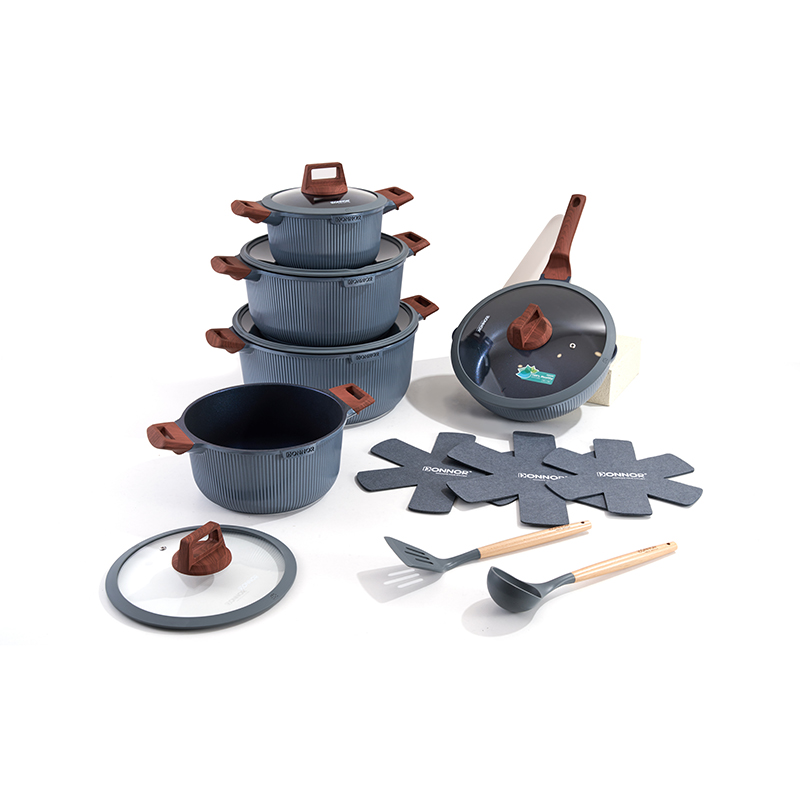
15pcs GraphiteGrain Aluminum Cookware Set
Design Advantages Compared with Competing Cookware Sets
Cookware buyers face a crowded market. Many products offer multiple pieces, but the actual value of a set depends on whether those pieces are useful, compatible, durable, and easy to store. The Graphite Grain set has several design advantages that can help it compete beyond a simple piece-count comparison.
A Coordinated Cooking Collection
Some low-cost cookware bundles achieve a high piece count by including small accessories that buyers rarely use. A stronger set focuses on practical vessels and useful tools. The combination of several casserole sizes and a shallow casserole gives the buyer genuinely different cooking functions rather than many duplicates.
Space-Efficient Storage
Stackability is a significant advantage over cookware that requires each pot to be stored separately. In compact homes, cabinet space can be more valuable than the number of cookware pieces. A stackable structure allows the collection to occupy a smaller footprint and makes it easier to keep the kitchen organized.
Distinctive Appearance
Plain metallic cookware can look interchangeable across many brands and product ranges. The dark grey ribbed body gives this set a stronger visual identity. The graphite-inspired finish is suitable for modern kitchens, neutral interior designs, and retail displays that favor understated colors rather than brightly colored cookware.
Comfort-Oriented Handles
Wooden handles create a contrast with the aluminum body and can provide a comfortable grip during normal use. They also help distinguish the collection from competitors that rely entirely on exposed metal handles. The warm appearance can make the cookware more appealing for open-shelf storage or gift-oriented retail packaging.
Broad Stovetop Compatibility
Compatibility with all stovetops broadens the potential customer base. This is helpful for retailers and distributors serving markets where consumers may use different cooking technologies. It also supports replacement purchasing when a household moves from one kitchen configuration to another.
Complete Package Positioning
Trivets and utensils allow the set to be positioned as a more complete kitchen solution. This is useful in new-home projects, hospitality supply, promotional programs, and gift channels. The purchaser receives a coordinated assortment rather than needing to source accessories separately.
Manufacturing Strengths and Factory Capabilities
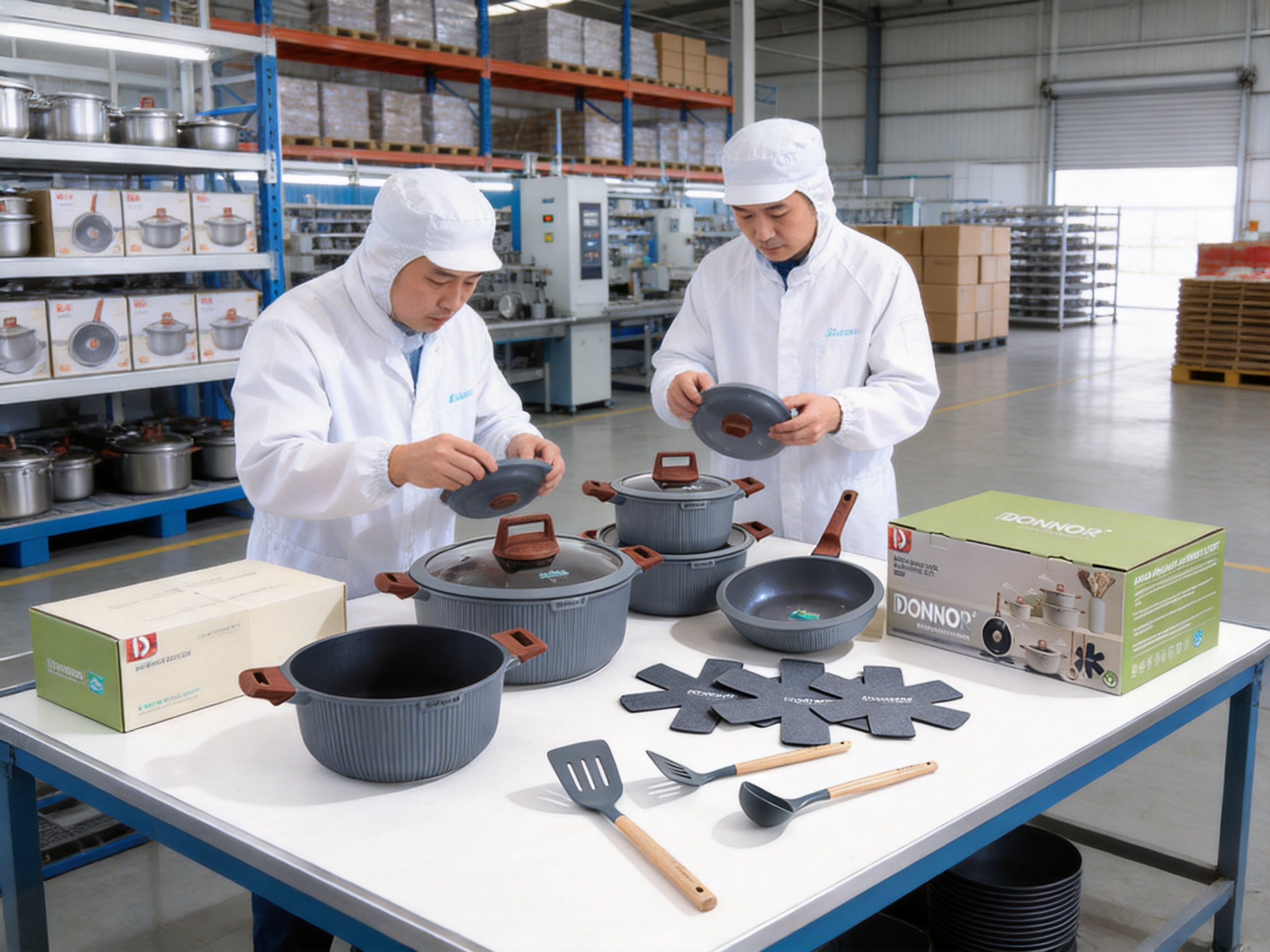
The performance of cookware depends heavily on manufacturing discipline. A well-designed concept can lose its value if the production process allows inconsistent dimensions, weak handle connections, poor surface treatment, uneven coating, or inadequate packaging. Zhejiang Echo Industry And Trade Co., Ltd. is positioned as a kitchenware supplier and factory partner with experience across aluminum cookware, stainless steel cookware, cast iron cookware, and kitchen utensils.
This wider product scope is important for buyers seeking consolidated sourcing. Instead of managing separate suppliers for each material category, a buyer can discuss multiple cookware and kitchen accessory requirements with one experienced partner. One-stop sourcing can reduce communication complexity, simplify product planning, and support a more consistent collection across different materials.
The company’s manufacturing and supply capabilities can support several stages of a cookware project, including product selection, specification discussions, sample coordination, packaging development, order production, and export preparation. For buyers with established designs, the factory can discuss OEM requirements. For buyers looking for a product adapted to a specific market, ODM cooperation can support adjustments to appearance, configuration, branding, packaging, and accessory selection.
Material and Forming Control
Aluminum cookware production begins with material selection and forming. The material must be suitable for the intended product structure, surface finish, and cooking application. Consistent forming helps maintain the roundness of the vessel, the flatness of the base, the alignment of the rim, and the fit of related components.
Dimensional control is especially important in a stackable set. If the diameters or heights vary beyond the intended tolerance, the pieces may not nest properly. Inconsistent forming can also affect packaging efficiency, lid compatibility where applicable, and the overall appearance of a retail display.
Surface Finishing
The dark grey ribbed finish requires controlled processing to achieve a consistent visual result across different production batches. Surface preparation, texture formation, coloring, and final inspection all influence the appearance. A reliable factory process helps reduce differences in shade, texture depth, edge quality, and surface uniformity.
Surface finishing also contributes to the product’s perceived value. Consumers often use appearance as an immediate indicator of quality before they have cooked with the product. A consistent graphite-style finish can help the set stand out in a showroom, online product image, or retail shelf.
Handle Assembly
Handle attachment is a critical safety and durability point. Wooden handles must be properly shaped, finished, and connected to the cookware body. The attachment should feel stable during normal lifting and pouring, without excessive movement or sharp transitions that could affect comfort.
Factory quality control should include checks for handle alignment, connection strength, surface smoothness, and appearance. These inspections help prevent common issues such as loose fittings, uneven handle placement, rough wooden edges, and inconsistent gaps between the handle and body.
Accessory Coordination
Because the set includes trivets and utensils, accessory control is also part of the manufacturing and packing process. The correct quantities must be included, the accessories should be protected from damage, and the packaging should keep them from marking the cookware during transportation.
Packaging and Export Readiness
Cookware is vulnerable to scratches, dents, and surface damage during shipping. Proper packaging design should separate nested pieces where necessary, protect the handles, stabilize the set inside the carton, and reduce movement during transport. The listed carton information for this product includes two cartons, with a carton size of approximately 66.5 by 42.5 by 53 cm and a total carton weight of approximately 23.9 kg. These details are useful for freight planning, warehouse organization, and container loading calculations.
Export-oriented manufacturing also requires attention to labeling, carton marks, product documentation, destination-market requirements, and buyer-specific packaging instructions. A factory familiar with international trade can help buyers coordinate these details earlier in the order process, reducing the risk of delays or repacking.
Food-Grade Safety and Responsible Product Communication
Food-grade safety is a central concern in cookware purchasing. A product intended for direct food contact should be manufactured from suitable materials and should meet the applicable requirements of the destination market. However, “food-grade safe” should not be treated as a vague slogan. It should be connected to measurable material controls, production procedures, and relevant testing.
In the United States, food-contact requirements may involve standards and rules administered by the Food and Drug Administration. In European markets, buyers may request documentation related to frameworks such as LFGB testing, migration testing, or other applicable food-contact requirements. The precise tests depend on the materials, coatings, handles, pigments, and intended use.
Potential areas of evaluation may include:
- Material composition of the aluminum body.
- Surface coating or finishing stability.
- Migration of substances into food under specified test conditions.
- Restrictions on heavy metals such as lead and cadmium.
- Heat resistance and performance of relevant non-metal components.
- Safety of wooden handle coatings, adhesives, and finishes where applicable.
- Packaging materials that come into direct or indirect contact with the cookware.
Buyers should request current documentation that matches the exact product configuration. A report for one coating, handle style, or cookware model may not automatically cover another version. This is particularly important when an importer changes the color, coating, utensils, packaging, or handle material.
Responsible product communication also means explaining proper use. No cookware should be described as indestructible. Even a durable surface can be damaged by sharp tools, severe overheating, or incorrect cleaning. Clear care instructions protect consumers, reduce avoidable complaints, and help preserve the product’s expected service life.
Recommended Care and Use Instructions
Before first use, wash the cookware with warm or hot soapy water and a soft cloth or sponge. This removes dust or residue that may remain from manufacturing, handling, or packaging. Rinse thoroughly and dry the pieces before cooking.
Use wooden, nylon, or other cookware-safe utensils. Metal or sharp utensils can scratch or mark the surface, particularly if the cookware includes a non-stick or specially treated cooking area. Avoid cutting food directly inside the pan with a knife.
Do not heat an empty pan for an extended period. Empty cookware can become extremely hot very quickly, and severe overheating may damage the finish, affect the handle, or create a safety risk. If a pan becomes seriously overheated, do not touch it immediately. Turn off the cooker and allow the cookware to cool completely before moving or cleaning it.
Keep the flame or heat source within the diameter of the cookware base. A flame extending beyond the base can heat the sides, handle connection, or wooden handle unnecessarily. It can also discolor the exterior and increase the risk of accidental burns.
For cleaning, use hot soapy water with a soft cloth or sponge. Avoid abrasive powders, steel wool, rough scouring pads, and harsh tools that may damage the finish. Hand washing is recommended to preserve the appearance of the cookware, especially the dark grey exterior and wooden handles.
The cookware should not be used in a microwave. Aluminum is not suitable for microwave use because metal can cause arcing and damage the appliance. The cookware should also be used only within the temperature conditions appropriate for its construction and handle materials.
After washing, dry the cookware thoroughly before stacking. Although aluminum itself does not rust like ordinary iron, moisture trapped between nested pieces can create unpleasant odors, water marks, or surface staining. A soft separator may be used between pieces if the buyer wants additional protection during storage.
Never place hot cookware directly on an unprotected countertop or table. Use the included trivets or another heat-resistant surface. This simple habit protects both the cookware and the surrounding furniture.
How the Set Supports Modern Kitchen Lifestyles
Modern households often require cookware that can handle a variety of meals without taking over the entire kitchen. People may prepare quick breakfasts, weekday lunches, one-pot dinners, slow-cooked stews, stir-fried vegetables, and weekend batch meals using the same core collection.
The different sizes in this set make it possible to choose a vessel according to the quantity being prepared. Using a very large pot for a small portion can waste energy and create unnecessary washing. Using a very small pot for a large recipe can cause overcrowding, uneven heating, and splashing. A graduated range of casseroles gives the cook more control.
Stackability is equally valuable for modern living. Smaller homes often have limited cabinet depth and fewer storage shelves. A cookware set that nests efficiently can free space for appliances, food containers, plates, and other kitchen tools.
The appearance of the cookware also supports open storage. The graphite-style finish and wooden handles can suit kitchens where pots are displayed on shelves, rails, or counters. The set can therefore function as both a cooking tool and a coordinated interior accessory.
For retailers, these features create several sales points: a complete 15-piece collection, a modern dark grey finish, natural-looking handles, multiple cooking sizes, included accessories, and broad stovetop compatibility. These benefits can be communicated clearly in product listings, showroom displays, catalogs, and distributor materials.
Suitability for Different Buyer Groups
Households
Families and individuals can use the set for everyday meals and occasional entertaining. The range of casserole sizes makes it practical for changing portion requirements, while the stackable design helps maintain an organized kitchen.
First-Time Kitchen Buyers
People furnishing a new apartment or home often prefer a coordinated collection instead of selecting pots and pans one by one. The included trivets and utensils make the set more convenient for first-time buyers who may not yet own a complete set of kitchen tools.
Property Developers and Furnished Housing Projects
Developers, landlords, and serviced-apartment operators can use a standardized cookware set across multiple units. Consistent product selection simplifies purchasing, replacement, and maintenance. The stackable design is useful when kitchens are compact, and the neutral color fits a range of interior styles.
Hospitality and Guest Accommodation
Vacation rentals and guest apartments require cookware that is easy to understand and flexible enough for different users. A multi-size set allows guests to prepare simple meals without needing specialized equipment. Clear care instructions can be included with the property’s kitchen information.
Retailers and Distributors
Retail buyers can position the product in cookware, homeware, wedding gift, new-home, and seasonal promotion channels. The collection combines practical functionality with visual differentiation, helping it compete with generic cookware sets that may offer less distinctive styling.
Private-Label and OEM Buyers
Importers and brand owners may discuss customized packaging, logos, labels, color options, accessory combinations, and product assortments. The product’s straightforward design makes it suitable for adaptation to different retail strategies, provided that any proposed changes are evaluated for manufacturing feasibility and compliance requirements.
Customization and One-Stop Supply Advantages
Cookware buyers rarely need only one isolated product. A retailer may want aluminum sets alongside stainless steel cookware, cast iron items, kitchen utensils, and replacement accessories. A supplier capable of handling several categories can make assortment planning more efficient.
Zhejiang Echo Industry And Trade Co., Ltd. provides one-stop cookware solutions that include aluminum cookware, stainless steel cookware, cast iron cookware, and kitchen utensils. This multi-category capability can help buyers build a more complete kitchenware range under one sourcing relationship.
Customization discussions may cover the following areas:
- Private-label marks and brand presentation.
- Retail box design and outer carton printing.
- Color selection for the cookware body or accessories.
- Handle materials and visual details where technically appropriate.
- Piece configuration and accessory combinations.
- Product inserts, care cards, and multilingual instructions.
- Carton quantities and shipping marks.
- ODM adjustments based on target-market preferences.
Flexible minimum order quantities can be important for small and medium-sized buyers. Large corporations may order full containers, while emerging brands may need a controlled launch quantity before expanding. A supplier experienced in export business can help discuss available options based on production scheduling, packaging requirements, and component availability.
Certification assistance is another valuable service. The factory can help buyers identify the documentation required for a specific destination and coordinate relevant product information. The buyer remains responsible for confirming its legal obligations as importer or distributor, but an organized manufacturing partner can make the preparation process more efficient.
Quality Control Priorities for Buyers
When evaluating a cookware supplier, buyers should look beyond product photographs. A professional assessment should cover materials, dimensions, surface quality, handle security, cooking performance, packaging, and documentation.
For the aluminum body, buyers can inspect wall consistency, rim smoothness, base flatness, shape accuracy, and resistance to visible deformation under normal handling. The pieces should sit securely on a suitable stovetop and should not wobble excessively.
For the ribbed finish, buyers should check whether the texture is consistent from piece to piece. The dark grey color should be reasonably uniform, with no obvious bare areas, excessive roughness, streaks, or unwanted marks. Since appearance is a key selling point, consistent finishing is important for retail presentation.
For wooden handles, buyers should examine the smoothness of the wood, the absence of splinters or sharp edges, the alignment of the handle, and the firmness of the connection. Handle materials should be evaluated for their intended heat exposure, and the product instructions should communicate safe handling clearly.
For stackability, the complete set should be tested as a group. Pieces should nest without excessive force, damaging contact, or unstable positioning. Packaging should preserve this arrangement during transport.
For accessories, buyers should verify the exact quantity and type of trivets and utensils included. If the set is sold as 15 pieces, the piece-count definition should be agreed in advance so that the supplier and buyer use the same method when describing the product.
For compliance, buyers should request the documents relevant to their market and product version. These may include material declarations, food-contact test reports, coating-related reports, packaging information, and other documents requested by customs, retailers, or regulators.
Operational Advantages for Retail and Wholesale Programs
A product’s commercial success depends not only on its cooking performance but also on how easily it can be purchased, stored, presented, and replenished. The 15-piece configuration gives retailers a clear product story. Instead of selling a single pan with limited applications, the retailer can offer an entire cooking solution.
The product can be presented through several benefit messages: space-saving storage, multiple casserole sizes, contemporary graphite-style styling, comfortable wooden handles, broad stovetop compatibility, and included cooking accessories. These messages are easy for shoppers to understand and can support both online and physical retail sales.
For wholesalers, carton dimensions and weight help with logistics planning. The approximate carton size of 66.5 by 42.5 by 53 cm and carton weight of 23.9 kg can be used for initial warehouse and freight calculations, although final shipping data should be confirmed against the actual production batch and packaging configuration.
Consistent packaging and product specifications also make it easier to create catalog listings, prepare inventory systems, and train sales teams. If the same factory supplies complementary cookware categories, the buyer may be able to develop a broader kitchenware program with consistent documentation and supply coordination.
Environmental and Product-Life Considerations
Product life is an important part of responsible cookware purchasing. A pan that remains useful and attractive for a longer period may reduce the need for frequent replacement. Proper care contributes directly to this goal. Avoiding metal tools, controlling heat, washing gently, and storing carefully can help maintain the cookware’s surface and appearance.
Aluminum is also a material with established recycling value. At the end of a product’s useful life, local recycling arrangements may accept aluminum cookware, although buyers should check local rules and remove non-metal components where required. Wooden handles and mixed-material attachments may need separate handling depending on the recycling system.
Manufacturers can support more responsible product development by reducing unnecessary packaging, improving carton efficiency, selecting durable materials, and providing clear care instructions. Efficient nesting can reduce the space required during storage and transportation, which may improve logistics efficiency when the packaging is properly designed.
Sustainability should be evaluated across the product’s full life cycle. A lightweight cookware set may require less effort to transport and handle than heavier alternatives, while durability and repairability influence how long it remains in service. Buyers should consider both the initial product specification and the supplier’s broader approach to healthy, sustainable kitchenware development.
Using the Set for Common Cooking Methods
Frying and Sautéing
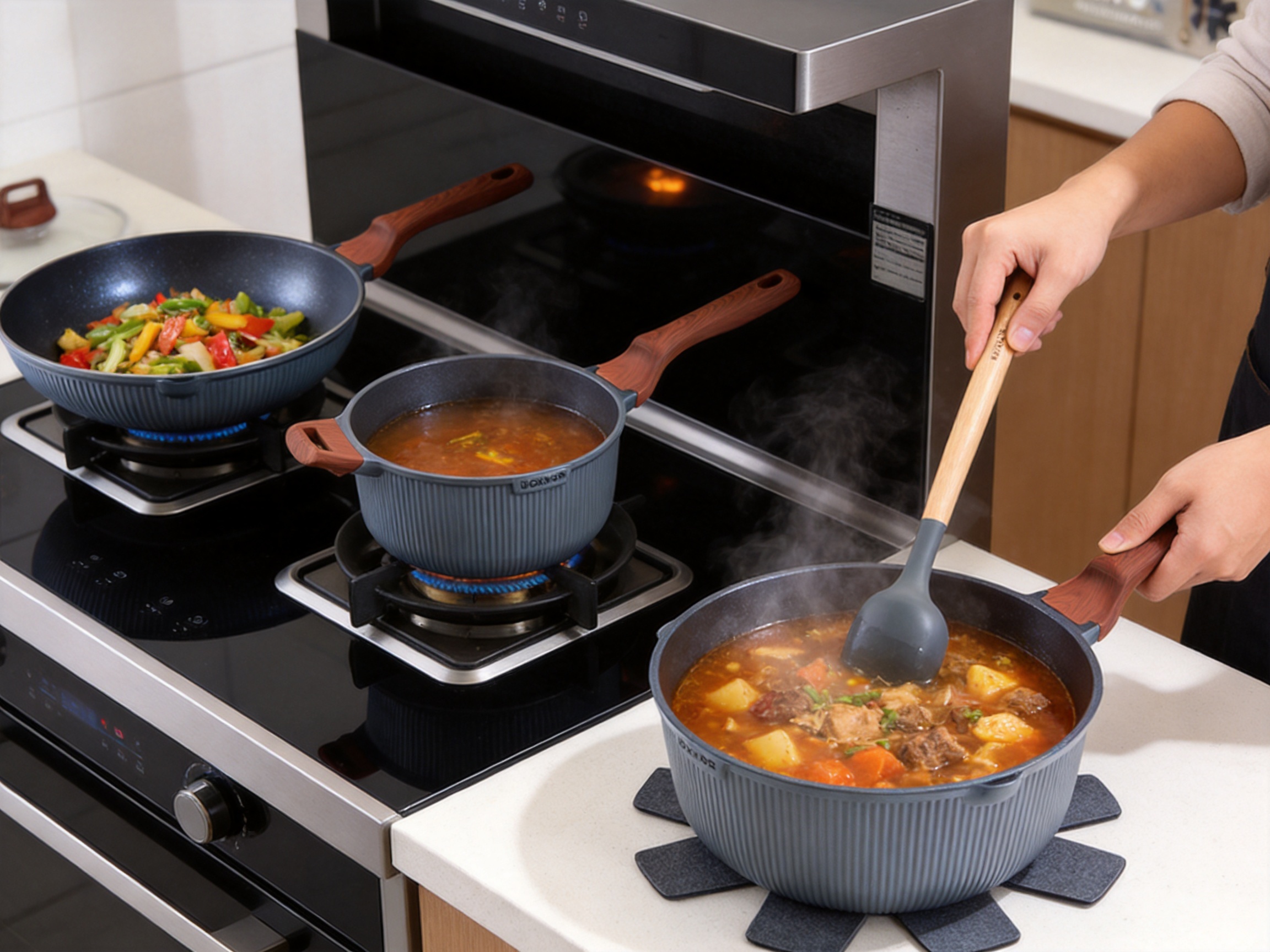
The shallow casserole is suitable for frying and sautéing ingredients that benefit from a broad surface. Preheat gradually, add an appropriate amount of oil, and avoid setting the burner higher than necessary. A moderate temperature can improve browning control and reduce the risk of overheating the empty pan.
Stewing and Braising
The deeper casseroles are useful for stews and braised dishes. Begin by browning ingredients if the recipe requires it, then add liquid and reduce the heat for simmering. The larger sizes can accommodate vegetables, meat, legumes, and sauces without excessive crowding.
Boiling and Simmering
The 24 cm and 28 cm casseroles can support pasta, grains, soup, and vegetables. Choose a size that leaves enough room for the food and liquid to move safely. Do not fill the cookware beyond a level that could cause boiling liquid to spill onto the stovetop.
Batch Cooking
The 32 cm casserole is useful for preparing larger quantities in advance. Batch cooking can save time during busy workweeks and may reduce the number of separate cooking sessions. After cooking, food should be transferred and stored according to appropriate food-safety practices rather than left in the cookware indefinitely.
Serving
The coordinated appearance of the set allows selected dishes to move from the kitchen to the table when appropriate. Always place the cookware on a trivet or another heat-resistant surface before serving. The included trivets support this transition and help protect the table.
Q&A: Frequently Asked Questions
What is included in the 15-piece Graphite Grain Aluminum Cookware Set?
The set includes multiple aluminum cookware pieces, including casseroles in 20 cm, 24 cm, 28 cm, and 32 cm sizes, plus a 28 cm shallow casserole. It also includes trivets and utensils. Buyers should confirm the final piece-count breakdown, accessory models, and packaging configuration with the supplier before placing an order.
Is the cookware compatible with all stovetops?
The product is specified as compatible with all stovetops. Users should still match the cookware base to the cooking zone, keep the heat source within the base diameter, and follow the instructions supplied with the final product configuration.
Does aluminum cookware heat quickly?
Yes. Aluminum generally responds quickly to heat, which helps shorten preheating time and allows the cook to adjust temperatures promptly. Actual cooking performance also depends on the body design, base construction, heat source, food quantity, and cooking technique.
Is hard-anodized aluminum better than regular aluminum?
Hard-anodized aluminum usually provides a tougher surface and may maintain its appearance better under repeated use. Regular aluminum remains lightweight, responsive, and economical. The better choice depends on the buyer’s expected frequency of use, budget, durability expectations, and product specifications.
Can metal utensils be used with this cookware?
Metal or sharp utensils are not recommended. Use wooden, nylon, or other cookware-safe utensils to reduce the risk of scratching or damaging the surface.
Can the cookware be washed in a dishwasher?
Hand washing is recommended to preserve the appearance of the cookware, especially the dark grey finish and wooden handles. Use hot soapy water and a soft cloth or sponge. The buyer should follow the final care instructions supplied with the product.
Can the cookware be used in a microwave?
No. Aluminum cookware should not be used in a microwave. Metal can cause arcing and may damage the microwave oven.
What should users do if a pan overheats?
Turn off the cooker and leave the pan to cool completely. Do not touch or move severely overheated cookware immediately, as the body and handle may be dangerously hot. Once fully cool, inspect the product before cleaning or using it again.
Why is stackability important?
Stackability reduces the amount of cabinet space required. It is especially useful in small kitchens, apartments, guest accommodations, and retail warehouses where efficient storage matters.
Are wooden handles safe around heat?
The handles are designed as heat-resistant wooden handles for normal stovetop use, but they should not be exposed directly to flames or excessive heat. Keep flames within the cookware base and avoid placing the handle over a burner.
Can the set be customized for private-label sales?
OEM and ODM discussions may cover branding, packaging, color, accessories, labels, and product assortment. The final options depend on order volume, production feasibility, materials, and destination-market requirements.
What documents should an importer request?
An importer should request documents appropriate to the product and destination, such as material information, food-contact test reports, coating documentation where relevant, packaging specifications, and declarations required by local authorities or retail customers.
Is this set suitable for commercial buyers?
Yes. Its multi-size configuration, stackable design, accessories, and export-oriented packaging can make it suitable for retailers, distributors, furnished housing projects, hospitality suppliers, and private-label programs. Commercial buyers should conduct their own sample and compliance evaluation before ordering.
What is the product SKU?
The listed SKU is DN03. Buyers should use the SKU when discussing samples, quotations, purchase orders, packaging, and product documentation to reduce the possibility of specification errors.
Why Choose a Specialized Kitchenware Supplier?
A specialized kitchenware supplier understands that cookware is a coordinated product system. Material, shape, finish, handle, accessory, packaging, testing, and logistics all affect the final customer experience. This is different from simply purchasing generic metal products and adding a label.
A supplier with experience across aluminum, stainless steel, cast iron, and kitchen utensils can provide broader market insight. The buyer can compare different materials, build a tiered assortment, and develop complementary products without changing sourcing partners for every category.
Zhejiang Echo Industry And Trade Co., Ltd. is based in Taizhou, Zhejiang, China, a region known for manufacturing and export activity. The company presents itself as a dynamic kitchenware supplier focused on product variety, one-stop sourcing, ODM and OEM customization, certification assistance, flexible minimum order quantities, and sustainable and healthy product development.
Its stated long-term direction is to develop as an R&D-driven supply chain partner for small and medium-sized kitchenware buyers rather than functioning only as an order-taking business. For buyers, this type of partnership can be valuable when a product needs to be adapted for a specific market, retail channel, price level, or design language.
Good supplier cooperation begins with clear communication. Buyers should provide target quantities, sales channel, required certifications, packaging preferences, expected delivery schedule, and performance expectations. The factory can then advise on available specifications, sample development, production timing, and quality-control checkpoints.
Conclusion
The 15-piece Graphite Grain Aluminum Cookware Set is designed to meet the practical needs of modern kitchens while offering a distinctive appearance and efficient storage. Its aluminum body supports fast heat response, the range of casserole sizes accommodates different recipes and portion levels, and the shallow casserole adds flexibility for frying, browning, and serving.
The dark grey ribbed body gives the set a recognizable visual identity, while the wooden heat-resistant handles provide a comfortable and natural-looking alternative to an entirely metal construction. Stackability helps reduce cabinet space, and the inclusion of trivets and utensils makes the collection more complete for household, gift, hospitality, and retail applications.
Compared with basic aluminum cookware, a carefully finished and well-controlled set can offer better visual consistency, more stable long-term appearance, and a more organized cooking experience. Compared with disorganized multi-piece bundles, this set provides a more useful relationship between piece count and cooking function.
Its commercial value also comes from the manufacturing and supply capabilities behind it. Zhejiang Echo Industry And Trade Co., Ltd. offers experience across several kitchenware categories, one-stop sourcing, OEM and ODM cooperation, certification assistance, flexible sourcing options, and export-oriented coordination. These strengths can help buyers develop a complete cookware program rather than purchase a single isolated item.
For the best result, users should follow the care instructions: wash before first use, use soft cleaning tools, avoid metal utensils, do not overheat empty cookware, keep flames within the base, avoid microwave use, and hand wash whenever possible. With proper care and suitable documentation for the target market, the Graphite Grain set can serve as a practical, attractive, and commercially adaptable cookware solution.
References
Food and Drug Administration, Food Contact Materials and Substances: General Regulatory Principles.
European food-contact materials guidance and applicable national implementation requirements.
General technical literature on aluminum cookware, thermal conductivity, forming, and surface treatment.
General technical literature on hard anodizing and aluminum oxide surface layers.
International guidance concerning migration testing for food-contact articles.
Manufacturer-provided product specification for the 15-piece Graphite Grain Aluminum Cookware Set, SKU DN03.
Manufacturer-provided care and use instructions for aluminum cookware with wooden handles.
Product: 15pcs GraphiteGrain Aluminum Cookware Set
Recommended Articles
Product Category
Related products
-
-
This cookware set has a ceramic non-stick inner liner, a heat-resistant wooden h...
See Details -
This cookware set is made of food-grade non-stick material, with a unique eye-ca...
See Details -
This off-white cookware set is made of wear-resistant non-stick material, with w...
See Details
Whether you're looking for bulk purchases or have any custom requirements, We are here to offer the best
solutions for you.
tiffany.zhong@echocn-trading.com
PHONE
+86-19561173975
+86-19557020621 (Hazel Wu)
ADD
Room 301, Unit 3014, No. 175 Qifeng Avenue, Wenqiao Town, Taizhou, Zhejiang, China
Fill Out the Form for More Information
Copyright © Zhejiang Echo Industry And Trade Co., Ltd.
All Rights Reserved.

China Cookware Set Manufacturer