
 en
 Español
This cookware set features a non-stick coating, even heat conduction, and multi-...
See Details
Multi-Function Aluminum Cookware Set for Efficient Everyday Cooking
Date:Aug 09, 2026

Choosing the right cookware set is an important decision for households, professional kitchens, hospitality businesses, retailers, and distributors. Cookware must do more than look attractive. It should support different cooking methods, use kitchen space efficiently, provide dependable heat performance, remain comfortable to handle, and be simple to maintain over time. The QTECUT Aluminium Pot and Pan Set is designed around these practical requirements, combining a coordinated group of frying, boiling, sautéing, milk-pan, and casserole pieces in a modern aluminum construction.
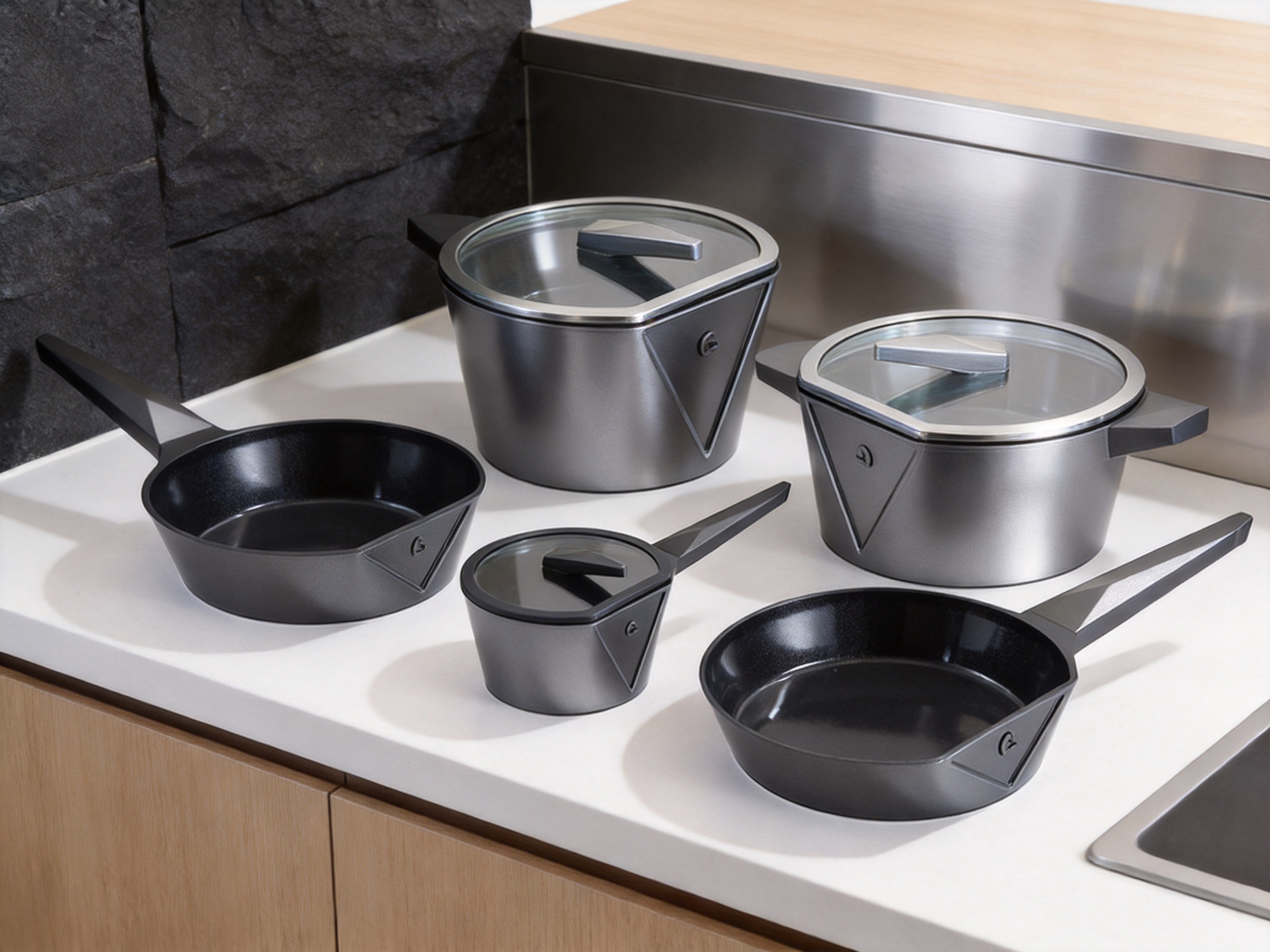
This cookware collection presents a balanced solution for people who want several cooking vessels without purchasing every piece separately. Its geometric angular design gives the set a distinctive visual identity while also supporting upright placement and more efficient storage. The matte black exterior creates a minimalist appearance that can suit contemporary kitchens, while the ergonomic geometric handles are intended to improve control during cooking and serving. Clear glass lids allow users to monitor food without repeatedly lifting the lid, helping retain heat and reduce unnecessary interruptions.
For importers, wholesalers, retailers, and kitchenware buyers, the product also offers the advantages of a coordinated product line. Multiple sizes and functions make it suitable for different consumer needs, while the manufacturer’s broader capabilities in aluminum cookware, stainless steel cookware, cast iron cookware, and kitchen utensils support one-stop sourcing. This article examines the product’s design, performance characteristics, manufacturing strengths, applications, care requirements, purchasing considerations, and competitive position.
Product Overview
The QTECUT Aluminium Pot and Pan Set is a multi-function cookware solution developed for frying, boiling, sautéing, heating milk or sauces, and preparing casserole-style dishes. The set is organized around practical household cooking tasks rather than a single cooking method. This makes it appropriate for kitchens where one coordinated collection needs to handle breakfast preparation, quick frying, soup or pasta cooking, slow simmering, side dishes, sauces, and family meals.
The product information identifies the cookware as an aluminum cookware set with several vessel formats and size options. The listed dimensions include frying-pan sizes of approximately 20 × 4.5 cm, 24 × 4.9 cm, and 28 × 5.2 cm. Additional pieces include a milk pan of approximately 18 × 10.8 cm, a sauté pan of approximately 28 × 7.6 cm, and casserole options of approximately 20 × 10 cm and 24 × 11.5 cm. These dimensions should be confirmed against final production specifications, packaging details, and regional product configurations before an order is placed.
The collection is built to serve both compact and larger cooking tasks. Smaller vessels can be used for individual portions, heating, breakfast foods, sauces, and side dishes. Medium sizes are suitable for everyday family meals, while larger frying, sautéing, and casserole pieces can accommodate greater quantities. Offering several sizes in one range also gives retailers an opportunity to present a complete cookware solution rather than a collection of unrelated individual items.
The set is supplied under SKU DL01 and has a carton quantity identified as 8 CTN in the product information. Buyers should confirm whether this refers to eight sets per carton or another packaging arrangement, as carton terminology can vary by supplier and shipment document. Clear confirmation of set composition, unit packaging, gross weight, net weight, carton dimensions, and container loading quantities is recommended during the quotation and sampling stage.
Design Advantages for Modern Kitchens
Geometric Angular Construction
One of the most visible characteristics of this cookware set is its geometric angular form. Instead of relying on a completely conventional rounded silhouette, the design uses clean, structured lines that create a contemporary appearance. This distinction can be valuable in a crowded cookware market, where visual differentiation influences both retail presentation and consumer purchase decisions.
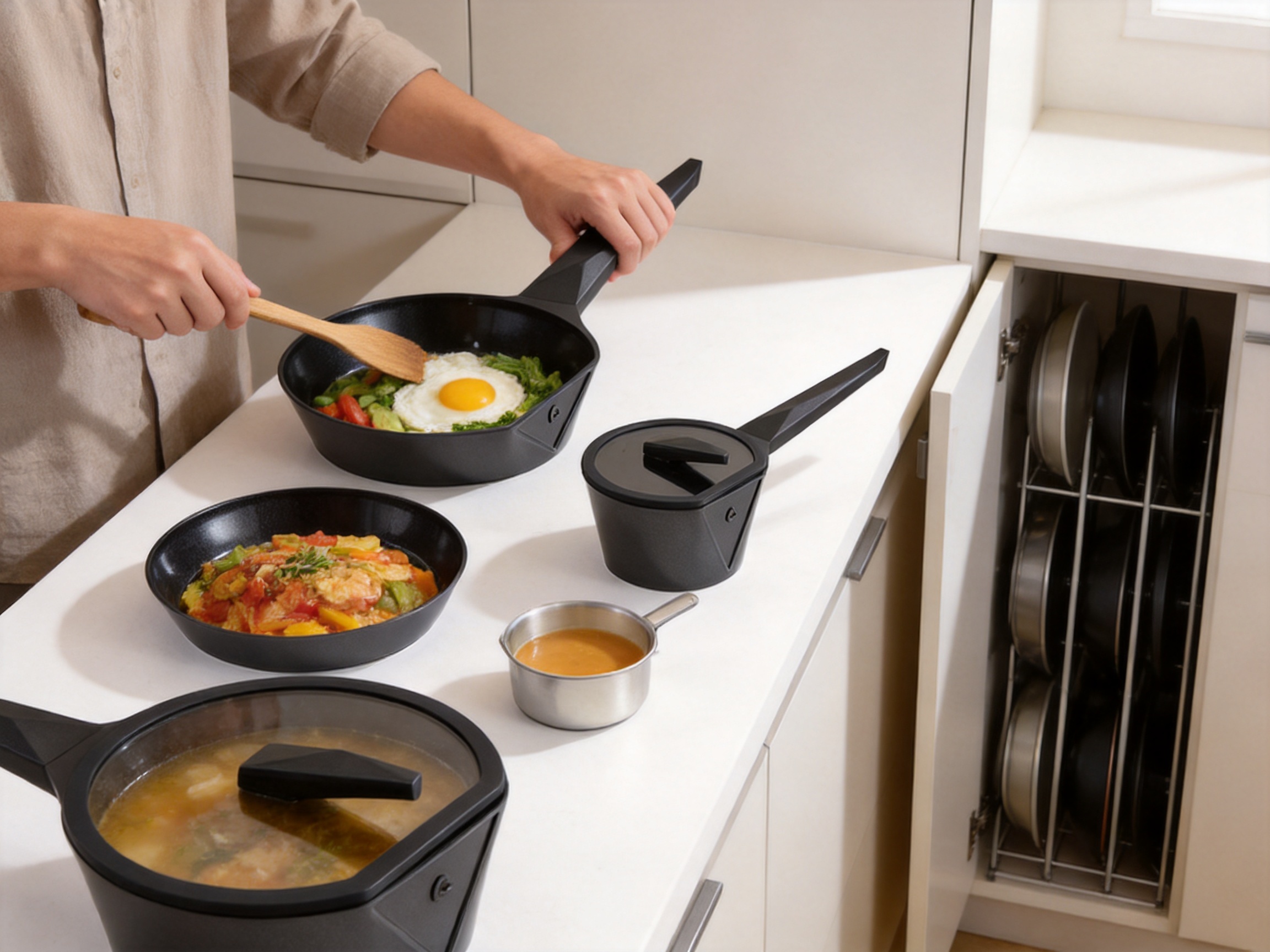
The angular design is not only decorative. It supports a more organized storage concept by allowing certain pieces to be placed upright. Upright placement can make better use of cabinet height and reduce the amount of horizontal shelf space required. This is particularly useful in apartments, compact homes, dormitory kitchens, recreational vehicles, and other spaces where storage capacity is limited.
Traditional round cookware often requires nesting, stacking, or hanging. Although these methods remain useful, they may cause scratches, require additional separators, or make it difficult to access the piece stored at the bottom. A design that supports upright placement offers another storage option. Users can position selected pans and pots next to one another, making the collection easier to view and retrieve.
Matte Black Minimalist Style
The matte black appearance provides a restrained and contemporary visual effect. It can coordinate with stainless steel appliances, dark induction surfaces, wood cabinetry, stone countertops, and neutral kitchen interiors. Compared with highly decorative patterns, a minimalist finish is easier for retailers to position across multiple market segments and consumer age groups.
A matte surface can also create a more premium impression when supported by consistent production quality. Even color coverage, clean edges, well-fitted handles, and carefully protected packaging are important to ensure that the visual promise of the product is maintained from factory to end user. For buyers, the finish should be evaluated through physical samples under normal retail lighting, because surface appearance may vary according to lighting conditions and photography.
The black style also provides a unified appearance across different pieces. A coordinated set looks more intentional on open shelving or hanging storage than a group of mismatched pans. This makes it suitable not only for private kitchens but also for display-oriented environments such as furnished apartments, boutique accommodation, cooking studios, and lifestyle retail stores.
Ergonomic Geometric Handles
The cookware includes ergonomic geometric handles intended to provide a secure and comfortable grip. Handles are central to cookware safety because they influence how users lift, move, turn, and serve hot food. A well-designed handle should provide sufficient clearance from the cooking surface, allow the user to maintain control, and feel balanced in the hand.
The geometric handle style complements the angular body of the cookware, creating a consistent design language throughout the collection. This is an advantage over low-cost cookware that may combine unrelated shapes, thin handles, or visually inconsistent attachments. A consistent handle system can improve the appearance of the complete set and simplify product presentation for retailers.
Handle comfort should still be assessed through sample testing. Buyers should examine grip width, attachment strength, surface temperature during normal use, balance when the vessel is partially filled, and compatibility with storage arrangements. Product testing should include lifting the cookware with realistic food loads rather than evaluating an empty piece alone.
Clear Glass Lids
Clear glass lids enable users to observe food while it cooks. This is particularly useful when simmering, boiling, reducing sauces, or preparing dishes that need regular visual monitoring. A transparent lid may reduce the frequency with which the user lifts the lid, helping maintain heat and moisture inside the vessel.
Visibility is also a practical convenience. Users can check the cooking stage, liquid level, and bubbling intensity without interrupting the process. For new cooks, this can make it easier to learn timing and temperature control. For experienced users, it supports more efficient multitasking.
When evaluating a complete product, purchasers should confirm the fit between each lid and its corresponding vessel. They should also verify lid handle construction, rim protection, packaging safeguards, and the supplier’s recommended cleaning instructions. Glass components require appropriate protective packaging because damage can occur during handling and transportation if the pieces are not adequately separated and secured.

QTECUT Aluminium pot and Pan Set
Functional Range for Everyday Cooking
Frying Pans
The frying-pan selection is intended for common high-frequency cooking tasks such as eggs, vegetables, pancakes, fish, meat portions, grilled sandwiches, and shallow-fried ingredients. Having multiple frying-pan sizes allows the user to select a vessel according to portion size and cooking method. Smaller pans are useful for individual servings or compact stovetops, while larger pans provide more surface area for family meals.
A range of frying-pan sizes also has commercial value for distributors. Some consumers want a complete set with several diameters, while others prefer to purchase replacement pieces or add-on items later. A consistent product family makes cross-selling easier because customers can identify matching pieces by their shape, color, and finish.
For best results, food should be prepared with appropriate heat control. Aluminum cookware can respond efficiently to changes in heat, but users should avoid overheating an empty pan. Preheating should be controlled, and food should be added according to the recipe and the intended cooking method. The care instructions specifically advise against overheating empty cookware and against allowing the flame or heat source to extend beyond the base.
Milk Pan
The milk pan is suitable for heating milk, preparing sauces, melting ingredients, making porridge, warming small portions, and handling other liquid-based tasks. Its smaller format can be more convenient than using a large saucepan when only a modest quantity is required.
Small pans are frequently used for foods that can scorch if left unattended. Users should therefore select moderate heat, stir when appropriate, and avoid leaving the pan empty on an active burner. The clear lid options in the broader collection can also help monitor liquid movement and reduce unnecessary lifting during controlled heating.
Sauté Pan
A sauté pan provides greater depth than a conventional shallow frying pan, making it useful for combining ingredients, browning food, reducing sauces, preparing one-pan meals, and cooking vegetables with a small amount of liquid. The approximately 28 × 7.6 cm format listed for the product offers a practical balance between surface area and side-wall height.
The sauté pan can help reduce the number of separate vessels needed for a meal. Ingredients can be browned first, followed by the addition of sauce, stock, vegetables, or other components. This supports efficient cooking and may also reduce cleanup compared with using multiple pans for sequential stages of a recipe.
Casserole Pans
The casserole pieces are designed for deeper cooking tasks, including simmering, stewing, preparing soups, cooking pasta, making rice dishes, and serving family-size meals. The listed options of approximately 20 × 10 cm and 24 × 11.5 cm provide different capacities for different household sizes and recipes.
Deep-sided cookware can be especially useful for meals involving liquids or ingredients that expand during cooking. Users should avoid filling cookware beyond a safe working level, particularly when preparing foods that foam or boil vigorously. Correct size selection improves cooking control and reduces the risk of spills.
Material Benefits of Aluminum Cookware
Aluminum is widely used in cookware because it combines relatively low weight with efficient thermal response. Compared with heavier materials, aluminum cookware can be easier to lift, move, wash, and store. This is valuable for everyday users who handle cookware repeatedly throughout the day.
The material can also heat comparatively quickly and respond to adjustments in the cooking setting. This supports a wide range of tasks, from quick frying to controlled simmering. Efficient heat response can help users manage cooking time and energy use, although actual performance depends on the construction, thickness, base design, cooking surface, stove type, and user technique.
Aluminum cookware can offer a practical alternative to heavier cast iron or certain thick stainless steel products. Cast iron may provide excellent heat retention but can be demanding to lift and maintain. Stainless steel is valued for durability and appearance but may require more careful heat management to reduce sticking. The aluminum format in this set is positioned as a more lightweight, accessible, and versatile option for routine cooking.
The matte black finish and structured design further distinguish the product from basic uncoated aluminum cookware. For buyers comparing alternatives, the relevant evaluation should include not only the base material but also the consistency of the finish, quality of forming, handle attachment, lid fit, packaging, and after-sales support.
Competitive Advantages Over Conventional Cookware Sets
More Versatile Than Single-Purpose Collections
A single frying pan or a basic two-piece saucepan combination may satisfy a narrow range of needs, but it may not provide enough flexibility for a complete kitchen. The QTECUT collection covers several cooking formats, including frying, sautéing, heating, boiling, simmering, and casserole preparation. This broad use range can make the set more attractive to consumers seeking a practical starter collection.
For retailers, functional variety can simplify product positioning. Instead of explaining the benefits of one isolated pan, sales staff can present the set as a solution for everyday cooking. Product pages can also communicate several use cases through recipes, serving suggestions, and size comparisons.
More Storage-Conscious Than Traditional Designs
Many cookware collections focus on nesting but do not address vertical storage. The upright-placement concept of this set responds to a growing consumer concern: limited kitchen space. The ability to organize cookware vertically can help users make better use of cabinets and shelves while keeping frequently used pieces within reach.
This advantage is especially relevant for urban consumers. Smaller kitchens often require products that perform multiple functions and occupy less storage space. A coordinated set with geometric forms can serve both needs by reducing the need for multiple unrelated purchases and supporting a more organized storage arrangement.
More Visually Cohesive Than Mixed-Brand Sets
Purchasing a coordinated cookware set can produce a more consistent appearance than collecting individual pieces from different manufacturers. Matching color, surface finish, handle geometry, and lid design contribute to a more polished kitchen environment.
The unified matte black style may also improve shelf presentation. Retailers can display the products as a complete collection, while online merchants can use lifestyle imagery that shows several pieces together. Cohesive design often helps a product line appear more premium and easier to recognize.
More Convenient Than Opaque-Lid Alternatives
Clear glass lids provide a practical visibility advantage over opaque lids. Users can observe the contents while reducing the need to interrupt cooking. This feature is useful for recipes that require careful timing or liquid monitoring, and it can improve the perceived value of the complete set.
More Flexible for Private Label and Distribution Programs
For business buyers, the product belongs to a broader kitchenware supply capability that includes aluminum cookware, stainless steel cookware, cast iron cookware, and kitchen utensils. This creates opportunities for product line expansion, coordinated sourcing, and private-label development. Buyers may be able to source complementary products from the same supplier rather than managing numerous separate vendor relationships.
The manufacturer identifies services including ODM and OEM customization, product certification assistance, flexible minimum order quantities, and sustainable and healthy product development. These capabilities can be important for importers and brand owners that need specific packaging, color, logo, product combinations, or market documentation.
Manufacturing and Supply-Chain Strengths
Zhejiang Kitchenware Manufacturing Background
The supplier is based in Zhejiang, China, a province known for manufacturing and export-oriented industrial activity. A location within an established production region can provide access to component suppliers, packaging companies, logistics services, technical labor, and related kitchenware manufacturing resources.
For international buyers, regional manufacturing concentration can support more efficient product development and sourcing. It may also make it easier to coordinate multiple categories, such as cookware, utensils, and kitchen accessories. However, buyers should still conduct their own supplier verification, quality audits, sample approvals, and compliance reviews before placing commercial orders.
Product Development and R&D Orientation
The company describes its future direction as an R&D-driven supply-chain partnership rather than merely an order-taking business. This positioning is relevant for buyers that need more than standard catalog products. Product development support can include shape refinement, handle styling, color selection, packaging structure, function combinations, and market-specific adjustments.
An R&D-oriented approach is particularly valuable for cookware because small design details can affect user experience. The angle of a handle, the balance of a pan, the fit of a lid, the shape of a rim, and the arrangement of a product set all influence the final market result. A supplier that treats these details as part of development can help buyers create a more distinctive product line.
Multi-Category Manufacturing Capability
The company’s stated product scope includes aluminum cookware, stainless steel cookware, cast iron cookware, and kitchen utensils. This category breadth supports one-stop sourcing for buyers building a complete kitchenware portfolio.
A multi-category supplier can help distributors coordinate design language across different materials. For example, a retailer might combine aluminum frying pans, stainless steel saucepans, cast iron cookware, and matching utensils under one kitchen collection. Shared design elements, packaging principles, or color selections can make the overall assortment more coherent.
One-stop sourcing may also reduce administrative workload. Instead of communicating with several factories about separate categories, a buyer can explore a broader product program through one supplier relationship. This does not eliminate the need for product-specific inspection, but it can streamline quotation, sampling, artwork review, and shipment coordination.
OEM and ODM Support
OEM support is useful when a buyer has an established design, brand identity, or packaging system and needs a capable manufacturing partner. ODM support is useful when the buyer wants to select, adapt, or co-develop a product based on an existing manufacturing platform.
Possible customization discussions may include exterior color, logo application, retail packaging, instruction manuals, set combinations, handle details, carton markings, and regional labeling. The feasibility of each option depends on order volume, tooling requirements, production schedules, material availability, and quality standards. These details should be agreed in writing before mass production.
Certification Assistance
The supplier states that it can assist with product certification. Certification requirements differ according to the destination market, product materials, food-contact regulations, packaging rules, and retailer standards. Buyers should identify all applicable requirements early in the development process.
Certification assistance may include document preparation, test coordination, material declarations, factory information, and communication with inspection or testing organizations. The buyer remains responsible for confirming that the final product, packaging, labeling, and documentation meet the legal requirements of the intended market.
Flexible MOQ and Commercial Adaptability
Flexible minimum order quantities can benefit small and medium-sized buyers that are testing a new market, launching a private label, or expanding an existing cookware line gradually. A flexible approach may reduce the risk associated with ordering large quantities before consumer response is known.
Commercial terms should still be reviewed carefully. Buyers should confirm the minimum order quantity per style, color, size, logo method, and packaging configuration. They should also establish whether mixed-size sets are permitted, how sample costs are handled, what production lead times apply, and how changes after approval affect the schedule.
Quality Considerations for Buyers
Product appearance is important, but cookware quality should be evaluated through a broader inspection plan. Buyers should examine the shape of each vessel, surface consistency, rim quality, handle attachment, lid fit, packaging protection, and dimensional accuracy.
For aluminum cookware, wall and base consistency should be reviewed according to the agreed specification. Uneven construction may affect balance, heat response, and long-term durability. A sample should be tested on the intended cooking equipment where possible, including gas, electric, ceramic, or induction-compatible surfaces if the product is advertised for those applications.
Buyers should not assume that all aluminum cookware is compatible with every stove type. Compatibility depends on the actual base construction and design. Product listings, packaging, and user instructions should state the approved heat sources clearly. If induction compatibility is required, it should be specifically confirmed and tested rather than inferred from the use of aluminum alone.
Handle construction deserves particular attention. Inspection should include attachment security, alignment, surface finish, grip comfort, and resistance to movement. The handle should remain stable during ordinary lifting and pouring. If the handle includes separate components, the connection points should be checked for gaps, looseness, sharp edges, or visible defects.
Glass lids should be inspected for clarity, edge condition, fit, and protection during shipment. Packaging should prevent direct contact between glass pieces and metal cookware. A strong packaging system can reduce breakage, cosmetic damage, and customer complaints.
Retailers should also verify that care instructions are clear and accurately translated for the destination market. Instructions should explain the recommended utensils, cleaning method, overheating precautions, microwave limitations, flame positioning, and first-use washing requirements.
Care and Maintenance Instructions
Use Suitable Cooking Utensils
To prolong the appearance and service life of the cookware, users should avoid metal or sharp cooking utensils. Wooden, nylon, or non-stick-compatible utensils are recommended in the supplied care guidance. These materials are less likely to create scratches or marks during normal cooking.
Utensil selection is especially important when food is stirred, turned, or scraped from the cooking surface. Users should avoid cutting food directly inside the pan with knives or other sharp tools. They should also avoid striking the rim or interior surface with hard utensils.
Clean with Hot, Soapy Water
The recommended cleaning method is hot, soapy water with a soft cloth or sponge. Gentle cleaning helps preserve the appearance of the cookware and reduces the possibility of surface damage. Food residue should be softened rather than aggressively scraped.
After washing, the cookware should be rinsed thoroughly and dried. Drying can help prevent water marks and keep the product ready for its next use. Users should follow the final care instructions supplied with the product, especially if the cookware includes any specialized surface treatment.
Avoid Empty Overheating
Empty cookware should not be overheated. When a pan or pot is left on a hot burner without food or liquid, the temperature can rise rapidly and may affect the finish, handle, lid, or cooking performance. Users should prepare ingredients before turning on the heat whenever possible.
If the pan severely overheats, users should turn off the cooker and allow the cookware to cool completely. They should not touch the hot surface directly or place it immediately under cold water. Sudden temperature changes can be harmful to cookware and glass components.
Control the Heat Source
The flame or heat source should not extend beyond the base of the cookware. Excess heat around the sides can damage the exterior finish, increase handle temperature, and waste energy. Correct burner selection and moderate heat settings support safer and more efficient cooking.
Users should center the vessel on the burner and choose a burner size that matches the base. This simple practice is relevant to all cookware, but it is particularly important for maintaining the appearance of a dark exterior finish.
Do Not Use in a Microwave
The supplied instructions state that the cookware should not be used in a microwave. Retail packaging and product listings should communicate this limitation prominently. Consumers should transfer food to microwave-safe containers when reheating is required.
Wash Before First Use
Each piece should be washed before its first use. Hand washing is recommended to preserve the appearance of the cookware. First-use cleaning removes manufacturing dust, packaging residue, and handling traces that may remain after production and packing.
Applications Across Consumer and Commercial Markets
Household Kitchens
The primary application is everyday household cooking. The combination of frying pans, a milk pan, a sauté pan, and casserole pieces gives households the basic formats needed for many recipes. The set can serve new homeowners, families upgrading their kitchen, students moving into accommodation, and consumers replacing older cookware.
Small Apartments and Compact Homes
The space-saving storage concept makes the collection relevant to compact homes. Urban consumers often value products that combine several functions without requiring excessive cabinet space. Upright placement and coordinated sizing can support more orderly storage in small kitchens.
Hospitality and Furnished Accommodation
Furnished apartments, guesthouses, short-term rental properties, and boutique accommodation providers may use coordinated cookware sets to equip kitchens efficiently. A consistent set can improve the guest experience and simplify purchasing when multiple rooms require similar kitchen equipment.
Retail and E-Commerce
The product is suitable for department stores, kitchen specialty shops, home-goods retailers, online marketplaces, and social-commerce channels. Its visual identity is suitable for lifestyle photography, while its functional variety supports informative product descriptions.
Online sellers can highlight the set’s multi-size configuration, storage-oriented form, clear lids, matte black appearance, and care instructions. They should present accurate dimensions and clearly explain the confirmed stove compatibility, included pieces, packaging contents, and limitations.
Gift and Housewarming Programs
A complete cookware collection can be positioned as a housewarming, wedding, graduation, relocation, or holiday gift. The coordinated appearance gives it a stronger presentation than a single unboxed pan, especially when the packaging is designed for retail display and transport.
Procurement and Customization Guidance
Buyers considering this cookware set should begin by confirming the exact set composition. The product data lists several dimensions and vessel types, but a final quotation should specify the number of frying pans, the inclusion of the milk pan and sauté pan, the number of casserole pieces, the presence of lids, and the accessories included in each set.
Packaging should be reviewed at the same time. Buyers should request details about individual boxes, master cartons, internal separators, protective bags, lid protection, barcode labels, outer carton markings, and palletization. Glass lids make internal protection especially important.
For private-label programs, buyers should provide brand guidelines, logo artwork, packaging text, regulatory statements, barcode information, and language requirements. Artwork should be approved against a physical or digital proof before production. Any requested changes to color, handle components, surface finish, or set composition should be confirmed for cost and lead-time impact.
Sampling is an essential stage. A sample should be evaluated for design, dimensions, balance, finish, handle comfort, lid fit, cleaning behavior, and performance on the target cooking equipment. If the product will be sold in several markets, samples should also be reviewed for local labeling and instruction requirements.
Pre-shipment inspection can help verify that production matches the approved sample. Inspection criteria may include quantity, dimensions, color consistency, surface condition, handle alignment, lid condition, carton markings, and packaging integrity. A written quality standard makes inspection more objective and reduces misunderstandings between buyer and supplier.
Because the product is intended for international distribution, logistics planning should include carton dimensions, container loading, shipping protection, customs documents, product classification, and destination-market requirements. The stated carton quantity of 8 CTN should be clarified in the commercial documentation before shipment.
How the Set Supports a Better Cooking Workflow
Efficient cooking depends on movement, timing, and preparation. A multi-function set helps users select the right pan for each stage rather than forcing every recipe into one oversized or undersized vessel. The frying pan can be used for surface cooking, the sauté pan for combining ingredients, the milk pan for small liquid portions, and the casserole pan for deeper recipes.
This division of functions can improve organization. Ingredients can be prepared in parallel, and users can choose a pan that matches the quantity being cooked. Correct sizing may help food cook more evenly and can reduce unnecessary energy use compared with heating a very large vessel for a small portion.
The clear lids support monitoring, while the ergonomic handles support movement between the stovetop and serving area. The minimalist design also allows the cookware to transition from cooking to presentation in suitable settings, provided it is handled safely and placed on an appropriate heat-resistant surface.
Frequently Asked Questions
What type of cookware is this product?
It is a multi-function aluminum cookware set that includes frying-pan, milk-pan, sauté-pan, and casserole-style formats. The exact number of pieces and lid configuration should be confirmed with the supplier for the selected package.
What are the main design features?
The main features include a geometric angular body, upright-placement storage potential, matte black minimalist styling, ergonomic geometric handles, clear glass lids, and several sizes for frying and boiling.
Is the cookware suitable for daily cooking?
Yes. The range is intended for common tasks such as frying, boiling, sautéing, heating milk or sauces, simmering, and preparing casserole-style meals. Users should follow the care instructions and use appropriate heat settings.
Can metal utensils be used?
Metal or sharp utensils should not be used according to the supplied care instructions. Wooden, nylon, or non-stick-compatible utensils are recommended to help preserve the cookware’s appearance and surface condition.
How should the cookware be cleaned?
Clean the cookware with hot, soapy water and a soft cloth or sponge. Hand washing is recommended. Avoid aggressive scraping and dry the cookware after washing.
Can the pans be placed in a microwave?
No. The supplied instructions state that the cookware should not be used in a microwave. Food should be transferred to an appropriate microwave-safe container before reheating.
What should be done if a pan overheats?
Turn off the cooker and allow the cookware to cool completely. Do not touch the overheated pan directly, and do not immediately expose it to sudden cooling. After it has cooled, inspect it and follow the supplier’s guidance if there is visible damage.
Can the cookware be used on every type of stove?
Stove compatibility should be confirmed from the final product specification. Aluminum cookware is not automatically induction-compatible, so buyers should request confirmation and testing if induction use is required.
What sizes are listed for the set?
The listed frying-pan dimensions are approximately 20 × 4.5 cm, 24 × 4.9 cm, and 28 × 5.2 cm. The listed additional sizes include a milk pan of approximately 18 × 10.8 cm, a sauté pan of approximately 28 × 7.6 cm, and casserole options of approximately 20 × 10 cm and 24 × 11.5 cm. Final measurements should be confirmed before ordering.
Are the glass lids included with every piece?
The product description identifies clear glass lids, but the exact lid-to-vessel configuration should be confirmed in the quotation, product specification, and approved sample.
Is the product available for OEM or ODM projects?
The supplier states that it provides OEM and ODM customization. Potential options may include logo application, packaging, colors, set combinations, and other design details, subject to order quantity, technical feasibility, and production approval.
Can buyers source other kitchen products from the same company?
Yes. The company states that it supplies aluminum cookware, stainless steel cookware, cast iron cookware, and kitchen utensils. This may support one-stop sourcing and coordinated product-line development.
What is the stated SKU?
The product information identifies the SKU as DL01.
What is the carton quantity?
The product information states “CTN: 8CTN.” Buyers should confirm the exact meaning, such as the number of sets per master carton, with the supplier before finalizing the purchase order.
Why Work with an Experienced Kitchenware Supplier?
Cookware production requires coordination across material selection, forming, surface treatment, handle assembly, glass-lid sourcing, packaging, inspection, and export documentation. A supplier with experience across several kitchenware categories may be better positioned to manage these connected requirements.
For a buyer, supplier value is not limited to the factory price. It also includes communication quality, sample accuracy, response time, production planning, documentation, customization support, packaging development, and the ability to resolve problems. A professional supplier can help translate a product concept into a manufacturable specification while maintaining attention to market requirements.
ECHO KITCHENWARE presents itself as a professional supplier and factory serving international buyers. Its stated mission is to help Zhejiang-made products reach global markets and to develop into an R&D-driven supply-chain partner for small and medium-sized kitchenware buyers. This positioning aligns with customers that want a long-term product-development relationship rather than a one-time transaction.
The company’s product breadth also supports assortment building. A buyer may begin with this aluminum set and later add stainless steel cookware, cast iron items, utensils, or complementary kitchen accessories. Building a broader range through a single experienced partner can support consistent purchasing processes and stronger collection planning.
Recommended Product Positioning
The set can be positioned as a modern, space-conscious, multi-function aluminum cookware collection. Its strongest selling points are its coordinated functions, angular storage-friendly design, matte black style, ergonomic handles, clear lids, and availability in multiple sizes.
For value-oriented retail, the collection can be presented as a practical starter set that covers core household cooking tasks. For design-oriented retail, the matte black finish and geometric appearance can be emphasized. For compact-living markets, upright placement and multi-function use can become central messages.
For professional buyers, the product can be introduced as a customizable platform suitable for OEM, ODM, private label, hospitality supply, and multi-category kitchenware programs. Product claims should remain consistent with verified specifications, especially regarding stove compatibility, surface technology, dishwasher suitability, oven use, and the precise number of pieces.
Conclusion
The QTECUT Aluminium Pot and Pan Set combines practical cooking functions with a distinctive contemporary design. Its collection of frying, milk-pan, sauté, and casserole formats supports a broad range of everyday recipes, while multiple sizes help users select the appropriate vessel for different portions and cooking methods.
The angular seamless design creates a recognizable alternative to conventional cookware silhouettes and may support upright storage in space-limited kitchens. The matte black finish provides a modern appearance, while ergonomic geometric handles and clear glass lids contribute to convenience and usability. Aluminum construction offers a lightweight and responsive option for routine cooking when used with suitable heat control and proper care.
From a sourcing perspective, the product benefits from the manufacturer’s stated capabilities in multi-category kitchenware, OEM and ODM customization, certification assistance, flexible MOQs, and product development. These strengths can be valuable for importers, retailers, distributors, hospitality buyers, and private-label brands seeking a coordinated cookware program.
Before commercial production, buyers should confirm the exact set configuration, dimensions, stove compatibility, lid inclusion, packaging, carton quantity, compliance documentation, and inspection standards. With these details clearly established, the cookware set can serve as a versatile and visually differentiated addition to modern kitchenware assortments.
Product Specification Summary
| Specification | Details |
|---|---|
| Product name | QTECUT Aluminium Pot and Pan Set |
| Product category | Aluminum Cookware |
| SKU | DL01 |
| Primary material | Aluminum |
| Design | Geometric angular seamless form |
| Exterior style | Matte black minimalist finish |
| Handles | Ergonomic geometric handles |
| Lids | Clear glass lids, subject to final configuration confirmation |
| Functions | Frying, boiling, sautéing, heating, simmering, and casserole preparation |
| Listed frying-pan sizes | Approximately 20 × 4.5 cm, 24 × 4.9 cm, and 28 × 5.2 cm |
| Listed milk-pan size | Approximately 18 × 10.8 cm |
| Listed sauté-pan size | Approximately 28 × 7.6 cm |
| Listed casserole sizes | Approximately 20 × 10 cm and 24 × 11.5 cm |
| Recommended utensils | Wooden, nylon, or non-stick-compatible utensils |
| Cleaning recommendation | Hot, soapy water with a soft cloth or sponge; hand washing recommended |
| Microwave use | Not recommended |
| Carton information | Listed as 8 CTN; exact packing meaning should be confirmed |
| Customization support | OEM and ODM services stated as available, subject to project requirements |
References
1. Product information supplied for the QTECUT Aluminium Pot and Pan Set, SKU DL01.
2. Care and maintenance instructions supplied with the product description.
3. Company information supplied for Zhejiang Echo Industry And Trade Co., Ltd.
4. General cookware purchasing and product-inspection principles for aluminum, stainless steel, cast iron, and kitchen utensil categories.
5. General food-contact product development and export documentation considerations for international kitchenware buyers.
Product: QTECUT Aluminium pot and Pan Set
Recommended Articles
Product Category
Related products
-
-
This cookware set has a ceramic non-stick inner liner, a heat-resistant wooden h...
See Details -
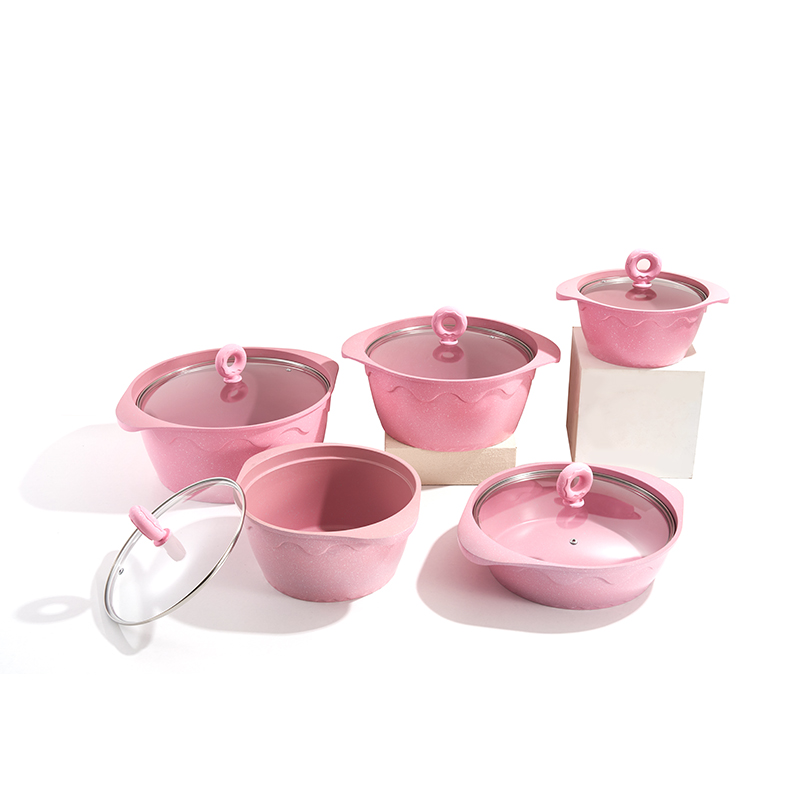
This cookware set is made of food-grade non-stick material, with a unique eye-ca...
See Details -
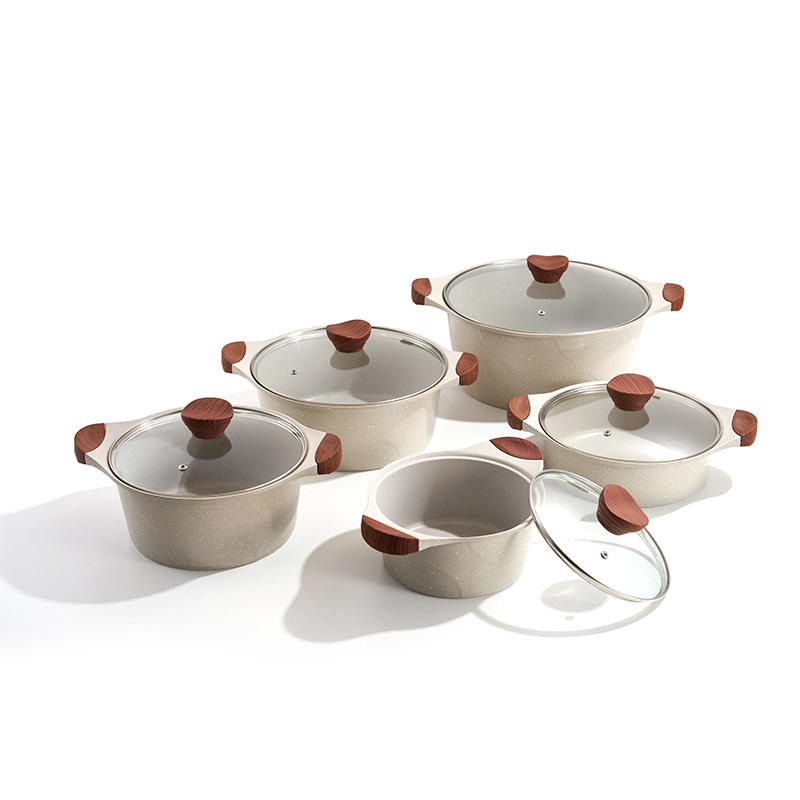
This off-white cookware set is made of wear-resistant non-stick material, with w...
See Details
Whether you're looking for bulk purchases or have any custom requirements, We are here to offer the best
solutions for you.
tiffany.zhong@echocn-trading.com
PHONE
+86-19561173975
+86-19557020621 (Hazel Wu)
ADD
Room 301, Unit 3014, No. 175 Qifeng Avenue, Wenqiao Town, Taizhou, Zhejiang, China
Fill Out the Form for More Information
Copyright © Zhejiang Echo Industry And Trade Co., Ltd.
All Rights Reserved.

China Cookware Set Manufacturer