
 en
 Español

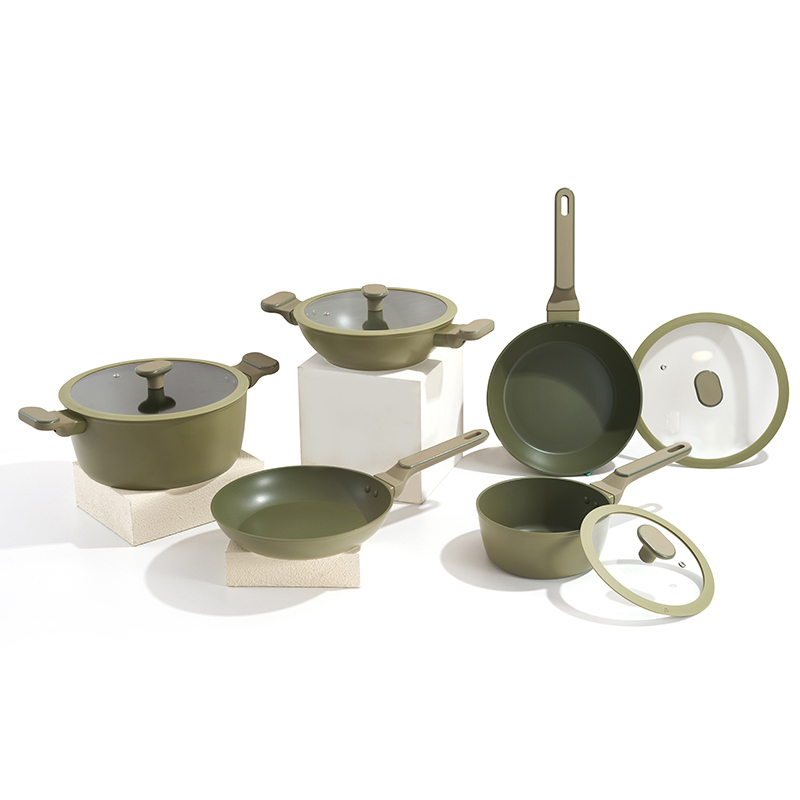
This cookware set features a non-stick coating, even heat conduction, and multi-...
See Details
Multicolor Silicone Kitchen Utensils: A Practical Guide to Safer, More Efficient, and More Flexible Cooking Tools
Date:Oct 01, 2026
Multicolor Silicone Kitchen Utensil
Kitchen utensils are among the most frequently used products in any household, restaurant, catering operation, hotel, or food-preparation facility. Although utensils may appear simple, their design, material combination, heat resistance, comfort, storage convenience, and long-term durability can strongly influence the cooking experience. A well-designed utensil should help users prepare food efficiently while protecting cookware surfaces and remaining easy to clean after use.
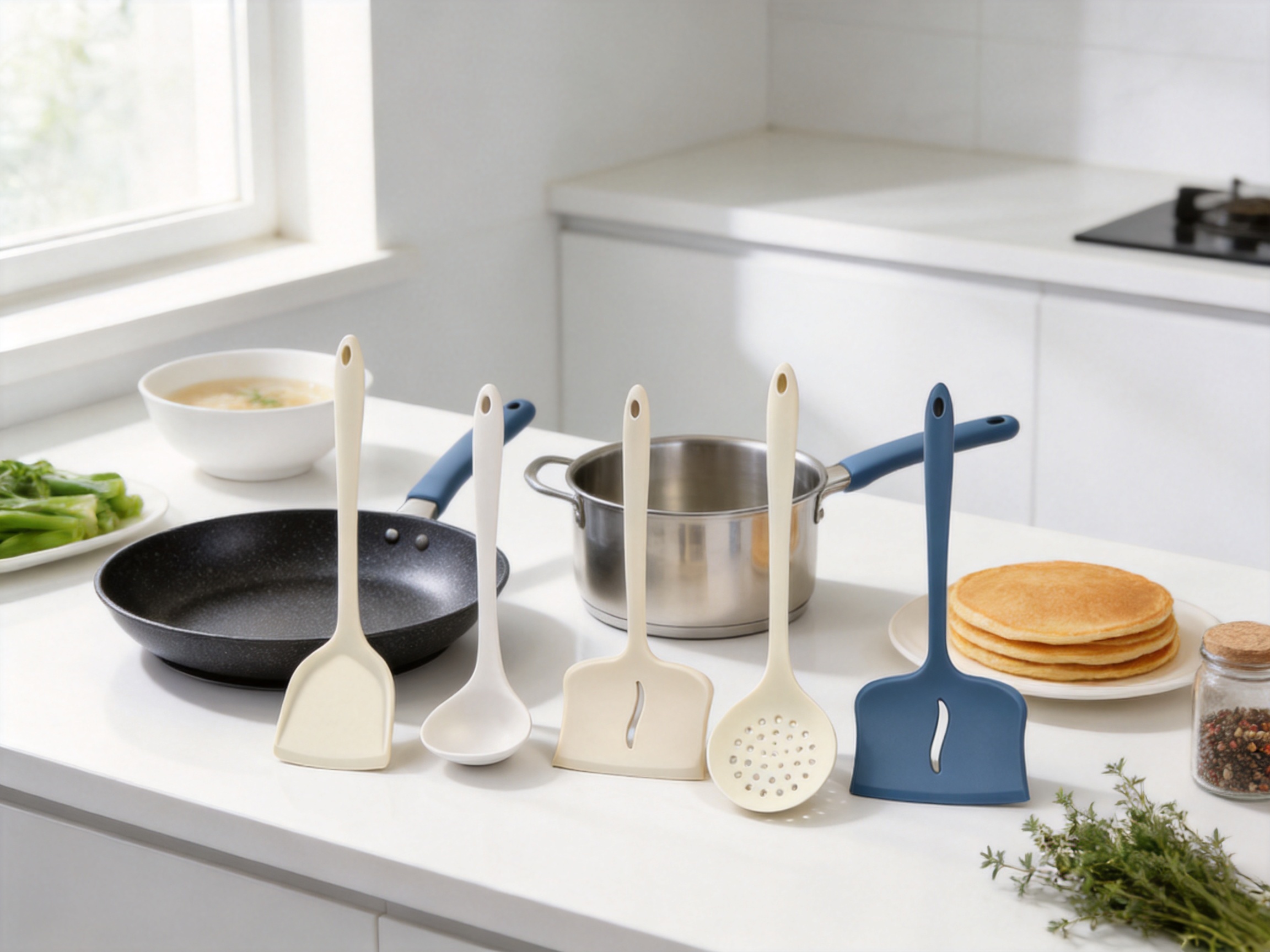
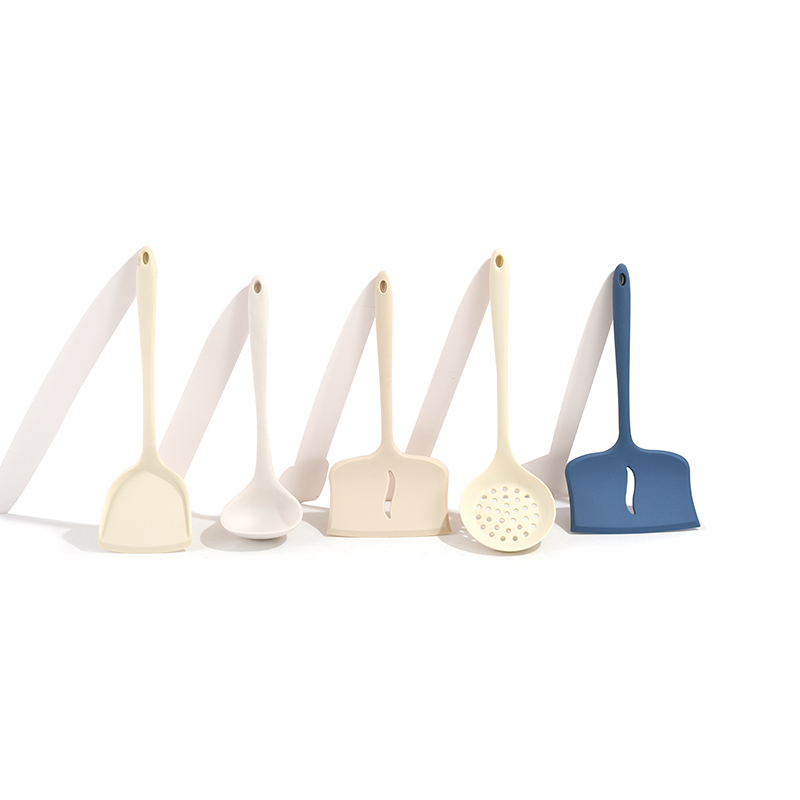
The Multicolor Silicone Kitchen Utensil range, supplied by Zhejiang Echo Industry And Trade Co., Ltd., is designed to meet these practical requirements through a combination of silicone and nylon construction. The range includes a spatula, soup ladle, strainer, and pancake shovel. Each tool is shaped for a specific cooking task, while the assortment provides buyers with a flexible foundation for household kitchens, cookware gift sets, restaurant supply programs, promotional bundles, and private-label projects.
With a selection of commonly used tools, white and blue color options, coordinated product specifications, and packaging suited to bulk distribution, this series is positioned as a useful alternative to ordinary single-material plastic utensils or unprotected metal tools. Its main value is not based on decoration alone. Instead, the product combines functional design, cookware-friendly contact surfaces, organized bulk packing, and supplier support for buyers seeking consistent kitchenware sourcing.
1. Product Overview
The Multicolor Silicone Kitchen Utensil series is available under the product codes ZY01, ZY02, ZY03, and ZY05. The range contains four essential kitchen tools:
| Product | Product Size | Primary Use |
|---|---|---|
| Spatula | 32.5 × 10 cm | Turning, lifting, spreading, and serving food |
| Soup Ladle | 30 × 8.5 cm | Serving soup, sauces, stews, and liquid foods |
| Strainer | 29 × 13 cm | Draining, lifting, rinsing, and separating food |
| Pancake Shovel | 29 × 13 cm | Turning pancakes, crepes, eggs, and flat foods |
The utensils are made from silicone and nylon. This combination allows the product to balance flexibility and structural support. Silicone is used where a soft, cookware-friendly contact surface is important, while nylon contributes to the utensil’s shape retention and functional strength. The combination is especially suitable for users who want tools that are gentler on cookware than exposed metal edges.
The listed color choices are white and blue. These colors can be used individually, mixed within a product assortment, or coordinated with broader cookware and kitchen accessory collections. A multicolor presentation can make a utensil set more attractive on retail shelves and can also help users distinguish different tools quickly in a busy kitchen.
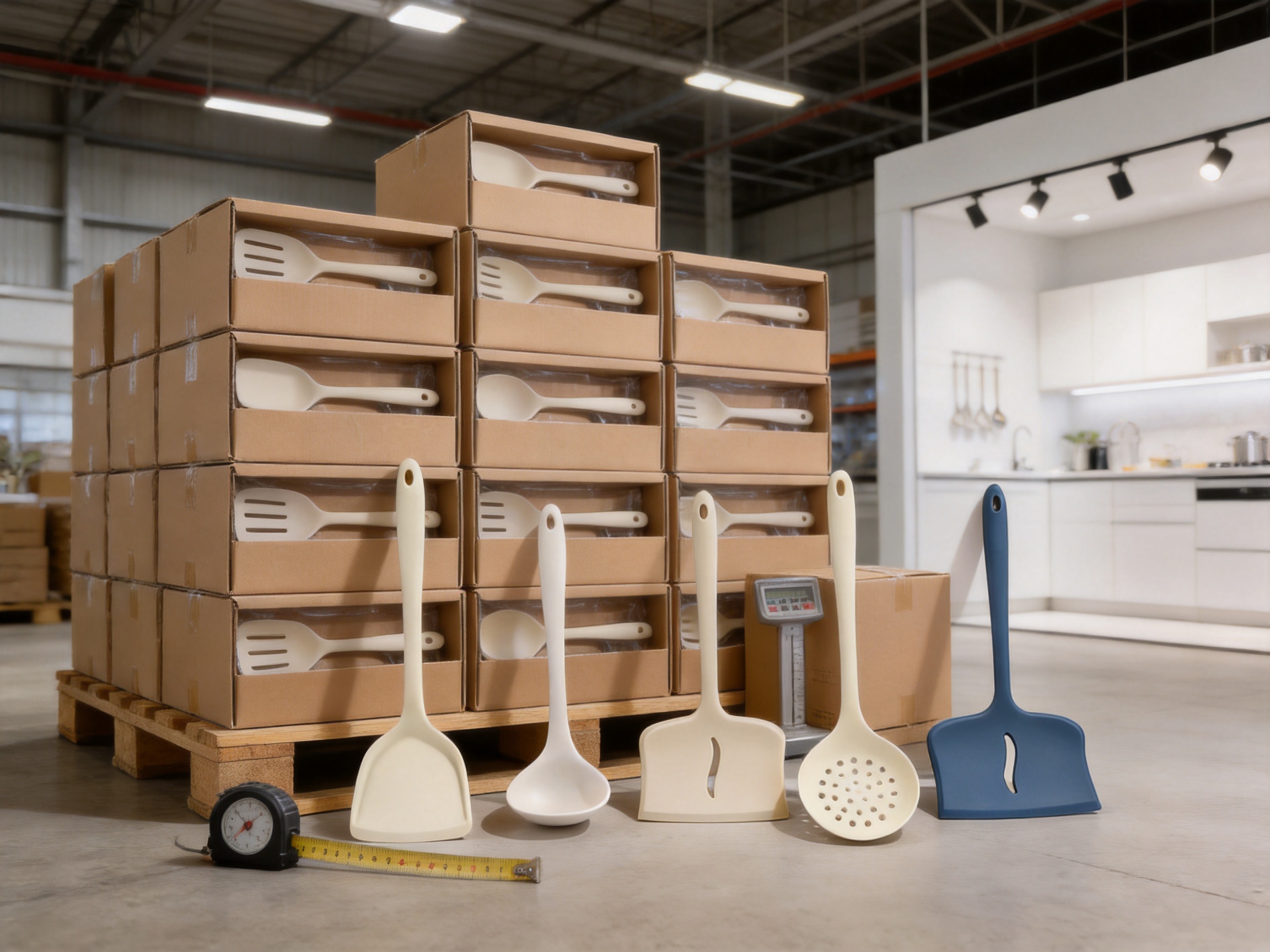
The product is packed in cartons of 100 pieces. The carton size is 50 × 30 × 15 cm, with a calculated carton volume of 0.0225 cubic meters and a carton weight of 13.5 kilograms. These specifications are important for importers, distributors, wholesalers, and e-commerce sellers because they support shipping calculations, warehouse planning, container loading estimates, and quotation preparation.
2. Why Silicone and Nylon Are Effective Materials for Kitchen Utensils
Material selection is one of the most important factors in utensil performance. A utensil may have an attractive shape, but it will not be successful if its material becomes brittle, scratches cookware, absorbs excessive odors, or loses its shape during normal use. Silicone and nylon are widely used in kitchen tools because their characteristics complement one another.
2.1 Silicone for cookware-friendly contact
Silicone is valued in kitchen utensils because it provides a comparatively soft and flexible contact surface. When a spatula or pancake shovel is used on a coated pan, a softer edge can help reduce the risk of scratching associated with exposed hard metal tools. This makes the range suitable for modern kitchens that use non-stick frying pans, ceramic-coated cookware, enamel cookware, and other surfaces that require careful handling.
The flexible nature of silicone also helps a spatula conform to the curve of a pan or the surface of a food item. This is useful when lifting delicate foods, scraping batter, turning pancakes, or removing food from corners. A rigid tool may leave food behind or require more pressure, while a flexible tool can provide more complete contact with the cooking surface.
Silicone is also easy to wipe and generally presents a smooth surface with fewer areas where food particles can become trapped. This can support efficient cleaning in both domestic and professional environments. For retailers, the easy-care characteristic is a practical selling point because consumers increasingly look for utensils that fit into fast-paced kitchen routines.
2.2 Nylon for support and usability
Nylon contributes a degree of firmness and structural support to the utensil design. A spatula must be flexible enough to slide beneath food, but it must also be firm enough to lift that food without excessive bending. A soup ladle needs to maintain its bowl shape while carrying liquid. A strainer must retain its form while lifting cooked ingredients or draining water. Nylon helps provide the supporting structure required for these different applications.
The use of nylon in combination with silicone allows the manufacturer to create utensils that are neither excessively rigid nor overly soft. This balance is important because a utensil that bends too easily can feel weak, while a tool that is too hard may be less suitable for coated cookware. The composite approach offers a practical middle ground for regular household and commercial use.
2.3 The value of a combined-material design
Compared with basic plastic utensils, a silicone and nylon construction can provide a more refined balance of flexibility, surface protection, and appearance. Compared with all-metal utensils, it can offer a gentler interaction with cookware. Compared with low-cost soft rubber tools, the nylon component can help improve structural stability and handling precision.
The value of this design is particularly clear when the four utensils are considered as a coordinated range. The spatula, soup ladle, strainer, and pancake shovel are designed for different motions, but they share a consistent material concept. This creates a unified product family that can be marketed as a set or supplied as individual stock-keeping units.
3. Functional Advantages of the Four-Piece Range
A major advantage of this product range is that it addresses several common cooking tasks without requiring buyers to source unrelated utensils from multiple suppliers. Each tool has a clear role, and together the products can support daily food preparation from frying and turning to serving and draining.
3.1 Spatula for turning and serving
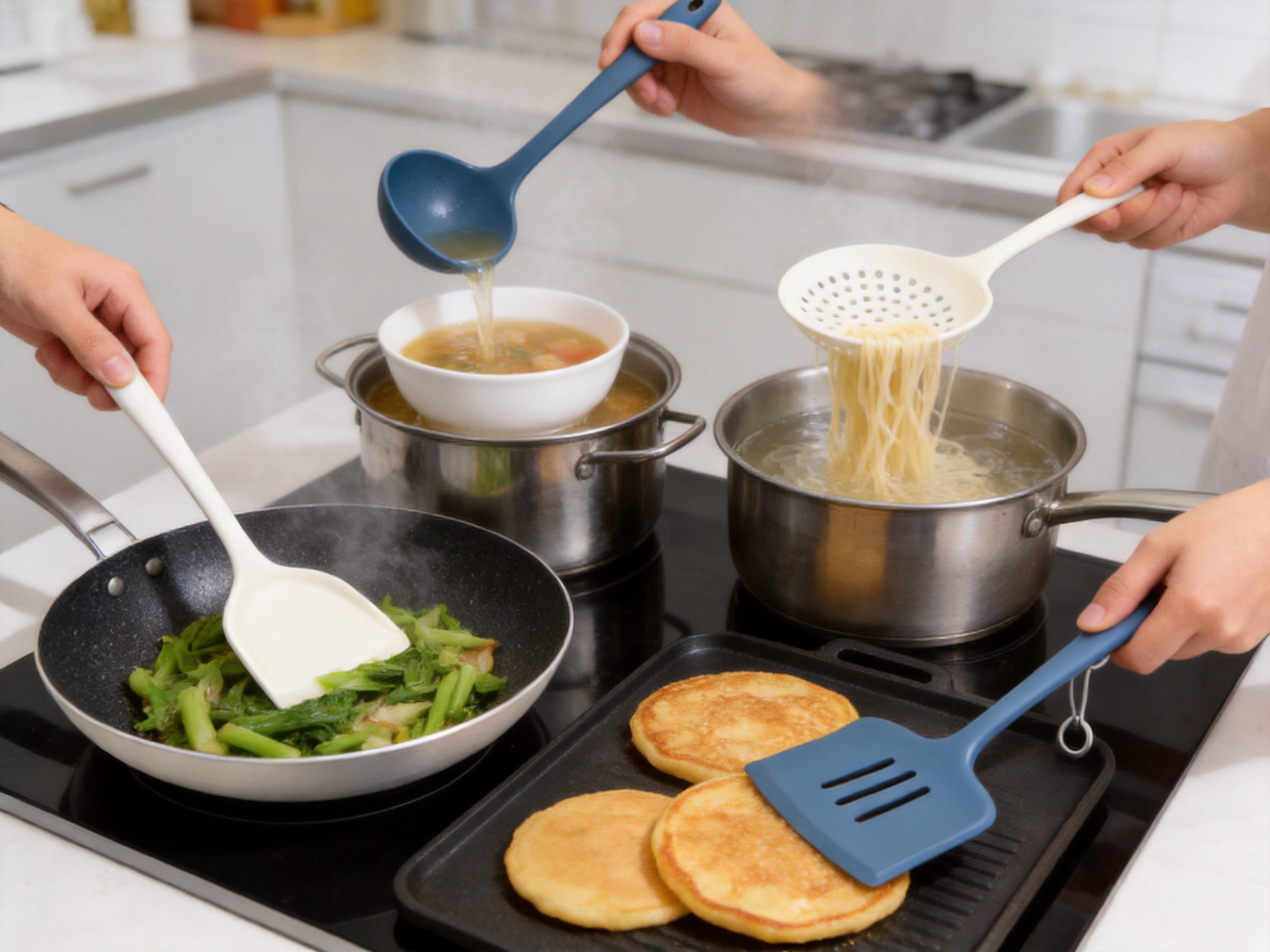
The 32.5 × 10 cm spatula provides a broad working surface for lifting, turning, spreading, and serving. Its length gives the user space between the hand and the cooking surface, while its width helps support food during transfer. It can be used for fried eggs, vegetables, fish portions, burgers, pancakes, grilled foods, and other items that require a broad lifting surface.
A silicone contact edge can be especially useful when users need to slide beneath food without damaging a coated pan. The flexibility can also help the tool follow the shape of the pan during scraping or turning. For retail customers, the spatula is often one of the most recognizable and frequently purchased kitchen tools, making it an effective anchor product for a larger utensil assortment.
3.2 Soup ladle for liquid foods
The soup ladle measures 30 × 8.5 cm and is intended for soups, broths, sauces, gravies, stews, and other liquid or semi-liquid foods. The ladle format helps transfer portions from a deep pot to a bowl or serving dish with less spilling than a flat utensil would allow.
A ladle is also useful for portion control in commercial kitchens. Restaurants and catering operations may use the same tool to serve consistent amounts of soup or sauce. For household users, the tool can simplify the serving of family meals. Its inclusion in the product range broadens the assortment beyond frying tools and makes the collection more suitable for complete kitchen accessory programs.
3.3 Strainer for draining and lifting
The 29 × 13 cm strainer is intended for separating food from liquid. It may be used to lift vegetables, noodles, dumplings, fried foods, or other ingredients from cooking water or oil, depending on the cooking application. A strainer can also be useful for rinsing or transferring ingredients while allowing excess liquid to drain away.
The presence of a strainer adds versatility to the series. Buyers do not need to treat the range as a narrow group of serving tools. Instead, they can present it as a practical collection that supports cooking, draining, lifting, and serving operations.
3.4 Pancake shovel for delicate flat foods
The pancake shovel measures 29 × 13 cm and is shaped for turning or lifting relatively flat foods. Pancakes, crepes, omelets, fried eggs, toast, and similar foods can benefit from a broad turning tool. The size provides useful coverage, while the silicone-based contact surface is suitable for cookware where users want to avoid direct contact with hard metal edges.
The pancake shovel can also be marketed as a breakfast and baking accessory. Retailers may position it alongside frying pans, crepe pans, griddles, pancake makers, or breakfast-themed cookware collections. Its larger surface area gives it a distinct purpose within the range rather than duplicating the function of the standard spatula.
4. Advantages Compared with Common Competitor Products
Kitchen utensil buyers generally compare products according to material, usability, appearance, durability, pricing, packaging, and supply reliability. The Multicolor Silicone Kitchen Utensil series offers several advantages when compared with basic plastic tools, exposed metal utensils, and uncoordinated low-cost assortments.
4.1 More cookware-friendly than exposed metal tools
Metal utensils can be strong and long-lasting, but exposed metal edges may create a greater risk of scratching or marking some cookware surfaces if used carelessly. The silicone contact components in this range provide a softer alternative for everyday cooking. This is especially relevant as non-stick cookware becomes increasingly common in household and commercial kitchens.
For cookware suppliers, this advantage creates a natural cross-selling opportunity. A retailer selling aluminum cookware with a coated interior, stainless steel cookware with delicate finishes, or multi-piece cookware sets can add silicone-based utensils as complementary accessories. The utensils can be positioned as a practical way to help users handle cookware more carefully.
4.2 More functional than single-purpose novelty tools
Some low-cost utensil assortments focus heavily on color or novelty while offering limited practical variation. This range includes four tools with clearly different functions. The collection can therefore deliver genuine daily utility rather than relying only on visual appeal.
The selection also allows distributors to create different commercial formats. Products can be sold individually for replacement purchases, grouped into a four-piece set for household buyers, or combined with cookware as part of a larger kitchen package. This flexibility can help reduce the need for separate product development for each sales channel.
4.3 More coordinated than mixed-source assortments
When a buyer sources spatulas, ladles, strainers, and pancake tools from different manufacturers, differences in color, surface finish, dimensions, packaging, and quality may become visible. A coordinated range can provide a more consistent shelf presentation and a more professional appearance in hospitality or promotional programs.
The white and blue color options allow the buyer to choose a clean, modern visual identity or create a mixed-color assortment. This can be useful for retailers that organize products by color theme or for importers that want a simple but recognizable kitchen accessory line.
4.4 Better suited to private-label and OEM programs
Many buyers do not simply want generic products. They may need utensils that fit a particular cookware brand, retail identity, gift-box concept, or promotional campaign. The supplier’s stated ODM and OEM capabilities can support discussions about customized product programs, subject to technical review, order requirements, packaging specifications, and production feasibility.
Customization may involve product color, packaging design, assortment composition, labeling, or other approved details. For small and medium-sized buyers, the availability of one-stop sourcing and flexible minimum order quantities can be especially valuable because it may reduce the complexity of coordinating several factories.
5. Manufacturing and Quality-Oriented Strengths
The performance of a kitchen utensil depends not only on the material specification but also on how the product is developed, formed, assembled, inspected, packed, and prepared for shipment. Zhejiang Echo Industry And Trade Co., Ltd. presents itself as a professional kitchenware supplier based in Zhejiang, China, a region known for manufacturing and export activity.
5.1 Product development from practical usage requirements
An effective utensil begins with an understanding of how it will be used. The shape of a spatula must support lifting and turning. A ladle must carry liquid without unnecessary spilling. A strainer must allow drainage while retaining food. A pancake shovel must combine broad coverage with manageable control.
The four products in this range show a practical product-development approach because they address distinct cooking movements rather than simply repeating one shape in different sizes. This application-oriented design can improve the commercial value of the range and make it easier for buyers to explain the product benefits to customers.
5.2 Material combination and production control
Products made with more than one material require attention to compatibility, fit, surface quality, and consistency. Silicone and nylon components must be formed and combined in a way that supports the intended structure of each utensil. The production process should maintain consistent dimensions, stable joining, smooth surfaces, and clean edges.
For a buyer, this means that product quality should be evaluated across a shipment rather than through a single sample only. Consistency in length, width, shape, color, surface finish, and assembly is essential for retail presentation and customer satisfaction. A professional supplier should be able to discuss sample approval, production specifications, inspection procedures, and packing standards before mass production.
5.3 Manufacturing workflow for export-oriented supply
An export-oriented kitchenware supplier typically needs to coordinate multiple stages: product confirmation, material preparation, forming, component assembly, appearance inspection, quantity verification, carton packing, and shipment documentation. Zhejiang Echo Industry And Trade Co., Ltd. describes its services as including product variety, one-stop sourcing, ODM and OEM customization, product certification assistance, flexible MOQs, and sustainable and healthy product development.
These capabilities are significant for overseas buyers because international sourcing involves more than manufacturing alone. Buyers need clear communication, reliable specifications, suitable packaging, and support with documentation or compliance preparation. A supplier that can coordinate these areas may help reduce the administrative burden associated with importing kitchen accessories.
5.4 Inspection considerations for silicone and nylon utensils
Inspection of this product category can include visual, dimensional, functional, packaging, and quantity checks. Visual inspection may examine color uniformity, surface smoothness, edge condition, mold marks, contamination, and assembly quality. Dimensional inspection may verify the listed lengths and widths. Functional checks may confirm that the spatula and pancake shovel have appropriate flexibility, that the ladle retains its shape, and that the strainer performs its draining function.
Packaging inspection should confirm that the correct number of pieces is packed per carton, that color assortments match the purchase order, and that cartons are properly labeled and protected for transport. These checks are particularly important when a buyer is preparing products for retail or distributing them across multiple markets.
5.5 Certification assistance and market preparation
The supplier states that it can assist with product certification. This should be understood as support during the certification or documentation process rather than an automatic guarantee that every product meets every market requirement. Importers should identify the regulations applicable to their destination market and confirm the exact testing, labeling, food-contact, packaging, and documentation requirements before placing a commercial order.
This type of support can still be valuable. A supplier familiar with export documentation and buyer requirements may help organize product information, material details, samples, packaging data, and other information needed by testing agencies or importing companies. Early communication can reduce the possibility of delays caused by incomplete specifications.
6. Supply Chain Advantages for Different Buyers
The Multicolor Silicone Kitchen Utensil range can serve several types of buyers. Its standard product structure makes it suitable for established importers, while the supplier’s customization and sourcing services can support more specialized projects.
6.1 Wholesalers and distributors
Wholesalers can purchase the utensils in bulk and distribute them to supermarkets, department stores, cookware shops, hospitality suppliers, and online sellers. The carton quantity of 100 pieces supports bulk handling, while the four product types allow distributors to offer a broader selection under one sourcing program.
Because the tools serve everyday cooking purposes, distributors may benefit from repeat demand. Spatulas and ladles are common replacement purchases, and the series can also be included in seasonal household promotions, moving-home packages, wedding gift collections, or cookware bundles.
6.2 Retailers and e-commerce sellers
Retailers can present the utensils as individual products or as a coordinated set. The white and blue colors provide a simple visual identity suitable for product photography and shelf display. E-commerce sellers can emphasize the cookware-friendly design, the combined silicone and nylon construction, the four available functions, and the dimensions of each tool.
Online sellers should provide accurate descriptions and clear size information. Showing the distinction between a standard spatula and a pancake shovel can help customers select the right tool. Listing the soup ladle and strainer separately can also attract buyers looking for replacement items rather than a complete set.
6.3 Cookware brands
Cookware brands can use the utensils as complementary accessories. A cookware set may be enhanced with a matching spatula, ladle, strainer, or pancake shovel. This approach can increase the perceived completeness of a cookware package and give consumers a useful accessory immediately after purchase.
For aluminum cookware, stainless steel cookware, and iron cookware collections, silicone and nylon utensils can provide a contrast to the hard cookware body while offering a surface designed for gentler handling. This creates a logical product relationship between the cookware and the accessory.
6.4 Hospitality and food-service buyers
Restaurants, hotels, catering companies, and institutional kitchens often need practical tools that can be replaced or replenished in volume. The carton quantity and standardized product codes can simplify purchasing. Different utensils can be allocated to specific preparation stations, such as frying, soup service, draining, or breakfast preparation.
Commercial buyers should evaluate the utensils according to their own operating conditions, including cooking temperatures, cleaning procedures, frequency of use, and local food-contact requirements. A sample evaluation before bulk purchasing is recommended, particularly for high-volume professional use.
6.5 Promotional and gift-set programs
The color options and product variety make the range suitable for promotional programs. A company may include a utensil with a cookware purchase, a supermarket campaign, a housewarming package, or a seasonal gift box. Buyers can select one tool for a promotional offer or combine several tools into a larger package.
OEM and ODM discussions can help determine whether the product can be adapted to the buyer’s branding, packaging, color requirements, or assortment strategy. The final possibilities depend on order quantity, tooling, packaging design, production schedules, and supplier confirmation.
7. Packaging, Logistics, and Bulk-Order Planning
Logistics can significantly influence the final cost of kitchen accessories. Product dimensions, carton quantity, gross weight, carton volume, stacking method, and loading efficiency all affect freight calculations. The listed packaging information provides buyers with a useful starting point for planning.
| Logistics Item | Specification | Buyer Relevance |
|---|---|---|
| Carton quantity | 100 pieces | Supports wholesale purchasing and inventory calculations |
| Carton size | 50 × 30 × 15 cm | Useful for warehouse and freight planning |
| Carton volume | 0.0225 m³ | Helps estimate shipment volume |
| Carton weight | 13.5 kg | Supports freight and handling calculations |
Importers should confirm whether the carton weight is gross or net weight and should verify the final packing method before shipment. They should also confirm the number of pieces per color, the assortment of product codes, inner packaging details, carton markings, palletization requirements, and export documentation.
For larger orders, buyers can use the carton volume to estimate the approximate space required for a shipment. The calculation should be treated as an initial planning figure because final loading efficiency depends on carton orientation, pallet use, container dimensions, mixed products, and any additional protective packaging.
Good packaging should help protect the silicone and nylon utensils from deformation, contamination, excessive friction, and carton damage during transportation. It should also present the product in an organized way when the carton is opened by a distributor or warehouse operator. Clear labeling can reduce errors during receiving and inventory management.
8. Product Presentation and Retail Positioning
The commercial success of a kitchen utensil often depends on how clearly its benefits are communicated. Buyers should avoid presenting the range as merely a group of colorful tools. The strongest product story combines material, function, cookware compatibility, coordinated design, and supply convenience.
8.1 Communicating the material benefit
Retail descriptions can explain that the utensils use a silicone and nylon construction designed to balance a flexible cookware-contact surface with supportive structure. This is more informative than simply stating that the products are colorful or modern.
Product packaging should use accurate language and avoid unsupported technical claims. If the buyer requires specific heat-resistance ratings, food-contact statements, dishwasher suitability, or other performance information, these details should be confirmed through supplier documentation or appropriate testing before being printed on the packaging.
8.2 Communicating the functional benefit
Each tool should be presented according to its intended use. The spatula can be associated with turning and serving. The soup ladle can be associated with soups and sauces. The strainer can be associated with draining and lifting. The pancake shovel can be associated with pancakes, crepes, eggs, and other flat foods.
Clear functional positioning helps customers understand why the range contains multiple tools. It also allows retailers to create search terms and product categories that match customer intent.
8.3 Communicating the visual benefit
White and blue provide a clean and recognizable appearance. White can suggest simplicity and freshness, while blue can create a calm and contemporary kitchen impression. The two colors may be marketed separately or combined to create a coordinated multicolor presentation.
For private-label buyers, color selection can be aligned with existing cookware, kitchen textiles, packaging, or brand guidelines. Color consistency should be confirmed with approved samples before large-scale production because visual differences can affect retail presentation.
9. Sustainable and Healthy Product Development Considerations
The supplier identifies sustainable and healthy product development as part of its broader service direction. For kitchen utensils, responsible product development may involve careful material selection, longer service life, efficient packaging, reduced unnecessary components, and improved supply-chain planning.
Durable utensils can help reduce the frequency of replacement when they remain suitable for regular use. A coordinated product range may also reduce the need for buyers to source multiple small shipments from different suppliers. Efficient carton planning can help improve transport utilization, although actual environmental performance depends on the complete manufacturing and logistics process.
Buyers that have sustainability targets should request specific information rather than relying only on general statements. Relevant topics may include material composition, packaging materials, production waste management, factory energy practices, product lifespan, and available documentation. These discussions can help align a product program with the buyer’s environmental and social responsibility requirements.
Healthy product development also requires attention to food-contact suitability and market regulations. Buyers should identify the standards applicable to their destination country and confirm the available testing or certification documents. The supplier’s certification assistance can be useful during this process, but the importer remains responsible for ensuring that the final product complies with local requirements.
10. Recommended Purchasing Process
A structured purchasing process can reduce misunderstandings and improve the outcome of an international kitchenware order.
10.1 Define the commercial purpose
First, the buyer should decide whether the utensils will be sold individually, offered as a four-piece set, bundled with cookware, used in hospitality operations, or distributed as promotional products. The intended market influences packaging, color selection, labeling, quantity, and compliance requirements.
10.2 Confirm the product assortment
The buyer should confirm the required product codes: ZY01, ZY02, ZY03, and ZY05. The buyer should also identify the desired quantity of each tool and determine whether white, blue, or a mixed-color assortment is needed.
10.3 Review samples
Samples should be evaluated for dimensions, balance, flexibility, surface finish, assembly quality, appearance, and practical function. Testing should reflect the intended use. For example, a buyer may slide the spatula beneath food, use the ladle with liquid, evaluate the strainer’s drainage, and turn flat foods with the pancake shovel.
10.4 Confirm specifications in writing
Approved specifications should include product code, material description, dimensions, color, packaging, carton quantity, carton markings, and any customization requirements. A written specification reduces the possibility of differences between the approved sample and the mass-produced order.
10.5 Discuss compliance and documentation
The buyer should explain the destination market and identify any required food-contact, labeling, packaging, or testing documentation. This discussion should take place before production so that the supplier can advise on available documents and the buyer can arrange independent testing if necessary.
10.6 Plan shipment and inspection
Before shipment, the buyer should confirm carton quantity, carton dimensions, weight, shipping marks, loading instructions, and inspection arrangements. Independent inspection may be considered for large orders or customized products. This process helps confirm that the finished goods match the purchase order.
11. Why Zhejiang Echo Industry And Trade Co., Ltd. Is a Suitable Supply Partner
Zhejiang Echo Industry And Trade Co., Ltd. is based in Taizhou, Zhejiang, China. The company presents itself as a kitchenware supplier with a focus on cookware and kitchen accessories. Its product coverage includes aluminum cookware, stainless steel cookware, cast iron cookware, and kitchen utensils.
This broad product scope can be advantageous for buyers that want to consolidate sourcing. Instead of purchasing cookware from one supplier and utensils from another, a buyer may be able to discuss a more complete kitchenware program through one supply partner. Consolidated sourcing can simplify communication, reduce the number of purchase relationships, and support a more unified product collection.
The company describes its long-term direction as becoming an R&D-driven supply chain partner for small and medium-sized kitchenware buyers rather than simply accepting orders. This approach is relevant to the Multicolor Silicone Kitchen Utensil range because buyers may require assistance with product selection, assortment development, OEM packaging, market preparation, and complementary cookware programs.
Its stated services include one-stop sourcing, ODM and OEM customization, flexible minimum order quantities, product certification assistance, and sustainable and healthy product development. These services are particularly useful for buyers that do not have a large internal product-development team. A supplier capable of discussing both standard products and customized projects can provide a more flexible purchasing experience.
The company’s location in Zhejiang also places it within an established manufacturing and export region. Regional manufacturing networks can support access to production resources, packaging suppliers, logistics providers, and related kitchenware categories. For international buyers, regional specialization can be an advantage when building a broader product line.
12. Best Applications for the Product Series
The range is suitable for many applications because the product functions are familiar and widely needed.
Household kitchens requiring everyday cooking and serving tools.
Cookware gift sets that need complementary accessories.
Retail kitchenware collections organized around color or material.
Restaurant and catering supply programs requiring standard replacement utensils.
Hotel breakfast and food-service operations using spatulas and pancake tools.
Supermarket promotional campaigns and seasonal household offers.
Private-label kitchen accessory collections.
E-commerce bundles containing cooking tools for new homeowners or students.
The product range is especially suitable for buyers seeking a balance between practical function and accessible presentation. The tools are not limited to a single cooking style or market segment, which can help distributors adapt the assortment to different channels.
13. Care, Use, and Customer Guidance
End users should use the utensils for their intended cooking applications and avoid practices that could damage any kitchen tool. Buyers may wish to provide care instructions with the final product, especially when the utensils are sold under a private label.
Users should avoid cutting directly on the utensil surface with sharp knives. They should also avoid exposing the tools to conditions outside the confirmed product specifications. Cleaning instructions should be based on supplier information and any applicable testing results. If dishwasher use has not been verified, packaging should not make an unsupported dishwasher-safe claim.
Proper storage can help prevent bending, deformation, or unnecessary surface contact with sharp objects. In commercial kitchens, utensils should be cleaned after use and stored in a manner that supports hygiene and easy access.
Retailers should communicate that cookware-friendly does not mean completely scratch-proof under every condition. Customers should still use reasonable care, avoid dragging utensils forcefully across cookware, and follow the maintenance instructions provided with their pans.
14. Frequently Asked Questions
Q1: What products are included in the Multicolor Silicone Kitchen Utensil range?
The range includes a spatula, soup ladle, strainer, and pancake shovel. The product codes are ZY01, ZY02, ZY03, and ZY05.
Q2: What materials are used?
The utensils are made from silicone and nylon. This combination is intended to provide a balance between a flexible, cookware-friendly contact surface and supportive structure.
Q3: What colors are available?
The listed colors are white and blue. Buyers should confirm the desired color assortment and quantities before placing an order.
Q4: What are the product dimensions?
The spatula measures 32.5 × 10 cm. The soup ladle measures 30 × 8.5 cm. The strainer measures 29 × 13 cm. The pancake shovel measures 29 × 13 cm.
Q5: Are the utensils suitable for non-stick cookware?
The silicone contact surface is designed to be gentler on cookware than exposed hard metal edges. However, users should still handle utensils carefully and avoid forceful dragging or cutting actions.
Q6: Can the products be purchased individually?
The range can be discussed as individual products or as a coordinated assortment. Buyers should confirm the available purchasing format, minimum order quantity, and packaging arrangement with the supplier.
Q7: Can the products be customized?
The supplier states that it provides ODM and OEM customization. Possible customization subjects may include color, packaging, labeling, assortment, or other approved details. Final options depend on order requirements, technical feasibility, and supplier confirmation.
Q8: What is the bulk carton quantity?
The listed carton quantity is 100 pieces. Buyers should confirm the exact product mix and whether the carton contains one product type or a mixed assortment.
Q9: What are the carton dimensions and weight?
The listed carton size is 50 × 30 × 15 cm, the carton volume is 0.0225 cubic meters, and the carton weight is 13.5 kilograms. The buyer should confirm whether the stated weight is gross or net weight before final freight planning.
Q10: Can the supplier help with certification requirements?
The supplier states that it offers product certification assistance. Buyers should provide the destination market and confirm the exact documents, testing, labeling, and food-contact requirements applicable to their products.
Q11: Are these utensils suitable for restaurants and hotels?
They may be suitable for hospitality and food-service applications because the range includes common preparation and serving tools. Commercial buyers should conduct sample evaluations based on their cooking temperatures, cleaning practices, frequency of use, and local requirements.
Q12: Can the utensils be combined with cookware products?
Yes. The utensils can be marketed alongside aluminum cookware, stainless steel cookware, cast iron cookware, frying pans, soup pots, griddles, and cookware gift sets. This creates opportunities for cross-selling and complete kitchen packages.
Q13: What should buyers check before placing a large order?
Buyers should check samples, dimensions, materials, color, packaging, product codes, carton quantity, documentation, inspection procedures, delivery schedule, and customization details. All approved information should be recorded in the purchase order or product specification sheet.
Q14: Who is the product most suitable for?
The product is suitable for kitchenware wholesalers, cookware brands, retailers, online sellers, hospitality suppliers, promotional distributors, and private-label buyers seeking practical silicone and nylon kitchen utensils.
15. Conclusion
The Multicolor Silicone Kitchen Utensil range provides a practical combination of everyday function, cookware-friendly design, coordinated appearance, and bulk-supply convenience. With a spatula, soup ladle, strainer, and pancake shovel, the assortment addresses several essential cooking and serving tasks while remaining flexible enough for individual sales, complete sets, cookware bundles, hospitality supply, and promotional programs.
Its silicone and nylon construction offers a useful balance between soft contact and structural support. Compared with exposed metal tools, the utensils are better suited to users who want to handle coated cookware carefully. Compared with basic single-material plastic tools, the combined-material design and coordinated assortment provide a more developed product proposition.
The product is supported by a supplier that offers a broad kitchenware portfolio, one-stop sourcing, ODM and OEM services, flexible minimum order discussions, certification assistance, and an expressed focus on sustainable and healthy product development. These strengths can help importers and brands create a more complete kitchen accessory program rather than purchasing isolated items.
For the best results, buyers should evaluate samples, confirm final specifications, identify destination-market requirements, and establish clear packaging and inspection procedures before mass production. With careful product positioning and suitable supply planning, this utensil series can serve as a reliable addition to household, retail, cookware, hospitality, and private-label kitchenware collections.
References
1. Product specification sheet for Multicolor Silicone Kitchen Utensil, including product codes, dimensions, materials, colors, carton quantity, carton size, carton volume, and carton weight.
2. General principles of kitchen utensil design, cookware surface protection, and material selection for household and commercial food preparation.
3. International purchasing and quality-control practices for kitchenware, including sample approval, dimensional inspection, packaging verification, and shipment planning.
4. General guidance on food-contact product documentation, market-specific compliance evaluation, labeling, and certification preparation.
5. Supplier information concerning cookware categories, kitchen accessory sourcing, ODM and OEM customization, certification assistance, flexible minimum order quantities, and sustainable product development.
Product: Multicolor Silicone Kitchen Utensil
Recommended Articles
Product Category
Related products
-
-
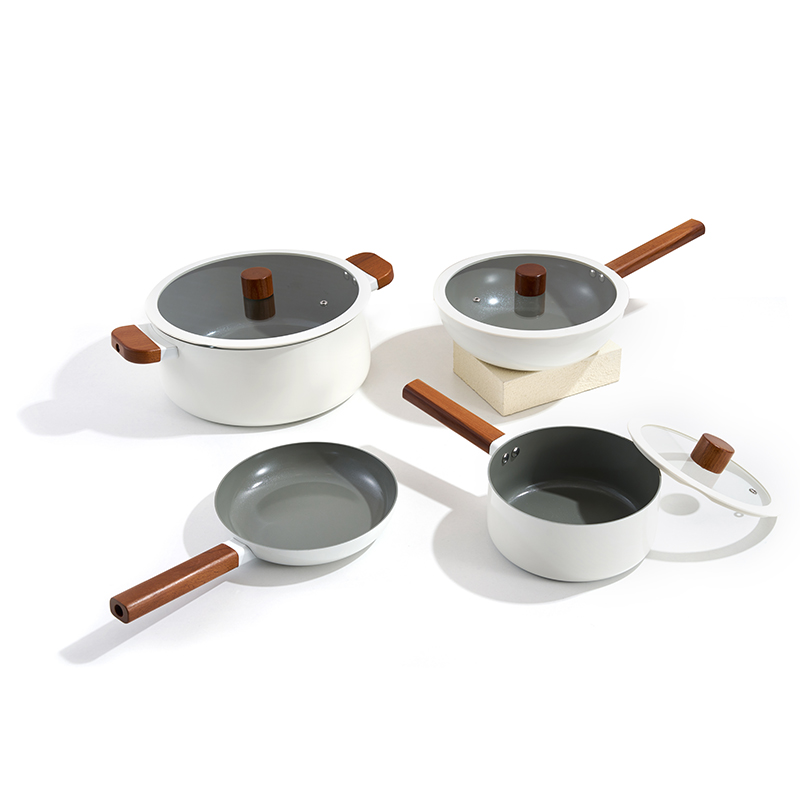
This cookware set has a ceramic non-stick inner liner, a heat-resistant wooden h...
See Details -
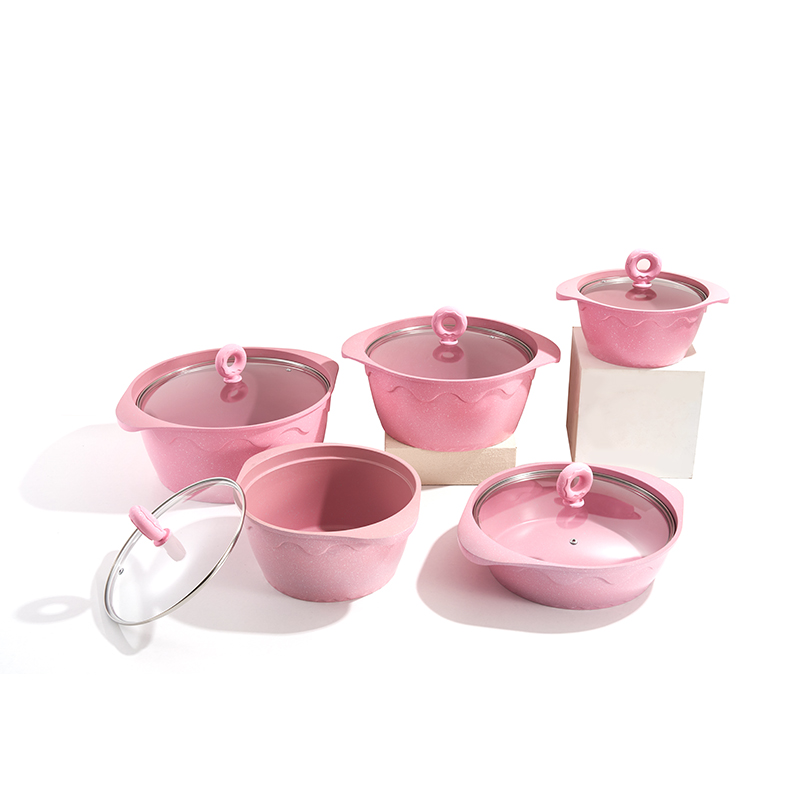
This cookware set is made of food-grade non-stick material, with a unique eye-ca...
See Details -
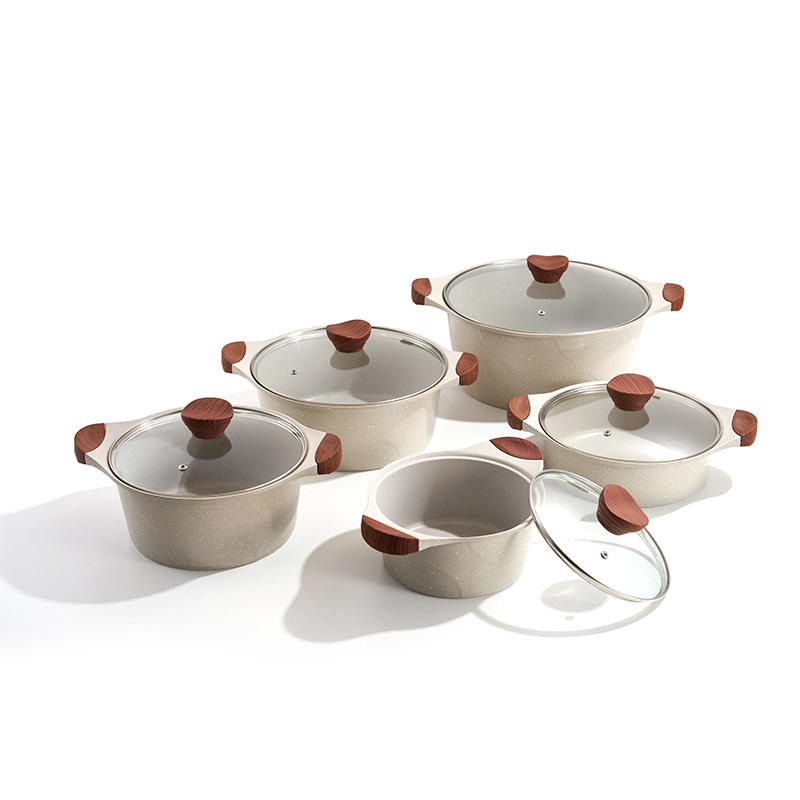
This off-white cookware set is made of wear-resistant non-stick material, with w...
See Details
Whether you're looking for bulk purchases or have any custom requirements, We are here to offer the best
solutions for you.
tiffany.zhong@echocn-trading.com
PHONE
+86-19561173975
+86-19557020621 (Hazel Wu)
ADD
Room 301, Unit 3014, No. 175 Qifeng Avenue, Wenqiao Town, Taizhou, Zhejiang, China
Fill Out the Form for More Information
Copyright © Zhejiang Echo Industry And Trade Co., Ltd.
All Rights Reserved.

China Cookware Set Manufacturer