
 en
 Español

This cookware set features a non-stick coating, even heat conduction, and multi-...
See Details
A Practical Guide to Choosing a High-Quality 7-Piece Aluminum Cookware Set
Date:Oct 03, 2026
Choosing a cookware set is rarely just a matter of selecting attractive pots and pans. A dependable set must balance heat performance, convenience, safety, appearance, durability, storage, and purchasing value. For households, retailers, hospitality buyers, and kitchenware distributors, a well-designed aluminum cookware set can provide a practical foundation for everyday cooking while remaining lighter and easier to handle than many stainless steel or cast iron alternatives.
The 7-piece aluminum cookware set discussed in this article is designed around those everyday requirements. It combines an aluminum body, ceramic non-stick inner lining, heat-resistant wooden handles, matching lids, and a minimalist white exterior. The configuration is intended to cover common cooking tasks such as frying, sautéing, boiling, simmering, and stewing without requiring the buyer to purchase several separate pieces.
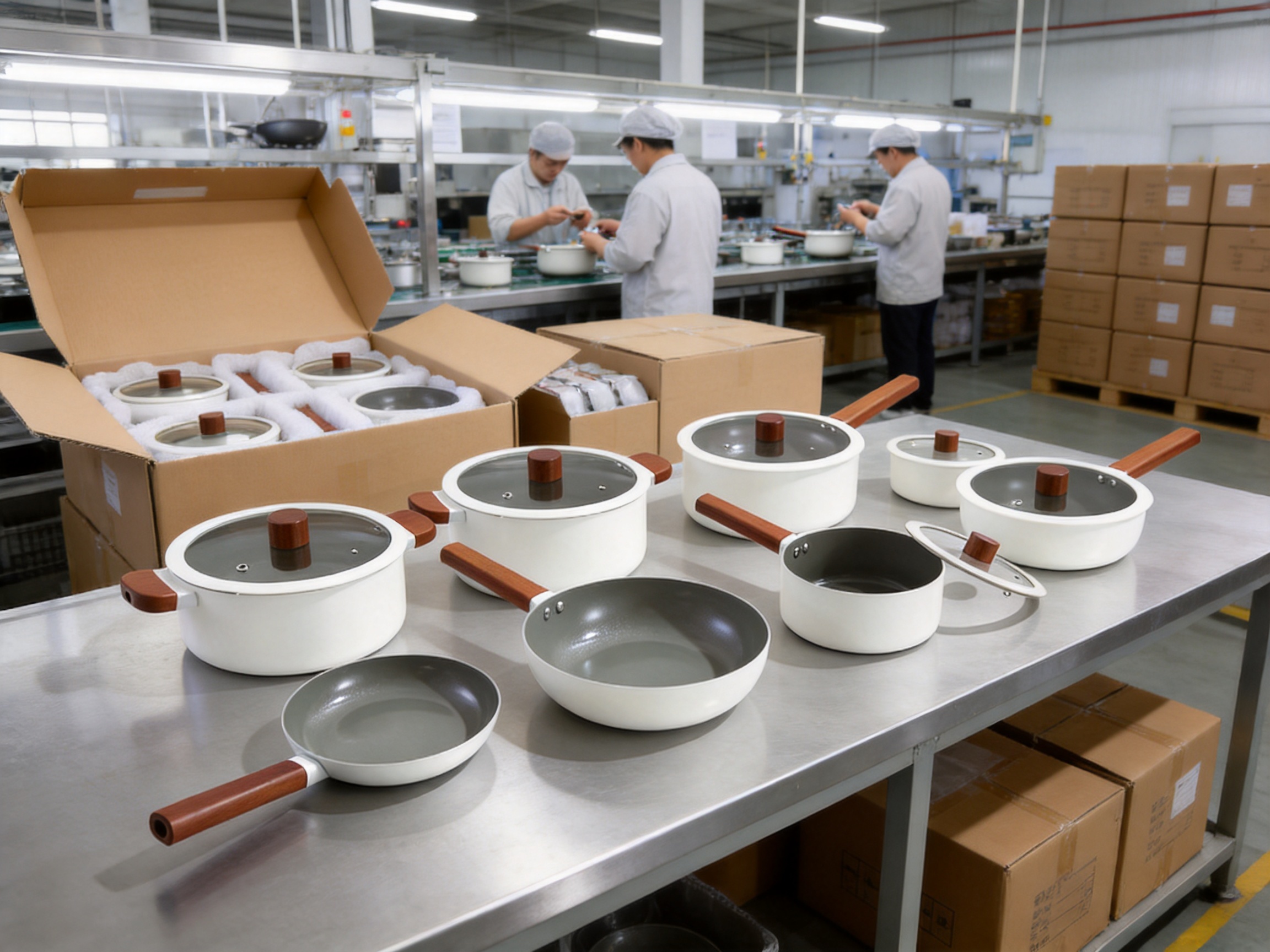
Beyond the product itself, the set reflects the capabilities of a professional kitchenware manufacturer and supplier based in Zhejiang, China. Its strengths include a broad cookware range, OEM and ODM support, one-stop sourcing, flexible minimum order quantities, product certification assistance, and a focus on practical and sustainable product development. These capabilities are important for buyers who need more than a single finished item and are looking for a long-term supply partner.
Why a 7-Piece Aluminum Cookware Set Is a Useful Kitchen Solution
A cookware set is valuable because it brings several compatible items together in one coordinated purchase. Instead of selecting a frying pan, saucepan, pot, and lids separately, the buyer receives a group of pieces designed to work together in appearance and function. This can reduce purchasing time, simplify packaging, and make the set easier to merchandise in retail stores or online catalogs.
The seven-piece format is especially suitable for small and medium-sized households. It generally includes a combination of cooking vessels and lids, providing enough capacity for daily meals without taking up the storage space associated with larger professional cookware collections. The listed product information includes cookware sizes of 18 cm, 20 cm, 24 cm, and 28 cm. The exact arrangement of the seven pieces should be confirmed against the final production specification, but the size range indicates a useful combination of compact and family-oriented cooking options.
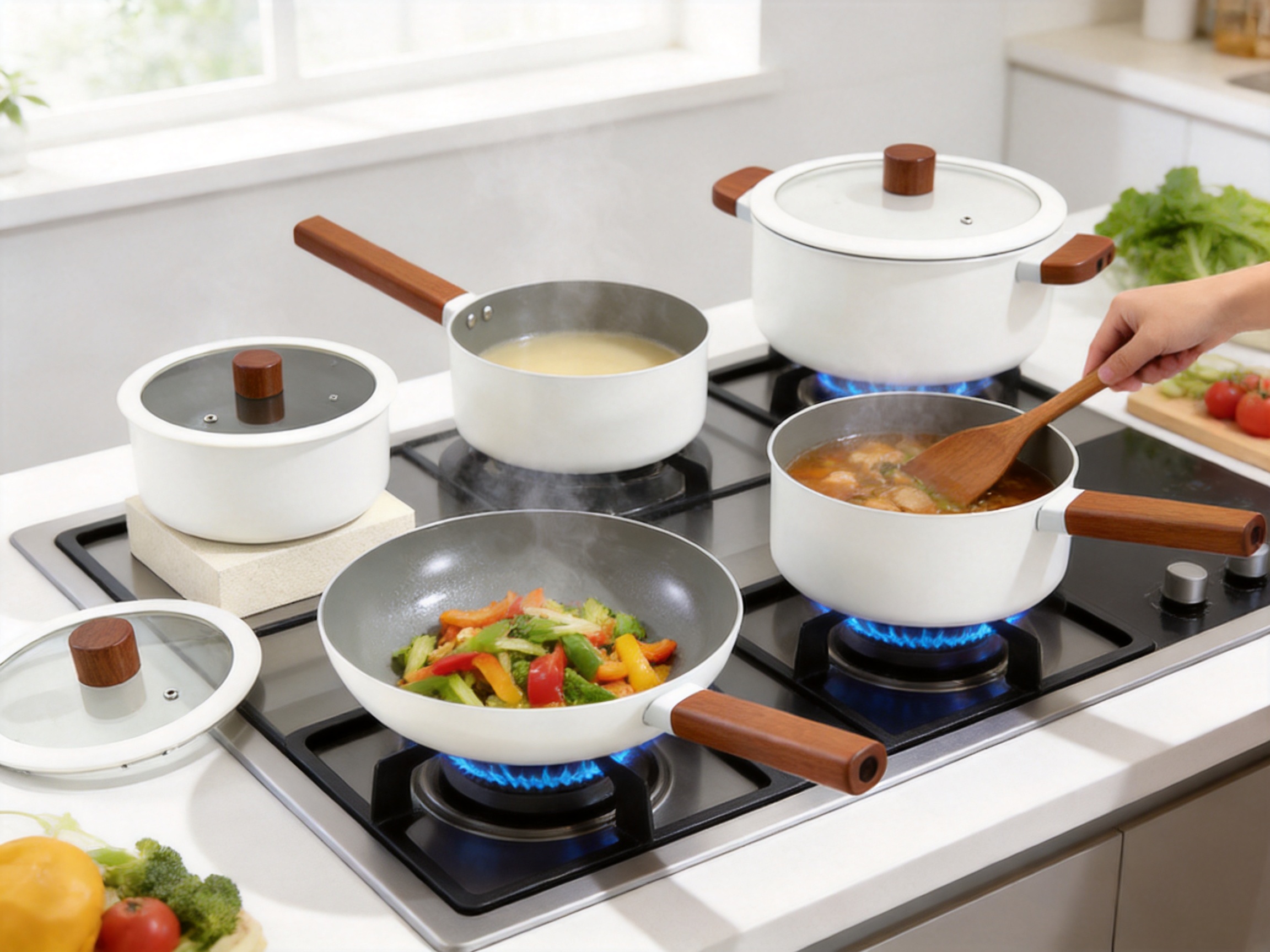
The set can support many ordinary kitchen tasks:
Frying eggs, vegetables, fish, and other ingredients in a shallow pan.
Sautéing onions, garlic, meat, and vegetables with moderate heat.
Boiling water, pasta, grains, or soup in a covered saucepan.
Stewing ingredients slowly in a deeper pot.
Preparing sauces, side dishes, and small portions.
Serving food directly from the cookware when an attractive appearance is desired.
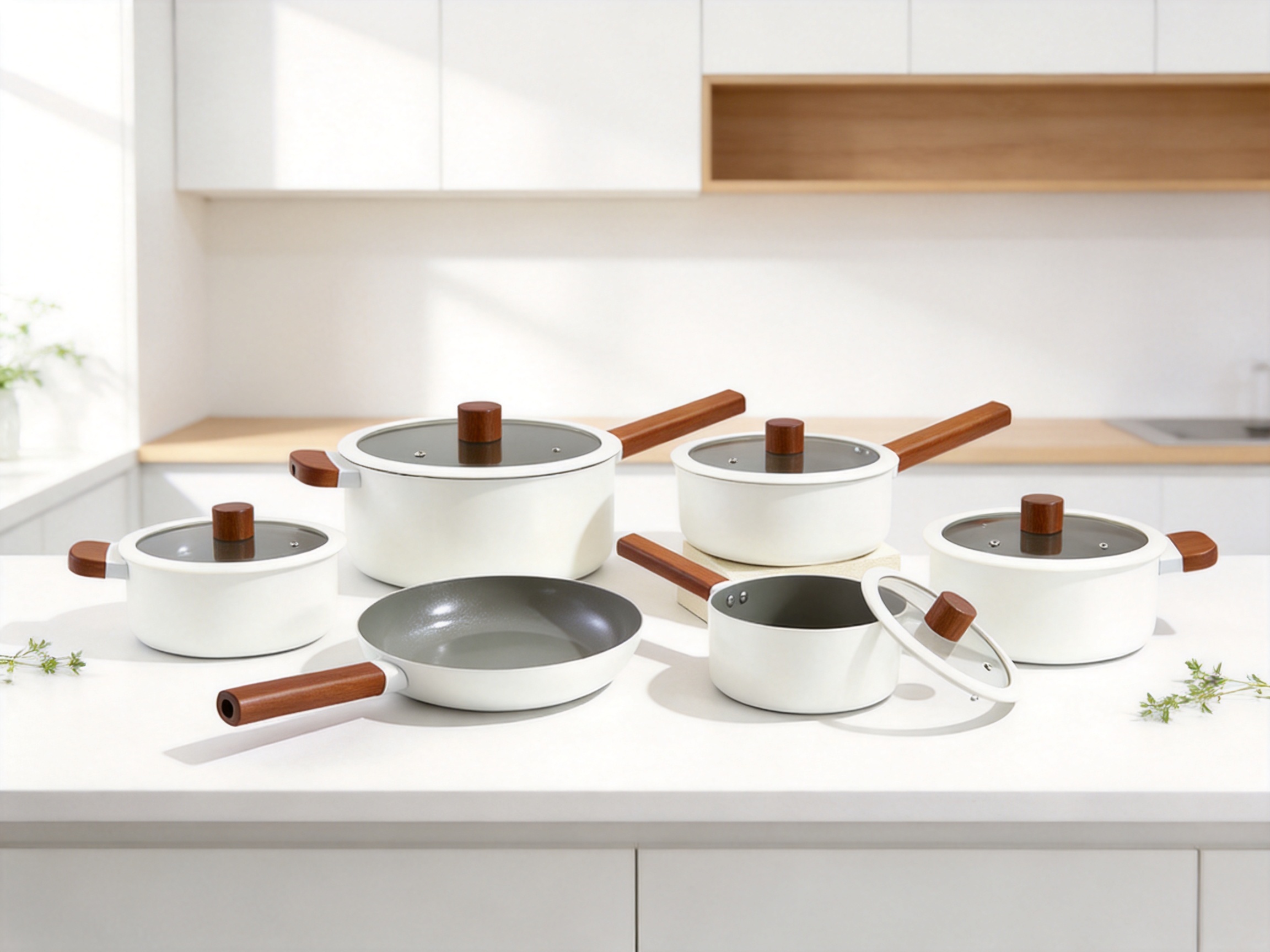
A coordinated set also creates a more consistent visual experience. The minimalist white exterior is appropriate for modern, Scandinavian, contemporary, and minimalist kitchens. Because many kitchens now use open shelving, kitchen islands, or visible hanging storage, appearance has become an important product consideration. Cookware is no longer always hidden inside cabinets; it can be part of the kitchen’s overall design.
Product Overview and Main Configuration
The product is a seven-piece aluminum cookware set with a ceramic non-stick inner surface, wooden handles, and lids. It is intended for cooking on various compatible stovetops and is suitable for frying and stewing. The light-colored exterior offers a clean appearance, while the aluminum body is designed to provide fast heating and convenient handling.
| Feature | Product Information | Practical Benefit |
|---|---|---|
| Product type | 7-piece aluminum cookware set | Provides several essential cooking vessels in one coordinated package |
| Inner surface | Ceramic non-stick lining | Supports easier food release and simpler routine cleaning |
| Handle material | Heat-resistant wood | Provides a comfortable, natural grip when used correctly |
| Exterior appearance | Minimalist white design | Fits modern and design-focused kitchen environments |
| Listed sizes | 18 cm, 20 cm, 24 cm, and 28 cm | Covers compact preparation and larger everyday cooking tasks |
| Carton quantity | 2 cartons | Supports organized export packing and shipment planning |
| Carton size | 61 × 37 × 30 cm | Provides a reference for logistics and warehouse planning |
| Carton weight | 4.15 kg | Helps buyers estimate handling and freight requirements |
For distributors and importers, packaging information is as important as the cooking features. The stated carton quantity, carton dimensions, and carton weight help buyers estimate warehouse requirements, shipping arrangements, container loading, and landed cost. Before placing a production order, the buyer should confirm whether the stated weight is the gross or net weight, how many retail sets are packed in each carton, and the final inner-box dimensions.
Advantages of the Aluminum Construction
Aluminum is widely used in cookware because it transfers heat efficiently and is comparatively lightweight. These characteristics make aluminum cookware easy to lift, reposition, pour from, and clean. For home cooks who use cookware daily, reduced weight can make a noticeable difference, especially when the pot contains water, soup, or a complete meal.
Fast heat response is another important advantage. Aluminum can heat up more quickly than many heavier materials, allowing the cook to begin preparing food without a long preheating period. It also helps distribute heat across the base and sides, reducing the risk of isolated cold areas or uneven cooking when the pan is used properly.
Compared with cast iron, aluminum cookware is significantly easier to handle and does not require the same seasoning routine. Cast iron is valued for heat retention and durability, but its weight can be inconvenient for everyday lifting and washing. Compared with many stainless steel products, aluminum cookware generally offers faster heat response and lower overall weight. Stainless steel remains highly valued for its toughness and resistance to surface wear, but it may require more oil or more careful temperature control when cooking delicate foods.
The aluminum body is particularly suitable for a set designed for everyday convenience. It supports a lighter product structure while allowing the manufacturer to apply a ceramic non-stick cooking surface. This combination aims to offer an accessible cooking experience without the bulk of heavy-duty cookware.
Heat Distribution and Cooking Control
Although the material conducts heat effectively, good cooking results still depend on appropriate heat settings. Aluminum cookware should not automatically be used at maximum temperature. Medium or low-to-medium heat is usually more appropriate for coated cookware, especially when cooking eggs, pancakes, fish, sauces, or other foods that can burn easily.
Controlled heating protects both the food and the cooking surface. Excessive heat can cause discoloration, produce smoke from food residue, and shorten the useful life of a non-stick coating. It can also damage handles or other components if the flame extends beyond the base.
The Role of the Ceramic Non-Stick Inner Lining
The ceramic non-stick inner surface is one of the product’s main selling points. It is designed to make food release easier and reduce the amount of oil needed for some cooking applications. For everyday dishes such as omelets, sautéed vegetables, pancakes, and light sauces, an effective non-stick surface can make cooking more convenient and cleaning less demanding.
Ceramic-coated cookware is often marketed to consumers who are looking for a modern non-stick alternative and who prefer products associated with low-oil cooking. The surface can also support a clean visual presentation because food residue is less likely to become strongly attached when the cookware is used at suitable temperatures.
However, the performance of any ceramic non-stick cookware depends on correct use. A ceramic surface is not indestructible. Metal utensils, sharp tools, abrasive cleaners, overheating, and aggressive scrubbing can reduce its performance. The product care instructions therefore recommend wooden, nylon, or other non-metal utensils.
The ceramic lining also creates a clear distinction between this product and uncoated aluminum cookware. Raw aluminum cookware can be economical and conductive, but it may be more reactive with certain foods and can be more difficult to clean. A properly applied cooking surface creates a more user-friendly interior and gives the product a stronger position in the consumer market.
Comparison with Common Alternative Coatings
PTFE-based non-stick coatings are common in budget and mid-range cookware because they usually provide smooth food release and an easy first-use experience. Ceramic coatings are often positioned as a PFAS-free alternative, depending on the exact formulation and supplier documentation. Hard-anodized aluminum does not rely on a conventional soft coating for its primary surface hardness and is often selected for durability.
Each system has its own characteristics. PTFE may offer very easy release, ceramic may appeal to consumers seeking a different coating technology, and hard-anodized aluminum may emphasize toughness. The choice depends on the buyer’s target market, price point, compliance requirements, and product positioning.
For commercial buyers, coating claims should always be supported by current technical documents and test reports. Terms such as “non-toxic,” “PFAS-free,” “healthy,” or “scratch-resistant” should not be used casually in marketing unless they accurately reflect the coating specification and available compliance evidence. A professional supplier can assist buyers with product certification and documentation requirements for their target market.
Heat-Resistant Wooden Handles and User Comfort
The wooden handle adds a natural visual and tactile element to the cookware. It contrasts with the white exterior and can make the set look warmer and more distinctive than cookware using entirely metallic or black plastic components. This is valuable for product lines aimed at design-conscious consumers.
From a handling perspective, a properly constructed wooden handle can provide a comfortable grip and reduce the impression of heat transfer during normal stovetop use. The handle should still be treated as a component requiring care. Users should follow the manufacturer’s instructions, avoid exposing the handle directly to flames, and use an oven only if the complete product specification explicitly permits it.
Wood is not a substitute for safe cooking habits. The flame or heat source should not extend beyond the base of the cookware. Direct exposure to high heat can darken, dry, crack, or otherwise damage the handle. The user should also avoid immersing wooden components unnecessarily or leaving them wet for extended periods.
The use of wood can be a competitive advantage in a crowded cookware category because it provides a recognizable design detail. Many mass-market cookware sets use identical-looking black handles. A white body paired with a natural wooden grip offers a more lifestyle-oriented appearance that may appeal to consumers furnishing modern apartments, open kitchens, and gift-oriented homeware collections.
White Exterior Design and Market Appeal
The white exterior is more than a decorative choice. It positions the set within a growing category of cookware designed to coordinate with kitchen interiors. White cookware can make a kitchen look brighter and cleaner, particularly when the set is displayed on open shelves or used in product photography.
A minimalist color scheme can help retailers present the cookware in several market segments:
Modern apartment and compact-kitchen collections.
Scandinavian-inspired homeware ranges.
Wedding, housewarming, and lifestyle gift categories.
Online stores focused on coordinated kitchen aesthetics.
Private-label cookware brands seeking a clean visual identity.
Compared with dark cookware, a white exterior can create a softer and more decorative presentation. Compared with bare metal cookware, it offers a stronger lifestyle identity. The finish may also be easier to photograph against neutral backgrounds, which is useful for online product listings and catalog design.
Exterior appearance must nevertheless be considered together with maintenance. Light-colored surfaces can show staining or discoloration if cookware is overheated or if grease is allowed to build up. The care instructions therefore recommend cleaning with hot, soapy water and a soft cloth or sponge. Regular cleaning is preferable to harsh treatment after residue has become difficult to remove.
Everyday Cooking Performance
The set is designed for practical daily cooking rather than a single specialized task. The different sizes allow users to select a vessel appropriate to the quantity of food being prepared. A smaller pan can be used for breakfast foods or sauces, while a larger piece can support family portions, vegetables, stews, and one-pot meals.
Lids improve the usefulness of the set by retaining moisture and heat. Covered cooking is beneficial for simmering, steaming with limited liquid, reducing cooking time, and keeping food warm for short periods. Lids also help reduce splashing during boiling or stewing. The buyer should verify the lid material, fit, handle construction, and heat limitations in the final technical specification.
The combination of aluminum, a ceramic inner surface, and lids makes the set suitable for users who want straightforward cooking with less cleanup. It is not necessary to treat the cookware as specialist restaurant equipment. Instead, its value lies in covering common kitchen activities with a coordinated group of easy-to-use pieces.
Suitable Cooking Methods
The product is described as suitable for stewing and frying and compatible with various stoves. Stovetop compatibility should be verified for the specific model and market because different cooking surfaces have different technical requirements. Buyers should confirm whether the set is intended for gas, electric, ceramic, induction, or a combination of these stove types.
When using gas, the flame should remain beneath the base and should not travel up the sides. On electric or ceramic stovetops, the cookware should be centered on a heating zone that matches the base size as closely as possible. If induction compatibility is required, the product must have an appropriate magnetic base or construction. Aluminum alone is not naturally induction-compatible.
Care Instructions for Longer Service Life
Care is central to the performance of coated aluminum cookware. The product instructions recommend washing before first use and favor hand washing to preserve appearance. Hand washing also allows users to control the water temperature, cleaning pressure, and tools used on the coating.
The following routine is recommended:
Allow the cookware to cool before washing. Sudden temperature changes can stress cookware components and may affect lids or coatings.
Use warm or hot soapy water with a soft cloth or non-abrasive sponge.
Remove food residue gently rather than scraping with a knife or metal tool.
Rinse away detergent thoroughly.
Dry the cookware and lids completely before storage.
Use soft separators if pieces are stacked to prevent friction between surfaces.
Metal utensils and sharp cooking tools should be avoided. Wooden, nylon, or silicone utensils are more appropriate for a ceramic non-stick surface. Even if a product is described as scratch-resistant, avoiding unnecessary contact with hard metal tools is a sensible way to extend service life.
Empty cookware should never be overheated. High heat without food, oil, or liquid can raise the surface temperature rapidly and may cause discoloration, coating deterioration, or damage to handles. If severe overheating occurs, the user should turn off the cooker and allow the cookware to cool completely before handling or cleaning it.
The cookware should not be used in a microwave. The flame or heat source should not extend beyond the base. These instructions are simple, but they are important both for consumer safety and for maintaining product performance.
How the Product Compares with Competing Cookware Categories
A product’s competitive position depends on how it compares with the alternatives most often considered by buyers. This set is not intended to replace every type of cookware. Instead, it offers a balance between lightweight handling, non-stick convenience, visual appeal, and multi-piece value.
| Cookware Category | Main Strength | Common Limitation | Position of This Aluminum Set |
|---|---|---|---|
| Stainless steel | Strong surface and long-term durability | Can be heavier and may require more technique for delicate foods | Lighter and easier for non-stick cooking |
| Cast iron | Excellent heat retention and robust construction | Heavy and requires more maintenance | More convenient for daily lifting and cleaning |
| Uncoated aluminum | Low weight and efficient heat transfer | May be more reactive and less convenient to clean | Adds a ceramic cooking surface for easier use |
| PTFE non-stick | Very smooth food release | Requires careful heat and utensil management | Uses a ceramic non-stick positioning |
| Hard-anodized aluminum | Harder aluminum surface and durability | May be more expensive or heavier | Focuses on lightness, appearance, and everyday convenience |
The strongest advantages of this set are its coordinated seven-piece format, ceramic non-stick interior, lightweight aluminum body, white exterior, and natural wooden handles. Together, these features help it compete in a consumer market where buyers want cookware that is functional but also visually compatible with their home.
Its limitations should also be stated honestly. Ceramic coatings require careful handling, wooden handles need protection from excessive heat and moisture, and the final stove compatibility must be confirmed before purchase. Transparent product communication builds more trust than broad claims that overlook normal usage requirements.
Manufacturing Strengths and Production Capabilities
A reliable cookware supplier must be able to manage more than basic production. The manufacturer associated with this product provides aluminum cookware, stainless steel cookware, cast iron cookware, and kitchen utensils. This broad category coverage gives buyers access to multiple product families through one supply relationship.
One-stop sourcing can reduce the administrative burden associated with working with several factories. A buyer developing a kitchenware collection may need cookware sets, individual frying pans, saucepans, utensils, and complementary accessories. A supplier with a wider product range can help coordinate product selection, packaging direction, quality requirements, and shipment planning.
The company also provides ODM and OEM customization. OEM service is useful when a buyer has an established design, brand identity, packaging system, or technical specification. ODM service is useful when a buyer needs assistance developing a product based on a market concept, price target, preferred materials, or visual direction.
Product Development and Customization
Customization may involve the exterior color, handle style, logo placement, packaging, lid design, size combination, coating specification, or set configuration. For a product such as this one, buyers may wish to create different versions for different markets. One market may prefer a compact set for apartments, while another may need larger capacities for family cooking.
A professional development process should begin with a written product brief. The brief should identify the intended market, cooking surfaces, target price, piece count, coating requirements, packaging expectations, testing requirements, and sales channel. Clear specifications reduce misunderstandings during sampling and mass production.
Sample approval is another important stage. Buyers should inspect the physical sample for handle attachment, coating consistency, lid fit, balance, edge finishing, color uniformity, surface smoothness, and overall dimensions. They should also review packaging protection, especially where white finishes may be vulnerable to scuffing during shipment.
Quality-Oriented Manufacturing Workflow
Although the precise factory equipment and inspection procedures should be confirmed directly with the supplier, a quality-oriented cookware workflow normally includes material preparation, forming, surface treatment, coating application, component assembly, inspection, packaging, and shipment control.
Material preparation begins with the selection and verification of aluminum material suitable for the product specification. Forming processes create the body shape and dimensions. The surface is then prepared so that the coating can adhere consistently. Ceramic coating application requires controlled preparation and curing according to the coating supplier’s technical requirements.
Assembly includes the attachment of handles, installation of hardware, lid fitting, and visual checking. The wooden handle must be inspected for smoothness, secure attachment, acceptable color, and freedom from visible defects. The cookware rim and base should also be checked for deformation, sharp edges, or uneven contact surfaces.
Inspection should be organized around the buyer’s approved standards. Possible checkpoints include dimensions, weight, appearance, coating coverage, handle stability, lid fit, packaging condition, and carton marks. Depending on the destination market, buyers may also request food-contact documentation, coating tests, migration testing, heat testing, or other compliance records.
The manufacturer’s product certification assistance is valuable at this stage. Certification needs differ by country and sales channel, so buyers should identify the relevant requirements before production begins. The supplier can help coordinate documentation, but the importer or brand owner remains responsible for ensuring that products meet the laws and standards applicable to the destination market.
Packaging, Logistics, and Export Planning
Cookware is vulnerable to scratches, dents, coating damage, and handle breakage if it is not packed appropriately. A seven-piece set requires internal organization so that the vessels, lids, and handles do not rub against one another during transportation.
The stated carton size of 61 × 37 × 30 cm and carton weight of 4.15 kg provide an initial basis for freight planning. Buyers should confirm all packaging details before shipment, including the number of retail sets per carton, gross and net weights, carton markings, pallet requirements, and drop or compression considerations.
White cookware deserves particular packaging attention because scuff marks and surface contamination may be more visible than on dark finishes. Protective bags, separators, molded inserts, or suitable paperboard components may help reduce contact damage. The final solution should balance protection, cost, recyclability, and ease of unpacking.
Export buyers should also consider whether packaging language, warning labels, barcode placement, instruction manuals, and country-specific recycling marks are required. These details are easier and less expensive to manage before mass production than after goods have been completed.
Why Work with a Broad Kitchenware Supplier
The supplier’s location in Zhejiang provides access to a major Chinese manufacturing and export region with extensive experience in household products and kitchenware. The company’s stated mission is to help Zhejiang-made products reach international markets while developing into an R&D-driven supply chain partner for small and medium-sized buyers.
This orientation is relevant to importers that may not have large internal product-development teams. A supply partner can help organize product selection, communicate manufacturing requirements, develop samples, coordinate documentation, and support repeat orders. These services can be especially helpful for independent retailers, online brands, regional distributors, and hospitality suppliers.
Flexible MOQs can also be important. A small or medium-sized buyer may want to test a new cookware design without committing immediately to a very large order. A flexible approach can support market testing, seasonal launches, regional product trials, and gradual expansion. The precise MOQ, lead time, sample policy, and customization cost should be negotiated for each project.
Commercial Positioning and Buyer Opportunities
The set can be positioned in several ways depending on the buyer’s target market. In consumer retail, it can be promoted as an attractive everyday cookware collection. In online commerce, the combination of white design, ceramic non-stick cooking, wooden handles, and seven-piece convenience creates several clear product benefits for visual merchandising.
For private-label brands, the product offers a foundation for a coordinated kitchen collection. A buyer could potentially develop matching utensils, storage accessories, or additional cookware in the same color and handle language. For hospitality or furnished-apartment projects, the set offers a practical selection of basic cookware without requiring a large assortment of individual items.
For gift channels, the white exterior and coordinated presentation may support housewarming, wedding, holiday, or new-home promotions. The packaging should be designed accordingly, with clear information about the contents, care instructions, stove compatibility, and coating characteristics.
Effective marketing should focus on verifiable advantages:
Seven coordinated pieces for common cooking tasks.
Lightweight aluminum construction.
Ceramic non-stick interior for easier food release.
Heat-resistant wooden handle design.
Clean white appearance for modern kitchens.
Matching lids for covered cooking.
Manufacturer support for OEM, ODM, sourcing, and documentation.
Marketing should avoid promising unlimited durability or claiming that the cookware is suitable for every appliance without confirmation. Clear instructions are part of a strong product experience and can reduce returns caused by incorrect use.
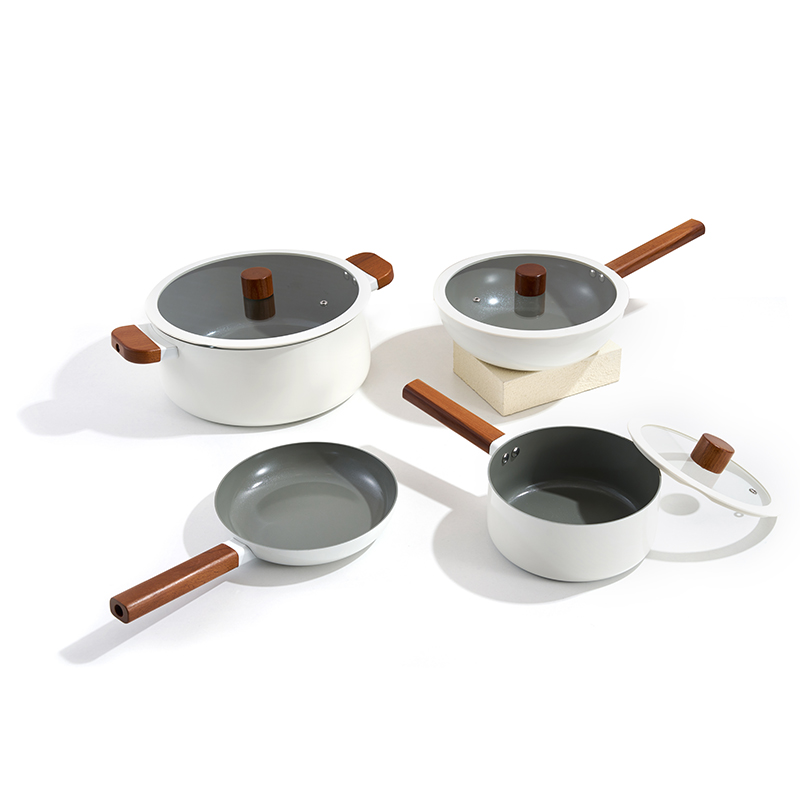
7pcs Nordicpure Aluminum Cookware Set
Important Considerations Before Ordering
Before ordering, buyers should confirm the complete bill of materials. The product title identifies a seven-piece set, while the technical information lists several body sizes. The final specification should state how many cooking vessels are included, how many lids are included, whether handles are detachable or fixed, and which components count toward the seven pieces.
The buyer should also request confirmation of the following items:
Exact body diameter, height, and capacity for every piece.
Aluminum material specification and body thickness.
Ceramic coating type, color, thickness, and test documentation.
Handle material, attachment method, and heat limitations.
Lid material, lid handle construction, and fit tolerance.
Compatible stove types.
Recommended cooking temperature and cleaning method.
Retail packaging and export carton configuration.
Minimum order quantity and sample lead time.
Production lead time and inspection arrangements.
These questions are not signs of distrust. They are normal parts of professional sourcing. A clear specification protects both the buyer and the supplier by ensuring that everyone is working toward the same product definition.
Quality Assurance for International Buyers
International buyers should establish quality standards before placing a production order. A written inspection checklist may include appearance, dimensions, coating coverage, color consistency, handle alignment, lid fit, base flatness, packaging, labeling, and carton condition.
Visual inspection is important because the product has a white exterior and a design-focused appearance. Small marks may be more noticeable on a light surface. The buyer may define acceptable limits for pinholes, color variation, scratches, dents, coating bubbles, edge irregularities, and wooden handle discoloration.
Functional checks are equally important. Handles should remain secure under reasonable handling. Lids should sit correctly and should not wobble excessively. The base should provide stable contact with the intended stovetop. Coating performance can be evaluated through agreed test methods, but the buyer should not invent testing criteria after production has started.
For food-contact products, compliance documentation should be appropriate to the destination market. Buyers may need declarations, laboratory reports, material information, or migration test results. The exact requirements depend on national regulations, retailer policies, and the product’s intended use. Early communication helps avoid delays at customs or in retail approval.
Frequently Asked Questions
What is included in the seven-piece cookware set?
The set is described as a seven-piece aluminum cookware collection with cookware bodies and matching lids. The listed sizes are 18 cm, 20 cm, 24 cm, and 28 cm. Buyers should confirm the exact piece-by-piece configuration, including the number of pans, pots, and lids, before ordering.
What coating is used inside the cookware?
The product uses a ceramic non-stick inner lining. It is designed to support easier food release and simpler cleaning. The precise coating formulation and any PFAS-related or food-contact claims should be confirmed through the supplier’s current technical documents and test reports.
Can metal utensils be used?
Metal and sharp utensils are not recommended. Wooden, nylon, or silicone tools are safer choices for protecting the ceramic surface from scratches and premature wear.
Is the cookware dishwasher-safe?
The supplied care instructions recommend hand washing to preserve the appearance and condition of the cookware. Even when a product is described elsewhere as dishwasher-safe, hand washing is generally the more cautious approach for a ceramic-coated set with wooden handles.
Can the cookware be used in a microwave?
No. The care instructions specifically state that the cookware should not be used in a microwave.
Can the set be used on induction stovetops?
Stove compatibility should be confirmed for the exact model. Aluminum is not naturally magnetic, so induction use normally requires a suitable magnetic base or construction. Buyers should obtain written confirmation before listing induction compatibility.
Can the cookware be placed in an oven?
Oven use should not be assumed. The wooden handle may have specific heat limitations, and the final product specification must state whether oven use is permitted and at what temperature.
How should severe overheating be handled?
Turn off the cooker and allow the cookware to cool completely. Do not immediately immerse severely overheated cookware in cold water, and do not touch it until it is safe to handle. After cooling, inspect the cookware for damage before using it again.
What are the main advantages over stainless steel cookware?
The aluminum set is lighter, heats quickly, and includes a ceramic non-stick interior that can make delicate foods easier to cook. Stainless steel generally offers a harder exposed surface, but it may require more cooking technique and can be heavier depending on its construction.
What are the main advantages over cast iron?
The aluminum set is easier to lift, faster to heat, and simpler to maintain for routine cooking. Cast iron offers excellent heat retention and exceptional robustness but is considerably heavier and often requires seasoning and drying practices.
Is the white exterior difficult to maintain?
The white exterior should be cleaned promptly with warm soapy water and a soft cloth or sponge. Avoid overheating, abrasive cleaners, and rough scrubbing. Regular gentle cleaning helps preserve the appearance.
Can the product be customized?
The supplier provides OEM and ODM services, so customization may be possible. Potential options can include colors, packaging, logos, handle details, set configurations, and other specifications. Each option should be confirmed during product development.
What information should a distributor request before purchasing?
A distributor should request the final product specification, dimensions, capacities, coating information, stove compatibility, care instructions, packaging details, MOQ, lead time, sample terms, inspection standards, and applicable compliance documentation.
Recommended Use and Care Summary
Wash the cookware before first use. Use low or medium heat whenever possible. Keep the flame beneath the base and never allow it to extend around the sides. Do not heat an empty pan for an extended period. Select wooden, nylon, or silicone utensils. Let cookware cool before washing. Clean with warm soapy water and a soft cloth or sponge. Avoid abrasive pads, sharp tools, and aggressive scrubbing. Dry the cookware and lids fully before storage.
When stacking the pieces, use soft separators to reduce surface friction. Store lids in a way that prevents them from striking the cookware or other hard objects. Keep wooden handles dry and away from direct flames. Following these simple practices can help preserve both the appearance and cooking performance of the set.
Conclusion
A seven-piece aluminum cookware set with a ceramic non-stick interior, wooden handles, matching lids, and a white minimalist design offers a balanced solution for everyday cooking. Its aluminum body supports lightweight handling and fast heat response. Its ceramic surface is intended to simplify food release and cleaning. Its white exterior and wooden details give it a more distinctive position than ordinary dark non-stick cookware.
The set competes effectively by combining practical cooking coverage with visual appeal. It is lighter and easier to handle than many cast iron alternatives, more immediately convenient for non-stick cooking than uncoated stainless steel, and more design-focused than basic aluminum cookware. At the same time, it should be used with appropriate care, moderate heat, non-metal utensils, and hand-washing practices.
For importers, retailers, and private-label buyers, the supplier’s broader capabilities add value beyond the individual product. Aluminum, stainless steel, cast iron, and kitchen utensil categories can be sourced through one company. OEM and ODM services support customization, while product certification assistance, flexible MOQs, and one-stop sourcing can help small and medium-sized buyers develop competitive kitchenware lines.
The strongest purchasing decision will come from combining the product’s visible advantages with careful technical verification. Buyers should confirm the final seven-piece configuration, coating documentation, stove compatibility, packaging, inspection standards, and destination-market requirements. With those details clearly established, this cookware set can serve as a practical, attractive, and commercially adaptable addition to a modern kitchenware portfolio.
References
1. Product specification and care instructions for the seven-piece aluminum cookware set, supplied in the project materials.
2. General principles of aluminum cookware construction, heat transfer, and household cookware handling.
3. General guidance on ceramic non-stick coating care and the use of non-metal cooking utensils.
4. General food-contact cookware compliance and product documentation practices for international trade.
5. General export packaging and quality inspection considerations for household kitchenware.
6. Manufacturer information concerning aluminum cookware, stainless steel cookware, cast iron cookware, kitchen utensils, OEM, ODM, sourcing, and certification assistance.
Product: 7pcs Nordicpure Aluminum Cookware Set
Recommended Articles
Product Category
Related products
-
-
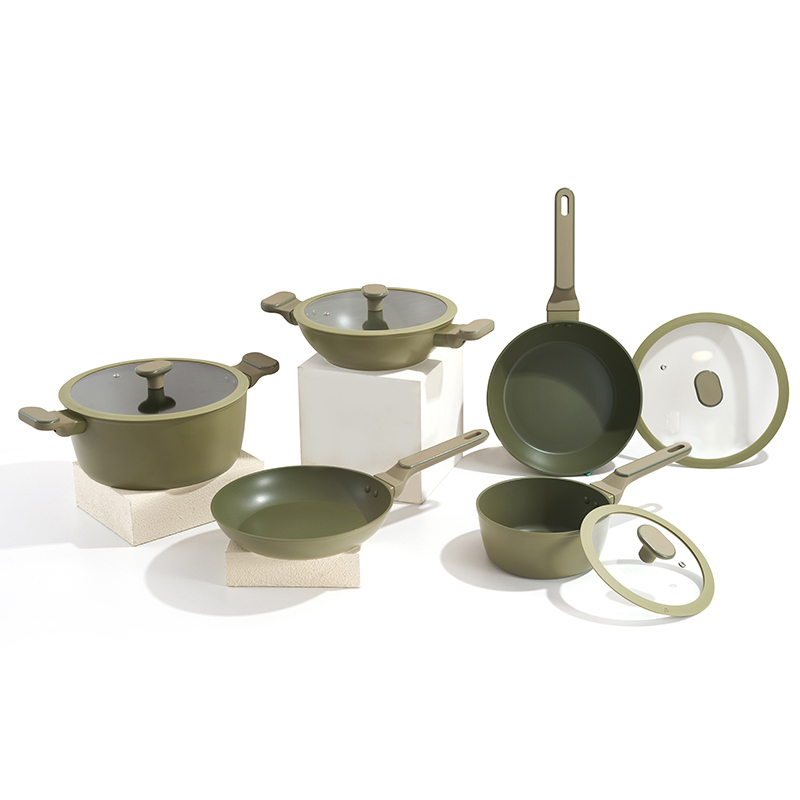
This cookware set has a ceramic non-stick inner liner, a heat-resistant wooden h...
See Details -
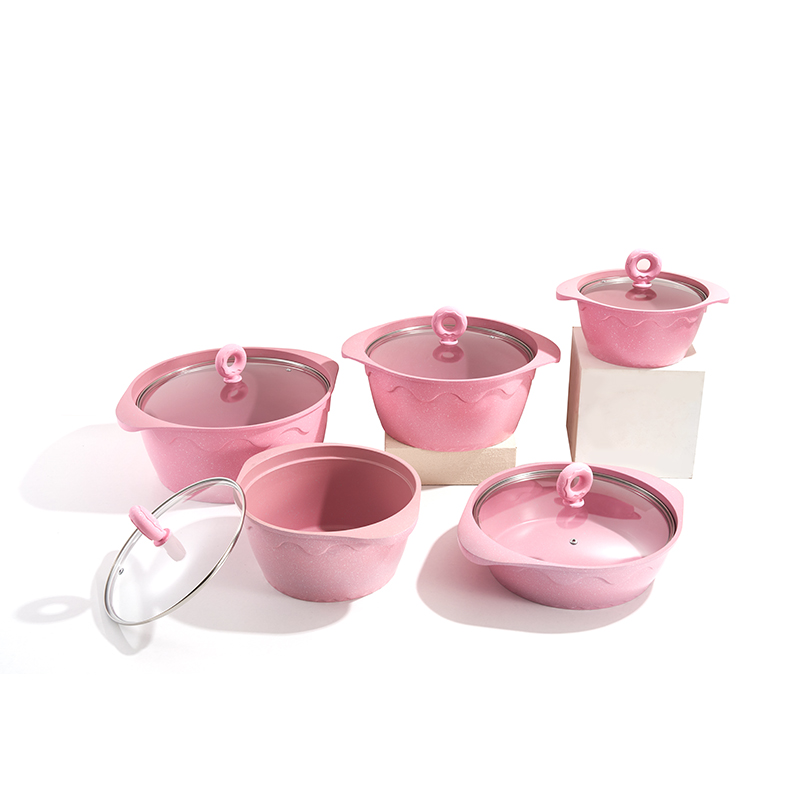
This cookware set is made of food-grade non-stick material, with a unique eye-ca...
See Details -
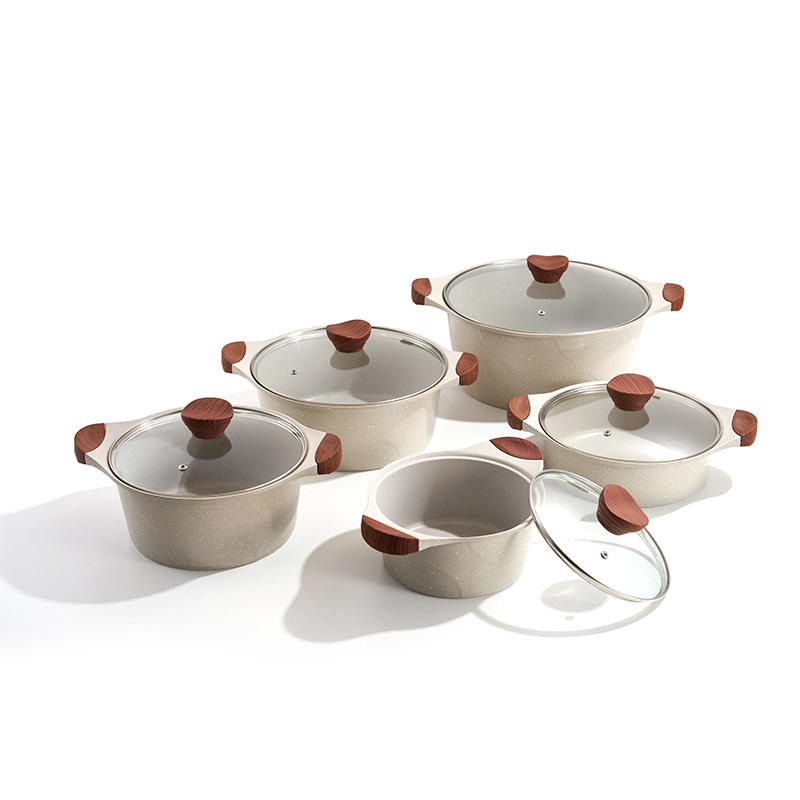
This off-white cookware set is made of wear-resistant non-stick material, with w...
See Details
Whether you're looking for bulk purchases or have any custom requirements, We are here to offer the best
solutions for you.
tiffany.zhong@echocn-trading.com
PHONE
+86-19561173975
+86-19557020621 (Hazel Wu)
ADD
Room 301, Unit 3014, No. 175 Qifeng Avenue, Wenqiao Town, Taizhou, Zhejiang, China
Fill Out the Form for More Information
Copyright © Zhejiang Echo Industry And Trade Co., Ltd.
All Rights Reserved.

China Cookware Set Manufacturer