
 en
 Español

This cookware set features a non-stick coating, even heat conduction, and multi-...
See Details
15-Piece Aluminum Cookware Set for Versatile Everyday Cooking
Date:Oct 05, 2026
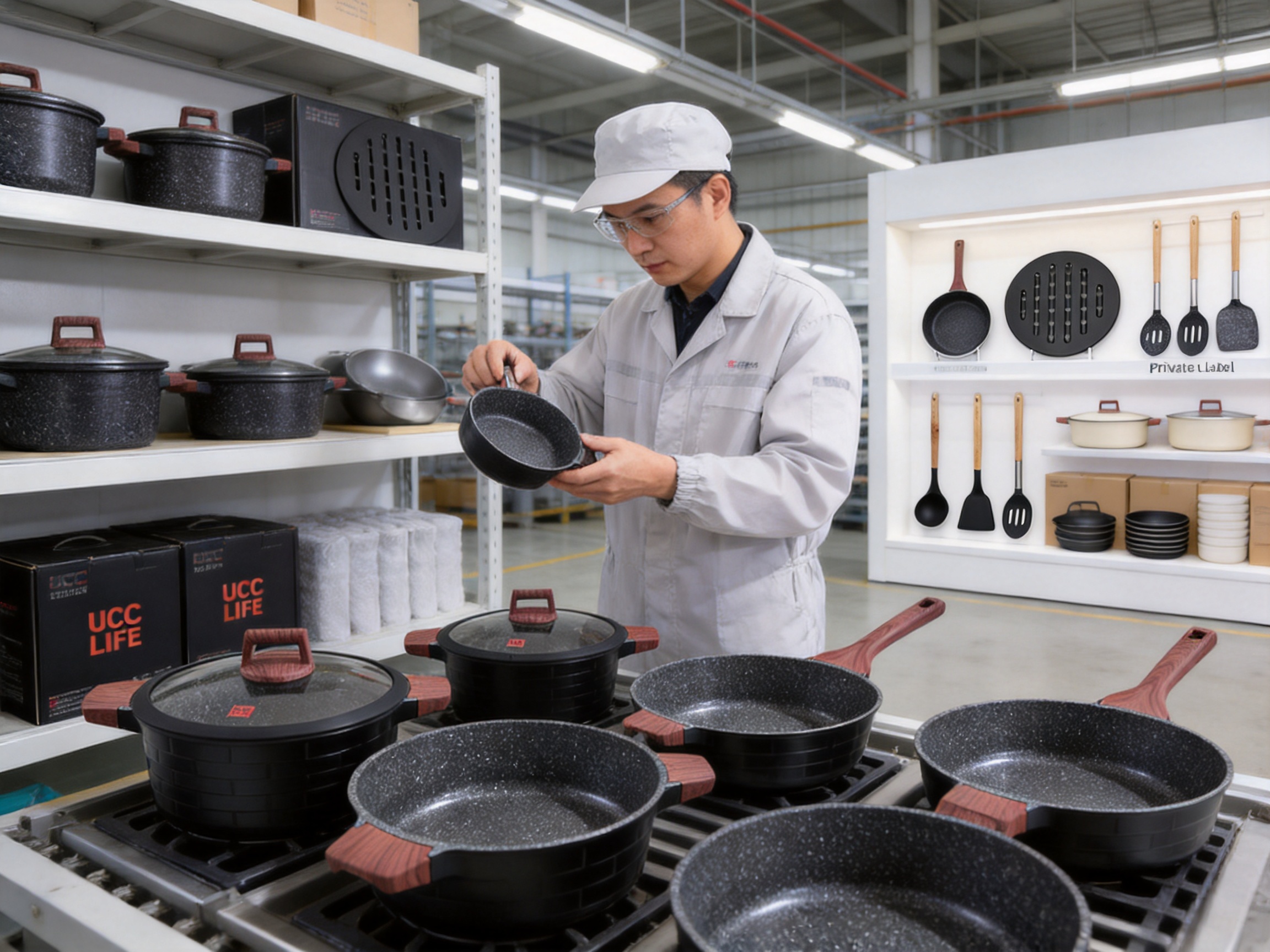
A well-designed cookware collection can make everyday meal preparation more efficient, more enjoyable, and more consistent. The 15pcs WoodEssentials Aluminium Cookware Set is developed as a practical multi-function solution for home kitchens that need a coordinated group of pots, pans, utensils, and supporting accessories. Instead of purchasing individual pieces one at a time, users can obtain a complementary cooking system designed around common kitchen tasks such as boiling, simmering, frying, sautéing, steaming, and serving.
The set combines a black granite-speckled aluminum body with wood-grain heat-resistant handles, a food-grade non-stick interior, wooden-handled silicone utensils, and grill pan accessories. Its appearance is contemporary, while its configuration is intended to remain useful for everyday family cooking. The cookware is also described as compatible with all stovetops, giving it broad application potential for households, furnished apartments, hospitality projects, kitchenware retailers, and private-label product programs.
A Complete Cooking Solution for the Modern Kitchen
Many cookware purchases focus on one frying pan or one stockpot. However, a single item rarely meets all cooking requirements. A frying pan may be suitable for eggs and vegetables but insufficient for soup. A small saucepan may be useful for sauces but too limited for family-sized meals. A stockpot can handle larger quantities but is not always convenient for shallow frying or quick sautéing.
This set addresses those limitations by combining several sizes and forms in one coordinated collection. The listed cookware includes 20 cm, 24 cm, 28 cm, and 32 cm casseroles, as well as a 28 cm deep frypan without a lid. The supplied accessories include two shovels and two insulation pads. The product is marketed as a 15-piece set, with the complete configuration also including wooden-handled silicone utensils and grill pan-related components shown in the product presentation.
The result is a more unified kitchen setup. Users can move from preparing ingredients to cooking and serving without relying on mismatched cookware from different product lines. For retailers and distributors, this creates a strong bundled product with clear shelf appeal. For consumers, it simplifies selection and provides a practical starting point for equipping a kitchen.
| Product Feature | Practical Benefit | Typical Kitchen Application |
|---|---|---|
| Multiple casserole sizes | Supports different food quantities and recipes | Soups, stews, pasta, rice, braised dishes |
| 28 cm deep frypan | Provides a broad cooking surface and useful depth | Stir-frying, frying, sautéing, one-pan meals |
| Food-grade non-stick interior | Helps reduce sticking and simplifies cleanup | Eggs, pancakes, fish, vegetables, low-oil cooking |
| Wood-grain heat-resistant handles | Improves handling comfort and visual distinction | Frequent stovetop cooking and serving |
| Silicone utensils with wooden-style handles | Helps protect the cooking surface when used correctly | Stirring, turning, scraping, and serving |
| Insulation pads | Helps protect tables and countertops from hot cookware | Dining table presentation and kitchen service |
| All-stovetop compatibility | Broadens suitability for different households | Gas, electric, ceramic, and other compatible stovetops |
Why Aluminum Is Effective for Everyday Cookware
Aluminum is widely used in cookware because it offers a useful balance of weight, heat responsiveness, and manufacturing flexibility. Compared with many heavier materials, aluminum cookware is easier to lift, move, and store. This is especially valuable when handling larger casserole sizes or transferring a pan from the stovetop to a preparation area.
Aluminum also responds relatively quickly to changes in heat. When a cook increases or reduces the burner setting, responsive cookware can support faster adjustment. This is helpful for recipes that require controlled simmering, quick sautéing, or changes between high and medium heat. The exact cooking result still depends on the stovetop, food quantity, recipe, and user technique, but the material provides a practical foundation for versatile cooking.
The black granite-speckled exterior adds visual character while helping the set stand apart from plain metallic cookware. A darker patterned finish can also create a coordinated appearance across casserole bodies and frying surfaces. For retailers, the finish offers a modern alternative to conventional silver aluminum or single-color non-stick collections.
Aluminum is also well suited to cookware production because it can be formed into different shapes and sizes. A supplier experienced in aluminum cookware can develop multiple vessels within a consistent product family, helping maintain a unified appearance and compatible handle styling. This is important for buyers seeking a private-label range or a coordinated retail collection rather than isolated items.
Food-Grade Non-Stick Interior for Easier Cooking
The food-grade non-stick interior is one of the set’s central user benefits. A non-stick surface can help reduce the amount of food that adheres during cooking, which is particularly useful for delicate foods such as eggs, fish, pancakes, and soft vegetables. It may also allow users to prepare certain recipes with less cooking oil, depending on the food and cooking method.
Reduced sticking can make kitchen work more efficient. When food is less likely to bond strongly to the pan surface, stirring and turning can become easier. Cleanup may also require less soaking and scrubbing. This convenience is valuable for busy households, food service accommodation, and buyers who prioritize straightforward maintenance.
Non-stick performance depends on responsible use. The care instructions for this product specifically recommend avoiding metal or sharp cooking utensils and using wooden, nylon, or non-stick-safe utensils instead. The included wooden-handled silicone utensils are therefore a practical complement to the cookware. Silicone tools can provide a softer contact surface than metal tools, helping users protect the interior when the utensils are used correctly.
The non-stick coating should not be viewed as a substitute for proper heat control. Cookware should not be overheated while empty, and users should avoid allowing flames or other heat sources to extend beyond the base. These practices are important for preserving the appearance and performance of non-stick cookware over time.

15pcs WoodEssentials Aluminium Cookware Set
Thoughtful Handle Design and Everyday Ergonomics
Handles influence how comfortable and safe cookware feels during routine use. The WoodEssentials set uses wood-grain heat-resistant handles, combining a natural visual effect with a more distinctive appearance than standard all-black or plain metal handles. The styling helps give the collection a warm, home-oriented character while maintaining a coordinated look across different pieces.
Heat-resistant handle materials can help make stovetop handling more comfortable, although users should always exercise caution because cookware components may become hot during use. The safest practice is to handle cookware carefully, use suitable protection when necessary, and keep handles positioned away from direct flame or excessive heat.
The handle design also supports the product’s retail identity. Consumers often compare cookware not only by technical specifications but also by how well it matches their kitchen environment. The combination of black granite speckles and wood-grain accents can appeal to buyers seeking cookware that looks more decorative than basic utility products.
For commercial buyers, coordinated handles can help create a recognizable range. The same visual language can potentially be extended to other aluminum cookware, kitchen utensils, or customized products in an OEM or ODM program. A consistent handle and surface design may strengthen product presentation across packaging, online listings, and physical displays.
Multiple Sizes for Different Cooking Tasks
The four casserole sizes—20 cm, 24 cm, 28 cm, and 32 cm—give the collection a broad working range. A smaller casserole can be useful for sauces, side dishes, breakfast portions, and meals for one or two people. Medium sizes can support family cooking, while the larger casserole can accommodate bigger batches, shared meals, soup, stew, and meal preparation for gatherings.
The range also allows cooks to use more than one vessel at the same time. For example, a smaller pan can handle sauce while a medium casserole prepares vegetables and a larger pot cooks pasta or soup. This flexibility is particularly useful when preparing multiple components of a meal.
The 28 cm deep frypan adds a different cooking format. Its broad surface can support frying, browning, sautéing, shallow cooking, and one-pan meals. The deeper profile provides more capacity than a traditional shallow skillet, which can be useful when combining ingredients or preparing dishes with sauces.
Offering multiple sizes in one set can also help reduce unnecessary purchasing. Instead of assembling a cookware collection gradually with unrelated pieces, the buyer receives a coordinated assortment from the outset. This is one of the key advantages of a complete set over buying individual cookware items from different brands.
Included Utensils and Insulation Accessories
A cookware collection becomes more useful when it includes compatible tools. The set presentation includes wooden-handled silicone utensils, two shovels, and two insulation pads. These accessories extend the product beyond basic pots and pans and create a more complete cooking and serving package.
Wooden-handled silicone utensils can be used for stirring, turning, folding, and serving. Their value is especially clear when paired with a non-stick interior, since appropriate soft or non-abrasive tools can help reduce the risk of surface scratching. Users should still avoid cutting food directly in the cookware and should not use sharp tools against the interior.
The two shovels can support common tasks such as turning fried foods, lifting vegetables, or serving portions. Their inclusion may reduce the need for immediate additional purchases after the cookware set is opened. This makes the product more attractive as a housewarming gift, starter kitchen package, or bundled retail item.
Insulation pads provide a practical transition from cooking to serving. Hot cookware should not be placed directly on an unprotected table or countertop. The pads can help create a designated resting area for the casserole or frypan, improving convenience during family meals and shared dining.
From a merchandising perspective, accessories increase the perceived completeness of a cookware set. A buyer sees not only a collection of vessels but also a coordinated group of tools intended to work together. This can create stronger value communication than a cookware-only package with no complementary items.
Advantages Compared with Basic Cookware Sets
The product offers several advantages over entry-level cookware sets that contain only a small number of mismatched pans. First, its variety of casserole sizes addresses a wider range of cooking quantities. Second, the deep frypan provides a broader and more versatile cooking surface. Third, the set incorporates utensils and insulation pads, which can make it more immediately usable after purchase.
The coordinated black granite-speckled finish and wood-grain handles also distinguish it visually. Many low-cost cookware sets rely on uniform plain finishes and generic handles. A more carefully coordinated appearance may improve the product’s appeal in both online product photography and physical retail displays.
The food-grade non-stick interior can provide a convenience advantage over uncoated cookware for users who prioritize easy release and simpler cleaning. While uncoated cookware has its own strengths and applications, non-stick cookware is often more approachable for beginners and busy home cooks.
Another advantage is the broad positioning of the collection. It can serve as everyday cookware for ordinary meals while also functioning as a presentable coordinated set for kitchens where appearance matters. This combination of utility and visual styling can help the product appeal to a wider market than purely functional cookware.
For distributors and kitchenware buyers, the product’s range-based structure is another advantage. It can be marketed as a complete solution, a family cookware set, a new-home essential, or a multi-function pot and pan collection. Multiple marketing angles can help retailers reach different customer groups without changing the basic product configuration.
Manufacturing Strengths and Product Development Capability
Zhejiang Echo Industry And Trade Co., Ltd. is presented as a kitchenware supplier based in Zhejiang, China, a region widely associated with manufacturing, industrial supply chains, and export-oriented production. The company’s stated product scope includes aluminum cookware, stainless steel cookware, cast iron cookware, and kitchen utensils.
This multi-category capability is significant for buyers looking for a broader sourcing partner. A supplier that understands several cookware materials and accessory categories may be better positioned to support coordinated collections, cross-category product development, and one-stop purchasing programs. Instead of working with separate vendors for aluminum cookware, utensils, and related kitchen accessories, a buyer may be able to consolidate part of the sourcing process.
The company describes itself as an R&D-driven supply chain partner for small and medium-sized kitchenware buyers. This positioning goes beyond simple order fulfillment. It suggests an emphasis on product development, customization, sourcing coordination, and long-term cooperation. For importers and brand owners, these capabilities can be important when adapting cookware to regional preferences, target price levels, packaging requirements, or market-specific designs.
The company also states that it provides ODM and OEM customization. In practical terms, such services may support changes to product colors, handle styling, logo application, packaging design, set combinations, and other agreed specifications. The exact feasibility of each customization should be confirmed during project development, but the stated service structure can be valuable for buyers building a private-label cookware range.
Product certification assistance is another stated service. Certification requirements vary by destination, product material, coating system, labeling rules, and intended market. Buyers should identify all applicable requirements early and request appropriate documentation, test reports, and compliance support before production and shipment. A supplier familiar with certification assistance can help organize the communication between product development, testing agencies, and import teams.
Production Considerations for Aluminum Cookware
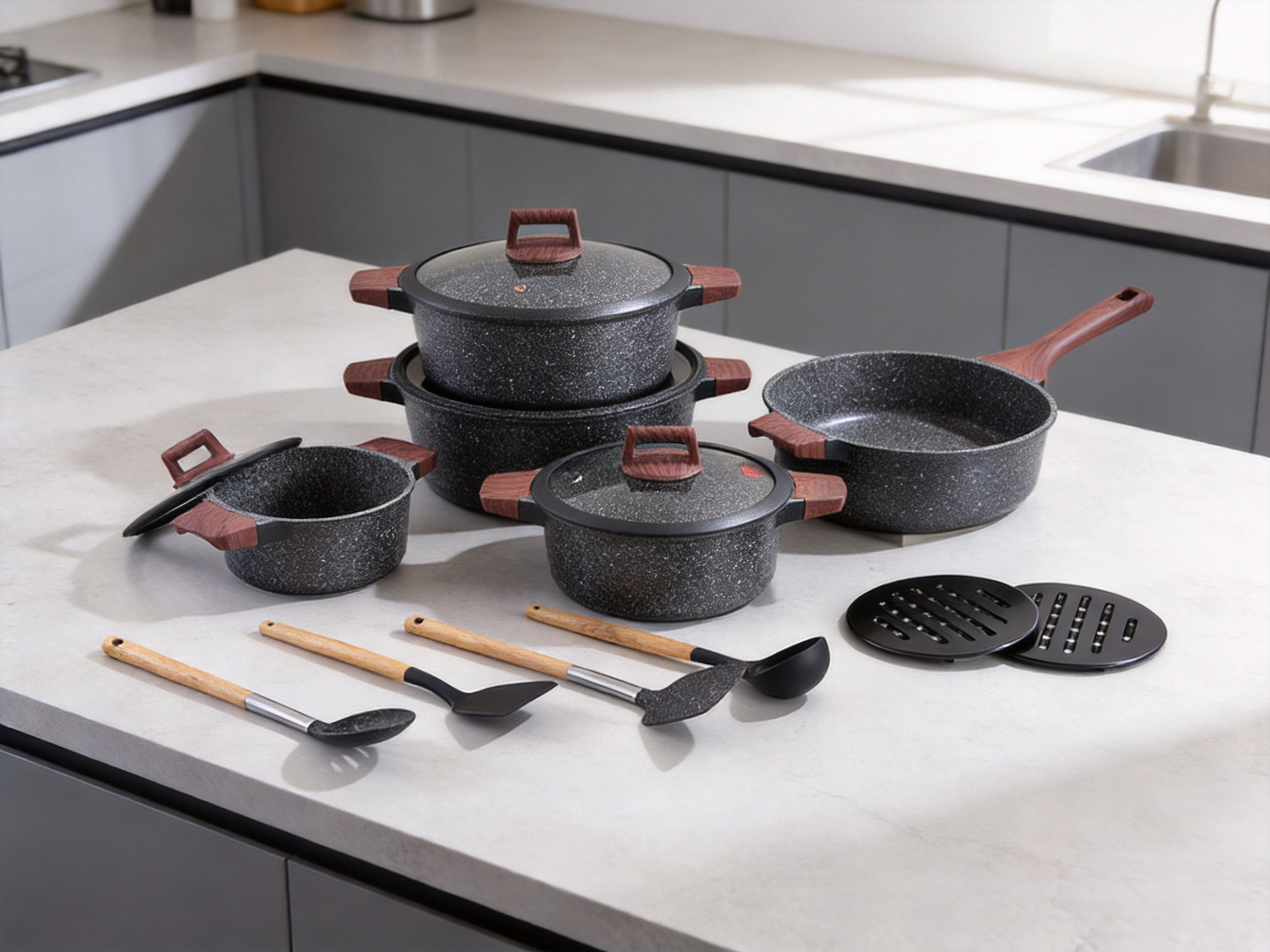
Manufacturing aluminum cookware requires attention to forming, surface treatment, coating, handle attachment, accessory integration, inspection, and packing. Each step affects the final user experience. A cookware body must maintain appropriate shape and stability. A non-stick interior requires controlled preparation and coating processes. Handles must be securely attached and positioned consistently. Finished goods must be checked for appearance, function, and packaging condition.
The product’s black granite-speckled appearance requires a controlled exterior finishing process to achieve a consistent visual effect across different cookware sizes. Pattern consistency matters because noticeable variation between pieces can reduce the perceived quality of a complete set. Proper production control helps ensure that the 20 cm, 24 cm, 28 cm, and 32 cm casseroles look like members of the same product family.
Non-stick cookware also requires careful process management. Surface preparation, coating application, curing, and inspection influence the quality and durability of the cooking surface. Buyers should work with the supplier to confirm the agreed coating specification, applicable food-contact requirements, performance expectations, and testing documentation.
Handle installation is another important production point. The wood-grain appearance must be paired with appropriate positioning and secure attachment. Handles should align consistently, and the connection between handle and cookware body should be inspected during production. Since the product is intended for regular use, structural consistency is essential to customer satisfaction.
Packaging is especially important for a multi-piece cookware set. Several vessels and accessories must be arranged to minimize movement and reduce the possibility of surface damage during transportation. The stated carton information identifies two cartons, a carton size of 65 × 42 × 41 cm, and a carton weight of 23.7 kg. Buyers should confirm whether these specifications apply to the complete shipment configuration, how many sets are packed per carton, and whether inner protection is included.
Quality Control Priorities
A professional cookware manufacturing program should apply quality control at multiple stages rather than relying only on final inspection. Incoming material checks can help verify that the specified aluminum, handle components, silicone tools, and packaging materials are used. In-process inspections can monitor body forming, handle assembly, coating appearance, and accessory matching.
Final inspection may include checking dimensions, surface finish, handle alignment, coating appearance, accessory quantities, and packaging labels. The cookware should also be reviewed for visible dents, scratches, irregular edges, loose components, or other defects that could affect use or presentation.
For a set product, completeness checks are especially important. A missing utensil or insulation pad can create customer dissatisfaction even if the cookware itself is undamaged. A standardized packing list and carton checklist can help reduce omissions. Buyers may also request photographs of packed cartons, random sampling records, and pre-shipment inspection procedures.
Quality control should be aligned with the destination market and the buyer’s sales channel. Products sold through supermarkets, e-commerce platforms, hospitality suppliers, or private-label programs may have different packaging, labeling, barcode, and documentation expectations. Early agreement on these requirements can reduce later delays.
| Inspection Area | Items to Review | Why It Matters |
|---|---|---|
| Cookware body | Shape, dimensions, base stability, visible defects | Supports safe placement and consistent cooking performance |
| Exterior finish | Granite-speckled appearance, color consistency, scratches | Maintains visual quality across the complete set |
| Interior surface | Coating uniformity, visible damage, clean finish | Supports food release and consumer confidence |
| Handles | Alignment, attachment, surface condition | Influences comfort, durability, and perceived quality |
| Accessories | Utensil count, shovel count, insulation pad count | Ensures the retail set is complete |
| Packaging | Protection, labeling, carton strength, packing arrangement | Helps reduce transit damage and warehouse confusion |
| Documentation | Specifications, care instructions, testing records where applicable | Supports import, retail, and customer service requirements |
Care Instructions for Long-Term Use
Correct care is central to preserving the appearance and performance of non-stick cookware. Before first use, the cookware should be washed. Hand washing is recommended because it can help preserve the appearance of the cookware and reduce exposure to harsh cleaning conditions.
For routine cleaning, users should use hot, soapy water with a soft cloth or sponge. Abrasive pads, steel wool, harsh scouring products, and sharp cleaning tools should be avoided. Gentle cleaning is usually sufficient when the pan is allowed to cool appropriately and food residue is removed without aggressive scraping.
Metal or sharp cooking utensils should not be used. Wooden, nylon, silicone, or other utensils specifically designed for non-stick cookware are more suitable. The included silicone utensils can support this care approach, provided they are used according to their intended purpose.
The cookware should not be overheated while empty. Empty cookware can heat rapidly, and excessive heat may affect the finish, handles, or cooking surface. Users should also ensure that flames or other heat sources do not extend beyond the base. This is especially important on gas stovetops.
If a pan severely overheats, users should turn off the cooker and allow the cookware to cool completely. They should not touch the overheated pan immediately or attempt to cool it suddenly with cold water. Sudden temperature changes may create unnecessary stress on cookware components and can also create a safety risk.
The cookware should not be used in a microwave. It should also be handled carefully when full of hot food. Even when handles are designed to resist heat, users should remain aware that the body, rim, lid if supplied, and handle connection areas may become hot during cooking.
All-Stovetop Compatibility and Practical Use
The product is described as compatible with all stovetops. This broad compatibility is an important selling point because households use different cooking technologies. A cookware set that can serve multiple stovetop environments has greater market flexibility than one designed for only a single heat source.
Before large-scale distribution, buyers should confirm the precise meaning of all-stovetop compatibility for their target markets. Different retailers may expect specific wording for gas, electric, ceramic, halogen, or induction use. Product documentation and packaging should communicate compatibility accurately and consistently.
On any stovetop, the cookware should be centered over the appropriate heating area. The heat source should not extend beyond the base. Moderate, controlled heat is generally preferable for non-stick cookware, and cooking performance should be adjusted according to the recipe and the quantity of food in the vessel.
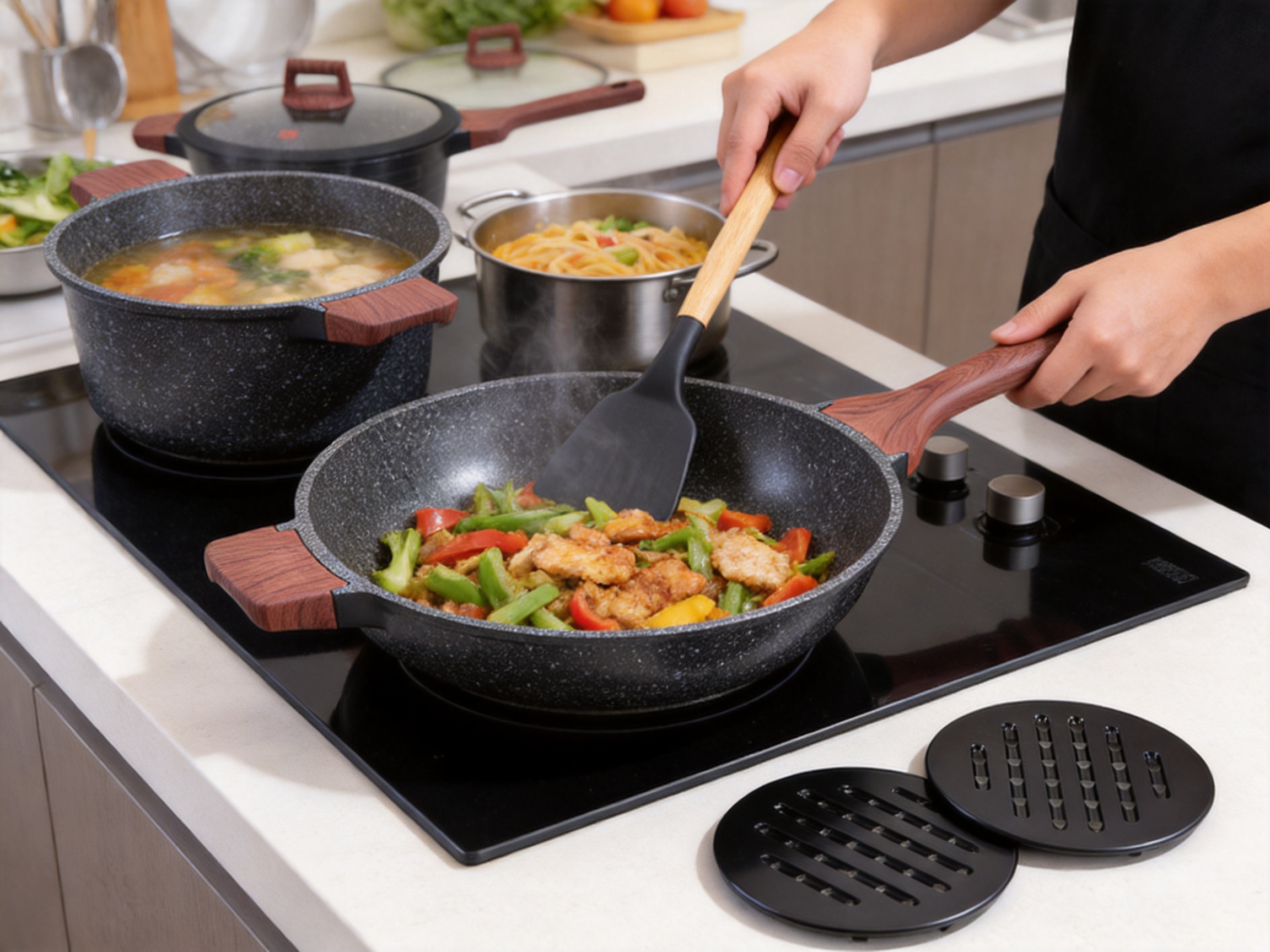
The collection can support many everyday meals. The smaller casserole may be used for sauces or side dishes. The medium casserole can handle rice, pasta, vegetables, or family portions. The larger casserole is suitable for soups, stews, and batch cooking. The deep frypan can support stir-fried vegetables, browned meats, shallow frying, omelets, and combined one-pan recipes.
Applications for Homes, Retailers, and Hospitality Projects
For home users, the set provides a practical foundation for everyday cooking. It can be especially suitable for new households, families replacing old cookware, students moving into furnished accommodation, or consumers seeking a coordinated kitchen collection.
For retailers, the product can be positioned in several ways. It may be presented as a complete cookware set, a multi-function pot and pan collection, a non-stick family cooking solution, or a kitchen starter package. Its combination of cookware and accessories supports gift-oriented merchandising as well as practical household sales.
For hospitality and property furnishing projects, a coordinated set may simplify purchasing and standardize kitchen equipment across multiple units. Furnished apartments, vacation rentals, student housing, and residential developments may benefit from consistent cookware configurations. Buyers should confirm durability expectations, replacement availability, packaging requirements, and usage conditions for any commercial program.
For private-label brands, the collection offers a base design that may be adapted through approved customization. Brand owners can explore packaging themes, color direction, accessory combinations, and market positioning with the supplier. The product’s visual identity can also be incorporated into lifestyle photography and digital product presentations.
Why Work with a One-Stop Kitchenware Supplier
One-stop sourcing can reduce the number of supplier relationships required for a cookware program. When a supplier offers aluminum cookware, stainless steel cookware, cast iron cookware, and kitchen utensils, buyers may be able to develop broader product lines through one communication channel.
This can simplify quotation management, product sampling, packaging coordination, and shipment planning. It may also help buyers compare materials and formats more efficiently. For example, a retailer could develop an aluminum non-stick range alongside stainless steel utensils or cast iron specialty items while maintaining a consistent supplier relationship.
The company’s stated flexible MOQ service may be useful for small and medium-sized buyers who are testing a new product category. Minimum order quantities should always be confirmed for the exact configuration, customization level, packaging format, and destination, but flexibility can make product launches more accessible.
Sustainable and healthy product development is also identified as part of the company’s service direction. Buyers should request specific details about any sustainability claims, such as material efficiency, packaging reduction, recyclability, production controls, or coating specifications. Clear evidence and precise wording are important when communicating such benefits to end customers.
Design and Branding Opportunities
The WoodEssentials concept offers a recognizable design foundation. Black granite speckles create a contemporary surface treatment, while wood-grain handles introduce warmth and a natural visual note. This combination can work well in product photography because it provides contrast between the dark cookware body and lighter handle accents.
Brand owners can build marketing around coordinated cooking, everyday versatility, family meal preparation, easy cleaning, and a complete kitchen setup. The product should be presented honestly, with claims supported by the agreed product specification and applicable testing. Avoiding exaggerated performance promises helps protect long-term brand credibility.
Packaging can emphasize the range of sizes and included accessories. A clear visual layout may show the casseroles, deep frypan, utensils, shovels, and insulation pads as a complete system. Size information should be stated clearly so customers understand the configuration before purchase.
Instructional content is equally important. Care instructions should be included in packaging or product documentation, particularly the recommendations to avoid metal utensils, avoid empty overheating, wash with a soft sponge, avoid microwave use, and hand wash when possible. Good instructions can reduce misuse and help lower avoidable returns.
Purchasing and Specification Checklist
Before placing an order, buyers should confirm the exact contents of the 15-piece configuration. The supplied information lists four casserole sizes, one 28 cm deep frypan without a lid, two shovels, two insulation pads, and additional wooden-handled silicone utensils and grill pan-related components in the product presentation. A detailed packing list should identify every individual piece.
Buyers should also confirm the cookware dimensions, body thickness where relevant, interior coating specification, handle materials, accessory materials, color standards, logo requirements, packaging design, carton quantity, and shipment terms. If the product will be sold in a regulated market, applicable food-contact and product-safety documentation should be discussed before production.
The carton information should be verified against the final order. The stated logistics data includes two cartons, a carton size of 65 × 42 × 41 cm, and a carton weight of 23.7 kg. These figures should be checked for the actual number of retail sets per carton and the final packed configuration.
Samples should be evaluated before mass production. A sample review can cover cooking surface appearance, handle comfort, balance, size accuracy, accessory completeness, packaging protection, and care-instruction clarity. Written approval of the final sample can help establish a clear reference for production.
Frequently Asked Questions
What is included in the cookware set?
The product is presented as a 15-piece aluminum cookware set. The listed information includes 20 cm, 24 cm, 28 cm, and 32 cm casseroles, a 28 cm deep frypan without a lid, two shovels, two insulation pads, and wooden-handled silicone utensils and grill pan-related components shown in the product presentation. Buyers should request the final itemized packing list before ordering.
What material is used for the cookware body?
The cookware body is aluminum with a black granite-speckled exterior appearance. Aluminum is valued for its relatively light weight, responsive heating characteristics, and suitability for a wide range of cookware designs.
Does the cookware have a non-stick interior?
Yes. The product is described as having a food-grade non-stick interior. To help preserve the surface, users should avoid metal or sharp utensils and use wooden, nylon, silicone, or other non-stick-safe tools.
Can the set be used on different stovetops?
The product is described as compatible with all stovetops. The exact compatibility wording and applicable heating technologies should be confirmed with the supplier for the intended market and packaging specification.
Is the cookware dishwasher safe?
The supplied care instructions recommend hand washing to preserve the appearance of the cookware. Users should follow the official product instructions rather than assuming dishwasher suitability.
How should the cookware be cleaned?
Use hot, soapy water with a soft cloth or sponge. Avoid abrasive pads, sharp cleaning tools, and harsh scrubbing methods that may damage the non-stick surface or exterior finish.
Can metal utensils be used?
No. Metal or sharp cooking utensils should not be used. Wooden, nylon, silicone, or non-stick-safe utensils are recommended instead. The included silicone utensils are intended to complement this care approach.
Can the cookware be used in a microwave?
No. The care instructions specifically state that the cookware should not be used in a microwave.
What should users do if a pan overheats?
If the pan severely overheats, users should turn off the cooker and allow it to cool completely. They should not touch it immediately or cool it suddenly with cold water.
What makes this set different from a basic cookware collection?
It combines several casserole sizes, a deep frypan, a food-grade non-stick interior, coordinated wood-grain heat-resistant handles, silicone utensils, shovels, and insulation pads. This gives the set broader functionality and a more coordinated appearance than a basic collection containing only a few unrelated pans.
Can the product be customized for private-label projects?
The supplier states that it provides OEM and ODM customization. Potential options should be discussed according to the required design, logo, packaging, quantity, market, and production schedule. Final customization availability must be confirmed for each project.
Does the supplier offer other kitchenware categories?
The company states that it supplies aluminum cookware, stainless steel cookware, cast iron cookware, and kitchen utensils. This range may support broader one-stop sourcing programs for kitchenware buyers.
What should buyers verify before placing an order?
Buyers should verify the exact piece count, dimensions, materials, coating details, handle specifications, accessory list, packaging, carton data, minimum order quantity, lead time, inspection procedure, and documentation required for the destination market.
Conclusion
The 15pcs WoodEssentials Aluminium Cookware Set is positioned as a versatile and visually coordinated solution for everyday cooking. Its combination of multiple casserole sizes, a 28 cm deep frypan, a food-grade non-stick interior, wood-grain heat-resistant handles, silicone utensils, shovels, and insulation pads gives it a broader functional range than a simple pot-and-pan assortment.
Its advantages extend beyond the cookware itself. The product offers a coordinated design language, broad stovetop positioning, practical accessory integration, and suitability for home, retail, hospitality, and private-label applications. The supplier’s stated capabilities in aluminum cookware, stainless steel cookware, cast iron cookware, kitchen utensils, ODM, OEM customization, certification assistance, flexible MOQs, and one-stop sourcing further support its potential as part of a broader kitchenware program.
As with any non-stick cookware, long-term satisfaction depends on correct use and care. Avoiding metal utensils, preventing empty overheating, using gentle cleaning methods, keeping flames within the base area, and following the supplied instructions can help protect the cookware’s appearance and cooking surface.
For importers, distributors, and brand owners, the next step is to confirm the complete itemized configuration, technical specifications, packaging arrangement, compliance documentation, and final commercial terms. With those details established, this cookware set can serve as a practical foundation for a modern, multi-function kitchenware collection.
References
1. Product specification and care instructions supplied for the 15pcs WoodEssentials Aluminium Cookware Set.
2. Company information supplied for Zhejiang Echo Industry And Trade Co., Ltd.
3. General principles of aluminum cookware design, non-stick cookware handling, and household kitchen safety.
4. General guidance on food-contact product documentation, packaging inspection, and cookware quality-control procedures.
5. General retail and private-label product development practices for cookware and kitchen accessories.
Product: 15pcs WoodEssentials Aluminium Cookware Set
Recommended Articles
Product Category
Related products
-
-
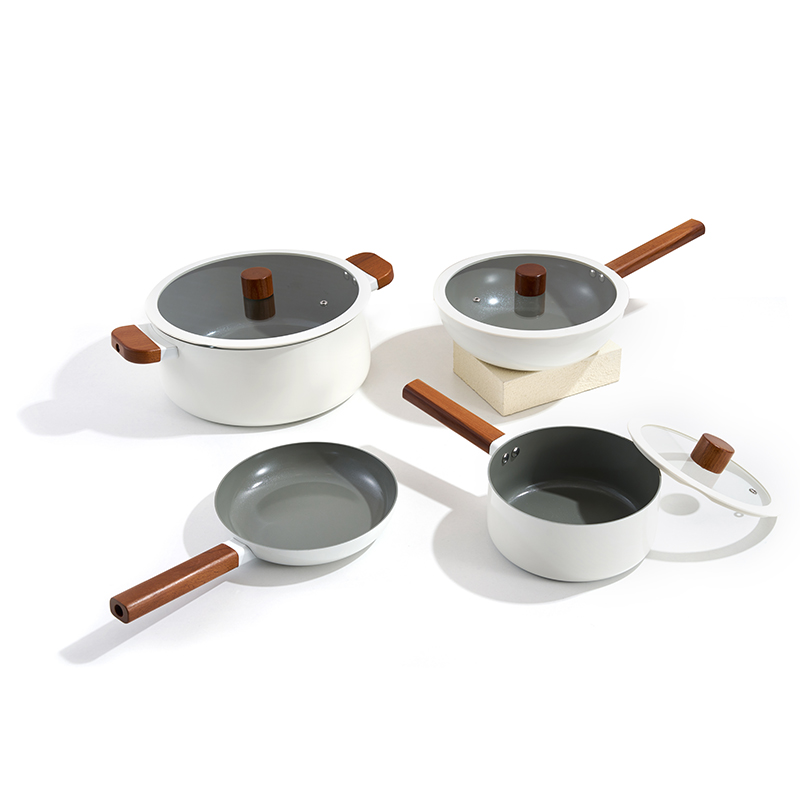
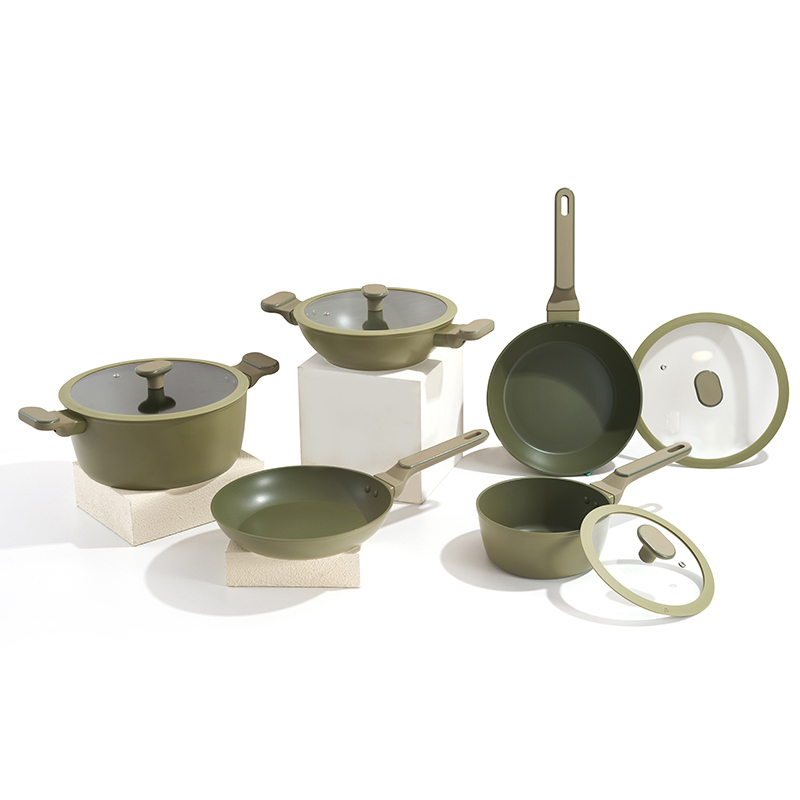
This cookware set has a ceramic non-stick inner liner, a heat-resistant wooden h...
See Details -
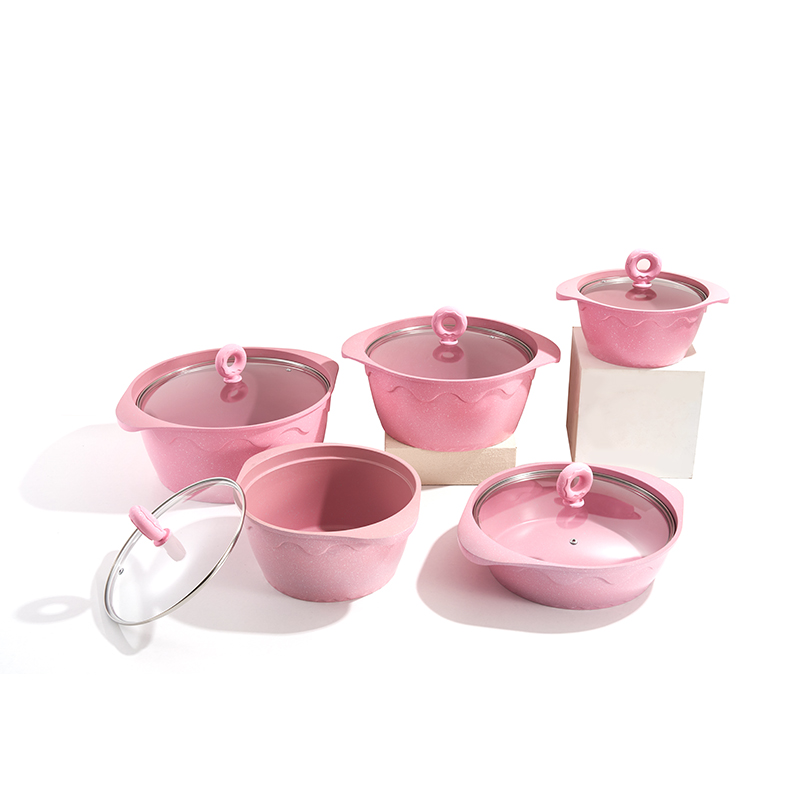
This cookware set is made of food-grade non-stick material, with a unique eye-ca...
See Details -
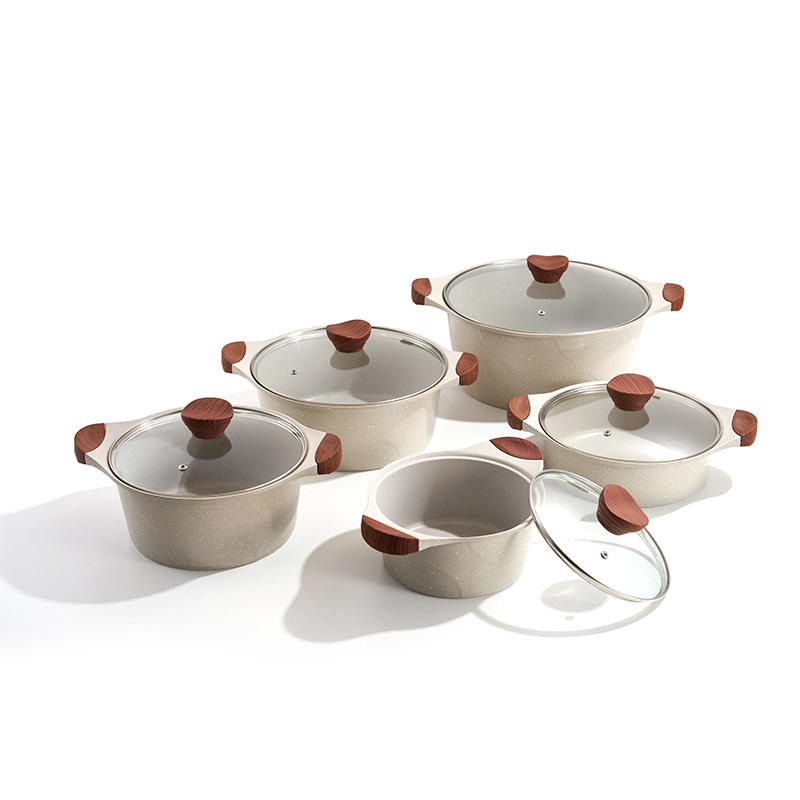
This off-white cookware set is made of wear-resistant non-stick material, with w...
See Details
Whether you're looking for bulk purchases or have any custom requirements, We are here to offer the best
solutions for you.
tiffany.zhong@echocn-trading.com
PHONE
+86-19561173975
+86-19557020621 (Hazel Wu)
ADD
Room 301, Unit 3014, No. 175 Qifeng Avenue, Wenqiao Town, Taizhou, Zhejiang, China
Fill Out the Form for More Information
Copyright © Zhejiang Echo Industry And Trade Co., Ltd.
All Rights Reserved.

China Cookware Set Manufacturer