
 en
 Español

This cookware set features a non-stick coating, even heat conduction, and multi-...
See Details
6-Piece Cream Silicone Kitchen Utensil Set: A Complete Guide to Safer, Smarter, and More Efficient Cooking
Date:Oct 29, 2026
Choosing the right kitchen utensils has a direct impact on cooking efficiency, cookware protection, food safety, storage convenience, and everyday cleaning. A well-designed utensil set should do more than provide several tools in one package. It should offer reliable heat performance, comfortable handling, compatibility with different cookware surfaces, easy maintenance, and a coordinated appearance that suits the modern kitchen.
The 6-Piece Cream Silicone Kitchen Utensil Set is designed to answer these requirements through a combination of food-grade silicone, a one-piece seamless construction, stainless steel accents, specialized utensil shapes, and a neutral cream finish. The set includes tools for stirring, turning, serving, straining, pasta handling, and ladling, giving households a practical selection for everyday cooking.
With heat resistance up to 230℃ and cold resistance down to -40℃, the utensils are suitable for a broad range of cooking and food-preparation situations. Their soft silicone working surfaces are gentle on coated cookware, while the seamless design helps reduce hidden gaps where food particles and moisture might otherwise collect.
This article examines the structure, functions, performance, design advantages, manufacturing considerations, quality strengths, and commercial value of this six-piece kitchen utensil set. It also explains why the product can be a competitive choice for retailers, distributors, hospitality buyers, cookware brands, and households seeking a coordinated and durable kitchen-tool solution.
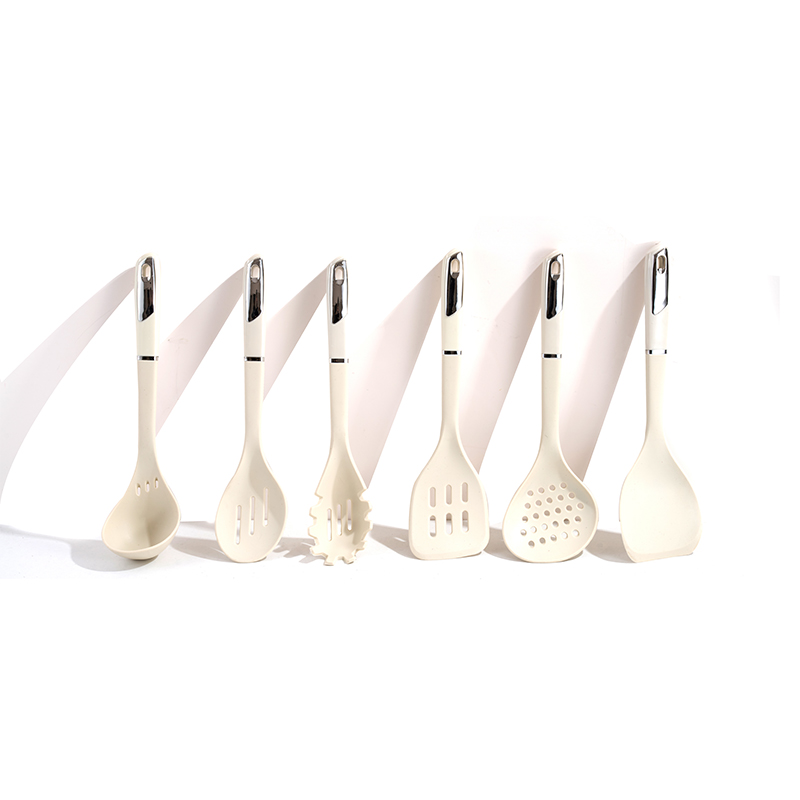
6pcs Cream Silicone Kitchen Utensil Set
1. Why a Complete Utensil Set Matters in the Modern Kitchen
Cooking involves many different movements. A single meal may require stirring a sauce, lifting vegetables from a pan, turning food during frying, serving soup, draining pasta, and transferring ingredients from a cooking vessel to a plate. Using one general-purpose utensil for every task is often inefficient and can create unnecessary wear on both the utensil and the cookware.
A complete utensil set solves this problem by assigning a suitable tool to each common cooking action. Specialized designs make it easier to control food, remove excess liquid, reach the bottom of a pot, serve portions neatly, and protect the cooking surface. The result is a more organized and enjoyable cooking process.
The six-piece configuration provides a balanced selection without becoming excessive. It is large enough to cover common meal-preparation needs while remaining easy to store in a kitchen drawer, utensil holder, or hanging arrangement. For households, this balance makes the set practical. For commercial buyers, it creates a product that is easy to explain and package for customers.
Many competing utensil sets focus primarily on appearance or quantity. A larger number of pieces does not necessarily mean better functionality. Some sets include repetitive tools, fragile accessories, or items that are rarely used. By contrast, the six-piece arrangement emphasizes core kitchen activities and gives each utensil a clear purpose.
Core cooking actions covered by the set
The set supports several important kitchen functions:
Stirring and mixing are supported by ladle-style tools and turners that help move ingredients through sauces, soups, stews, and stir-fries.
Turning and lifting are handled by turners that can be used for eggs, pancakes, vegetables, meat, and other foods prepared in a pan.
Straining is made easier with slotted ladles, which allow liquid to drain while retaining solid food.
Pasta handling is supported by a pasta server designed to lift and portion noodles while allowing excess water or sauce to pass through.
Deep serving is possible with the deep ladle, which is suitable for soups, broths, sauces, and other liquid-based dishes.
This combination gives the set strong everyday value. It is not limited to one type of cooking or one category of food. Instead, it is designed as a flexible tool collection for breakfast preparation, quick weekday meals, slow cooking, baking support, festive dining, and creative recipes.
2. Product Overview and Six-Piece Configuration
The product is a cream-colored silicone kitchen utensil set identified by SKU CS08. It is supplied in cartons of 12 units, with a carton size of 44.5*38*48.5cm. These specifications are relevant to distributors, importers, retailers, and wholesale purchasers planning storage, shipment, and order quantities.
The set uses a minimalist cream matte appearance with stainless steel accents. This combination gives the utensils a clean, coordinated look that can fit contemporary, Nordic, neutral, and premium kitchen interiors. The color is visually softer than traditional black or brightly colored utensils and can be marketed as a refined household accessory as well as a functional cooking tool.
Slotted ladle
The slotted ladle is designed for lifting food while allowing liquid to drain through the openings. It is useful for removing vegetables, dumplings, meat pieces, fried foods, and other ingredients from cooking liquid or oil. Compared with an ordinary solid spoon, the slotted structure improves drainage and reduces the amount of unwanted liquid transferred to the plate.
The silicone surface is also suitable for use in cookware where metal tools could cause scratches or surface damage. This makes the slotted ladle appropriate for coated frying pans, saucepans, stockpots, and other modern cookware.
Turners
Turners are among the most frequently used kitchen tools. They help lift, flip, separate, and reposition food during cooking. The set includes turner-style tools for common pan-based cooking tasks.
A silicone turner can be particularly useful when working with non-stick surfaces. Its flexible working edge can slide beneath food with less risk of scraping the coating. This is an important advantage over rigid stainless steel or uncoated metal turners, especially for consumers who have invested in premium coated cookware.
Pasta server
The pasta server is shaped to help collect, lift, and portion noodles. Its structure supports common pasta varieties and can also be used for noodles, certain vegetables, and other foods that benefit from controlled lifting.
For household users, the pasta server adds convenience to daily meal preparation. For retailers, it adds a recognizable specialty tool that helps distinguish the set from basic collections containing only a spoon, spatula, and ladle.
Deep ladle
The deep ladle is intended for soups, sauces, broths, gravies, and other liquid dishes. Its deeper bowl can help transfer a practical amount of food in each serving movement while reducing splashing.
The deep ladle also adds versatility to the set. A shallow spoon may be sufficient for stirring, but a deeper design is more effective for serving liquid foods from a pot or deep pan.
3. Food-Grade Silicone and Its Performance Advantages
The main working material is food-grade silicone. Silicone is widely used in kitchen tools because it combines flexibility, heat resistance, surface protection, and easy cleaning. It can provide a softer contact point between the utensil and cookware than many traditional metal tools.
For this set, the silicone material is designed for temperatures up to 230℃ and down to -40℃. This broad operating range supports hot cooking applications as well as cold food preparation and storage-related tasks. The temperature performance makes the utensils suitable for stirring sauces, turning food in a hot pan, serving soups, working with chilled ingredients, and assisting with a variety of kitchen preparations.
Heat resistance up to 230℃
Heat resistance is one of the most important performance features in a kitchen utensil. Utensils are frequently exposed to hot cookware, steam, boiling liquids, simmering sauces, heated oil, and freshly cooked food. A material that softens, deforms, becomes brittle, or produces an unpleasant odor under normal kitchen conditions will quickly lose consumer confidence.
The rated heat resistance of up to 230℃ gives this set a substantial performance range for everyday cooking. It allows users to work confidently around many common stovetop applications, provided that the utensil is used according to normal kitchen-safety practices and is not left directly against an open flame or an active heating element.
This performance also creates a commercial advantage. Buyers increasingly expect utensils to function across multiple cooking methods rather than being limited to low-temperature preparation. A clear heat-resistance specification helps retailers communicate product value and gives end users a simple reason to select the set over lower-grade alternatives.
Cold resistance down to -40℃
Cold resistance down to -40℃ broadens the product’s material-performance profile. Although most consumers will use the utensils at room temperature or in hot cooking environments, cold resistance indicates that the silicone is engineered to maintain performance across a wide range of temperatures.
This can be valuable in kitchens where ingredients, prepared foods, or containers are handled at low temperatures. It also supports improved material stability during transportation and storage in varying climates. For international buyers, wide-temperature performance is a useful product feature because distribution conditions and end-use environments can differ significantly from one market to another.
Gentle contact with cookware
One of the strongest advantages of silicone utensils is their compatibility with cookware coatings. The soft working surface is less likely to scratch or mark non-stick coatings than hard metal tools. This is especially important for aluminum cookware and other pans with coated interiors.
Protecting the cooking surface can help consumers preserve the appearance and usability of their cookware for longer. It also reduces the need to purchase replacement pans caused by avoidable surface damage. A utensil set that is gentle on cookware therefore delivers value beyond the utensils themselves.
The cookware-friendly design is relevant to a wide range of kitchens, including homes using non-stick frying pans, ceramic-coated cookware, enamel pots, stainless steel vessels, and other modern cooking products. The utensils can also complement cast iron and other durable cookware while offering a softer contact point during stirring and serving.
4. One-Piece Seamless Construction
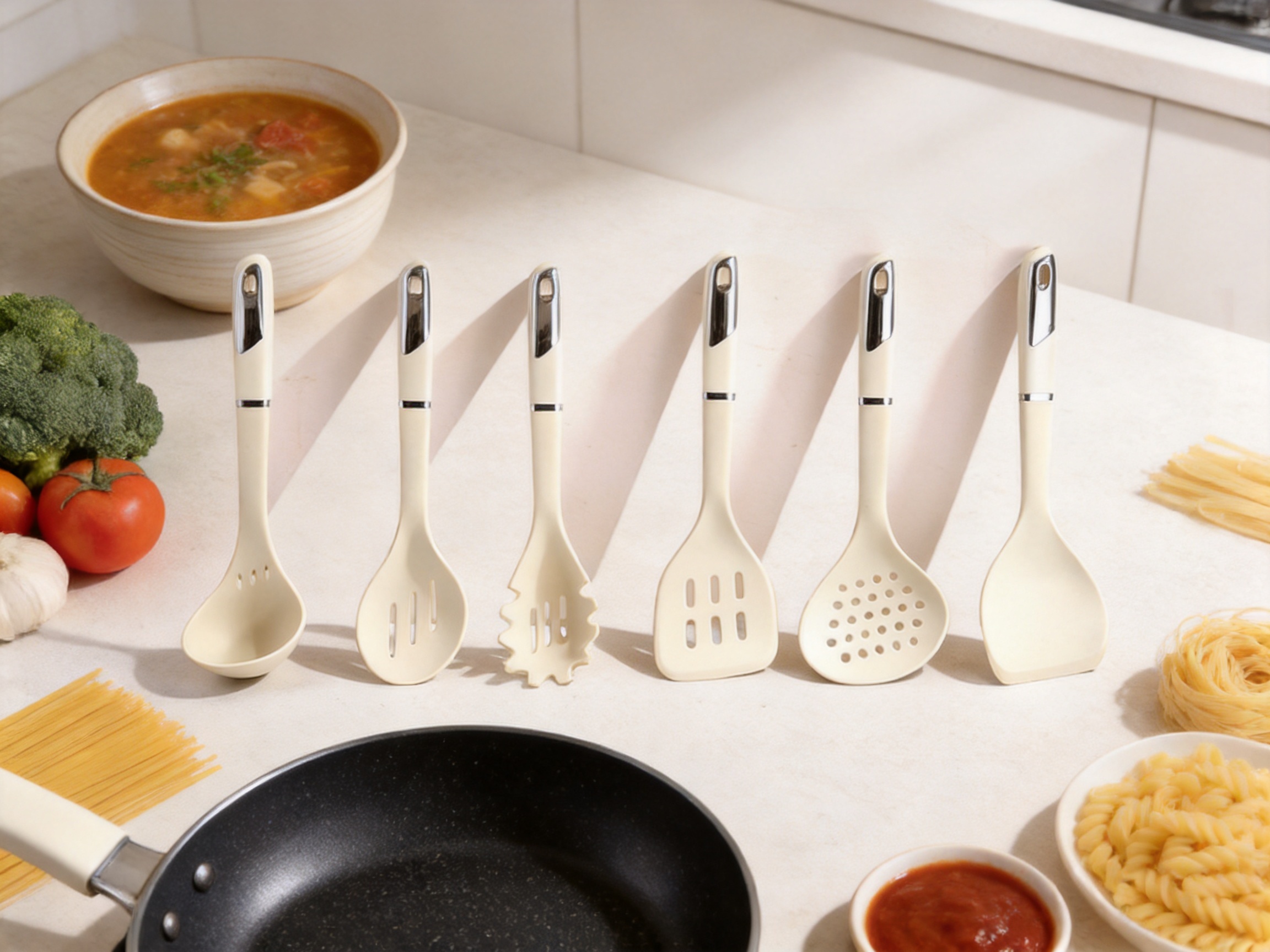
The one-piece seamless design is a central feature of this product. Instead of relying on multiple exposed joints, separate silicone heads, or complicated connection points, the utensil body is created as a continuous structure. This construction approach has practical benefits for hygiene, durability, cleaning, and visual quality.
Improved hygiene
Traditional multi-part utensils may contain small gaps around handles, metal shafts, rivets, or attached heads. These areas can collect food residue, grease, moisture, and detergent if they are not cleaned carefully. Over time, concealed residue can create unpleasant odors and reduce confidence in the product.
A seamless one-piece structure reduces the number of hidden crevices. The smooth surface is easier to rinse and wipe, helping users maintain a cleaner utensil after cooking. This is especially useful for tools used with oily sauces, dairy-based preparations, sticky ingredients, and heavily seasoned foods.
Reduced moisture retention
Moisture trapped inside a utensil joint can contribute to hygiene concerns and material deterioration. Since the seamless design has fewer internal gaps, there are fewer locations where water can remain after washing. This supports faster drying and helps reduce conditions that may encourage mold development.
The product description specifically emphasizes mold resistance and easy rinsing. These properties are important in busy kitchens where utensils may be washed frequently and stored soon afterward.
Greater structural continuity
A utensil with fewer assembled sections can offer a more unified feel in the hand. The working head and handle function as one coordinated body, reducing the risk of a loose attachment that may occur in poorly assembled products.
Seamless construction also supports consistent appearance. Without visible connection lines or bulky assembly points, the cream silicone body can maintain a smooth, premium finish that is suitable for open storage and display.
Manufacturing significance
Producing a one-piece silicone utensil requires careful attention to material preparation, mold design, temperature control, forming, trimming, inspection, and finishing. The process must deliver a consistent shape while maintaining the intended flexibility and strength of the silicone.
Advanced manufacturing is not defined only by complex machinery. It also depends on process integration and consistency. For a product such as this, manufacturing strength can be demonstrated through the ability to control the complete product cycle: selecting suitable food-contact material, forming accurate utensil geometries, creating smooth surfaces, integrating stainless steel accents, inspecting finished units, and preparing reliable packaging for export.
5. Design and Ergonomic Value
Kitchen utensils must be practical in the hand as well as attractive on the shelf. Shape, weight, surface texture, balance, and handle construction all influence how comfortably a user can cook for several minutes or prepare a large meal.
The cream matte finish contributes to a soft visual impression and can make the tools feel more refined than brightly colored or highly glossy alternatives. A matte finish may also help reduce the appearance of minor fingerprints and reflections during display.
Comfort during repeated use
Cooking often involves repeated stirring, lifting, scraping, and turning. A utensil that is difficult to hold may cause hand fatigue, especially when working with heavy food or large quantities. Silicone provides a more comfortable tactile surface than cold, hard metal and can offer a secure grip during ordinary kitchen movements.
The one-piece format also eliminates some of the uncomfortable edges that may be found around assembled handles. A continuous exterior allows the user to maintain a more natural grip while moving the tool between the cooking vessel and serving area.
Balanced visual design
The stainless steel accents create a visual contrast with the cream silicone body. This balance combines the softness of silicone with the clean appearance associated with metal. It can help position the set above basic single-material utensils without making the design overly decorative.
The result is a product that can be displayed in a drawer, utensil container, countertop holder, or open kitchen arrangement. Because the appearance is neutral, the set can coordinate with white, gray, beige, wood, black, stainless steel, and other popular kitchen styles.
Hanging storage
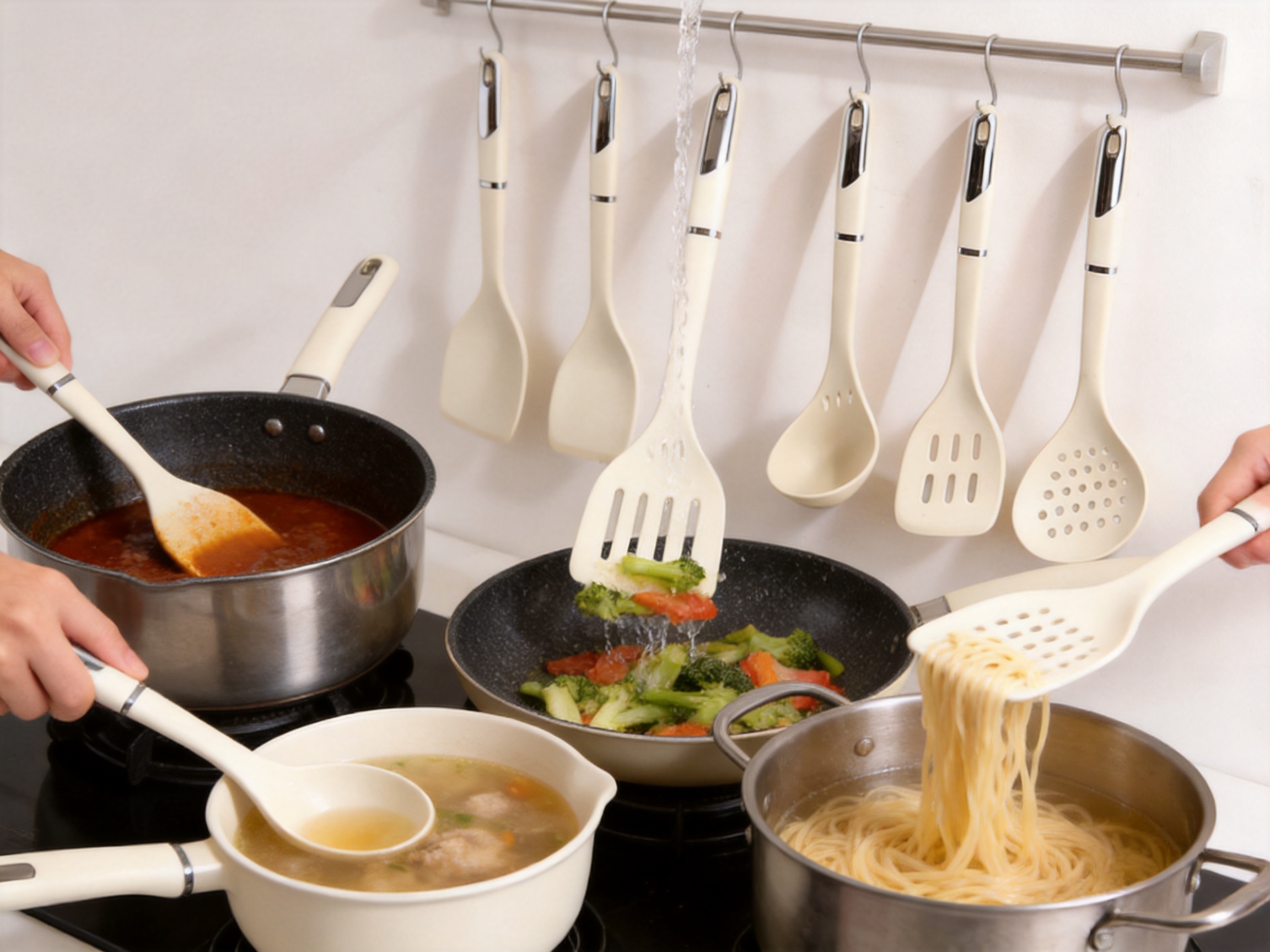
Each applicable utensil includes a built-in hanging hole. This feature allows users to place the tools on a wall rail, hook, pegboard, or other hanging storage system. Hanging storage can free drawer space, improve visibility, and allow wet utensils to dry more effectively after washing.
For smaller kitchens, storage efficiency is a major purchasing consideration. A utensil set that can be stored vertically or openly may be more useful than one that must be placed inside a crowded drawer. The hanging-hole design also makes the set easier to organize because each tool remains visible and accessible.
6. Cleaning, Maintenance, and Long-Term Usability
Ease of cleaning is one of the most important factors affecting customer satisfaction with kitchen tools. A utensil may perform well during cooking, but if it is difficult to wash or develops odors after repeated use, the consumer may stop using it.
The smooth, seamless silicone construction is designed for easy rinsing. Food residue can generally be removed from the surface without the need to work around multiple joints or exposed fasteners. This reduces the time required for routine maintenance.
Mold-resistant design considerations
Mold prevention depends on more than material selection. It also depends on surface smoothness, drainage, drying, storage, and cleaning habits. A seamless utensil can support better hygiene by reducing hidden spaces where moisture and food particles may remain.
Users should still rinse utensils promptly after use, wash them thoroughly, and allow them to dry before long-term storage. The built-in hanging holes make this easier by supporting open-air drying rather than enclosed storage while the utensil is still damp.
Dishwasher compatibility
Select parts of the set are dishwasher-safe, providing added convenience for users who prefer machine cleaning. Dishwasher suitability can be an important retail selling point, particularly for families, busy professionals, hospitality users, and consumers who prioritize low-maintenance products.
As with any kitchen product, users should follow the care guidance supplied with the final product. Different dishwasher cycles, detergent types, temperatures, and loading positions may influence long-term appearance. Proper care helps preserve the cream finish, silicone surface, and stainless steel accents.
Simple daily care
For ordinary use, the utensils can be rinsed after cooking to remove loose residue, washed with warm water and a suitable dishwashing detergent, and dried or hung in a ventilated location. Abrasive materials should be avoided when they are unnecessary because they can affect surface appearance over time.
Simple maintenance is an important competitive advantage. Consumers increasingly look for products that save time rather than create additional household work. This set addresses that expectation through smooth surfaces, fewer joints, dishwasher-safe components, and hanging storage capability.
7. Advantages Compared with Common Competing Utensils
The market includes wooden utensils, stainless steel tools, plastic utensils, multi-part silicone tools, and low-cost mixed-material sets. Each category has its place, but the six-piece cream silicone set offers a combination of features that can distinguish it from many alternatives.
Compared with wooden utensils
Wooden utensils are valued for their natural appearance and traditional feel. However, wood may absorb moisture and food odors, and it can require more careful drying and maintenance. The seamless silicone construction of this set is less porous in everyday use and easier to rinse.
Silicone also offers greater flexibility and heat performance for certain cooking tasks. It can be a more suitable option for coated cookware because it provides a soft contact surface.
Compared with rigid metal utensils
Stainless steel utensils are strong and heat-resistant, but rigid metal edges may scratch or damage some cookware coatings if used carelessly. The silicone working surfaces in this set provide a gentler alternative for non-stick and coated pans.
Silicone tools can also feel more comfortable during repeated use because they do not have the same cold, hard contact as metal. The stainless steel accents retain a premium visual element without making the main cooking surfaces rigid.
Compared with ordinary plastic tools
Lower-grade plastic utensils may deform under heat, develop surface damage, or become brittle with age. The specified 230℃ heat resistance gives this silicone set a broader performance range than many general-purpose plastic tools.
The silicone material also offers a more premium tactile quality and a softer cookware contact. These differences can help justify a higher perceived value in retail and wholesale channels.
Compared with multi-part silicone utensils
Some silicone utensils use a separate silicone head fitted onto a metal or plastic handle. While this structure can be functional, the joint may become a point of weakness or a location where food and moisture collect.
The one-piece seamless design reduces this concern. It presents a cleaner appearance, supports easier washing, and can provide improved confidence in long-term daily use.
Compared with oversized utensil collections
Large sets may contain many pieces, but quantity alone does not guarantee usefulness. The six-piece configuration is more focused and easier for customers to understand. It contains core tools for common cooking tasks without overwhelming the user with rarely used accessories.
For retailers, a focused product assortment can simplify merchandising and product education. For consumers, it offers a practical starting collection that can be used immediately.
8. Manufacturing Process and Quality-Control Strengths
The performance of a kitchen utensil depends heavily on manufacturing consistency. A product may have an attractive specification, but the specification must be reflected in every finished unit. Consistent material quality, accurate molding, clean finishing, and dependable inspection are therefore essential.
The manufacturing strengths behind this type of product can be understood through several important process stages.
Material selection and preparation
The first stage is the selection of suitable food-grade silicone and compatible stainless steel components. Material selection affects flexibility, heat performance, color stability, surface feel, and durability.
Silicone compounds must be prepared consistently so that the finished utensils maintain a uniform cream color, stable structure, and reliable performance. Stainless steel accents must also be selected and finished to match the intended appearance of the silicone body.
For an export-oriented supplier, controlled material sourcing is especially important. Buyers may require consistent appearance across repeat orders, and differences in color or texture can affect retail presentation. A professional supply chain should therefore maintain clear material specifications and repeatable purchasing standards.
Mold and tooling accuracy
One-piece utensils rely on accurate molds to produce the correct head shape, handle profile, hanging hole, slot arrangement, and surface finish. The mold must support consistent dimensions while allowing the silicone to fill the intended areas evenly.
Specialized forms such as pasta servers, deep ladles, and slotted ladles require more than a simple flat shape. Their functional performance depends on controlled geometry. Slot openings must be positioned correctly, the bowl of a ladle must have suitable depth, and the working edge of a turner must retain its intended profile.
Reliable tooling helps reduce variation between units. It also supports more efficient production by minimizing rework, trimming problems, and dimensional inconsistencies.
Controlled forming and curing
Silicone utensils require controlled forming and curing conditions. Temperature, pressure, time, and material distribution influence the final hardness, flexibility, surface quality, and dimensional stability.
A professional manufacturing process should monitor these variables to reduce problems such as incomplete forming, surface defects, deformation, uneven thickness, or inconsistent elasticity. The objective is to produce tools that feel and perform similarly across the entire set.
Surface finishing and trimming
After forming, the utensils may require trimming and finishing to remove excess material and achieve clean edges. This stage is particularly important for turners and slotted tools because rough edges can affect both comfort and food handling.
Smooth finishing contributes to the premium appearance of the cream matte design. It also supports easier cleaning by reducing irregular areas where residue could collect.
Stainless steel accent integration
The stainless steel accents add a refined visual element and may contribute to structural or decorative value. Their integration must be handled carefully so that the final utensil remains comfortable and free from sharp edges or loose parts.
Consistency between the silicone body and stainless steel component is essential. The materials should appear coordinated, and the joining or finishing process should withstand ordinary handling, washing, and storage.
Inspection and quality assurance
Quality control should include visual inspection, dimensional checks, surface checks, functional review, and packaging inspection. Important points may include silicone color consistency, edge smoothness, slot clarity, handle integrity, hanging-hole formation, stainless steel finish, and overall cleanliness.
Temperature performance and food-contact suitability should be supported by appropriate material documentation and testing procedures relevant to the intended market. Buyers may also request samples, inspection reports, packaging details, and product specifications before placing larger orders.
The ability to manage these details is a major strength for a professional supplier. It demonstrates that the product is not simply assembled from generic parts but developed through coordinated design, production, and quality-control procedures.
9. Supply-Chain and Customization Capabilities
For distributors and kitchenware brands, product quality is only one part of a successful purchasing decision. Buyers also need dependable communication, product variety, customization options, manageable minimum order quantities, export experience, and support with documentation.
The supplier behind this product provides one-stop cookware solutions covering aluminum cookware, stainless steel cookware, cast iron cookware, and kitchen utensils. This broad category coverage can be useful for buyers who want to build a coordinated cookware collection rather than source each item from a separate manufacturer.
One-stop sourcing
One-stop sourcing can simplify purchasing administration. Instead of coordinating separate orders for pans, pots, utensils, and accessories, buyers may be able to develop a broader product program through one supply partner.
This can reduce communication complexity, support more consistent packaging and design language, and make it easier to create matching collections. The cream silicone utensil set can be positioned alongside aluminum cookware, stainless steel products, or other kitchen accessories as part of a larger assortment.
ODM and OEM support
Original design manufacturing and original equipment manufacturing services are valuable for brands seeking differentiation. Potential customization areas may include color, packaging, logo placement, product combinations, labeling, and coordinated collection design, subject to project requirements and production feasibility.
The cream color and stainless steel accents already create a clear visual identity. Buyers can use this design as a finished product or explore adaptations that match their own brand palette, retail positioning, or target market preferences.
Flexible purchasing for different buyer sizes
Flexible minimum order quantities can be important for small and medium-sized kitchenware buyers. Large established brands may order at scale, while emerging retailers and regional distributors may need to test market response before committing to very large volumes.
A professional supplier that can discuss different order sizes, packaging requirements, and production schedules is better positioned to support both developing and established customers. The carton quantity of 12 units provides a clear reference point for wholesale planning and inventory calculations.
Certification assistance
Different markets may require different product documents, test reports, labeling formats, and compliance information. Certification assistance can help buyers prepare products for their intended sales regions.
Actual requirements depend on the destination market, product configuration, packaging, and applicable regulations. Buyers should confirm the specific documentation needed for food-contact kitchen utensils before final production and shipment.
Sustainable and healthy product development
Modern buyers increasingly evaluate kitchenware in terms of material responsibility, product lifespan, health considerations, and packaging efficiency. A durable utensil that can be used repeatedly may offer better long-term value than a disposable or short-lived alternative.
The food-grade silicone construction, reusable format, seamless design, and long-term usability support a product-development approach focused on healthier and more practical kitchen tools. Sustainable development also involves avoiding unnecessary packaging, improving production efficiency, reducing defects, and selecting materials responsibly.
10. Commercial Applications and Target Markets
The six-piece utensil set can serve a broad range of commercial channels. Its neutral appearance, clear function, and compact configuration make it suitable for both direct-to-consumer sales and business-to-business distribution.
Retail stores
Homeware shops, department stores, cookware retailers, and lifestyle stores can present the set as an everyday kitchen essential. The cream color supports premium and minimalist merchandising, while the six-piece format makes the product easy for shoppers to understand.
Retail packaging can highlight the heat range, cookware-safe silicone, seamless construction, hanging storage, and specialized tool selection. These points help customers compare the product with lower-priced, less complete alternatives.
Online marketplaces
For online sales, the product has several easy-to-communicate benefits: six useful utensils, food-grade silicone, heat resistance up to 230℃, cold resistance down to -40℃, compatibility with cookware coatings, and easy cleaning.
Product images can show the complete set, individual utensil shapes, close-ups of the seamless surface, and storage options. Clear descriptions are important because customers cannot physically hold the utensils before purchasing.
Hospitality and food-service environments
Restaurants, cafés, catering businesses, cooking schools, and serviced accommodation providers may require practical utensils that can withstand repeated daily use. The specialized tool selection can support food preparation, cooking, and serving tasks.
Commercial users should evaluate the product according to their own operational requirements, cleaning systems, heat exposure, and replacement schedules. The smooth design and easy-rinse surface may be especially useful in busy kitchens where cleaning efficiency matters.
Housewarming and gift channels
The coordinated cream appearance allows the set to function as a housewarming, wedding, holiday, or kitchen-upgrade gift. It looks more complete and intentional than a collection of unrelated single utensils.
Gift buyers often value products that combine attractive design and daily usefulness. This set meets both expectations by offering a decorative neutral finish and a selection of practical tools.
Private-label kitchenware programs
Brands seeking private-label products can use the utensil set as part of a broader cookware collection. Matching the cream color with pots, pans, storage products, or baking accessories can create a unified visual identity across a retail range.
The product can also support promotional bundles. For example, a cookware purchase may be paired with the utensil set as a premium accessory, or the utensil set may be sold with a complementary frying pan or saucepan.
11. Packaging, Logistics, and Wholesale Considerations
Wholesale buyers need to consider more than the product itself. Carton quantity, carton dimensions, storage efficiency, handling, and shipping organization all influence landed cost and inventory planning.
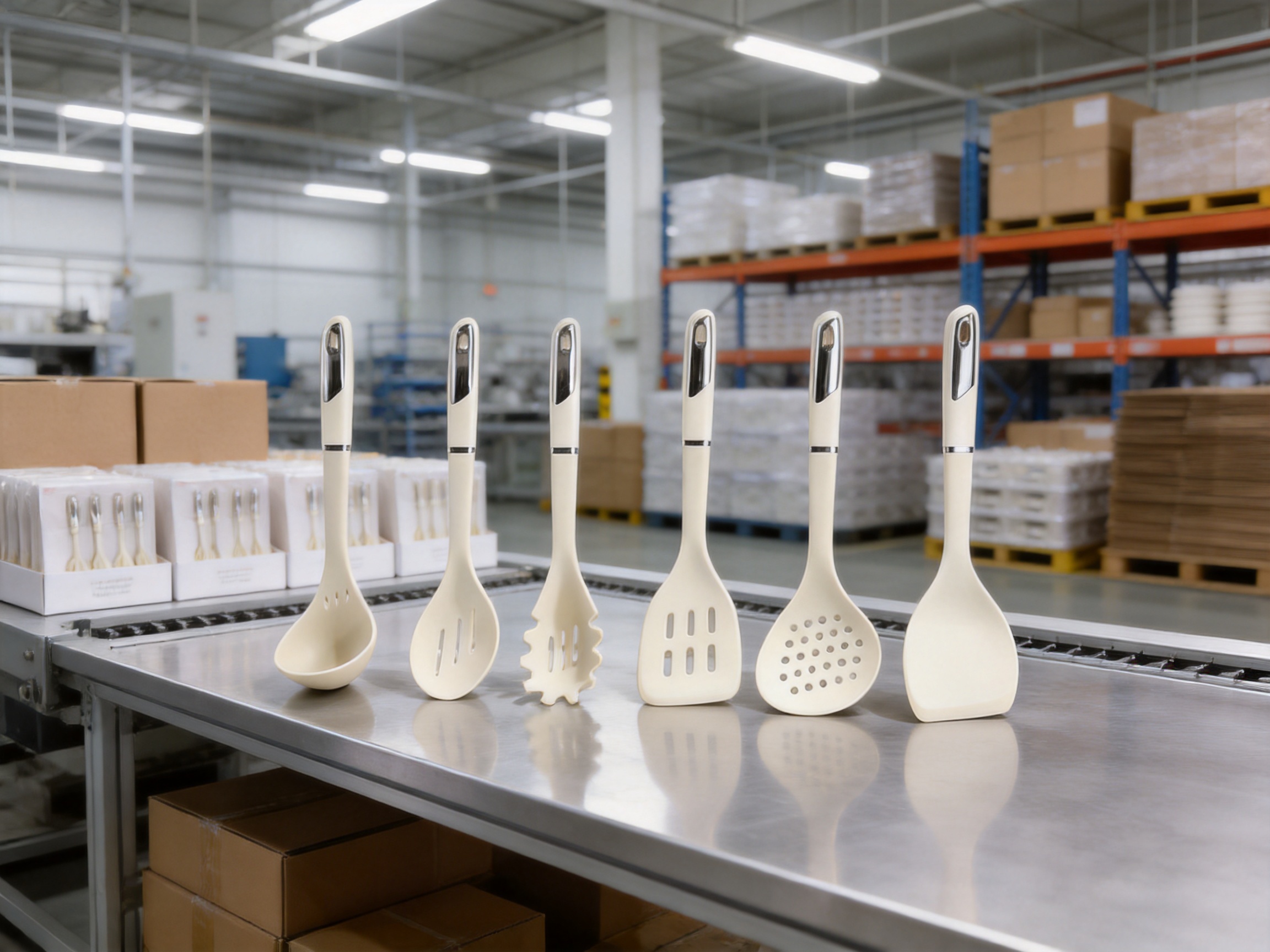
The specified carton quantity is 12 units, with a carton size of 44.5*38*48.5cm. These details allow importers and distributors to estimate warehouse space, pallet planning, freight volume, and initial purchase quantities.
Because the set contains multiple utensils, packaging should protect the cream silicone surfaces and stainless steel accents from unnecessary marks during transit. Internal arrangement should prevent excessive movement, while the outer carton should be suitable for ordinary handling through factory dispatch, freight transport, customs processing, and warehouse receiving.
Good packaging also supports retail presentation. A coordinated set should be packaged in a way that allows the customer to understand the contents quickly. Product information may include the utensil count, material, temperature range, cleaning guidance, storage features, and care recommendations.
For international buyers, packaging and labeling should be reviewed according to destination-market requirements. Product names, material statements, care instructions, carton marks, barcodes, and language versions may need to be adjusted for different sales regions.
12. How to Position the Product Against Competitors
Successful product positioning should focus on meaningful benefits rather than simply listing features. The most persuasive message is that the set helps users cook more safely, protect cookware, clean more easily, and organize the kitchen more effectively.
Positioning around cookware protection
The set can be positioned as a cookware-friendly alternative to hard metal tools. This message is particularly relevant to consumers who use non-stick or coated pans and want to reduce the risk of scratches.
Positioning around hygiene
The one-piece seamless design can be presented as a cleaner and easier-to-maintain option. Fewer hidden crevices, easy rinsing, mold resistance, and selected dishwasher-safe components create a strong hygiene and convenience story.
Positioning around complete functionality
The six-piece format can be described as a carefully selected cooking toolkit rather than an oversized collection. The combination of slotted ladles, turners, a pasta server, and a deep ladle gives customers tools for a wide range of meals.
Positioning around modern design
The cream matte finish and stainless steel accents support a premium lifestyle message. The product can appeal to customers who want their kitchen tools to coordinate with their home décor instead of appearing purely utilitarian.
Positioning around supplier capability
For business buyers, product positioning should include the supplier’s wider strengths: one-stop cookware sourcing, ODM and OEM services, flexible MOQs, product certification assistance, category expertise, and export-oriented supply-chain support.
This combination gives the product an advantage over suppliers that offer only a single generic utensil style without customization or broader cookware coordination.
13. Recommended Use and Care Guidance
Use the utensils for ordinary cooking, stirring, serving, turning, draining, and pasta handling within the stated temperature range.
Avoid placing the silicone directly on an open flame or in direct contact with an active heating element. Do not leave the utensil unattended in extremely hot cookware for longer than necessary.
Use the turners and ladles according to their intended functions. Avoid using them as cutting tools or applying excessive force against sharp edges.
Rinse the utensils after use to remove food residue. Wash with warm water and a suitable kitchen detergent, then dry thoroughly or hang using the built-in hanging hole.
Place only the applicable components in the dishwasher and follow the care instructions provided with the final product.
Store the utensils in a clean and dry location. Hanging storage can help improve ventilation, visibility, and access.
Regular inspection is recommended for any frequently used kitchen tool. If a utensil shows serious damage, excessive deformation, or a compromised surface, it should be replaced.
14. Buyer Checklist for Wholesale and Private-Label Orders
Before confirming a purchase, buyers should review the exact utensil composition and confirm that the six-piece assortment matches the intended market.
Material documentation should identify the silicone specification and any relevant food-contact information required by the destination country.
Buyers should request production samples when color, surface texture, handle design, or stainless steel accents are important to the brand identity.
Packaging details should be confirmed, including individual packaging, master carton quantity, carton dimensions, labeling, barcode requirements, and logo placement.
Quality expectations should be documented in advance. These may include acceptable color tolerance, surface finish, edge smoothness, dimensional consistency, product cleanliness, and packaging condition.
Order schedules should account for sample approval, artwork approval, material preparation, production, inspection, and shipping.
Buyers should also confirm whether selected parts are dishwasher-safe, how the temperature rating is presented on packaging, and whether additional market-specific testing or certification is required.
| Buyer Review Area | Key Point to Confirm | Commercial Benefit |
|---|---|---|
| Product configuration | Six-piece assortment and utensil functions | Clear product positioning and easier inventory planning |
| Material | Food-grade silicone and stainless steel accents | Supports safety, durability, and premium presentation |
| Temperature performance | Up to 230℃ and down to -40℃ | Communicates broad cooking and storage versatility |
| Construction | One-piece seamless design | Improves hygiene, cleaning, and perceived quality |
| Cookware compatibility | Gentle silicone contact surface | Suitable for many coated cookware products |
| Storage | Built-in hanging hole | Supports space-saving and open storage |
| Cleaning | Easy rinsing and selected dishwasher-safe parts | Reduces daily maintenance effort |
| Wholesale logistics | Carton quantity of 12 and specified carton size | Supports freight, warehouse, and order calculations |
| Customization | ODM, OEM, packaging, and color possibilities | Enables private-label and differentiated product programs |
15. Frequently Asked Questions
Q1: What utensils are included in the six-piece set?
The set includes specialized tools for common cooking tasks, including slotted ladle-style tools, turners, a pasta server, and a deep ladle. The exact assortment should be confirmed against the approved product sample and packaging specification before order placement.
Q2: What is the main material of the utensils?
The working utensils are made from food-grade silicone and feature stainless steel accents. The silicone provides flexibility, heat performance, cookware protection, and a comfortable surface for everyday use.
Q3: What temperature range is specified for the silicone?
The product is specified as heat-resistant up to 230℃ and cold-resistant down to -40℃. Users should still avoid direct contact with an open flame or active heating element and follow the care instructions supplied with the product.
Q4: Are the utensils suitable for non-stick cookware?
Yes. The silicone working surfaces are designed to be gentle on cookware coatings, making the utensils suitable for many non-stick and coated pans. Users should avoid dragging any utensil forcefully across a surface and should replace products that become damaged.
Q5: What is the advantage of the one-piece seamless design?
The seamless design reduces hidden joints and crevices where food residue and moisture can collect. It supports easier rinsing, improved hygiene, more convenient maintenance, and a unified appearance.
Q6: Are the utensils dishwasher-safe?
Select parts are dishwasher-safe. Buyers and end users should confirm the care instructions for each component and use the recommended dishwasher conditions to help preserve the silicone finish and stainless steel accents.
Q7: Can the utensils be hung on a kitchen wall?
Yes. The built-in hanging hole allows the utensils to be placed on hooks, rails, or other suitable wall-storage systems. Hanging storage can save drawer space and improve drying after washing.
Q8: Is the cream color suitable for different kitchen styles?
The cream matte finish is designed to coordinate with modern, Nordic, minimalist, neutral, and premium kitchen interiors. It can complement light wood, white, gray, black, stainless steel, and other common kitchen finishes.
Q9: What is the wholesale carton quantity?
The stated carton quantity is 12 units. The specified carton size is 44.5*38*48.5cm. Buyers should confirm final packing details, including individual packaging and any customized carton configuration, before production.
Q10: Can the product be customized for a private-label brand?
The supplier provides ODM and OEM customization services. Potential customization areas may include color, packaging, logo application, labeling, and coordinated product programs, subject to design review, order requirements, and production feasibility.
Q11: Can the supplier provide other cookware products?
Yes. The supplier offers one-stop cookware solutions across aluminum cookware, stainless steel cookware, cast iron cookware, and kitchen utensils. This can help buyers develop broader product collections through one supply-chain partner.
Q12: What should buyers confirm before placing a large order?
Buyers should confirm the approved sample, material documentation, utensil configuration, color standard, packaging, carton quantity, quality requirements, production schedule, shipping terms, and any destination-market certification or labeling requirements.
16. Overall Product Assessment
The 6-Piece Cream Silicone Kitchen Utensil Set combines practical function, cookware-friendly performance, modern design, and convenient maintenance. Its strongest features are the food-grade silicone construction, broad temperature range, one-piece seamless design, specialized utensil assortment, cream matte finish, stainless steel accents, hanging storage, and selected dishwasher-safe components.
Compared with basic plastic tools, it offers a more advanced heat-performance profile and a more premium tactile experience. Compared with rigid metal tools, it provides a softer contact surface that is better suited to many coated cookware products. Compared with multi-part utensils, the seamless construction reduces hidden crevices and creates a cleaner, more unified product structure.
The set is also supported by broader supplier capabilities. One-stop sourcing, ODM and OEM services, flexible MOQs, certification assistance, product variety, and export-oriented supply-chain experience can help buyers develop a complete kitchenware program rather than purchasing a single isolated item.
For consumers, the product offers an organized collection of tools for daily cooking. For retailers, it provides a visually appealing and easy-to-explain kitchen accessory. For distributors and private-label brands, it creates opportunities for customization, coordinated cookware collections, promotional bundles, and differentiated merchandising.
Its value ultimately comes from the balance between performance and simplicity. The set does not depend on unnecessary complexity. Instead, it focuses on materials, useful shapes, smooth construction, easy storage, and dependable everyday operation. That combination gives the product strong potential in modern kitchenware markets where customers expect safety, convenience, durability, and attractive design in one package.
References
1. Product specification information for the 6-Piece Cream Silicone Kitchen Utensil Set, including material, temperature range, utensil assortment, storage, cleaning, SKU, and carton data.
2. General principles of food-contact kitchenware material selection and product hygiene.
3. General guidance for the use and care of silicone utensils with coated cookware.
4. General manufacturing considerations for molded silicone kitchen products, including tooling, curing, trimming, finishing, and quality inspection.
5. General wholesale planning practices for kitchenware packaging, carton quantities, logistics, and private-label product development.
Product: 6pcs Cream Silicone Kitchen Utensil Set
Recommended Articles
Product Category
Related products
-
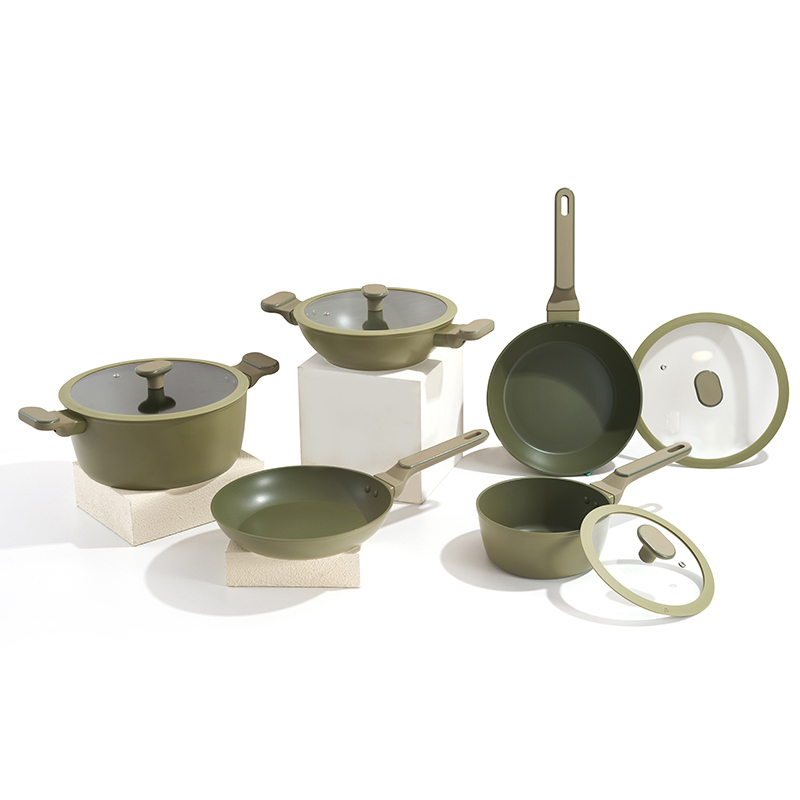
-
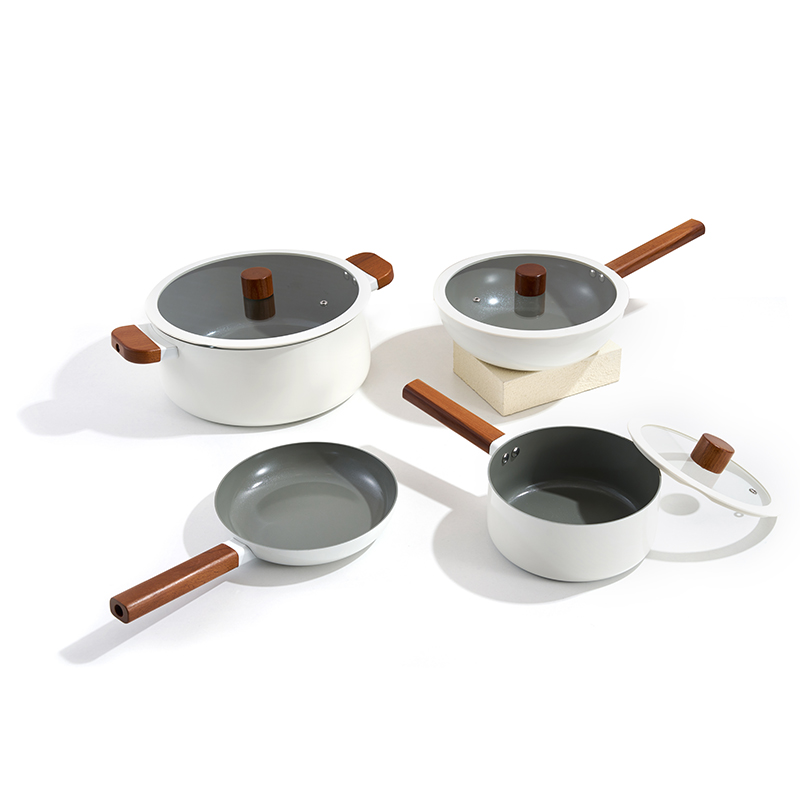
This cookware set has a ceramic non-stick inner liner, a heat-resistant wooden h...
See Details -
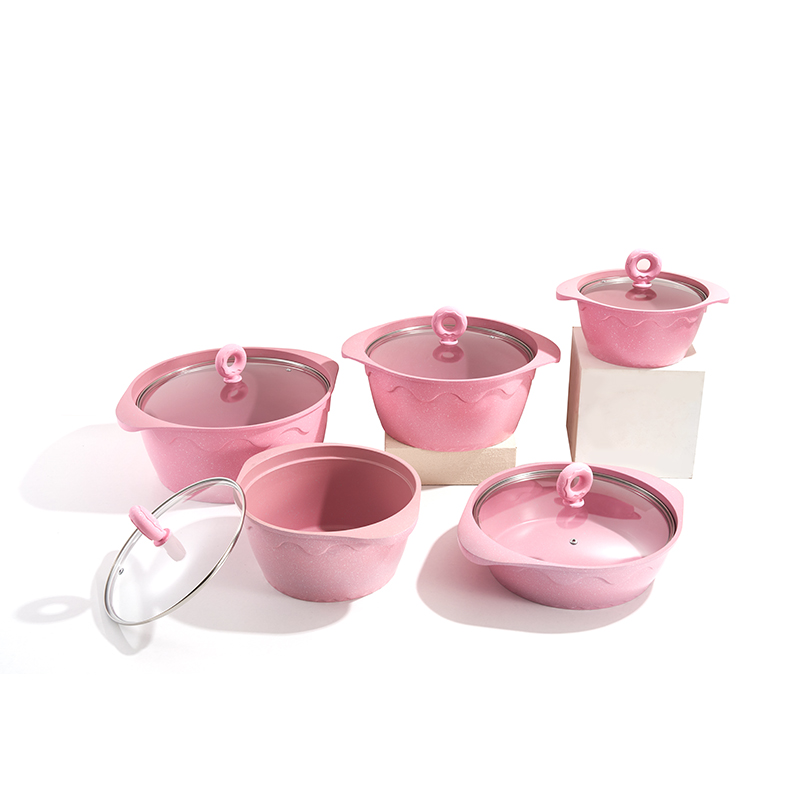
This cookware set is made of food-grade non-stick material, with a unique eye-ca...
See Details -
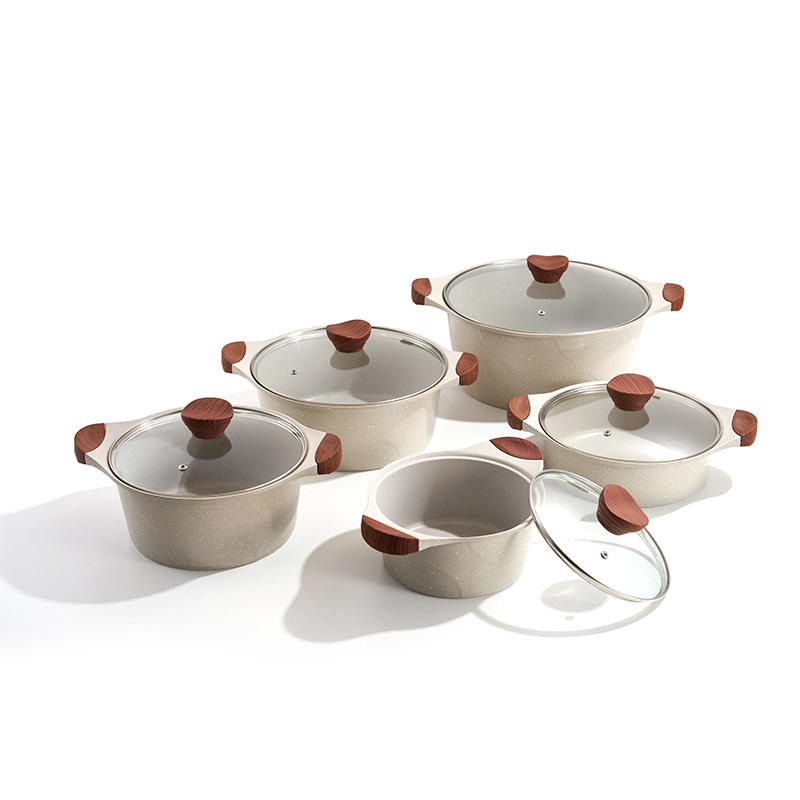
This off-white cookware set is made of wear-resistant non-stick material, with w...
See Details
Whether you're looking for bulk purchases or have any custom requirements, We are here to offer the best
solutions for you.
tiffany.zhong@echocn-trading.com
PHONE
+86-19561173975
+86-19557020621 (Hazel Wu)
ADD
Room 301, Unit 3014, No. 175 Qifeng Avenue, Wenqiao Town, Taizhou, Zhejiang, China
Fill Out the Form for More Information
Copyright © Zhejiang Echo Industry And Trade Co., Ltd.
All Rights Reserved.

China Cookware Set Manufacturer