
 en
 Español

This cookware set features a non-stick coating, even heat conduction, and multi-...
See Details
10-Piece Diamond-Embossed Aluminum Cookware Set: A Versatile Solution for Modern Kitchens
Date:Oct 27, 2026
Introduction
Modern kitchens increasingly require cookware that can perform several jobs while remaining easy to use, clean, and store. A family may need one pan for quick frying, a deeper vessel for stews, and several casserole sizes for daily cooking, entertaining, or preparing meals in batches. Buying each item separately can increase cost, create inconsistent performance, and occupy valuable cabinet space. A carefully designed cookware set offers a more practical alternative by combining complementary sizes and functions in one coordinated collection.
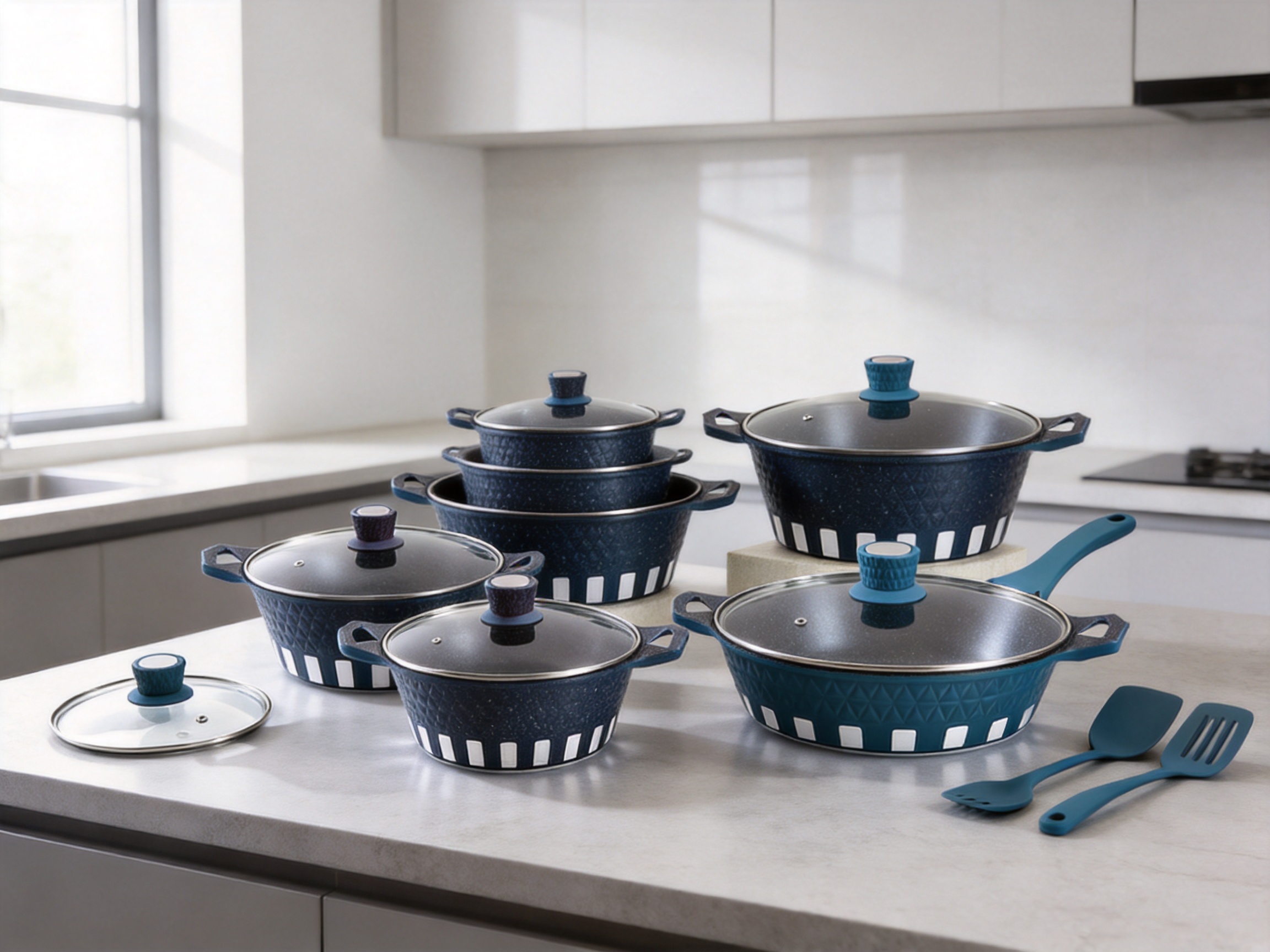
The 10-piece IndigoDiamond aluminum cookware set is designed around this multi-purpose approach. Its construction combines a die-cast aluminum substrate with granite treatment on both the interior and exterior surfaces. A diamond-embossed body gives the cookware a distinctive appearance while supporting a modern minimalist style. The set includes casserole sizes of 20 cm, 24 cm, 28 cm, and 32 cm, together with a 28 cm deep fry pan, creating a useful range for frying, boiling, stewing, simmering, and family-size meal preparation.
Beyond its appearance, the set is positioned as a practical solution for households, hospitality buyers, retailers, distributors, and project purchasers seeking versatile aluminum cookware. It is compatible with all stovetops, designed for convenient cleaning, and produced with a focus on durability and everyday usability. Its combination of varied sizes, non-stick granite interior, die-cast structure, and coordinated design helps it compete with ordinary single-purpose pans and less comprehensive cookware collections.
For international buyers, the product also benefits from the manufacturing and supply capabilities of Zhejiang Echo Industry And Trade Co., Ltd. The company provides aluminum cookware, stainless steel cookware, iron cookware, and kitchen utensils, allowing buyers to develop broader kitchenware programs through one supplier. Its services include one-stop sourcing, ODM and OEM customization, flexible minimum order quantities, product certification assistance, and sustainable and healthy product development.

10pcs IndigoDiamond Aluminium Cookware set
Product Overview
The cookware set is built for buyers who want a broad selection of cooking capacities without purchasing unrelated products. Its product specification identifies the substrate as die-casting aluminum and lists granite coating for both the exterior and interior treatments. These two features form the technical foundation of the collection: aluminum provides a practical balance of weight and heat response, while the granite treatment contributes to the cookware’s visual character and easy-cleaning positioning.
The collection includes four casserole sizes: 20 cm, 24 cm, 28 cm, and 32 cm. The range moves from compact everyday cooking to larger family meals. The 20 cm casserole can be suitable for smaller portions, side dishes, sauces, or cooking for one or two people. The 24 cm size provides a flexible middle option for regular household meals. The 28 cm casserole offers additional capacity for larger portions, while the 32 cm casserole is suited to batch cooking, family gatherings, and food preparation where greater volume is required.
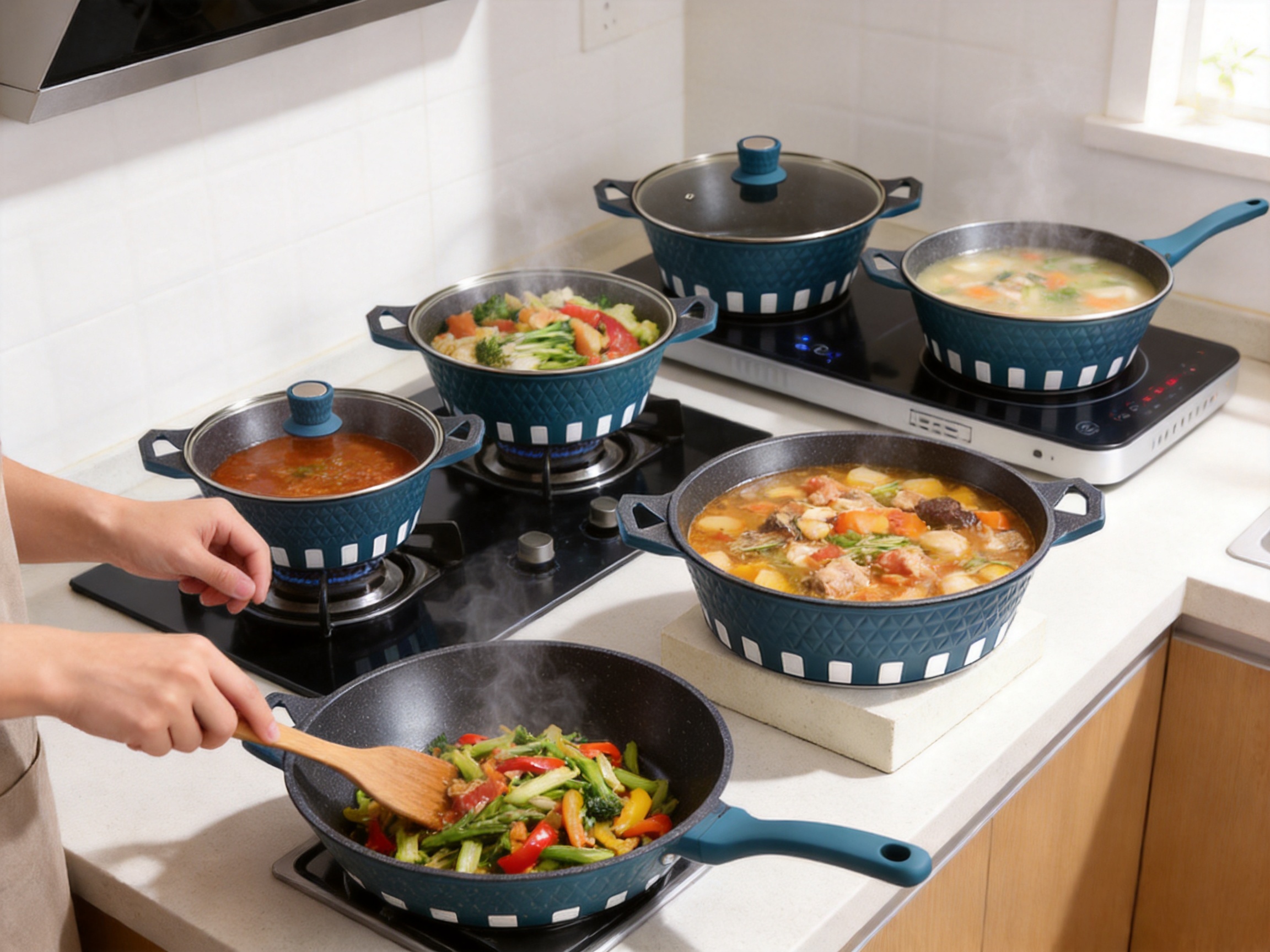
A 28 cm deep fry pan adds a separate cooking format to the set. Compared with a standard shallow frying pan, a deep fry pan can provide more room for ingredients and sauces. It can be used for stir-frying, shallow frying, sautéing, braising, reducing sauces, and preparing meals that require frequent stirring. The combination of casseroles and a deep fry pan means that users can select cookware according to both portion size and cooking method.
The product is identified by SKU HC02 and is packed for commercial shipment in cartons. The stated carton information is four cartons, with a carton size of 69.5 by 38.5 by 49.5 centimeters and a carton weight of 31 kilograms. This information is useful for importers, distributors, warehouse planners, and e-commerce operators calculating storage, transportation, and handling requirements.
| Item | Specification | Practical Role |
|---|---|---|
| Cookware type | 10-piece aluminum cookware set | Coordinated collection for everyday cooking |
| Substrate | Die-casting aluminum | Provides a formed, durable cookware body |
| Interior treatment | Granite coating | Supports non-stick cooking and easier cleaning |
| Exterior treatment | Granite coating | Creates a coordinated, modern exterior finish |
| Casserole sizes | 20 cm, 24 cm, 28 cm, 32 cm | Supports different portions and recipes |
| Deep fry pan | 28 cm | Suitable for frying, sautéing, stir-frying, and saucy dishes |
| Stovetop compatibility | All stovetops | Broadens household and market suitability |
| SKU | HC02 | Product identification for purchasing and logistics |
| Carton quantity | 4 cartons | Useful for shipping and warehouse planning |
| Carton size | 69.5 × 38.5 × 49.5 cm | Supports freight and storage calculations |
| Carton weight | 31 kg | Relevant to transport and handling arrangements |
Die-Cast Aluminum Construction
The substrate is die-casting aluminum, a construction method that gives manufacturers the ability to form cookware with a consistent body shape and carefully defined dimensions. Compared with very thin stamped cookware, a die-cast body can present a more substantial feel in the hand. It also provides a stable foundation for applying interior and exterior treatments.
Aluminum is widely used in cookware because it offers a practical combination of relatively low weight, useful heat response, and manufacturing flexibility. Consumers often want cookware that feels solid but is not unnecessarily difficult to lift. Buyers also need products that can be produced in multiple sizes with consistent visual coordination. Die-cast aluminum supports this product strategy by allowing a family of casseroles and pans to be developed around the same general design language.
The structure is especially important in a multi-size set. Each vessel must remain convenient for daily use while preserving a consistent appearance across the collection. A 20 cm casserole should be easy to handle for smaller meals, while a 32 cm casserole must provide greater capacity without appearing unrelated to the rest of the set. A common die-cast aluminum platform helps create a unified range that can be presented effectively in retail displays, catalogs, and kitchenware collections.
For distributors, the material specification is also an important selling point. Die-cast aluminum communicates a more engineered construction than an unspecified metal body. It gives buyers a clear foundation for product comparison and allows sales teams to explain why the cookware is positioned above basic, lightweight alternatives. The material does not eliminate the need for correct cooking and care practices, but it contributes to the overall value proposition of the collection.
Balanced Weight and Everyday Handling
Cookware is used frequently, sometimes several times a day. Excessive weight can discourage users from selecting larger vessels, while an overly light body may feel less stable during cooking. The die-cast aluminum design aims to provide a practical balance. The exact handling experience will vary by size, food quantity, and accessories, but the graduated casserole range gives users the opportunity to choose the smallest suitable vessel instead of automatically using the largest pan.
Using the correct size has several practical benefits. A smaller vessel can simplify cooking a single portion and reduce unnecessary washing. A medium casserole can serve ordinary family meals. Larger casseroles can be reserved for batch cooking and entertaining. This flexibility makes the set more useful than a collection made entirely of similar-sized pans.
Granite Interior and Exterior Treatment
The product specification lists granite coating on both the interior and exterior. The interior treatment is associated with the set’s non-stick granite cooking surface, while the exterior treatment creates a coordinated finish around the body. Together, these treatments provide a more complete visual and functional identity than cookware with an attractive exterior but a plain or less refined inner surface.
A non-stick-oriented interior can help users cook with less sticking when the cookware is used correctly. It can also make cleaning more convenient because food residue is less likely to bond heavily to the surface. This is particularly helpful for foods involving sauces, shallow frying, or repeated stirring. Easy cleaning is one of the key features that influence cookware purchase decisions, especially among households looking to reduce time spent at the sink.
The granite appearance contributes to a contemporary product presentation. It can help the cookware stand out from basic single-color aluminum products and give a coordinated set a more premium visual impression. For retailers, appearance matters because cookware is frequently displayed in open shelving, showroom areas, online product galleries, and lifestyle photography. A distinctive but restrained surface can support both modern and traditional kitchen themes.
Exterior treatment also helps the pieces look like a complete collection rather than a group of unrelated vessels. When several casserole sizes and a deep fry pan are displayed together, the matching finish reinforces the idea of a planned cookware system. This can improve merchandising opportunities for retailers and make the set more attractive as a gift or housewarming purchase.
Why the Surface Requires Correct Use
Non-stick and granite-treated surfaces are designed to improve convenience, but they must be protected from unnecessary abrasion. The care instructions specifically advise users not to use metal or sharp cooking utensils. Wooden, nylon, or non-stick-safe utensils are recommended instead. These tools are less likely to scratch or damage the cooking surface during ordinary use.
Users should also avoid overheating an empty pan. An empty vessel can become hot very quickly, and excessive heat may place unnecessary stress on the coating and cookware body. The recommended practice is to add ingredients or cooking oil as appropriate and to monitor the heat throughout the cooking process.
Cleaning should be carried out with hot, soapy water and a soft cloth or sponge. Abrasive pads, aggressive scraping, and harsh handling should be avoided. Hand washing is recommended to preserve the appearance of the cookware. These instructions are straightforward and can be included in product packaging, retailer listings, and after-sales guidance.
Multi-Size Functionality for Different Cooking Needs
The four casserole sizes are one of the strongest advantages of the collection. Many competing cookware offers focus on one or two standard sizes, forcing users to compromise between capacity and convenience. A single large pot may be inefficient for small meals, while a small pan may not provide enough room for family cooking. The 20 cm, 24 cm, 28 cm, and 32 cm sequence gives users a more logical progression.
20 cm Casserole
The 20 cm casserole is the compact option in the collection. It can be used for small portions, sauces, vegetables, porridge, reheating, or meals for one or two people. Its smaller diameter may also be convenient for kitchens with limited storage or cooking space. For retailers, this size helps the set appeal to students, couples, smaller households, and consumers who prefer portion-controlled cooking.
24 cm Casserole
The 24 cm casserole provides a versatile middle size. It can serve as an everyday vessel for soups, pasta sauces, grains, vegetables, and moderate family portions. Consumers often rely on a mid-sized pot for frequent cooking, so including this size improves the set’s daily usefulness. It can also reduce dependence on the largest casserole when the meal does not require high capacity.
28 cm Casserole
The 28 cm casserole offers additional room for family meals and recipes with several ingredients. It may be used for stews, braised dishes, larger servings, and meals that need space for stirring. Its capacity makes it a natural complement to the 28 cm deep fry pan, although the two pieces serve different cooking formats.
32 cm Casserole
The 32 cm casserole is the largest listed casserole size and is intended for higher-volume cooking. It can be valuable for larger families, meal preparation, celebrations, and buyers who regularly cook several portions at once. Large cookware is often purchased separately because it is not included in basic sets, so its presence gives this collection an advantage for users who want a more complete range.
28 cm Deep Fry Pan
The 28 cm deep fry pan broadens the set beyond casserole cooking. Its deeper profile can provide useful capacity for ingredients that need to be tossed, stirred, fried, or combined with liquid. It can support common cooking methods such as sautéing, shallow frying, stir-frying, braising, and sauce-based recipes. The pan also offers an alternative to the casseroles when a wider cooking surface is preferred.
The combination of depth and diameter is useful for recipes where ingredients must be moved during cooking. A deep fry pan can help keep food contained while offering more flexibility than a shallow skillet. For commercial buyers, this gives the collection a stronger multi-function message and makes it easier to present the set as a complete everyday cooking solution rather than a simple group of pots.
Advantages Over Basic and Less Complete Alternatives
The cookware market includes many low-cost sets with limited size choices, thin construction, inconsistent finishes, or unclear care instructions. The 10-piece collection offers several points of differentiation that buyers can communicate clearly.
First, the range of sizes creates a more complete cooking system. Instead of receiving several similar pieces, users gain compact, medium, large, and extra-large casserole options, along with a deep fry pan. This assortment is more adaptable to different recipes and household sizes.
Second, the die-cast aluminum substrate provides a defined construction specification. Buyers are not limited to a general description such as “metal cookware.” They can identify the base material and explain its role in the product design. This is valuable in wholesale purchasing, private-label development, and retail content creation.
Third, granite treatment on the interior and exterior creates a unified appearance. Some competing products may emphasize function but provide limited attention to visual coordination. Others may have decorative exteriors without offering a clear non-stick-oriented interior. This collection combines both elements in one design concept.
Fourth, compatibility with all stovetops broadens the potential customer base. A cookware set that is limited to one heating method may require consumers to check compatibility before purchase. The stated all-stovetop compatibility simplifies product positioning for retailers and makes the collection suitable for a wider range of homes.
Fifth, the care guidance is clear and practical. Consumers are told which utensils to use, how to clean the cookware, what to avoid, and how to respond if the pan overheats. Clear instructions help protect the product in use and can reduce misunderstandings after purchase.
Finally, the set is suitable for international sourcing programs because it is backed by a supplier offering multiple cookware categories. Buyers who need aluminum cookware together with stainless steel cookware, iron cookware, or kitchen utensils can explore a broader product portfolio rather than managing every category through a different factory.
| Comparison Point | 10-Piece Collection | Basic Single-Pan Purchase |
|---|---|---|
| Size selection | Four casserole sizes plus a deep fry pan | Usually limited to one size |
| Cooking flexibility | Supports small portions, family meals, batch cooking, and frying | Function depends on one vessel |
| Construction description | Die-casting aluminum substrate | May provide limited material information |
| Surface design | Granite treatment inside and outside | Often uses a simpler finish |
| Visual coordination | Unified collection appearance | May not match other cookware |
| Stovetop positioning | Compatible with all stovetops according to specification | Compatibility may vary by product |
| Procurement value | One coordinated purchase for multiple cooking needs | Additional products may be needed |
Manufacturing Process and Quality-Oriented Product Development
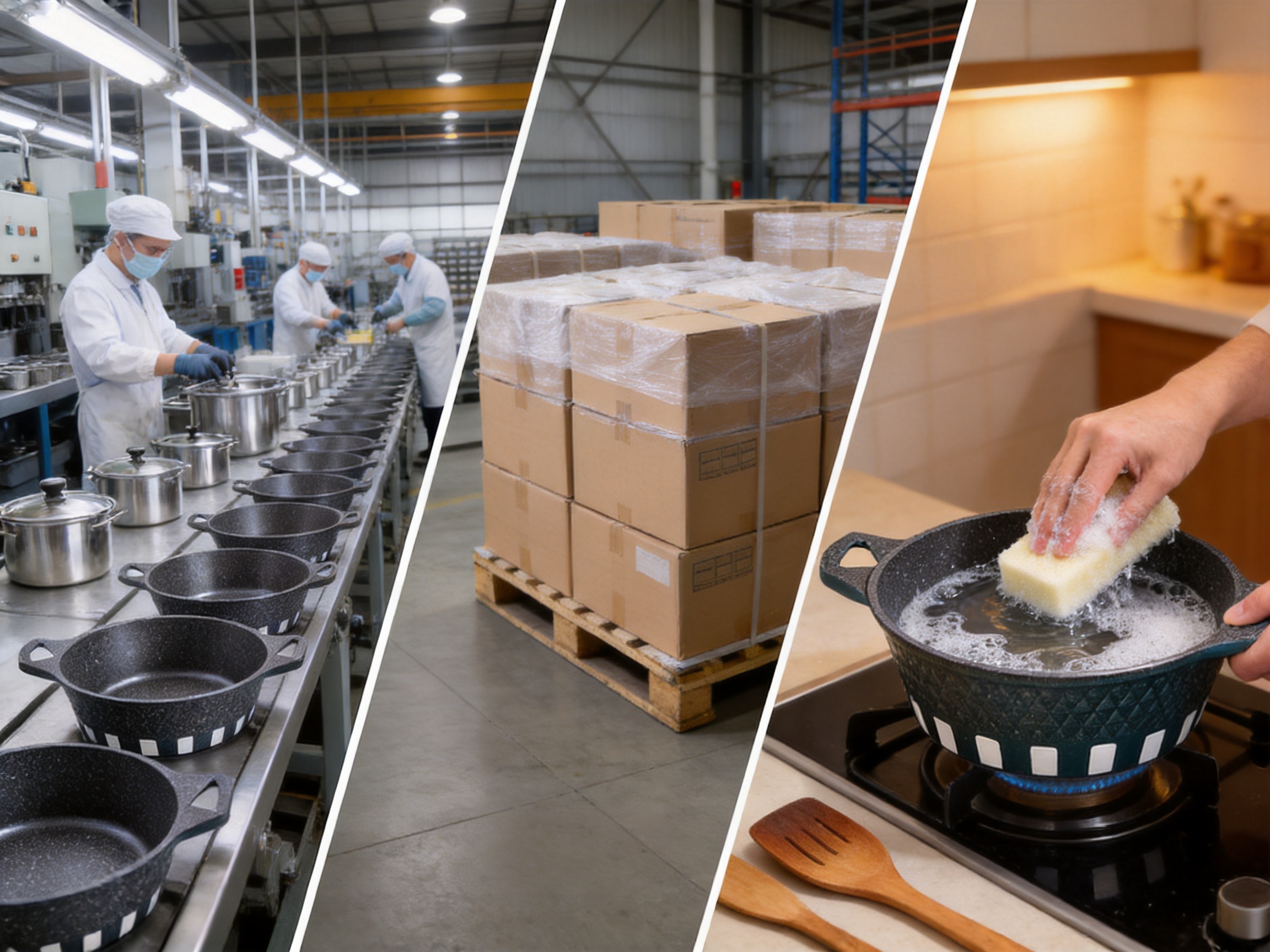
The product’s manufacturing foundation begins with die-casting aluminum. In a general die-casting process, aluminum is shaped in a controlled mold to form the cookware body. This allows the manufacturer to create repeatable dimensions and a consistent design across different sizes. The method is appropriate for a coordinated series because each vessel can be developed around defined dimensions and a shared visual identity.
After forming, the cookware body requires surface preparation before coating. A professional production workflow generally includes inspection, cleaning, and preparation of the aluminum surface so that the exterior and interior treatments can be applied consistently. Proper preparation is important because the appearance and performance of a coating depend not only on the coating material itself but also on the condition of the underlying substrate.
The granite treatment is then applied to the specified surfaces. The interior coating supports the product’s non-stick positioning, while the exterior coating contributes to the finished appearance. Coating operations require attention to coverage, consistency, curing, and visual quality. These steps are particularly important when multiple pieces must match one another in color, texture, and overall presentation.
A coordinated cookware collection also requires dimensional control. The 20 cm, 24 cm, 28 cm, and 32 cm casseroles must be manufactured according to their intended sizes, and the 28 cm deep fry pan must maintain its own design requirements. Consistent dimensions help lids, packaging components, displays, and product descriptions remain aligned. For buyers, this supports smoother inventory management and more reliable catalog information.
Process Control for a Multi-Size Collection
Manufacturing a single pan and manufacturing a complete cookware range involve different quality challenges. A set must be consistent not only within each item but also across the entire family. The pieces should share a recognizable finish, coordinated styling, and stable packaging presentation. Variations that might be acceptable in a stand-alone item can become more visible when several pieces are displayed together.
A quality-oriented production approach should therefore examine the aluminum body, surface finish, dimensions, appearance, and packing condition. The supplier’s experience in cookware and kitchen accessories supports the development of products for different markets and customer requirements. Buyers can also discuss inspection standards, sample approval, packaging details, and customization requirements during the sourcing process.
Because the company offers ODM and OEM services, the product can serve as a starting point for buyers who want to adjust branding, packaging, color direction, or other commercial details. Any customization should be confirmed with the supplier before production, including minimum order quantities, available finishes, labeling requirements, and technical specifications.
Packaging and Export Readiness
The stated carton quantity, carton dimensions, and carton weight provide an initial logistics reference. Four cartons are identified for the product, with each carton measuring 69.5 by 38.5 by 49.5 centimeters and weighing 31 kilograms. These details can help importers estimate warehouse space, container planning, freight handling, and distribution requirements.
Packaging is particularly important for coated cookware because the surface must be protected during movement and storage. A coordinated set also contains multiple pieces that need to be arranged efficiently to reduce contact and prevent avoidable cosmetic damage. Buyers should confirm the final packing configuration, protective materials, labeling, and drop or transport requirements with the supplier for each order.
For retail distribution, packaging should communicate the main selling points without creating confusion. The product name, number of pieces, cookware sizes, material, coating information, stovetop compatibility, and care instructions are all useful content areas. Clear packaging can help consumers understand the value of the set before opening the carton.
Supplier Strengths and One-Stop Kitchenware Sourcing
Zhejiang Echo Industry And Trade Co., Ltd. is presented as a professional kitchenware supplier based in Zhejiang, China. The region is recognized for manufacturing and export activity, and the company’s product range covers aluminum cookware, stainless steel cookware, iron cookware, and kitchen utensils. This broad category coverage can simplify supplier management for buyers seeking a complete kitchenware program.
Instead of treating the 10-piece set as an isolated product, the supplier can support a wider purchasing strategy. A distributor may combine aluminum cookware with stainless steel items for different market segments. A retailer may add iron cookware to create a premium or traditional cooking collection. Kitchen utensils can be sourced alongside cookware to form coordinated bundles, seasonal promotions, or house-brand assortments.
The company’s stated mission is to develop into an R&D-driven supply chain partner for small and medium-sized kitchenware buyers rather than simply receiving orders. This direction is relevant to customers who require more than standard catalog purchasing. Product development, packaging adjustments, sourcing coordination, and long-term range planning can all become important as a buyer’s business grows.
ODM and OEM Support
ODM and OEM capabilities allow buyers to explore different commercial models. An OEM project may focus on producing cookware under the buyer’s brand, subject to agreed specifications and packaging requirements. An ODM project may begin with an existing product platform and develop selected changes for a target market. The 10-piece set can therefore function as a ready-made product or as a foundation for a customized collection.
Potential customization topics may include brand presentation, carton artwork, product photography, color preferences, instruction leaflets, barcode labels, and assortment planning. Technical changes must be reviewed carefully because modifications to coating, dimensions, handles, lids, or stovetop construction may affect tooling, cost, lead time, and testing requirements.
For small and medium-sized buyers, flexible minimum order quantities can be especially valuable. Large factories may impose order volumes that are difficult for emerging brands or regional distributors to manage. Flexible purchasing arrangements can help buyers test a market, launch a new assortment, or build inventory gradually. The exact MOQ and commercial terms should be confirmed for each product and customization request.
Product Certification Assistance
The company also states that it provides product certification assistance. Certification and compliance requirements differ according to destination market, product construction, food-contact regulations, labeling rules, and retail channel. Buyers should identify the requirements of their target countries before placing an order and request the relevant documentation or testing support from the supplier.
Certification assistance can help create a more organized sourcing process, but buyers should confirm the scope of support, responsible testing laboratories, applicable standards, and validity of any documents. Clear communication at the beginning of a project helps prevent delays and ensures that product claims are supported by appropriate information.
Sustainable and Healthy Product Development
The supplier identifies sustainable and healthy product development as part of its service direction. In practical terms, buyers may discuss material selection, product durability, packaging efficiency, useful product life, and responsible development goals. A durable cookware item can reduce the need for frequent replacement when it is used and maintained correctly. Efficient packaging design may help reduce wasted space during transportation.
Any environmental or health-related claim should be verified against the final product specifications and applicable regulations. Buyers should request detailed information when such claims are important to a marketing program. The supplier’s stated development focus provides a starting point for these discussions and can support more responsible product planning.
Applications Across Retail and Food Preparation
The cookware set can be positioned for a range of customer groups. In household retail, its strongest message is convenience: several sizes and cooking formats in one coordinated collection. In e-commerce, the set can be presented through size charts, cooking-use illustrations, care instructions, and detailed material information. In physical retail, the matching granite finish can support attractive open display arrangements.
The assortment may also suit housewarming, wedding, holiday, and seasonal gifting. Consumers often view a complete cookware collection as a practical investment for a new home. The multiple casserole sizes make the gift useful for both everyday meals and special occasions, while the deep fry pan adds a familiar cooking format.
Distributors can use the set as a mid-range or premium-value product depending on packaging, market positioning, and final commercial configuration. Its die-cast aluminum description, granite treatment, all-stovetop compatibility, and broad size range provide several content points for sales teams. Buyers can choose which features to emphasize according to local consumer preferences.
For hospitality or catering-related buyers, the range of sizes may help support varied preparation tasks. However, suitability for professional heavy-duty use should be evaluated according to the specific operating environment, cooking frequency, heat levels, cleaning procedures, and required certifications. The product is described for general multi-purpose cooking, and commercial users should confirm whether it meets their particular application requirements.
Care and Maintenance Guidelines
Correct care is essential for preserving the appearance and performance of coated cookware. Before first use, the cookware should be washed. This removes dust or residues from manufacturing and packing and prepares the surface for cooking.
Metal or sharp cooking utensils should not be used. Wooden, nylon, or utensils designed for non-stick cookware are recommended. When stirring, turning, or serving food, users should avoid cutting directly inside the pan with knives or other sharp tools.
The cookware should not be overheated while empty. Users should avoid leaving an empty vessel on an active burner, especially at high temperature. Heat should be matched to the cooking task, and the pan should be monitored during preheating.
The flame or heat source should not extend beyond the base of the cookware. Excess heat around the sides can affect the exterior surface, handles, or surrounding kitchen areas. Correct burner sizing also promotes more controlled cooking.
If the cookware severely overheats, users should turn off the cooker and allow the pan to cool completely. They should not touch the hot vessel immediately or attempt to cool it rapidly with cold water. Sudden temperature changes can create unnecessary stress, and direct contact may result in burns.
For cleaning, hot soapy water and a soft cloth or sponge are recommended. The cookware should be cleaned after use and dried appropriately. Hand washing is advised to help preserve the appearance of the granite treatment. Food should not be allowed to remain on the surface for extended periods when it can be cleaned promptly.
The cookware is not intended for microwave use. This instruction should be clearly communicated to consumers, particularly in online listings and printed care materials. Retailers may also include a concise care panel on product pages to reduce incorrect use.
Purchasing Considerations for Importers and Distributors
Commercial buyers should begin by confirming the exact contents of the 10-piece configuration. The available information identifies four casserole sizes and one deep fry pan, but buyers should verify how the complete ten pieces are counted, including any lids or accessories, before approving purchase orders or publishing final product descriptions.
Buyers should also confirm the final color, coating appearance, handle construction, lid specifications if applicable, packaging materials, and labeling. Product photography and online descriptions should match the approved production sample. This is especially important for international distribution, where inaccurate dimensions or incomplete accessory information can create customer complaints.
Logistics planning should use the stated carton information as an initial reference. The four-carton quantity, 69.5 by 38.5 by 49.5 centimeter carton dimensions, and 31 kilogram carton weight should be checked against the final packing list. Freight calculations may change if packaging, inserts, protective materials, or customization are adjusted.
Sampling is recommended before mass production. A buyer can evaluate the finish, cooking surface, body feel, size progression, packaging, and care documentation. The buyer may also use the sample to create product images and develop accurate sales materials. Approval standards should be documented so that production and inspection teams share the same expectations.
Q&A
What material is used for the cookware body?
The cookware body uses die-casting aluminum. This provides a defined structural base for the casserole collection and deep fry pan while supporting consistent manufacturing across multiple sizes.
What type of surface treatment does the cookware have?
The specification identifies granite coating on both the interior and exterior. The interior is described as a non-stick granite surface, while the exterior provides a coordinated granite finish.
How many casserole sizes are included?
The listed casserole sizes are 20 cm, 24 cm, 28 cm, and 32 cm. This progression is designed to support different portion sizes and cooking tasks.
Is a frying pan included?
Yes. The specification lists a 28 cm deep fry pan. It complements the casseroles by supporting frying, sautéing, stir-frying, braising, and other recipes requiring a wider or deeper frying format.
Can the cookware be used on different stovetops?
The product is specified as compatible with all stovetops. Buyers should still confirm the final technical configuration and any market-specific requirements before publishing detailed compatibility claims.
Can metal utensils be used?
No. Metal or sharp cooking utensils should be avoided because they may scratch or damage the treated cooking surface. Wooden, nylon, or non-stick-safe utensils are recommended.
How should the cookware be cleaned?
Use hot, soapy water with a soft cloth or sponge. Hand washing is recommended to help preserve the appearance of the cookware.
Can the cookware be used in a microwave?
No. The care instructions state that the cookware should not be used in a microwave.
What should users do if a pan overheats?
Users should turn off the cooker and leave the pan to cool completely. They should not touch the cookware while it is dangerously hot and should avoid rapid cooling methods.
What is the product SKU?
The SKU is HC02.
What are the stated carton details?
The product information lists four cartons, with a carton size of 69.5 by 38.5 by 49.5 centimeters and a carton weight of 31 kilograms. These details should be reconfirmed against the final packing list.
Can the supplier support customized projects?
The supplier states that it provides ODM and OEM customization, flexible minimum order quantities, one-stop sourcing, and product certification assistance. Specific customization possibilities, costs, minimum quantities, and lead times should be discussed before production.
Can buyers source other kitchenware categories from the same company?
Yes. The company provides aluminum cookware, stainless steel cookware, iron cookware, and kitchen utensils. This can support broader product development and one-stop purchasing programs.
Conclusion
The 10-piece diamond-embossed aluminum cookware set offers a balanced combination of variety, surface design, practical construction, and everyday functionality. Its four casserole sizes cover compact, medium, family, and high-volume cooking needs, while the 28 cm deep fry pan adds an adaptable frying and sautéing option. The die-cast aluminum substrate gives the collection a clear material identity, and granite treatment on the interior and exterior supports both convenience and modern presentation.
Compared with basic cookware assortments, the set stands out through its coordinated multi-size format, all-stovetop positioning, non-stick granite interior, and distinctive diamond-embossed body. These advantages make it suitable for household retail, gifting, e-commerce, distribution, and customized kitchenware programs.
The supplier’s broader capabilities further strengthen the product’s commercial potential. Its range of aluminum, stainless steel, and iron cookware, together with kitchen utensils, ODM and OEM services, flexible MOQs, certification assistance, and one-stop sourcing, gives buyers opportunities to build complete product lines. Through appropriate sampling, specification confirmation, packaging review, and quality control, importers and distributors can adapt the collection to their target markets while maintaining accurate product communication.
For the end user, the most important message is practical versatility. Multiple sizes reduce the need to compromise, the deep fry pan expands cooking options, and the granite-treated surfaces are designed for easier cooking and cleaning when properly maintained. With correct utensil selection, controlled heat, careful cleaning, and hand washing, the collection can serve as a dependable foundation for everyday meal preparation.
References
1. Product specification for the 10-piece IndigoDiamond aluminum cookware set, SKU HC02.
2. Manufacturer-provided care instructions for coated aluminum cookware.
3. Manufacturer-provided information concerning die-casting aluminum, granite interior treatment, and granite exterior treatment.
4. Manufacturer-provided carton and logistics information for the HC02 cookware set.
5. General cookware handling and non-stick surface maintenance principles.
6. General guidance for cookware sourcing, product sampling, packaging review, and export documentation.
Product: 10pcs IndigoDiamond Aluminium Cookware set
Recommended Articles
Product Category
Related products
-
-
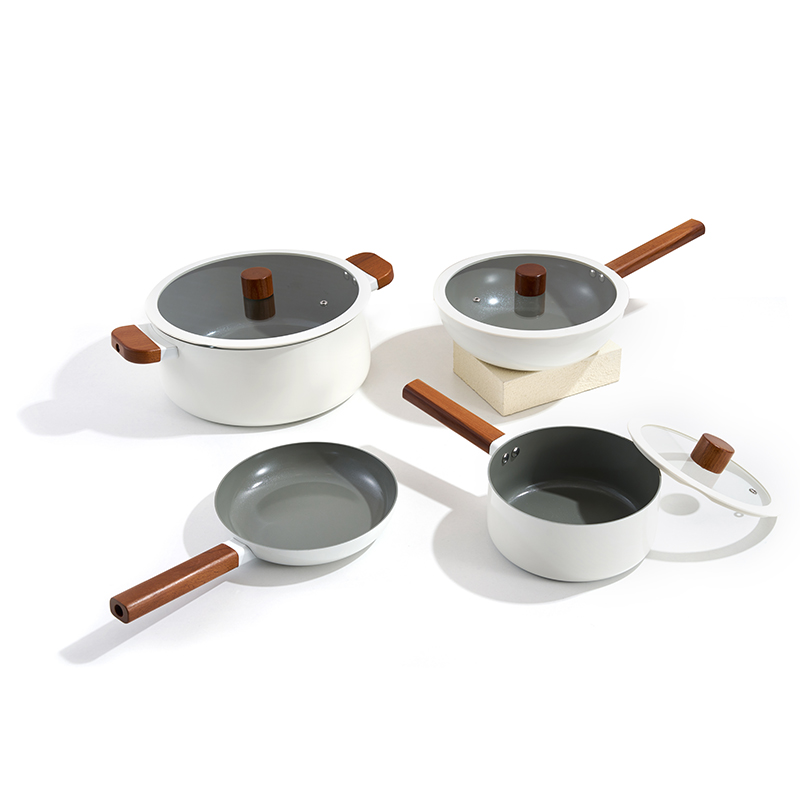
This cookware set has a ceramic non-stick inner liner, a heat-resistant wooden h...
See Details -
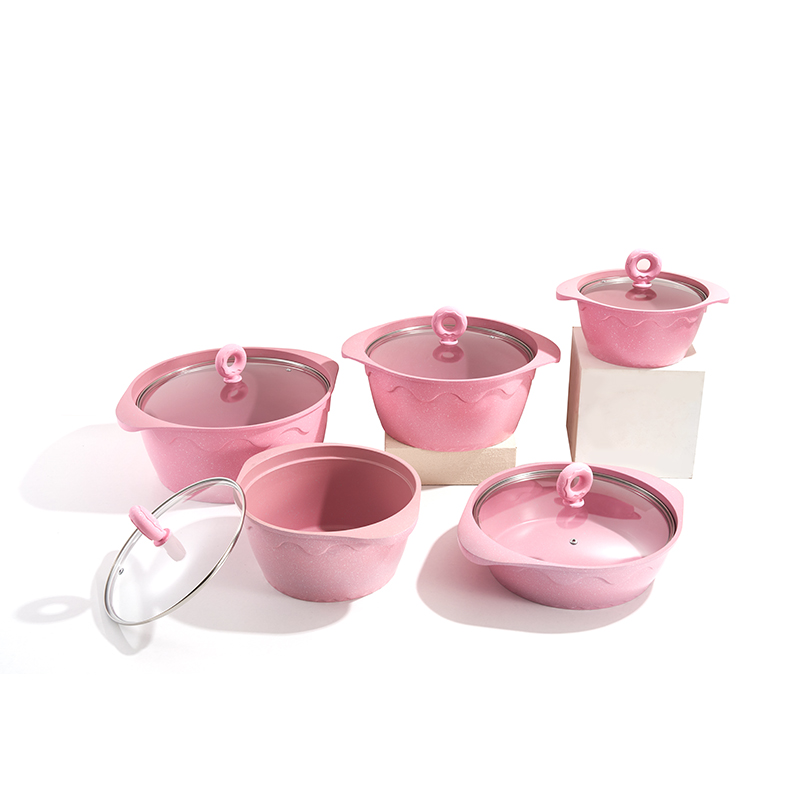
This cookware set is made of food-grade non-stick material, with a unique eye-ca...
See Details -
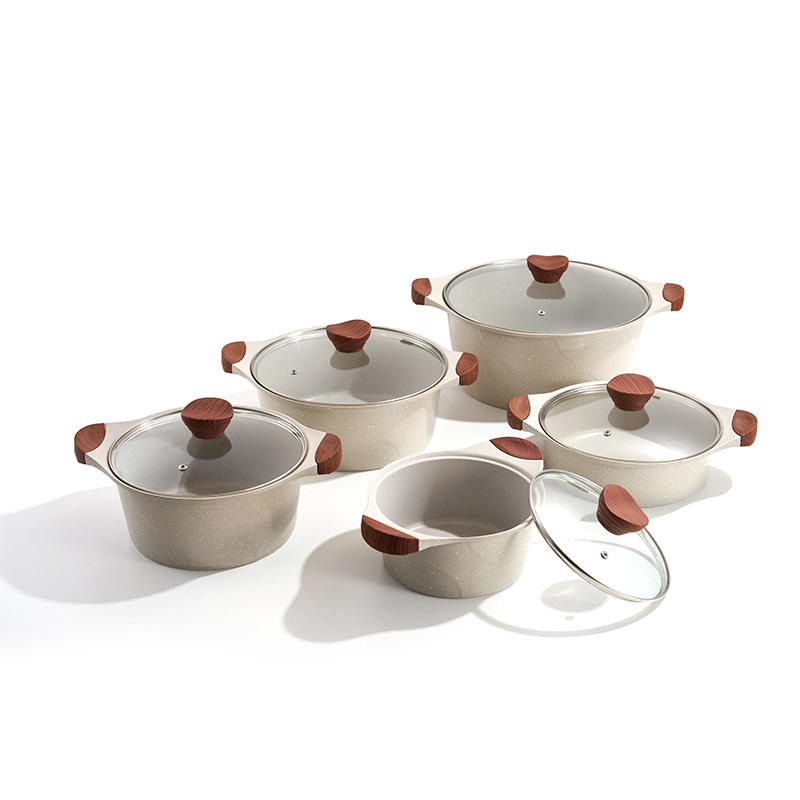
This off-white cookware set is made of wear-resistant non-stick material, with w...
See Details
Whether you're looking for bulk purchases or have any custom requirements, We are here to offer the best
solutions for you.
tiffany.zhong@echocn-trading.com
PHONE
+86-19561173975
+86-19557020621 (Hazel Wu)
ADD
Room 301, Unit 3014, No. 175 Qifeng Avenue, Wenqiao Town, Taizhou, Zhejiang, China
Fill Out the Form for More Information
Copyright © Zhejiang Echo Industry And Trade Co., Ltd.
All Rights Reserved.

China Cookware Set Manufacturer