
 en
 Español

This cookware set features a non-stick coating, even heat conduction, and multi-...
See Details
15-Piece SquareStack Woodline Aluminum Cookware Set: A Space-Saving Solution for Modern Kitchens
Date:Sep 19, 2026
Choosing a cookware set is an important decision for households, professional kitchens, hospitality businesses, retailers, and distributors. Cookware must do more than look attractive. It should heat efficiently, feel comfortable during everyday use, remain practical in storage, support a broad range of recipes, and withstand the demands of repeated cooking and cleaning. The 15-piece SquareStack Woodline Aluminum Cookware Set is designed around these expectations, combining a distinctive square profile, lightweight aluminum construction, wooden heat-resistant handles, stackable storage, food-grade non-stick performance, silicone trivets, and wooden-handled utensils.
Rather than offering a collection of unrelated pans, this set is designed as an integrated cooking solution. Its square ribbed body provides a modern visual identity while creating a useful cooking surface. Its nesting structure addresses one of the most common problems in contemporary kitchens: limited cabinet and countertop space. Its accessory combination helps users begin cooking with fewer additional purchases. At the same time, its aluminum body offers responsive heating and manageable weight compared with many heavier cookware materials.
The product is also supported by the capabilities of Zhejiang Echo Industry And Trade Co., Ltd., a kitchenware supplier based in Zhejiang, China. The company provides aluminum cookware, stainless steel cookware, iron cookware, and kitchen utensils, allowing buyers to source complementary product categories from one supply partner. Its business model includes one-stop sourcing, ODM and OEM customization, product certification assistance, flexible minimum order quantities, and the development of sustainable and healthy product solutions.
This article examines the product’s design, cooking functions, user advantages, storage benefits, care requirements, commercial potential, and manufacturing strengths. It also explains how the set compares with more conventional round cookware collections and why it may be suitable for importers, wholesalers, retailers, hospitality buyers, and consumers seeking a coordinated cooking system.

15pcs SquareStack Woodline Aluminium Cookware Set
1. Product Overview
The 15-piece SquareStack Woodline Aluminum Cookware Set is an aluminum cookware collection with a square ribbed body and a contemporary wood-accented appearance. The set is identified by SKU DN01 and belongs to the aluminum cookware category. Its principal cookware sizes are listed as follows:
| Cookware Type | Diameter or Size | Capacity |
|---|---|---|
| Square Casserole | 20 cm | 3.0 liters |
| Square Casserole | 24 cm | 5.3 liters |
| Square Casserole | 28 cm | 8.3 liters |
| Square Casserole | 32 cm | 12.6 liters |
| Shallow Square Casserole | 28 cm | 4.9 liters |
The listed capacities create a useful progression from compact everyday cooking to large-batch preparation. The smallest casserole can serve routine meals, sauces, side dishes, and smaller portions. The mid-sized vessels can support family cooking, while the larger 28 cm and 32 cm casseroles are suited to soups, stews, braised dishes, pasta, batch cooking, and entertaining. The 28 cm shallow casserole adds another cooking format for dishes that benefit from a broad surface and lower profile.
The product description states that the set includes silicone trivets and wooden-handled utensils in addition to the cookware. These accessories improve the practical completeness of the package. Silicone trivets offer a protective surface for placing hot cookware on suitable countertops or tables, while wooden-handled utensils complement the non-stick coating and help reduce the risk of scratching during use.
The collection is described as compatible with all stovetops. This broad compatibility makes the set suitable for kitchens using gas, electric, ceramic, and induction cooking systems, subject to the user following the instructions of the particular stovetop and cookware. For buyers serving varied markets, all-stovetop compatibility can simplify product positioning and reduce the need to maintain multiple versions for different household cooking technologies.
2. A Distinctive Square Design
Most household cookware is round because circular vessels are familiar, easy to manufacture, and compatible with traditional burners. The square format of this collection offers a different combination of visual appeal and functionality. The square ribbed body gives the cookware a strong geometric identity that can help it stand out in a crowded retail category. For retailers, product differentiation is increasingly important because many cookware sets appear similar when displayed online or on a shelf.
The square structure can also provide useful corner areas for arranging food. Depending on the recipe, the corners may help users organize vegetables, meat, seafood, or other ingredients in a way that feels different from a conventional circular pan. The broad visual surface makes the cookware suitable for kitchen-to-table presentation, particularly when the pan is used for roasted, braised, or shared dishes.
Ribbing adds depth and texture to the exterior body. Beyond its decorative value, the ribbed appearance gives the cookware a more substantial, engineered look than a completely smooth vessel. It reinforces the product’s modern positioning and creates a recognizable design language across the set. A coordinated shape is valuable for consumers who prefer kitchen products that match rather than appear assembled from different collections.
The square profile also has a clear lifestyle advantage. Many modern kitchens combine cooking, serving, and social activities in one space. Cookware is often left visible on open shelving, placed on an island, or carried directly to the dining table. A carefully designed square casserole can function as both a cooking tool and a presentable serving vessel, reducing the need to transfer every dish to a separate serving container.
Compared with a basic round cookware set, the SquareStack design therefore competes through a combination of form and function. It offers a more distinctive silhouette, a coordinated visual theme, and a format that suits both cooking and presentation. Its appeal is particularly strong for design-conscious consumers, lifestyle retailers, housewarming gift programs, and kitchenware stores that need products with a clear story.
3. Aluminum as a Practical Cookware Material
Aluminum is widely used in cookware because it offers a favorable balance of thermal responsiveness, weight, manufacturability, and cost. It heats relatively quickly, allowing users to adjust cooking temperatures without waiting for a heavy vessel to respond. This responsiveness is useful for sautéing, simmering, reducing sauces, cooking grains, and preparing recipes that require frequent temperature adjustments.
The material is also easier to handle than many heavier cookware alternatives. Large-capacity cookware can become difficult to lift when the vessel itself is heavy before food is added. An aluminum body can help reduce that burden, especially for home cooks, older users, catering staff, and commercial kitchens that move cookware repeatedly throughout the day.
Another advantage is the material’s suitability for forming different sizes and profiles. The SquareStack collection includes multiple capacities while maintaining a unified square design. This consistency is important for manufacturing efficiency and for retail presentation. It allows the product family to appear coordinated while addressing different cooking requirements.
Compared with traditional uncoated iron cookware, aluminum is generally more approachable for users who do not want a lengthy seasoning routine. Compared with some stainless steel cookware, a non-stick aluminum set can offer easier food release and simpler cleanup for everyday recipes. Compared with very heavy cast cookware, it can be more convenient for frequent handling and storage.
These comparisons do not mean that one material is superior for every recipe. Cast iron may be preferred for intense heat retention, and stainless steel may appeal to users who want a durable uncoated cooking surface. The strength of this product lies in its intended balance: practical heating, manageable weight, modern non-stick convenience, broad compatibility, and a complete coordinated package.
4. Food-Grade Non-Stick Coating
The product is described as having a food-grade non-stick coating. A non-stick surface is valuable because it can help food release more easily during cooking and serving. This is especially useful for eggs, pancakes, delicate fish, vegetables, rice dishes, and recipes containing sauces or reduced liquids. Easier release can also help preserve the appearance of food, which matters when a casserole is taken directly to the table.
Non-stick cookware can support lower-oil cooking, although the appropriate cooking temperature and recipe method should always be followed. For consumers seeking convenient and relatively light everyday meals, a non-stick surface can reduce dependence on excessive cooking fat. It can also make the pan more approachable for new cooks who may otherwise worry about food sticking to an uncoated surface.
The coating contributes directly to cleanup convenience. Residual food is less likely to bond tightly to the cooking surface when the cookware is used correctly. The care instructions recommend hot, soapy water with a soft cloth or sponge. This cleaning method is gentler than aggressive scraping and is appropriate for preserving the appearance and performance of the coating.
However, non-stick performance depends on responsible use. Users should not use metal or sharp cooking utensils with the cookware. Wooden, nylon, or non-stick utensils are recommended. This guidance is not merely a packaging detail; it is an important part of protecting the cooking surface over time. The included wooden-handled utensils provide a convenient starting point for safe daily use.
For product buyers, the combination of a food-grade non-stick coating and compatible utensils strengthens the set’s value proposition. Instead of selling a pan that requires customers to purchase suitable tools separately, the package communicates a complete usage system. For retailers, this can make the product easier to explain and more attractive as a gift or starter cookware solution.
5. Wooden Heat-Resistant Handles and User Comfort
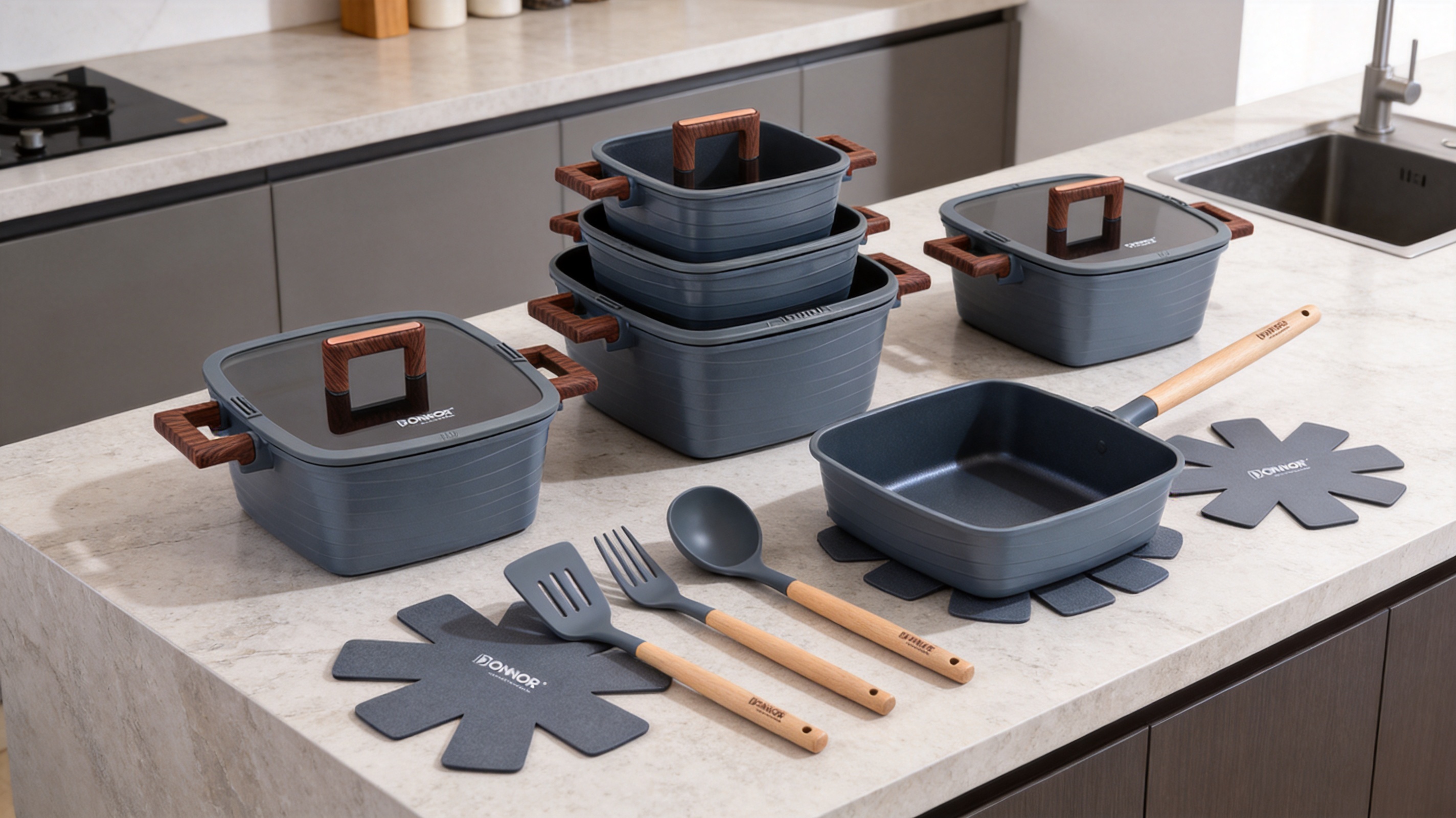
The wooden heat-resistant handles are one of the collection’s most visible design features. They create a warm contrast with the aluminum body and help distinguish the product from cookware using only metal or synthetic handles. Wood accents are particularly suitable for contemporary kitchen styling, natural-material trends, and consumers who want cooking products to feel less industrial.
Handle design affects comfort, control, and confidence. A well-positioned handle allows users to move cookware more securely, especially when the vessel contains hot food. The wooden appearance can also make the cookware more attractive when it is displayed openly. This is useful in kitchens with open shelving, hanging storage, or countertop presentation.
The description identifies the handles as heat-resistant, but users should still exercise normal caution. Cookware handles may become hot depending on the stovetop, cooking time, position, and proximity to the heat source. Users should use appropriate protection when necessary and should not assume that any handle remains cool under every cooking condition.
The natural visual character of the handles also supports the product’s “Woodline” identity. This creates a coherent design connection between the cookware, the wooden-handled utensils, and the wider kitchen environment. Competing cookware sets may offer similar basic functions but lack an equally clear aesthetic theme. The combination of square ribbed aluminum and wood accents gives this set stronger shelf recognition and a more memorable product narrative.
6. Stackable Storage for Space-Conscious Kitchens
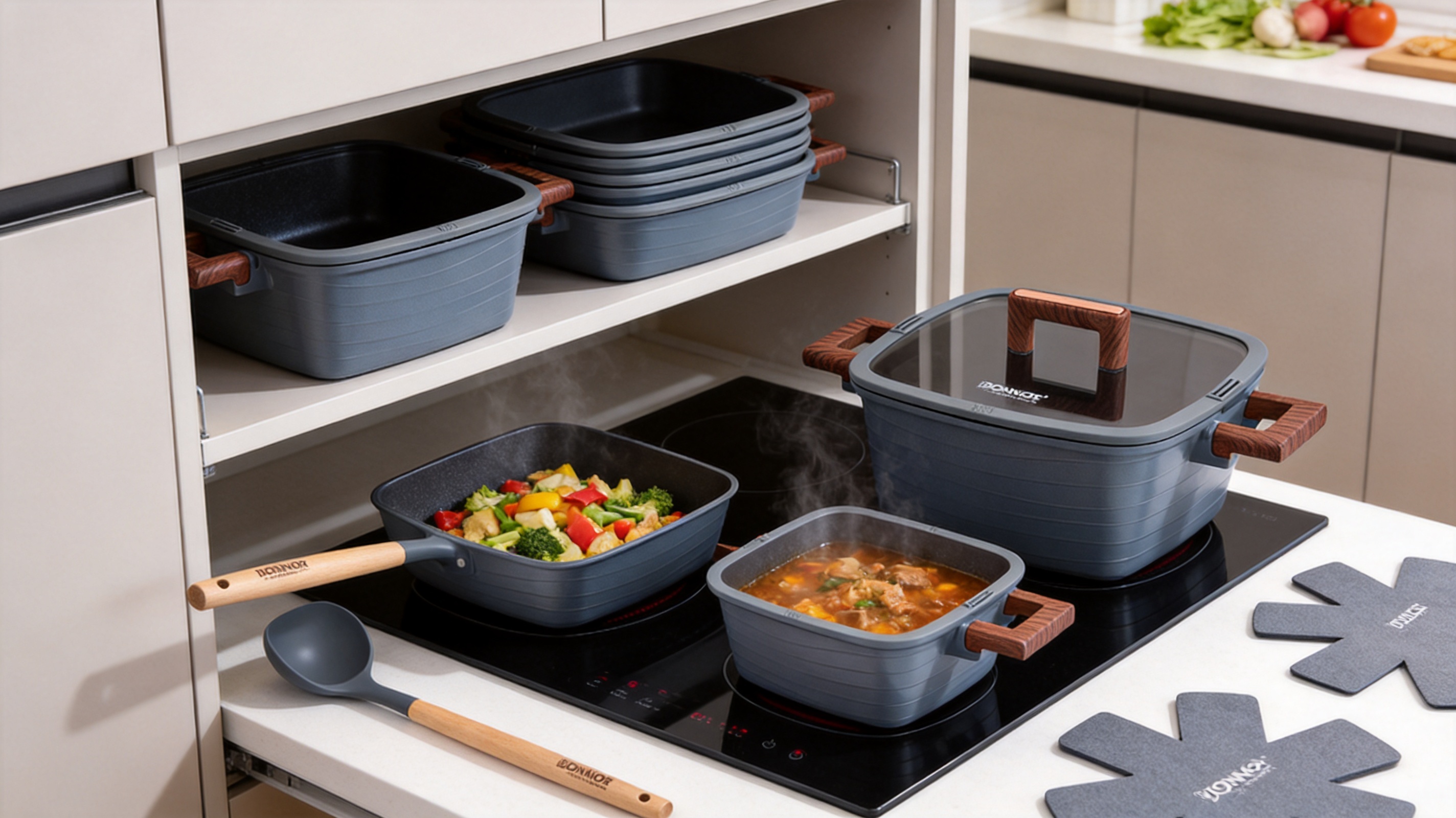
Storage is one of the strongest practical benefits of the SquareStack concept. Cookware often occupies a large amount of cabinet space, and mixed-size pans can become difficult to organize. Handles may obstruct nesting, lids may not align, and irregular shapes can create empty spaces. A stackable design addresses these problems by allowing multiple pieces to be organized vertically rather than spread across a cabinet.
This advantage is especially relevant in apartments, compact homes, studio kitchens, student accommodation, recreational vehicles, holiday properties, and small food-service operations. It is also useful for households that already own other kitchen equipment and need to maximize every shelf and drawer.
Stackability can provide value beyond space saving. A coordinated nesting arrangement makes it easier for users to see the complete set and select the appropriate size. It can reduce unnecessary handling because cookware is stored as an organized group rather than scattered across separate locations. For retailers, the stackable structure may also simplify packaging, warehouse handling, and merchandising.
The set’s range of square casseroles and the shallow square casserole are designed to work as part of one collection. Buyers can present the items as a progressive size system rather than five disconnected vessels. The result is a more efficient use of cabinet volume and a stronger sense of product completeness.
When storing coated cookware, users should avoid actions that cause unnecessary abrasion. If pieces are nested, placing a soft protective layer between surfaces can provide additional protection, particularly during transport or long-term storage. Users should also ensure that cookware is fully clean and dry before stacking.
7. A Versatile Range of Cooking Capacities
The size range is a major reason the product can serve different types of cooking. The 20 cm, 3.0-liter square casserole provides a manageable option for smaller portions and routine meals. It may be useful for warming, simmering, preparing side dishes, cooking grains, or making sauces in quantities larger than a small saucepan but smaller than a family-size pot.
The 24 cm, 5.3-liter casserole occupies a flexible middle position. It can support everyday family meals, pasta, curry, soup, braised vegetables, and one-pot recipes. This size is often the kind of vessel that receives frequent use because it is large enough for multiple servings without being unnecessarily bulky.
The 28 cm, 8.3-liter casserole is suitable for larger family meals and batch cooking. Users may choose it for stews, stocks, large portions of pasta, meal preparation, and dishes intended for gatherings. For commercial or semi-commercial users, it can provide a useful capacity for preparing food in advance without immediately moving to the largest vessel.
The 32 cm, 12.6-liter casserole is designed for high-volume cooking. Its capacity can be valuable for large families, catering, hospitality, community events, and food-service preparation. A large casserole is not only about quantity; it also allows ingredients to be combined in one vessel, reducing the need to divide a recipe among several pans.
The 28 cm, 4.9-liter shallow square casserole offers a different geometry from the deeper vessels. Its lower profile and broad cooking area can be useful for searing, shallow braising, pan roasting, layered recipes, vegetables, and dishes that benefit from easier access with a spatula. It expands the collection’s functionality rather than simply repeating the capacities of the deeper casseroles.
| Cooking Requirement | Most Suitable Format | Potential Use |
|---|---|---|
| Small and routine portions | 20 cm casserole | Sauces, grains, side dishes, and smaller meals |
| Everyday family cooking | 24 cm casserole | Pasta, soup, curry, and one-pot dishes |
| Batch preparation | 28 cm casserole | Stews, stocks, meal preparation, and shared meals |
| Large-volume cooking | 32 cm casserole | Large gatherings, catering, and high-volume recipes |
| Broad, shallow cooking | 28 cm shallow casserole | Searing, shallow braising, roasting, and layered dishes |
8. Stovetop Compatibility and Kitchen Flexibility
The product is specified as compatible with all stovetops. This is a significant commercial and household advantage because kitchens increasingly use different heating technologies. Gas cookers remain common in many regions, while electric, ceramic, and induction systems are also widely used. A product positioned for broad stovetop compatibility can appeal to a wider audience and reduce concerns when customers move homes or replace their cooker.
For consumers, compatibility supports long-term flexibility. A household may purchase cookware for one kitchen and later relocate to a property with a different stovetop. A broadly compatible set reduces the likelihood that the entire cookware collection must be replaced. For retailers and distributors, it simplifies product communication because the same set can be marketed across multiple regions with varied cooking habits.
Users should always position the cookware correctly on the cooking zone and select a suitable heat setting. The care instructions state that the flame or heat source should not extend beyond the base of the item. This helps protect the exterior, handle area, and surrounding kitchen surfaces while promoting more controlled heating.
The all-stovetop positioning also complements the set’s role as a one-stop cookware solution. Consumers do not need to select separate cookware for different cooking surfaces, provided that their specific appliance and the product instructions are followed. This reduces decision complexity and strengthens the convenience of the complete set.
9. Included Accessories and Complete-Set Value
A cookware package becomes more valuable when its accessories are relevant rather than decorative. This set includes silicone trivets and wooden-handled utensils, both of which have a direct relationship to the cookware.
Silicone trivets provide a designated surface for placing hot cookware. They can help protect suitable countertops and dining surfaces from heat, although users should follow the trivet’s own temperature and care instructions. Including trivets supports the product’s kitchen-to-table function and reduces the need to purchase separate heat-protection accessories.
The wooden-handled utensils are compatible with the care guidance for the non-stick coating. Wooden tools are appropriate for stirring, turning, serving, and mixing many everyday dishes, while their handles reinforce the visual relationship with the cookware’s wooden handles. This coordinated design can make the set feel more intentional and gift-ready.
The accessories also increase the perceived value of the package. A buyer comparing a cookware set with a similarly priced collection may consider not only the number of pans but also the usability of what comes inside the carton. A product that helps users cook, serve, and protect surfaces immediately after purchase can be more persuasive than a cookware-only package.
For wholesalers and retailers, accessories can support promotional campaigns such as housewarming bundles, wedding gifts, seasonal kitchen promotions, and new-home packages. They can also make product demonstrations more complete because the cookware can be shown in use with the tools and trivets supplied in the set.
10. Advantages Over Conventional Competitor Sets
The cookware market includes many standard round aluminum sets, stainless steel collections, cast iron products, and mixed-material packages. The SquareStack collection differentiates itself through the combination of several features rather than relying on one isolated specification.
First, the square ribbed form gives the set a stronger visual identity than a conventional smooth round collection. This can improve shelf appeal and help retailers present the product as a modern design-led alternative.
Second, the nesting structure addresses storage limitations. Some cookware sets offer multiple sizes but do not organize them effectively. A stackable system provides a clearer practical benefit, particularly for customers with limited cabinet space.
Third, the wooden heat-resistant handles and wooden-handled utensils establish a unified appearance. Many competing sets use generic handles and unrelated accessories. The Woodline design instead creates a consistent aesthetic that can be used in product photography, showroom displays, and lifestyle marketing.
Fourth, the range of capacities covers both everyday meals and large-volume cooking. The inclusion of a shallow square casserole increases versatility by adding a broad, lower-profile option. This is more useful than simply supplying several vessels with similar proportions.
Fifth, the food-grade non-stick coating supports easy release and simplified cleaning when the cookware is used according to the instructions. This can be more convenient for everyday cooks than uncoated surfaces that require greater technique or maintenance.
Sixth, the included silicone trivets and wooden utensils make the set more complete. These additions can reduce the number of extra items a buyer must purchase and can improve the product’s suitability for gifting.
Finally, all-stovetop compatibility broadens the target market. Buyers do not have to make a separate selection based solely on whether their kitchen uses gas, electric, ceramic, or induction heating. Together, these features make the product a coordinated lifestyle solution rather than a basic group of aluminum pots.
11. Manufacturing and Supply-Chain Strengths
The product is supplied by Zhejiang Echo Industry And Trade Co., Ltd., based in Taizhou, Zhejiang, China. Zhejiang is a major manufacturing and export region with extensive experience in household goods, hardware, kitchenware, and consumer products. Operating in this environment gives a kitchenware supplier access to established industrial networks, component sourcing channels, logistics services, and export-oriented business infrastructure.
The company describes itself as a dynamic and professional kitchenware supplier serving international markets. Its product scope includes aluminum cookware, stainless steel cookware, cast iron cookware, and kitchen utensils. This breadth is commercially important because buyers can develop a broader product program through one supplier rather than managing separate relationships for every material category.
The company’s stated approach is not limited to order-taking. It aims to develop into an R&D-driven supply-chain partner for small and medium-sized kitchenware buyers. This positioning suggests a focus on product development, design adaptation, category planning, and longer-term cooperation. For buyers who need differentiated products rather than generic stock items, an R&D-oriented supplier can provide more value during concept development and range expansion.
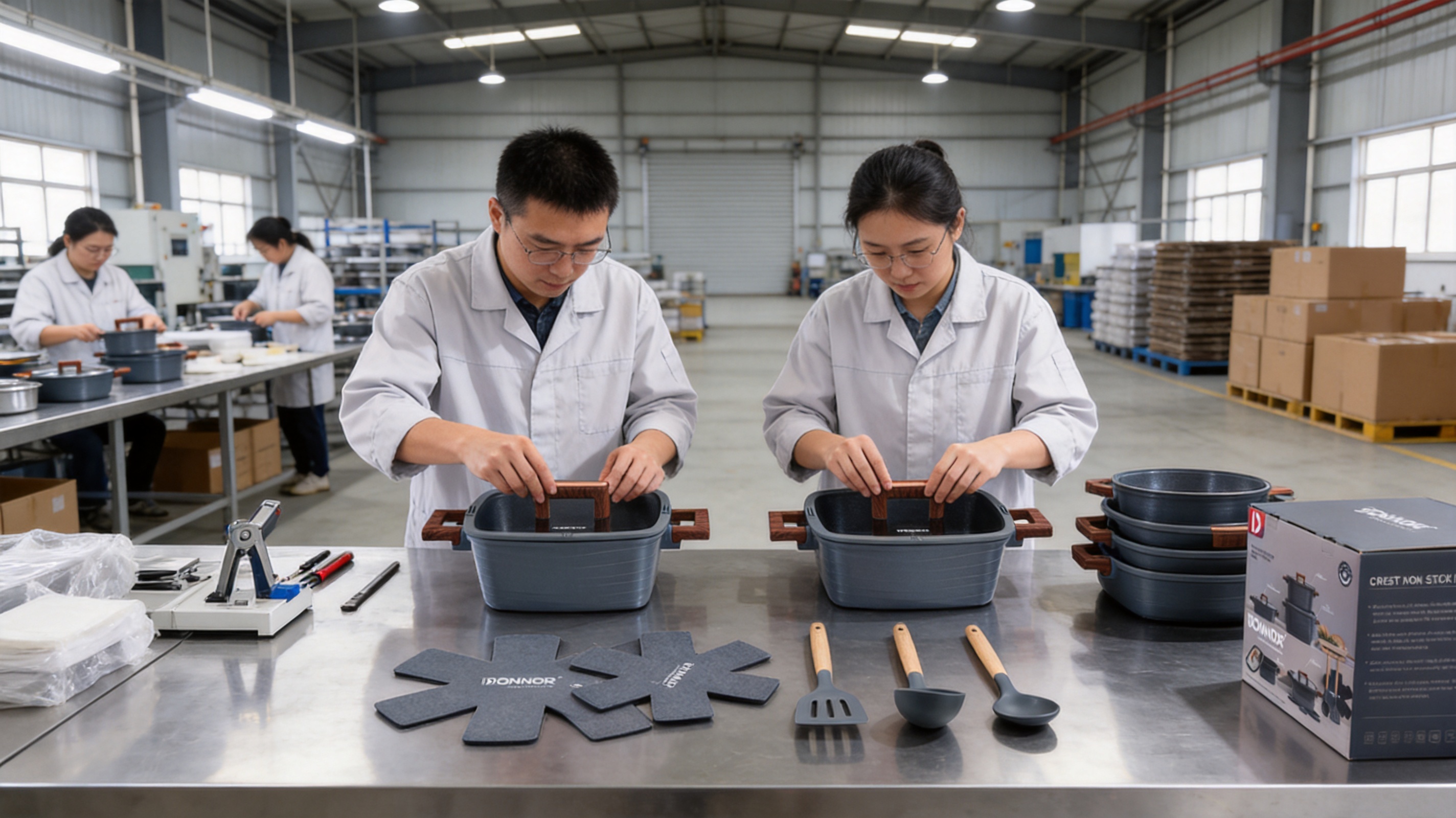
The manufacturing process for a product such as this generally requires coordination across several stages. These may include aluminum body forming, dimensional control, surface preparation, non-stick coating application, handle installation, accessory sourcing, assembly, inspection, packaging, and export documentation. Consistency across the complete set is particularly important because the product includes several sizes and multiple accessory types.
Advanced manufacturing strength should be understood as the ability to coordinate these stages reliably and repeatedly. A successful cookware supplier must maintain consistency in wall shape, base flatness, coating coverage, handle attachment, visual finish, nesting performance, and packaging protection. The product’s square form adds design and production requirements because corners, ribs, and geometric alignment must be controlled carefully.
Square cookware requires more than simply changing a round mold into a square one. The corners must be formed evenly, the body must retain its intended shape, and the base must make stable contact with the cooking surface. The ribbed structure also needs consistent definition across sizes. These considerations make process control important to the final user experience.
Coating application is another key manufacturing stage. A food-grade non-stick surface must be applied consistently across the cooking area and protected during later assembly and packaging. The supplier’s ability to manage surface preparation, coating, curing, inspection, and handling contributes directly to release performance and product appearance.
Handle integration is equally significant. Wooden heat-resistant handles must be securely attached and aligned with the cookware body. A coordinated set requires visual consistency across different sizes, while safety and usability require the handles to remain stable during normal handling. Accessory matching, including wooden-handled utensils and silicone trivets, adds another layer of product coordination.
The company’s stated services include ODM and OEM customization. These capabilities can benefit buyers who want to adjust colors, packaging, logo placement, handle details, accessory combinations, carton design, or market-specific presentation. Customization is especially useful for retailers and distributors building private-label kitchenware programs.
Product certification assistance is also listed among the company’s services. Certification requirements vary by destination, material, product type, and intended market. A supplier able to assist with documentation and compliance coordination can help buyers manage the complexity of international sourcing. Buyers should still confirm the exact certifications, test reports, and regulatory requirements applicable to their own market and sales channel.
Flexible minimum order quantities can make the product more accessible to small and medium-sized importers. Large minimums can create unnecessary inventory risk, especially when a buyer is testing a new design or entering a new region. Flexible ordering may support staged market launches, assortment testing, and gradual expansion based on sales performance.
12. Quality Control Considerations
Quality control for this cookware set should cover both individual components and the finished package. The aluminum body should be inspected for dimensional accuracy, stable bases, consistent corners, smooth edges, and a uniform ribbed profile. These checks help ensure that the cookware nests properly and sits securely on a stovetop.
The coating should be examined for even coverage, appropriate adhesion, surface uniformity, and absence of visible defects. Because the product relies on food release and easy cleaning, coating quality has a direct effect on customer satisfaction. Packaging should also prevent pieces from rubbing against one another during shipment.
Handle inspection should confirm alignment, secure attachment, and appropriate finishing. Since the handles are both functional and highly visible, defects can affect safety perceptions as well as appearance. Wooden utensils should be checked for smooth finishing and clean assembly, while silicone trivets should be reviewed for accurate shape and material consistency.
Set completeness is another important checkpoint. The correct cookware sizes, trivets, utensils, labels, care instructions, and packaging components should be included before cartons are sealed. A missing accessory can create customer complaints even when the cookware itself is satisfactory.
Export packaging is especially important for a multi-piece set. The listed carton information identifies two cartons, with a carton size of 77 by 41 by 41.5 centimeters and a carton weight of 23.8 kilograms. These specifications help logistics teams estimate storage, palletization, loading, and transportation requirements. Buyers should confirm whether the stated figures refer to total shipment details or a specific carton configuration before finalizing freight arrangements.
13. Care and Maintenance Instructions
Correct care is essential for preserving the appearance and functionality of non-stick aluminum cookware. The product instructions recommend washing before first use. This removes any dust or residue from manufacturing, packing, and transportation and prepares the cookware for the kitchen.
Users should avoid metal or sharp cooking utensils. Such tools can scratch or damage the non-stick surface, particularly when used with force or at an angle. Wooden, nylon, or cookware-specific non-stick utensils are recommended alternatives. The included wooden-handled utensils are suitable for reinforcing this safe-use practice.
Cleaning should be performed with hot, soapy water and a soft cloth or sponge. Abrasive pads, harsh scraping, and aggressive cleaning methods may reduce the visual quality of the surface and should be avoided unless specifically approved by the manufacturer. Hand washing is recommended to preserve the appearance of the cookware.
The cookware should not be overheated while empty. Empty heating can cause temperatures to rise rapidly and may place unnecessary stress on the coating, body, and handle area. Users should add suitable ingredients or liquid before heating and should avoid leaving an empty vessel unattended on an active burner.
The flame or heat source should not extend beyond the base of the cookware. Oversized flames can heat the sides and handles unnecessarily and may cause external discoloration or damage. Choosing a suitable burner size and moderate heat setting supports more controlled cooking.
If the pan severely overheats, users should turn off the cooker and leave the cookware to cool completely. They should not touch the pan while it is extremely hot or attempt to move it without suitable protection. Rapid cooling with cold water may also create unnecessary thermal stress and should be avoided unless the manufacturer specifically permits it.
The cookware should not be used in a microwave. Aluminum cookware is not designed for microwave operation, and placing metal cookware in a microwave can be hazardous. This instruction should be clearly communicated in product packaging and retailer descriptions.
After washing, the cookware should be dried thoroughly before stacking. Proper drying helps maintain a clean appearance and prevents moisture from remaining between nested pieces. If consumers place protective material between items during storage, it should be clean, dry, and non-abrasive.
14. Sustainability and Long-Term Product Value
A cookware product’s environmental value is influenced by its service life, material efficiency, packaging, and frequency of replacement. A durable, well-maintained cookware set can reduce the need for repeated purchases. The SquareStack collection supports this objective through a coordinated set design, stackable storage, and care instructions intended to protect the non-stick surface.
Stackability may also reduce storage demands throughout the product’s distribution chain. More efficient nesting can help retailers organize inventory and may support more practical warehouse use. The exact transportation and packaging benefits depend on the final packing configuration, but the underlying design is suitable for space-conscious logistics planning.
The company identifies sustainable and healthy product development as part of its broader service direction. For buyers, this creates an opportunity to discuss material selection, packaging reduction, responsible product use, and longer service life during product development conversations. Any environmental or safety claim should be supported by appropriate technical documentation and market-specific testing.
Long-term value also comes from versatility. A set that covers small portions, family meals, large batches, shallow cooking, serving, and storage can reduce the need to own multiple unrelated collections. Consolidating functions into one coordinated set may help consumers use cabinet space and household resources more efficiently.
15. Applications for Different Customer Groups
Home Consumers
For home users, the set offers a broad range of cooking capacities and a coordinated appearance. It can serve households that cook daily, prepare meals in batches, entertain guests, or want cookware that can move from stovetop to table presentation. The non-stick surface and included utensils make the package approachable for users who prioritize convenience.
Small Apartments and Compact Homes
The stackable design is particularly attractive for users with limited storage. A complete set that nests efficiently can provide more cooking capability without requiring a large cabinet footprint. The square form also gives compact kitchens a visually distinctive product that can be displayed on open shelves.
Gift and Lifestyle Retailers
The combination of cookware, wooden handles, wooden utensils, and silicone trivets creates a strong gift proposition. Retailers can position the set for weddings, housewarmings, anniversaries, seasonal promotions, and new-home purchases. The visual identity is suitable for lifestyle photography and coordinated kitchen displays.
Hospitality and Catering Buyers
The larger capacities may be useful for hospitality businesses, catering operations, event kitchens, and shared cooking environments. The lightweight aluminum construction can make large vessels easier to handle than heavier alternatives. Commercial users should evaluate the product against their own duty cycle, cleaning procedures, heat levels, and applicable regulations before placing large orders.
Importers and Distributors
Importers can benefit from a product with multiple selling points: square design, non-stick convenience, stackability, all-stovetop compatibility, accessories, and varied capacities. These features allow the product to be marketed through several channels, including cookware specialists, department stores, online marketplaces, homeware retailers, and gift distributors.
Private-Label Buyers
ODM and OEM support may allow private-label buyers to adapt the product for specific market needs. Possible areas for discussion may include packaging language, branding, accessory configurations, color schemes, handle treatments, and assortment planning. Exact customization options, development timelines, tooling requirements, and minimum quantities should be confirmed directly with the supplier.
16. Merchandising and Marketing Opportunities
The product has a strong visual story that can be communicated clearly in retail listings. The square ribbed profile should be shown from multiple angles so buyers can understand its shape and surface texture. Images should demonstrate the nested arrangement, the wooden handles, the shallow casserole, the accessory set, and the range of sizes.
Marketing language should focus on specific benefits rather than vague superlatives. Useful themes include space-saving storage, coordinated cooking, convenient non-stick release, all-stovetop flexibility, modern square design, broad capacity selection, and included cooking accessories. These themes can be adapted for product pages, brochures, catalogs, trade-show displays, and distributor presentations.
Retailers can also create recipe-based content. The 20 cm casserole may be shown preparing a smaller side dish, the 24 cm size may be used for a family meal, the larger vessels may demonstrate batch cooking, and the shallow casserole may illustrate braising or broad-surface cooking. Such demonstrations help consumers understand why a five-piece cookware range is more useful than a single generic pot.
Storage photography is particularly important. A clear image of the cookware nested together can communicate the SquareStack advantage instantly. Lifestyle images showing the wooden handles and coordinated utensils can strengthen the product’s premium and design-oriented positioning.
For business buyers, technical content should include the SKU, cookware sizes, capacities, carton information, care instructions, compatibility statement, accessory information, and available customization services. Accurate details help reduce customer uncertainty and support efficient sales training.
17. Buyer Checklist Before Ordering
Buyers should confirm the final component list for the 15-piece package, including the exact number and type of utensils, trivets, and any additional accessories. The listed cookware sizes and capacities should also be verified against production samples and final packaging.
Buyers should request the available material and coating documentation relevant to their destination market. They should clarify whether specific food-contact, non-stick, induction, or other compliance reports are available and whether those documents apply to the exact production version being ordered.
Packaging details should be confirmed, including carton count, carton dimensions, gross and net weights, inner protection, labeling, barcodes, and pallet information. The stated logistics information provides a useful starting point, but final shipment data should be agreed before booking freight.
Buyers should also discuss sample approval, color and finish consistency, handle construction, accessory specifications, logo placement, instruction language, and quality inspection procedures. These steps help ensure that the delivered product matches the intended market presentation.
| Buyer Review Area | Important Questions |
|---|---|
| Product configuration | What exact cookware and accessory components are included? |
| Materials and coating | What documentation is available for food-contact and coating requirements? |
| Compatibility | Has all-stovetop performance been confirmed for the final production model? |
| Customization | What branding, packaging, color, and accessory options are available? |
| Quality control | What inspections are performed before shipment? |
| Logistics | What are the final carton count, dimensions, weights, and loading details? |
| After-sales support | What documents and assistance are available for retailer and consumer support? |
18. Why This Set Is a Strong Product Development Choice
The main strength of the 15-piece SquareStack Woodline Aluminum Cookware Set is the way its features reinforce one another. The square body creates visual differentiation. The ribbed construction adds character. The aluminum material supports responsive, manageable cooking. The non-stick coating encourages convenient food release and cleaning. The wooden handles provide comfort-oriented styling. The nesting structure saves space. The accessories make the set more complete. The size range supports both everyday and large-volume cooking.
Individually, many cookware products can claim one or two of these benefits. The competitive advantage comes from presenting them as one coordinated package. A product with only an unusual shape may be difficult to use. A product with only a non-stick coating may look generic. A product with many sizes may create storage problems. This collection addresses design, function, storage, and presentation together.
The supplier’s broader capabilities add another layer of value. Buyers are not limited to one isolated product. They can explore aluminum cookware, stainless steel cookware, iron cookware, and kitchen utensils through the same business relationship. ODM and OEM services, certification assistance, flexible MOQs, and one-stop sourcing can make the company a practical partner for businesses that want to build or expand a kitchenware range.
For a consumer, the product offers convenience and a modern appearance. For a retailer, it offers a clear sales story. For an importer, it offers category versatility and customization potential. For a distributor, it offers a complete set with several marketable functions. These overlapping benefits make the product suitable for both direct consumer sales and broader business-to-business programs.
19. Frequently Asked Questions
Q1: What material is used for the cookware body?
The cookware body is made from aluminum. Aluminum is valued for its relatively light weight, responsive heating, and suitability for forming into multiple cookware sizes and profiles.
Q2: Does the cookware have a non-stick surface?
Yes. The product is described as having a food-grade non-stick coating. Users should protect this surface by avoiding metal and sharp utensils and by following the recommended hand-washing instructions.
Q3: What cookware sizes are included?
The listed cookware includes 20 cm, 24 cm, 28 cm, and 32 cm square casseroles, plus a 28 cm shallow square casserole. Their stated capacities are 3.0 liters, 5.3 liters, 8.3 liters, 12.6 liters, and 4.9 liters respectively.
Q4: Is the set suitable for all stovetops?
The product description states that it is compatible with all stovetops. Users should still operate the cookware according to the instructions for their appliance and avoid allowing flames or heat sources to extend beyond the cookware base.
Q5: Are accessories included?
Yes. The description states that the set includes silicone trivets and wooden-handled utensils in addition to the cookware.
Q6: Can metal cooking utensils be used?
No. Metal or sharp utensils should not be used because they may scratch or damage the non-stick coating. Wooden, nylon, or non-stick cooking utensils are recommended.
Q7: How should the cookware be cleaned?
The recommended method is hot, soapy water with a soft cloth or sponge. Hand washing is recommended to preserve the appearance of the cookware and protect the coated surface.
Q8: Can the cookware be placed in a microwave?
No. The care instructions state that the cookware should not be used in a microwave.
Q9: What should users do if the pan overheats?
If the pan severely overheats, users should turn off the cooker and leave the cookware to cool completely. They should not touch or move it while it is dangerously hot.
Q10: Is the cookware stackable?
Yes. The product is designed to be stackable for space-saving storage. Users should ensure that the pieces are clean and dry before nesting them and may use protective layers if desired.
Q11: What makes the set different from standard cookware collections?
Its main differentiators are the square ribbed body, wooden heat-resistant handles, coordinated wooden-handled utensils, silicone trivets, stackable construction, broad capacity range, food-grade non-stick coating, and all-stovetop positioning.
Q12: Is customization available for business buyers?
The supplier provides ODM and OEM customization services. Buyers should discuss available options such as branding, packaging, colors, accessories, and market-specific requirements directly with the supplier.
Q13: Does the supplier offer other kitchenware categories?
Yes. The company’s stated product scope includes aluminum cookware, stainless steel cookware, iron cookware, and kitchen utensils.
Q14: What is the product SKU?
The listed SKU is DN01.
Q15: What are the stated carton details?
The product information lists two cartons, a carton size of 77 by 41 by 41.5 centimeters, and a carton weight of 23.8 kilograms. Buyers should confirm the final packing configuration and whether the weight applies to each carton or the shipment specification as a whole.
Conclusion
The 15-piece SquareStack Woodline Aluminum Cookware Set presents a thoughtful alternative to conventional cookware collections. Its square ribbed aluminum body gives it an immediately recognizable appearance, while the food-grade non-stick coating supports everyday convenience. The wooden heat-resistant handles and wooden-handled utensils add a coordinated natural accent, and the silicone trivets improve the practical completeness of the package.
Its range of square casseroles and shallow casserole allows the set to cover small meals, family cooking, large-volume preparation, and broad-surface recipes. Its stackable construction addresses one of the most persistent challenges in modern kitchens: limited storage space. Its all-stovetop compatibility expands the potential customer base and simplifies product selection.
From a commercial perspective, the product benefits from a clear market story. It can be presented as a space-saving set, a modern kitchen upgrade, a practical housewarming gift, a complete cookware solution, or a differentiated private-label product. Its visual identity provides strong merchandising potential, while its accessory package gives retailers additional value to communicate.
The manufacturing and supply-chain capabilities of Zhejiang Echo Industry And Trade Co., Ltd. further support the product’s potential. With experience across aluminum cookware, stainless steel cookware, iron cookware, and kitchen utensils, together with stated ODM, OEM, certification assistance, flexible MOQ, and one-stop sourcing services, the supplier is positioned to support buyers seeking more than a standard catalog item.
For consumers, the collection offers a balance of appearance, function, storage efficiency, and ease of care. For professional buyers, it offers a scalable product concept with multiple customization and distribution possibilities. When used and maintained according to the instructions, the SquareStack design can become a durable, attractive, and highly practical part of a modern kitchenware program.
References
1. Product specification sheet for the 15-piece SquareStack Woodline Aluminum Cookware Set, SKU DN01.
2. Product care and handling instructions supplied for the SquareStack aluminum cookware collection.
3. Supplier information for Zhejiang Echo Industry And Trade Co., Ltd., including product categories and service capabilities.
4. General kitchenware material guidance concerning aluminum cookware, non-stick surfaces, wooden utensils, and cookware storage.
5. General retail and supply-chain considerations for cookware packaging, assortment planning, ODM, OEM, and international distribution.
Product: 15pcs SquareStack Woodline Aluminium Cookware Set
Recommended Articles
Product Category
Related products
-
-
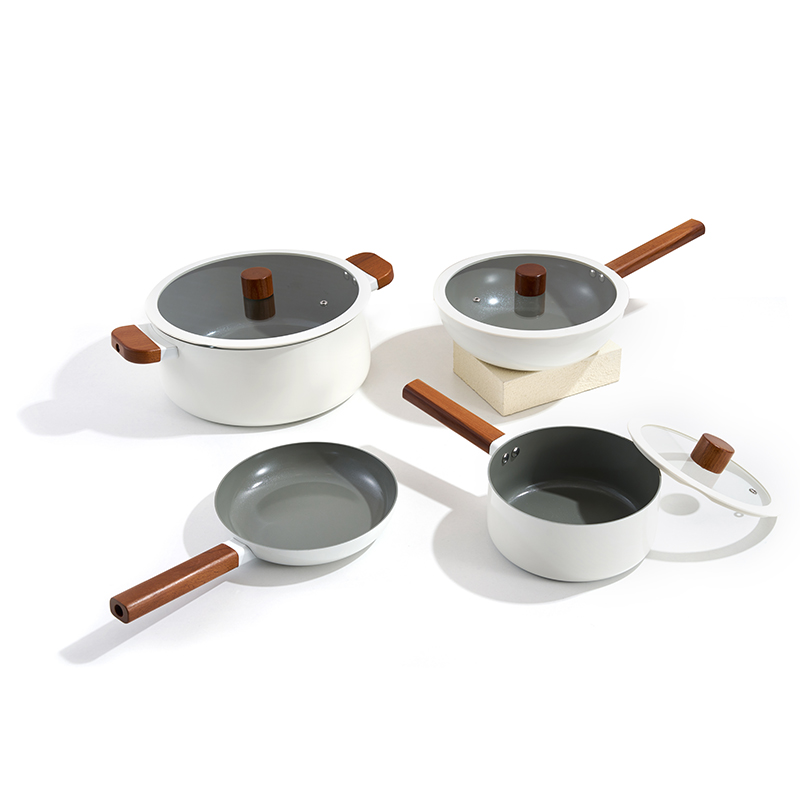
This cookware set has a ceramic non-stick inner liner, a heat-resistant wooden h...
See Details -
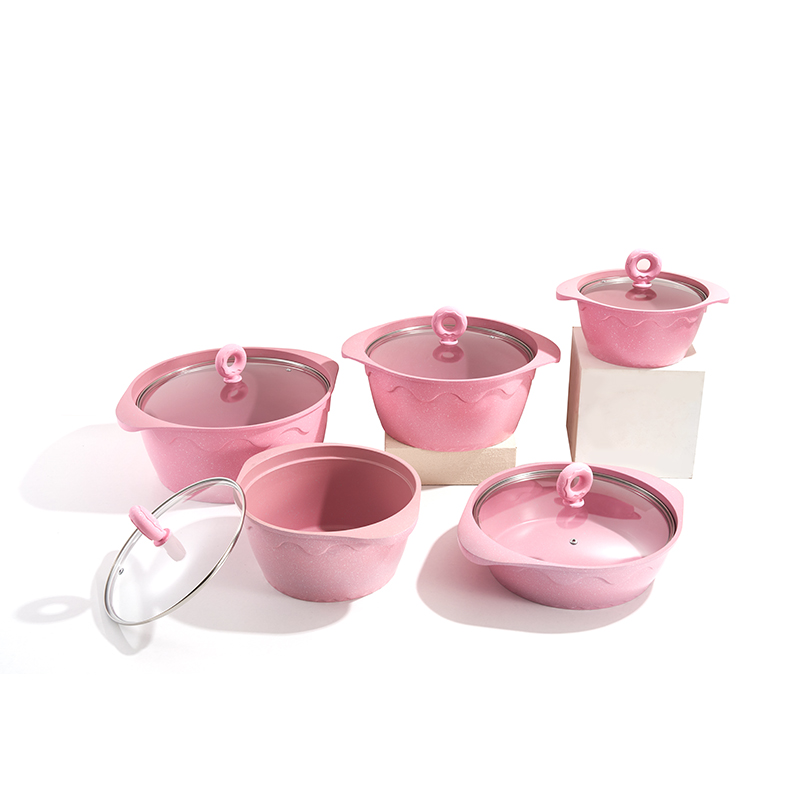
This cookware set is made of food-grade non-stick material, with a unique eye-ca...
See Details -
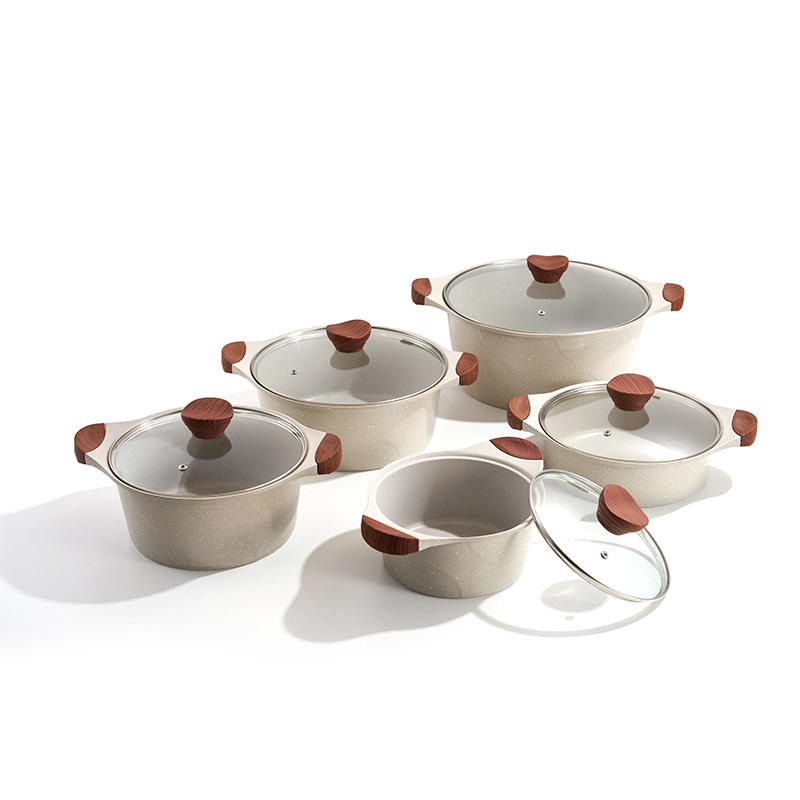
This off-white cookware set is made of wear-resistant non-stick material, with w...
See Details
Whether you're looking for bulk purchases or have any custom requirements, We are here to offer the best
solutions for you.
tiffany.zhong@echocn-trading.com
PHONE
+86-19561173975
+86-19557020621 (Hazel Wu)
ADD
Room 301, Unit 3014, No. 175 Qifeng Avenue, Wenqiao Town, Taizhou, Zhejiang, China
Fill Out the Form for More Information
Copyright © Zhejiang Echo Industry And Trade Co., Ltd.
All Rights Reserved.

China Cookware Set Manufacturer