
 en
 Español

This cookware set features a non-stick coating, even heat conduction, and multi-...
See Details
10-Piece Granite-Coated Aluminum Cookware Set for Modern Kitchens
Date:Sep 17, 2026
Choosing a cookware set is an important decision for households, restaurants, retailers, and professional kitchen suppliers. A good set should provide practical cooking performance, convenient maintenance, broad compatibility, attractive design, and dependable long-term value. The 10pcs RushRed Aluminum Pot Set is designed around these requirements. It combines a die-cast aluminum body, granite-style interior and exterior treatment, a sleek black finish, contrasting red trim, detachable silicone lid rings, and a selection of cookware sizes for everyday meal preparation.
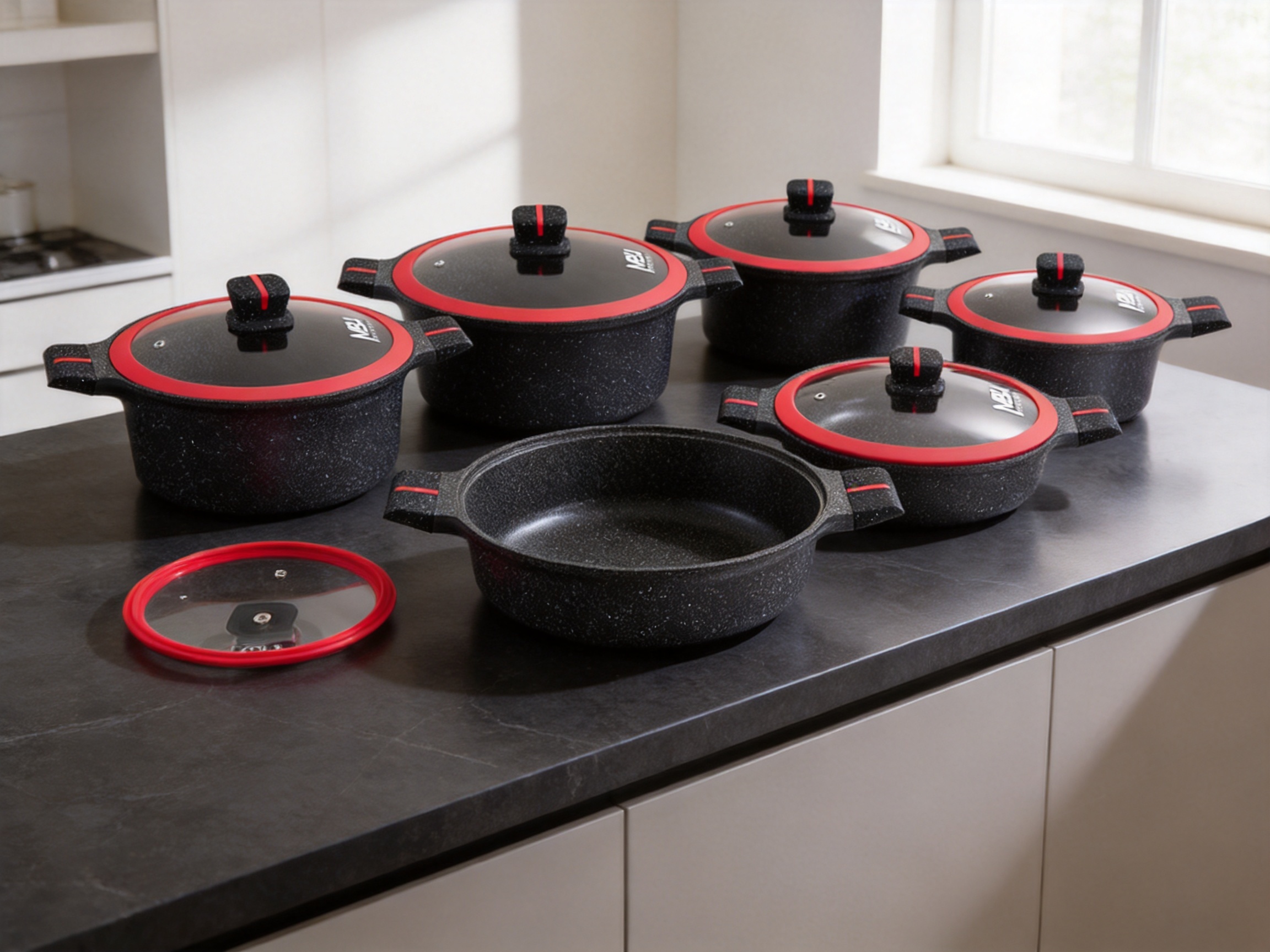
Rather than offering only one specialized pan, this multi-function set brings together several essential pieces for frying, stewing, braising, simmering, and general stovetop cooking. Its product configuration includes four casseroles in 20 cm, 24 cm, 28 cm, and 32 cm sizes, together with a 28 cm shallow casserole. The set is intended to help users prepare individual portions, family meals, side dishes, sauces, braised dishes, and larger recipes without requiring multiple unrelated cookware purchases.
The product is supplied by Zhejiang Echo Industry And Trade Co., Ltd., a cookware and kitchenware supplier based in Taizhou, Zhejiang, China. The company provides aluminum cookware, stainless steel cookware, cast iron cookware, and kitchen utensils, while also supporting one-stop sourcing, ODM and OEM customization, flexible minimum order quantities, product certification assistance, and sustainable product development. These capabilities make the cookware set suitable not only for home users but also for importers, distributors, supermarkets, hospitality suppliers, and other buyers seeking a coordinated cookware product line.

10pcs RushRed Aluminum pot Set
A Complete Multi-Size Solution for Everyday Cooking
The main strength of a cookware set is the convenience of having several compatible pieces in one coordinated collection. Different recipes require different cooking surfaces and capacities. A small casserole may be useful for sauces, vegetables, grains, or individual portions, while a larger casserole is better suited to soups, braised meat, family-sized stews, and meals prepared for gatherings. The inclusion of several diameters gives the user greater flexibility than a single-pan purchase.
The 20 cm casserole is practical for smaller quantities and daily side dishes. It can be used for heating sauces, preparing breakfast portions, warming leftovers, or cooking ingredients that do not require a large vessel. The 24 cm casserole offers a balanced size for couples and small families, providing enough capacity for routine meals without occupying excessive stovetop space.
The 28 cm casserole is a versatile middle-to-large option. It can accommodate larger portions, mixed ingredients, and recipes that need room for stirring. The 32 cm casserole is the largest listed piece and is especially useful for family cooking, batch preparation, holiday meals, and recipes with multiple ingredients. The 28 cm shallow casserole adds another cooking format to the collection. Its broader, lower profile is useful when the recipe benefits from increased surface area, faster evaporation, or easier access for turning and serving food.
Compared with purchasing individual pans from different collections, a coordinated set offers a more consistent appearance and a simpler buying process. The pieces share the same design language, making them suitable for kitchens where visual coordination matters. For retailers, the set is also easier to present as a complete value-oriented solution rather than as a collection of unrelated products.
Die-Cast Aluminum Construction
The cookware set uses die-casting aluminum as its substrate. Aluminum is widely used in cookware because it offers a useful balance between low weight, heat responsiveness, workability, and cost efficiency. Compared with many heavier cookware materials, aluminum is easier to handle during cooking, lifting, washing, storage, and shipment. These characteristics are particularly valuable for users who cook frequently or need to move cookware between preparation and serving areas.
Die-casting is a manufacturing process in which molten aluminum is introduced into a prepared mold under controlled pressure. After the metal solidifies, the formed body is removed, trimmed, and prepared for subsequent finishing operations. This process enables the production of cookware with repeatable shapes and consistent dimensions. It also supports the creation of a stable body that can accommodate a broad cooking surface and carefully formed sidewalls.
A die-cast body can provide a more substantial feel than very thin stamped cookware while remaining more manageable than many heavy cast iron alternatives. The resulting structure is appropriate for cookware designed for repeated household use. It gives the product a solid foundation for the application of exterior and interior granite-style treatments, while supporting the multi-size configuration required for the product range.
The aluminum substrate also responds relatively quickly to changes in heat input. This can be helpful when a cook needs to increase or reduce the temperature during frying, simmering, or braising. As with any cookware, cooking performance depends on the stove, heat source, recipe, quantity of food, and user technique. Nevertheless, the material selection provides a practical platform for a responsive and user-friendly cookware set.
Granite-Style Interior and Exterior Treatment
The product specification identifies granite coating on both the interior and exterior surfaces. This treatment contributes to the set’s visual appearance and is also intended to support convenient everyday use. The black granite-textured body creates a contemporary look that can fit modern kitchens, while the red contrast trim gives the cookware a distinctive visual identity.
The interior treatment is designed to provide a non-stick cooking surface. A non-stick surface can reduce the amount of oil needed for many recipes and can help food release more easily during cooking. It may also simplify cleaning after use, especially when the cookware is cared for according to the recommended instructions. This combination of cooking convenience and easier maintenance is one of the main advantages of the product over basic uncoated aluminum cookware.
The exterior granite treatment gives the cookware a coordinated finish rather than leaving the aluminum body visually exposed. A well-finished exterior can improve shelf presentation for retailers and provide a more polished appearance in the home. The black surface also creates a neutral foundation that allows the red trim to stand out without making the product difficult to coordinate with other kitchen items.
It is important to understand that non-stick performance is supported by correct use and maintenance. The cookware should not be overheated while empty, and users should avoid sharp or metal utensils that could damage the treated surface. Wooden, nylon, or other non-stick-safe utensils are recommended. Following these practices helps preserve the appearance and function of the coating over time.
Designed for Frying, Stewing, and Braising
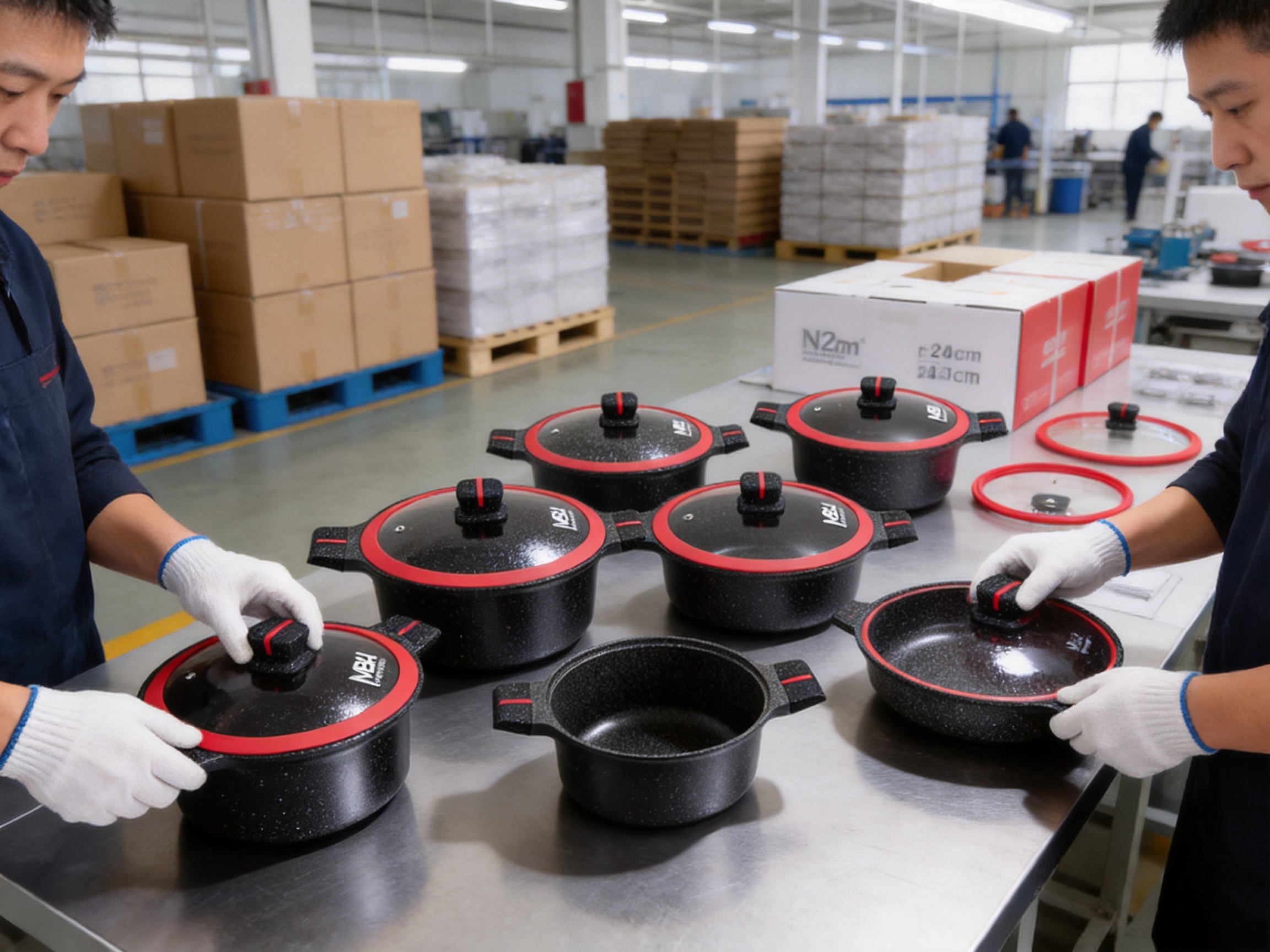
The set is described as suitable for frying, stewing, and braising, giving it a broad role in daily cooking. Frying often requires a smooth cooking surface that allows ingredients to move easily and reduces sticking. The shallow casserole, with its broad form, can be particularly useful for pan-frying, sautéing, reducing sauces, and preparing dishes that need convenient access from above.
Stewing involves cooking ingredients in liquid over a period of time. The larger casserole sizes provide useful capacity for vegetables, meat, legumes, soups, and mixed dishes. A stable cookware body and a fitted lid can help users manage simmering recipes while limiting splashing and helping retain moisture. Users should select the pan size according to the recipe quantity so that food has sufficient room for stirring without filling the pan excessively.
Braising typically combines an initial browning stage with slower cooking in a smaller amount of liquid. A multi-size set is useful for this method because the user can choose a pan with enough surface area for browning while still providing suitable depth for the later cooking stage. The non-stick surface can also make it easier to move ingredients and clean the cookware after cooking.
The range of sizes means that the same product family can support both small and large cooking tasks. This is more practical than relying on a single oversized pan for every recipe. Smaller pieces can reduce unnecessary energy use and may be easier to handle, while larger pieces are available when the recipe requires greater capacity.
Detachable Silicone Lid Ring
A notable design element is the detachable silicone lid ring. Silicone is commonly selected for cookware components because it is flexible and can provide a cushioning interface between a lid and the cookware body. A detachable ring can also make cleaning more convenient because users may be able to remove the component and wash areas where moisture or food residue could otherwise collect.
The lid ring contributes to the product’s practical design without permanently complicating the cookware body. For manufacturers and distributors, detachable components can also be considered during product development, packaging, replacement-part planning, and private-label customization. The precise care method should follow the supplier’s final product instructions, particularly regarding washing temperature, dishwasher use, and reassembly.
When using a lid, the user should choose the correct size and position it properly. Steam can become hot, and lids should be handled with suitable caution during cooking. Users should also avoid touching severely overheated cookware and should allow it to cool completely after switching off the cooker.
Induction Compatibility and Broad Household Use
The product information identifies the cookware as induction-compatible. This makes the set suitable for kitchens that use induction cooking technology in addition to conventional stovetops. Induction compatibility is increasingly important for modern households, apartment kitchens, hospitality properties, and markets where energy-efficient cooking appliances are becoming more common.
Cooktop compatibility should always be verified against the final product sample and the requirements of the intended market. Different cookers may have different operating instructions, power levels, and surface dimensions. Users should place the cookware centrally on the cooking zone and ensure that the base is clean and properly positioned before operation.
In addition to induction cookers, the set may be used with other compatible stovetop heat sources according to the manufacturer’s instructions. The flame or heat source should not extend beyond the base of the cookware. Excessive heat around the sides can affect the exterior finish, handles, lid components, and surrounding surfaces. Controlled heat is especially important when using a coated cooking surface.
Advantages Over Basic and Single-Function Alternatives
The 10-piece set offers several advantages when compared with basic single-layer aluminum cookware. First, the die-cast body provides a more structured construction than lightweight, thin-gauge cookware that may feel less substantial. Second, the interior and exterior granite-style treatment creates a coordinated finish and supports non-stick cooking. Third, the multiple sizes allow the set to cover a broader range of recipes.
Compared with uncoated aluminum cookware, the treated interior is intended to reduce sticking and simplify cleaning. Uncoated surfaces may require more oil or more careful cooking techniques for delicate ingredients. The coated surface can be more convenient for users who prioritize quick meal preparation and easy washing.
Compared with many cast iron sets, aluminum cookware is generally easier to lift and maneuver. Cast iron can offer excellent heat retention, but its weight may be inconvenient for some users. The aluminum construction of this set offers a more accessible option for everyday cooking, especially in households where cookware is frequently moved, washed, and stored.
Compared with stainless steel cookware, a non-stick aluminum set can provide a different cooking experience. Stainless steel is valued for durability and high-temperature cooking, but food may require more careful heat management and oil control to prevent sticking. The granite-coated interior is intended to provide a more forgiving surface for routine cooking, while the aluminum body supports responsive heating.
Compared with buying separate pieces, the coordinated set can provide better visual consistency and product value. Retailers can market it as a practical kitchen upgrade, while importers can list one complete item that addresses several cooking needs. Its combination of appearance, sizes, material, and compatible cooking technology gives it a broad position within the cookware market.
| Product Feature | Practical Benefit | Value for Buyers |
|---|---|---|
| Die-cast aluminum substrate | Lightweight, responsive, and suitable for formed cookware bodies | Supports convenient daily handling and scalable production |
| Granite interior treatment | Non-stick cooking surface and easier food release | Improves user convenience and product appeal |
| Granite exterior treatment | Modern black textured appearance | Creates strong shelf and online presentation |
| Red contrast trim | Adds a recognizable visual accent | Helps the set stand out from plain cookware |
| Multiple casserole sizes | Supports small, medium, and large recipes | Provides a complete cooking solution in one purchase |
| 28 cm shallow casserole | Useful for frying, sautéing, and low-depth recipes | Expands the set beyond standard deep pots |
| Detachable silicone lid ring | Supports a practical lid design and convenient maintenance | Adds functional differentiation |
| Induction compatibility | Works with a widely used modern cooking technology | Broadens market suitability |
Manufacturing Process from Aluminum to Finished Cookware
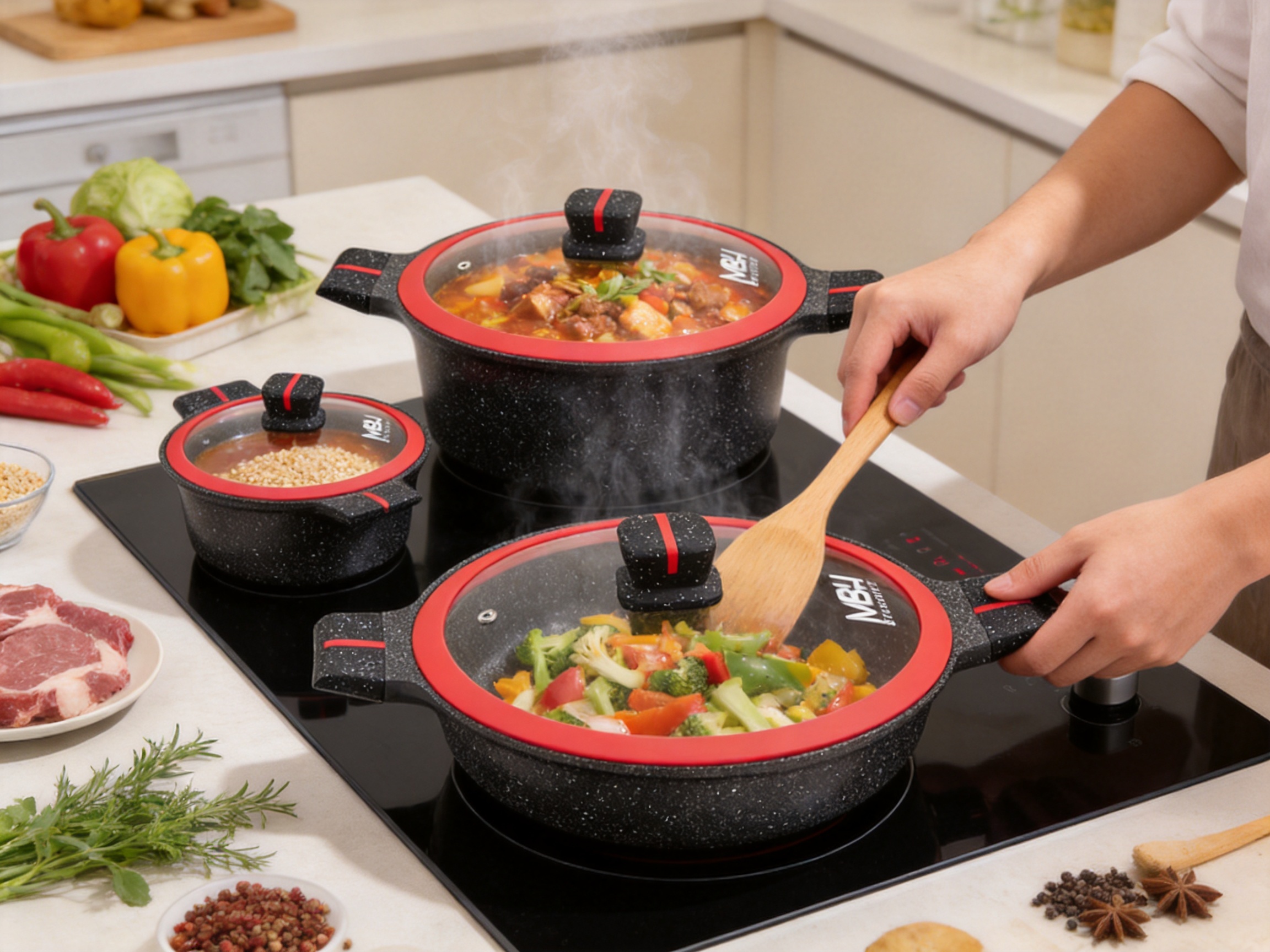
The performance and appearance of cookware depend not only on the selected material but also on how the product is manufactured. A typical production route for this type of cookware begins with material preparation, followed by die-casting, trimming, surface preparation, coating, component assembly, inspection, and packaging. Each stage affects the final product’s appearance, dimensions, coating quality, and usability.
Material Preparation
The process starts with aluminum material selected for the cookware substrate. The material must be prepared for melting and forming in accordance with the factory’s production controls. Proper material handling helps support consistency between production batches and provides a stable foundation for the subsequent forming process.
Die-Casting and Forming
During die-casting, aluminum is formed inside a mold designed for the required cookware shape. The mold determines important dimensions such as the diameter, wall profile, base structure, and overall geometry. Controlled forming helps produce repeatable cookware bodies across the 20 cm, 24 cm, 28 cm, and 32 cm sizes.
After forming, the cookware body may undergo trimming and finishing operations to remove excess material and prepare edges for coating. Proper control at this stage is important because uneven edges, surface imperfections, or dimensional variation can affect the appearance and assembly of the finished product.
Surface Preparation
Before coating, the aluminum surface must be cleaned and prepared. Surface preparation can include removing residues, smoothing selected areas, and ensuring that the substrate is ready to receive the interior and exterior treatment. Good preparation supports adhesion and helps the coating form a consistent visual layer across the cookware body.
Granite Coating Application
The interior and exterior surfaces are treated with the specified granite-style coating. The application process requires attention to coverage, thickness, curing, and appearance. Coating control is important for achieving the intended non-stick function on the cooking surface and the textured black finish on the outside.
Depending on the factory’s specific process and equipment, coating may be applied through controlled spraying or another suitable industrial method. The finished surfaces should be reviewed for visible defects such as uneven color, pinholes, scratches, excessive particles, or incomplete coverage. The exact coating formulation and process parameters should be confirmed through the supplier’s technical documentation and approved samples.
Component Assembly
After the coated cookware body has been processed, associated components such as lids and detachable silicone rings can be fitted or prepared for packing. Assembly checks should verify that components correspond to the intended cookware sizes and that the silicone ring is correctly positioned. Careful assembly helps reduce the risk of mismatched parts reaching the customer.
Inspection and Packing
Quality inspection may include checking dimensions, surface appearance, coating condition, product quantity, component fit, labeling, and carton arrangement. The product information identifies a packing configuration of two cartons, with a stated carton size of 73.5 by 36 by 34.5 cm and a carton weight of 18 kg. These logistics details are useful for importers planning warehouse space, shipping calculations, palletization, and distribution.
Packaging should protect the coated surfaces and prevent pieces from rubbing against each other during transportation. Appropriate separators, protective materials, and stable carton placement can help reduce the possibility of scratches or impact damage. For export buyers, packaging specifications can be reviewed and customized according to destination requirements, retail presentation, and shipping conditions.
Quality Control Considerations
For cookware buyers, product quality is evaluated through more than appearance alone. A dependable cookware program should consider substrate consistency, dimensional accuracy, coating uniformity, lid fit, component compatibility, packaging strength, and labeling accuracy. These factors influence the customer experience and the rate of returns or complaints.
Inspection of the aluminum body should look for cracks, deformation, sharp edges, incomplete forming, and unacceptable surface irregularities. The body should match the approved sample in shape and size. Consistent dimensions are especially important in a multi-size set because lids, rings, and packaging components must correspond correctly.
Coating inspection should consider the interior cooking surface and exterior finish separately. The interior should have a consistent appearance and should not show obvious bare areas, blistering, peeling, or contamination. The exterior should maintain the intended black granite-style texture and red trim without excessive variation. Buyers may establish acceptable quality limits and inspection standards before mass production.
Functional checks may include reviewing the stability of the cookware on a flat surface, checking lid compatibility, examining the detachable silicone ring, and confirming the intended stovetop compatibility. Importers may also request samples for internal testing and market-specific compliance review before placing a larger order.
Zhejiang Echo Industry And Trade Co., Ltd. states that it provides product certification assistance. This is valuable for buyers who need to organize documentation for their destination market. Certification and testing requirements vary by country, product category, retailer, and intended use. The buyer and supplier should agree in advance on the required test standards, documents, labeling, and packaging information.
Supplier Capabilities for Wholesale and Private-Label Buyers
A cookware factory or supplier must provide more than an attractive product image. International buyers often need coordinated product selection, stable communication, documentation, packaging support, order flexibility, and the ability to develop products for specific markets. The company behind this cookware set presents itself as a professional kitchenware supplier with a broad product portfolio and an export-oriented business model.
Its product categories include aluminum cookware, stainless steel cookware, cast iron cookware, and kitchen utensils. This range allows buyers to combine several material types within one sourcing program. A retailer, distributor, or hospitality supplier may be able to build a broader kitchenware assortment while communicating with one supply partner instead of managing numerous unrelated vendors.
The company also offers one-stop cookware solutions. For buyers, one-stop sourcing can simplify quotation management, product selection, sample coordination, packaging discussions, and shipment planning. It may also make it easier to develop a consistent brand presentation across pots, pans, utensils, and accessories.
ODM and OEM customization provide additional opportunities. Depending on the project requirements, buyers may discuss color combinations, surface finishes, logo application, packaging artwork, handle designs, set configurations, and other product details. Customization should be reviewed through a formal development process, including drawings, samples, target prices, minimum order quantities, lead times, and quality approval procedures.
Flexible minimum order quantities can be useful for small and medium-sized buyers testing a new cookware range. Lower initial risk may allow a distributor to introduce a product gradually, evaluate customer response, and plan future replenishment. The final MOQ remains subject to product configuration, materials, packaging, customization, and production capacity.
The company’s stated focus on R&D-driven supply chain cooperation is also relevant to buyers seeking more than standard catalog products. Product development may include reviewing customer feedback, studying market preferences, adjusting cookware configurations, improving packaging, and creating new combinations of materials and functions.
Brand Presentation and Retail Positioning
The product’s appearance supports several retail positioning strategies. The black granite-textured body gives it a modern and premium-inspired visual character, while the red trim adds energy and differentiation. It can be positioned as an everyday cookware upgrade, a practical gift set, a family cooking solution, or a coordinated kitchen collection.
For online retailers, the set offers multiple content points for product pages. Listings can emphasize the die-cast aluminum construction, granite-style finish, multi-size configuration, non-stick interior, induction compatibility, detachable silicone lid ring, and suitability for frying, stewing, and braising. Clear images and accurate descriptions should be used to show each included piece and its size.
For physical retail, the set can be displayed as a complete solution rather than as individual cookware pieces. The red accent may help create shelf recognition, while the multi-piece format communicates value. Retailers should clearly state the included sizes, care instructions, compatible cooking surfaces, and any market-specific limitations.
For hospitality and food-service buyers, the set may be appropriate for selected applications where lightweight handling and non-stick convenience are priorities. The buyer should evaluate the intended usage intensity, cooking temperature, washing method, and replacement requirements before selecting the product for commercial environments. Household cookware and heavy-duty professional cookware may have different service expectations.
Care and Maintenance Recommendations
Proper care is essential for preserving the appearance and performance of coated cookware. Before the first use, the cookware should be washed. Hand washing is recommended to help preserve the appearance of the coating and exterior finish. Hot, soapy water and a soft cloth or sponge should be used for routine cleaning.
Metal utensils and sharp cooking tools should not be used because they may scratch or damage the non-stick surface. Wooden, nylon, or other utensils specifically designed for non-stick cookware are more suitable. Users should avoid dragging utensils across the interior and should not cut food directly inside the cookware.
The cookware should not be overheated while empty. Heating an empty coated pan can cause unnecessary stress to the cooking surface and may affect the finish. Users should add appropriate ingredients or cooking liquid before the cookware becomes excessively hot and should select a heat level suitable for the recipe.
The flame or heat source should not extend beyond the base of the cookware. Heat extending around the sides may discolor the exterior, damage components, or create a safety concern. The cookware should also not be placed in a microwave because it is metal cookware and is not designed for microwave use.
If the pan severely overheats, the cooker should be turned off and the cookware should be left to cool completely. Users should not touch severely overheated cookware immediately. Sudden contact with a hot surface can cause burns, and placing hot cookware under cold water may create thermal stress.
Food residue should be removed with gentle cleaning rather than abrasive pads, harsh powders, or sharp scraping tools. Allowing the cookware to cool before washing is generally advisable. The detachable silicone lid ring should be removed and cleaned as appropriate, then correctly reassembled after the components are dry.
Purchasing Considerations for Importers and Distributors
Buyers evaluating the 10-piece cookware set should begin by confirming the exact product configuration. The supplied information identifies casseroles in four sizes and one 28 cm shallow casserole, but the final packing list, lid quantity, handle configuration, and complete piece count should be verified against the approved commercial specification. Clear documentation prevents misunderstandings during quotation, production, and shipment.
Buyers should request a pre-production sample or approval sample before mass manufacturing, particularly when customized colors, logos, packaging, or coating finishes are required. The sample can be used to confirm the visual appearance, dimensions, component fit, labeling, and general cooking functionality.
Destination-market requirements should be identified early. These may include food-contact materials documentation, coating information, packaging marks, carton labels, barcode requirements, country-of-origin statements, and testing reports. The supplier’s certification assistance can support the process, but the buyer remains responsible for confirming the requirements applicable to its market and sales channels.
Shipping planning should account for the two-carton configuration, carton dimensions, carton weight, product protection, and the final number of sets per shipment. Accurate carton information helps buyers estimate freight costs and warehouse capacity. It also supports planning for container loading and distribution to retail or wholesale customers.
Commercial discussions should cover unit pricing, tooling or development fees where applicable, minimum order quantities, production lead time, payment terms, packaging specifications, inspection arrangements, warranty expectations, and after-sales communication. A complete quotation should identify whether customization, testing, packaging, and shipping-related services are included or priced separately.
Why the Product Is Suitable for Global Markets
The cookware set addresses several widely recognized consumer priorities: convenience, appearance, versatility, manageable weight, easy cleaning, and compatibility with modern cooking equipment. These priorities can apply across many market segments, although the preferred colors, packaging formats, sizes, and price points may differ by country.
Its black-and-red appearance provides a recognizable design direction, while the underlying cookware format remains broadly familiar. The combination of standard casserole sizes and a shallow casserole allows the product to serve different cooking habits without becoming overly specialized. The set can therefore be considered for general household retail, online commerce, gift channels, kitchenware distribution, and selected hospitality applications.
The product also fits the growing interest in coordinated cookware collections. Consumers often prefer kitchen products that look consistent and provide multiple functions. A complete set reduces the need to match pieces from different manufacturers and can create a more organized cooking environment.
For B2B buyers, the supplier’s broader kitchenware portfolio adds another advantage. A buyer may begin with this aluminum set and later expand into stainless steel cookware, cast iron products, utensils, or customized kitchen accessories. This creates the possibility of developing a broader product range through a unified sourcing relationship.
Q&A: Frequently Asked Questions
What material is used for the cookware body?
The cookware body uses die-cast aluminum. This material provides a practical combination of manageable weight, responsive heating, formability, and suitability for a multi-size cookware collection.
What surface treatment does the set have?
The product specification identifies granite coating on both the interior and exterior surfaces. The interior is intended to provide a non-stick cooking surface, while the exterior creates a black granite-textured appearance with red contrast trim.
What pieces and sizes are included?
The listed configuration includes casseroles in 20 cm, 24 cm, 28 cm, and 32 cm sizes, together with a 28 cm shallow casserole. Buyers should confirm the final piece count, lid arrangement, and packing list with the supplier before ordering.
Can the cookware be used on an induction cooker?
The product information identifies the set as induction-compatible. Users should follow the instructions for their specific cooktop, place the cookware centrally on the cooking zone, and confirm compatibility with the approved product sample and final technical documentation.
What cooking methods are suitable for this set?
The cookware is designed for everyday cooking methods including frying, stewing, and braising. The shallow casserole is useful for recipes requiring a broad cooking surface, while the deeper casseroles are suitable for sauces, stews, braised dishes, and larger meals.
Which utensils should be used?
Wooden, nylon, or other non-stick-safe utensils are recommended. Metal or sharp utensils should not be used because they may scratch or damage the coated interior.
How should the cookware be cleaned?
Use hot, soapy water with a soft cloth or sponge. Hand washing is recommended to help preserve the appearance of the cookware. Abrasive cleaners, harsh scouring tools, and sharp scraping instruments should be avoided.
Can the cookware be placed in a microwave?
No. The cookware should not be used in a microwave. It is designed for compatible stovetop cooking rather than microwave heating.
What should be done if the cookware overheats?
Turn off the cooker and allow the cookware to cool completely. Do not touch severely overheated cookware immediately. Empty-pan overheating should be avoided because it may affect the coating and other components.
What is the purpose of the detachable silicone lid ring?
The detachable silicone ring provides a flexible interface for the lid and can make cleaning and maintenance more convenient. The ring should be removed, cleaned, dried, and correctly reassembled according to the supplier’s instructions.
Is this product suitable for private-label projects?
The supplier states that it provides ODM and OEM services. Buyers can discuss possible customization of colors, packaging, logos, configurations, and other product details. All customization should be confirmed through samples and written specifications before production.
What packaging information is available?
The supplied information identifies a two-carton configuration, a carton size of 73.5 by 36 by 34.5 cm, and a carton weight of 18 kg. Buyers should verify the final packing data because packaging may change with customization or revised product arrangements.
Does the supplier provide other kitchenware products?
Yes. The company presents a portfolio covering aluminum cookware, stainless steel cookware, cast iron cookware, and kitchen utensils. This supports one-stop sourcing for buyers seeking a broader kitchenware range.
Conclusion
The 10pcs RushRed Aluminum Pot Set combines a practical material platform, coordinated design, broad cooking functionality, and a multi-size configuration. Its die-cast aluminum body is designed for manageable handling and responsive cooking, while the granite-style interior and exterior treatments provide a modern appearance and non-stick convenience. The inclusion of several casseroles and a shallow casserole allows users to select cookware according to recipe size and cooking method.
The set also offers clear advantages for wholesale and retail buyers. Its black granite-textured finish and red trim create a distinctive product identity, while induction compatibility expands its relevance to modern kitchens. The detachable silicone lid ring adds a functional detail that can support convenient maintenance. When used with suitable utensils, controlled heat, and gentle cleaning, the cookware is designed to provide a practical everyday cooking experience.
Behind the product is an export-oriented kitchenware supplier with capabilities in die-cast aluminum cookware, stainless steel cookware, cast iron cookware, kitchen utensils, ODM and OEM development, certification assistance, flexible MOQs, and one-stop sourcing. Its manufacturing and supply-chain strengths can help buyers develop coordinated product lines rather than purchasing isolated items from multiple sources.
For importers, distributors, and retailers seeking a versatile cookware collection with a modern visual profile, this set represents a balanced combination of functionality, presentation, and sourcing flexibility. Final purchasing decisions should be based on approved samples, confirmed specifications, destination-market requirements, and agreed quality standards.
References
1. Product specification and care information supplied for the 10pcs RushRed Aluminum Pot Set, SKU HT01.
2. Technical information supplied for the die-cast aluminum substrate, granite interior treatment, granite exterior treatment, cookware sizes, and carton configuration.
3. General manufacturing principles for die-cast aluminum cookware, including forming, trimming, surface preparation, coating, assembly, inspection, and export packaging.
4. General cookware care principles concerning non-stick surfaces, utensil selection, heat control, hand washing, and safe handling of overheated cookware.
5. Supplier information concerning aluminum cookware, stainless steel cookware, cast iron cookware, kitchen utensils, OEM and ODM services, product certification assistance, flexible MOQs, and one-stop sourcing.
Product: 10pcs RushRed Aluminum pot Set
Recommended Articles
Product Category
Related products
-
-
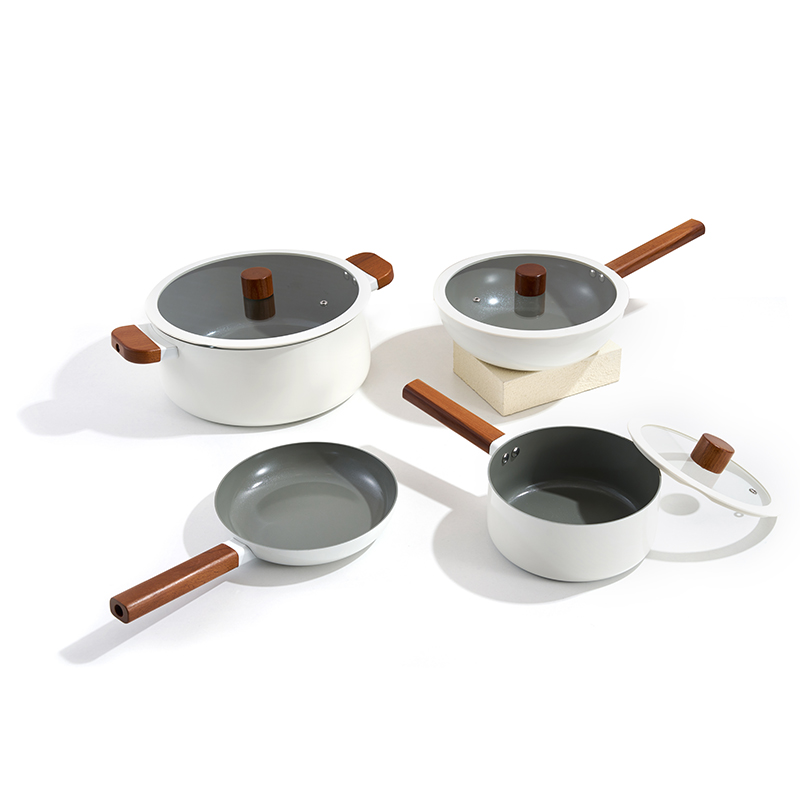
This cookware set has a ceramic non-stick inner liner, a heat-resistant wooden h...
See Details -
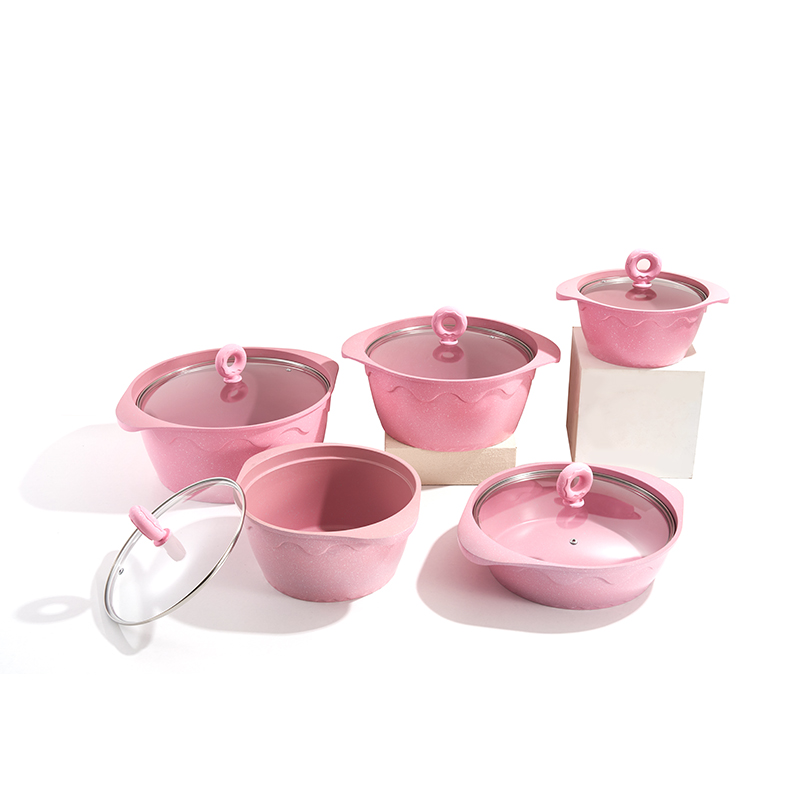
This cookware set is made of food-grade non-stick material, with a unique eye-ca...
See Details -
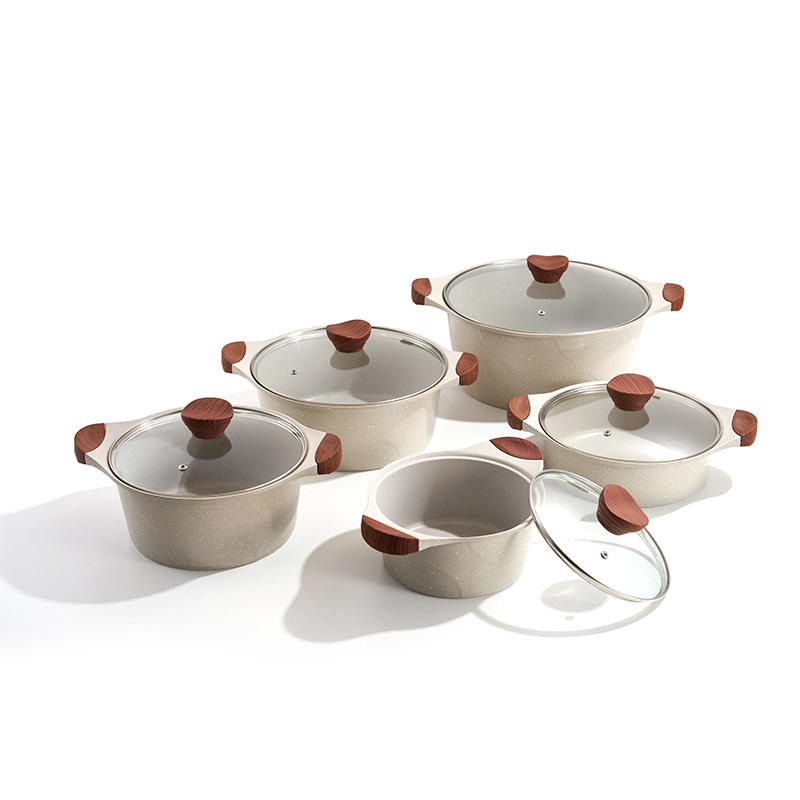
This off-white cookware set is made of wear-resistant non-stick material, with w...
See Details
Whether you're looking for bulk purchases or have any custom requirements, We are here to offer the best
solutions for you.
tiffany.zhong@echocn-trading.com
PHONE
+86-19561173975
+86-19557020621 (Hazel Wu)
ADD
Room 301, Unit 3014, No. 175 Qifeng Avenue, Wenqiao Town, Taizhou, Zhejiang, China
Fill Out the Form for More Information
Copyright © Zhejiang Echo Industry And Trade Co., Ltd.
All Rights Reserved.

China Cookware Set Manufacturer