
 en
 Español

This cookware set features a non-stick coating, even heat conduction, and multi-...
See Details
10-Piece Speckled Aluminum Cookware Set: A Practical Guide to Performance, Design, and Wholesale Value
Date:Sep 15, 2026
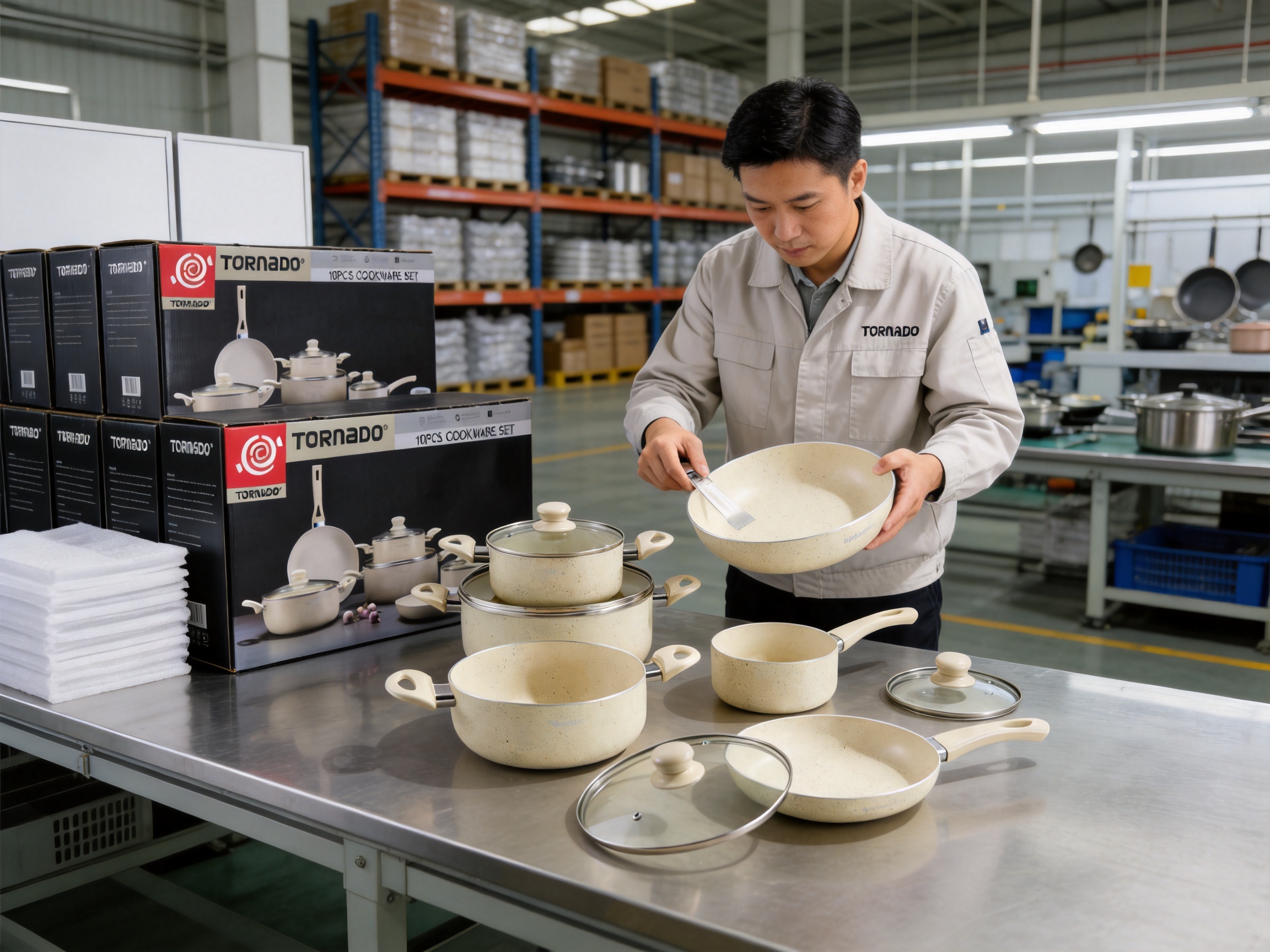
Choosing a cookware set is a practical decision that affects everyday cooking, kitchen organization, cleaning time, and long-term household value. A well-designed set should offer more than a collection of pots and pans. It should provide a balanced combination of cooking versatility, dependable heat performance, convenient handling, easy maintenance, and a consistent appearance that suits modern kitchens. The 10-Piece SpeckleEssential Aluminium Cookware Set is designed around these requirements, combining a granite-speckled aluminum body, matching handles, a food-grade non-stick interior, and a selection of cookware sizes for daily meal preparation.
This cookware set is suitable for home cooks, retailers, hospitality suppliers, distributors, and private-label buyers seeking a versatile multi-piece solution. Its range includes casserole-style pots, a shallow casserole, frypans, and a saucepan configuration intended to support common cooking tasks such as boiling, simmering, sautéing, frying, reheating, and preparing family-size meals. Rather than requiring consumers to purchase individual pieces one at a time, the set brings several essential forms of cookware together in a coordinated collection.
The product is manufactured and supplied by Zhejiang Echo Industry And Trade Co., Ltd., a kitchenware company based in Zhejiang, China. The company focuses on aluminum cookware, stainless steel cookware, cast iron cookware, and kitchen utensils. Its broader business model includes one-stop sourcing, ODM and OEM customization, flexible minimum order quantities, product certification assistance, and sustainable and healthy product development. These capabilities are particularly relevant for buyers who need more than a standard catalog product and may require packaging changes, coordinated product ranges, or development support.
For consumers, the most important questions concern cooking convenience, safety, compatibility, durability, and maintenance. For commercial buyers, additional factors include product consistency, export experience, packaging efficiency, manufacturing coordination, customization possibilities, and supply-chain reliability. This article examines the 10-piece set from both perspectives, explains its main advantages over ordinary cookware collections, and outlines how its design and supplier capabilities can create value in competitive cookware markets.

10pcs SpeckleEssential Aluminium Cookware Set
Product Overview
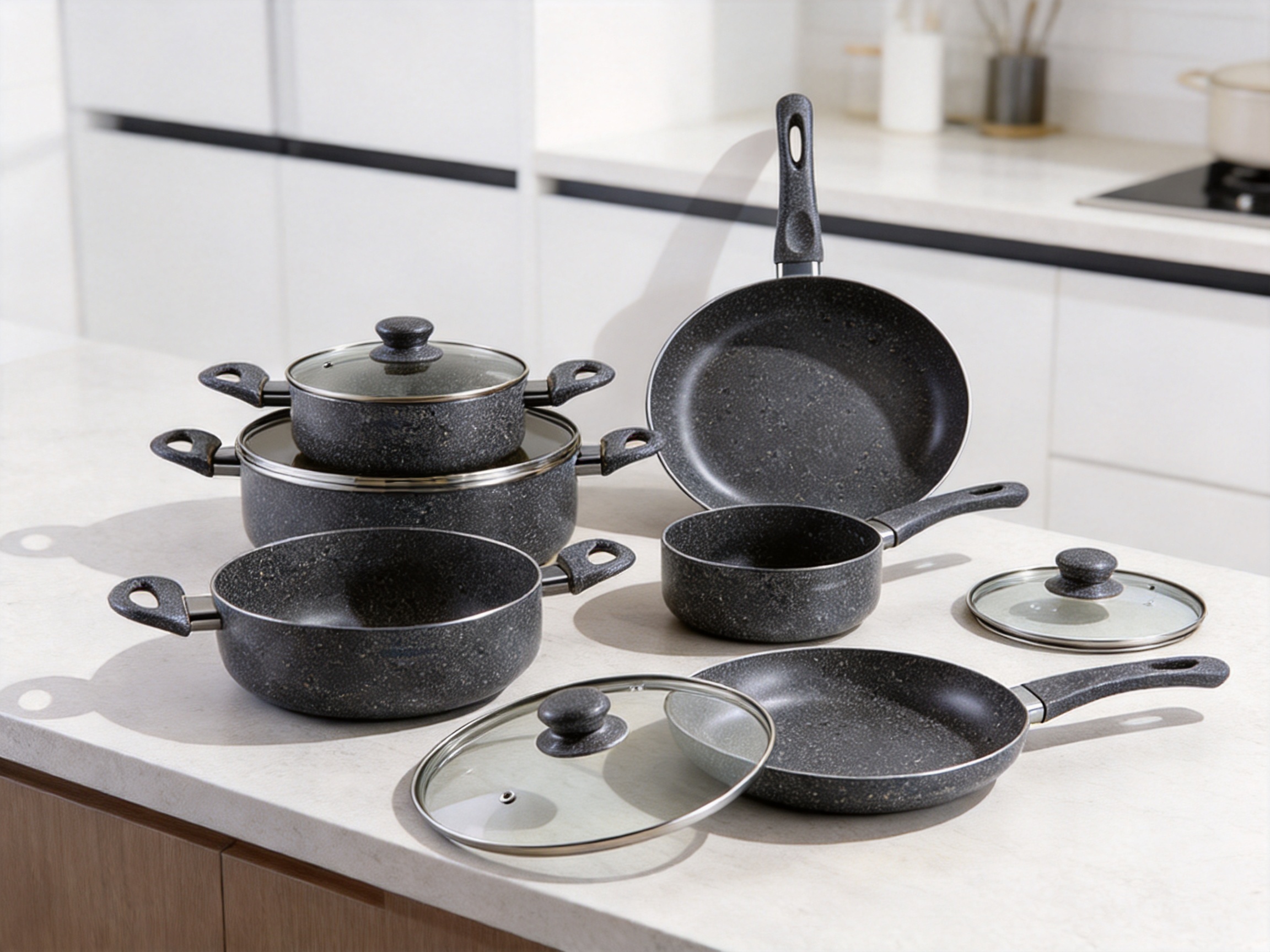
The 10-Piece SpeckleEssential Aluminium Cookware Set uses a granite-speckled textured exterior to create a distinctive visual identity. The speckled finish is more decorative than a plain metallic surface and can help the set stand out in retail displays, online product images, and coordinated kitchen collections. The appearance also communicates a practical, contemporary style that can appeal to consumers who want cookware that looks attractive while remaining suitable for everyday use.
The cookware body is made from aluminum. Aluminum is widely used in cookware because it is relatively lightweight, practical to handle, and capable of transferring heat efficiently. Compared with heavier materials, an aluminum body can make a large pot easier to lift, move, wash, and store. This is especially useful for households that prepare meals in larger quantities or for cooks who regularly move cookware between the stovetop, preparation area, and sink.
The interior is described as food-grade non-stick. A non-stick cooking surface can reduce the amount of oil needed for many recipes, help food release more easily, and simplify cleaning after cooking. It is particularly useful for eggs, pancakes, fish, vegetables, delicate foods, and recipes that might otherwise adhere to a conventional metal surface. The non-stick interior also supports more convenient daily cooking because residue can often be removed with hot, soapy water and a soft cloth or sponge.
The set includes multiple sizes and forms of cookware. The supplied product information identifies casserole sizes of 16 centimeters, 18 centimeters, 22 centimeters, and 26 centimeters, as well as a 26-centimeter shallow casserole. The product is also described as including stockpots, frypans, and a saucepan in a multi-size configuration. Since the exact ten-piece retail breakdown may depend on the final package configuration, buyers should confirm the individual pieces, lids, handles, and accessories before placing a production order.
Matching handles contribute to a coordinated appearance. When handles use a consistent material, shape, and color treatment, the complete set looks more intentional than a group of unrelated cookware pieces. Matching components can also help retailers present the cookware as a unified collection rather than as separate products. For private-label programs, the handles, exterior color, logo treatment, packaging, and labeling may provide additional opportunities for customization, subject to supplier confirmation.
Why Aluminum Is a Strong Material for Everyday Cookware
Material selection has a direct influence on how cookware feels and performs. Aluminum is popular in household cookware because it offers a useful balance between weight, heat responsiveness, manufacturability, and cost. It is generally easier to handle than cast iron and can heat more quickly than many heavier cookware materials. These characteristics make it suitable for cookware intended for frequent use rather than occasional specialty cooking.
A lightweight body can be an important advantage for families, older users, professional food-service workers, and anyone who prepares several dishes at once. Large cookware can become difficult to handle when filled with soup, pasta, vegetables, or sauce. A reasonably lightweight aluminum construction helps reduce the burden of lifting and pouring, although users should still handle hot and full cookware carefully.
Aluminum also supports responsive temperature control. When a cook adjusts the burner, the cookware can respond relatively quickly compared with a very heavy vessel. This can be helpful for tasks that require frequent temperature changes, such as sautéing vegetables, reducing sauces, browning ingredients, or moving from boiling to simmering. The result is a more flexible cooking experience for everyday recipes.
Another benefit is design flexibility. Aluminum cookware can be formed into different shapes and sizes, allowing a manufacturer to produce coordinated casseroles, frypans, saucepans, and stockpots. This makes it practical to develop a complete set with a consistent exterior finish and common handle design. The manufacturer can also coordinate product dimensions and packing arrangements to improve the efficiency of a multi-piece package.
Aluminum is not automatically superior to every other cookware material. Stainless steel may be preferred for certain high-temperature or uncoated applications, while cast iron offers exceptional heat retention. However, the purpose of this set is to deliver a convenient everyday cooking solution that is easier to handle and maintain than many heavier alternatives. Its food-grade non-stick interior and multi-size format further improve its suitability for routine home cooking.
Granite-Speckled Exterior Design
The granite-speckled exterior is one of the product’s most visible differentiators. A plain black or metallic pan can be practical, but a textured speckled finish gives the cookware a more distinctive retail identity. It can suggest durability, modernity, and a premium visual effect without requiring the weight associated with some traditional heavy cookware designs.
The textured appearance can also make small marks or ordinary signs of use less visually obvious than they might be on a completely uniform glossy surface. This does not mean that the exterior is immune to scratches, stains, or discoloration. Proper handling and cleaning remain essential. However, the speckled style may help maintain a presentable appearance during normal household use.
For retailers and distributors, visual differentiation is valuable. Cookware shelves and online marketplaces often contain many similar black, silver, and red products. A granite-speckled set can create a stronger image in product photography and make a coordinated collection easier for customers to recognize. A distinctive surface treatment may also support premium positioning when combined with good packaging, clear product information, and consistent quality control.
The matching handles reinforce the visual design. Instead of treating handles as unrelated functional attachments, the product presents them as part of the overall style. This approach may appeal to consumers who prefer coordinated kitchen tools and to retailers seeking a collection with clear shelf presence.
Non-Stick Interior and Everyday Cooking Convenience
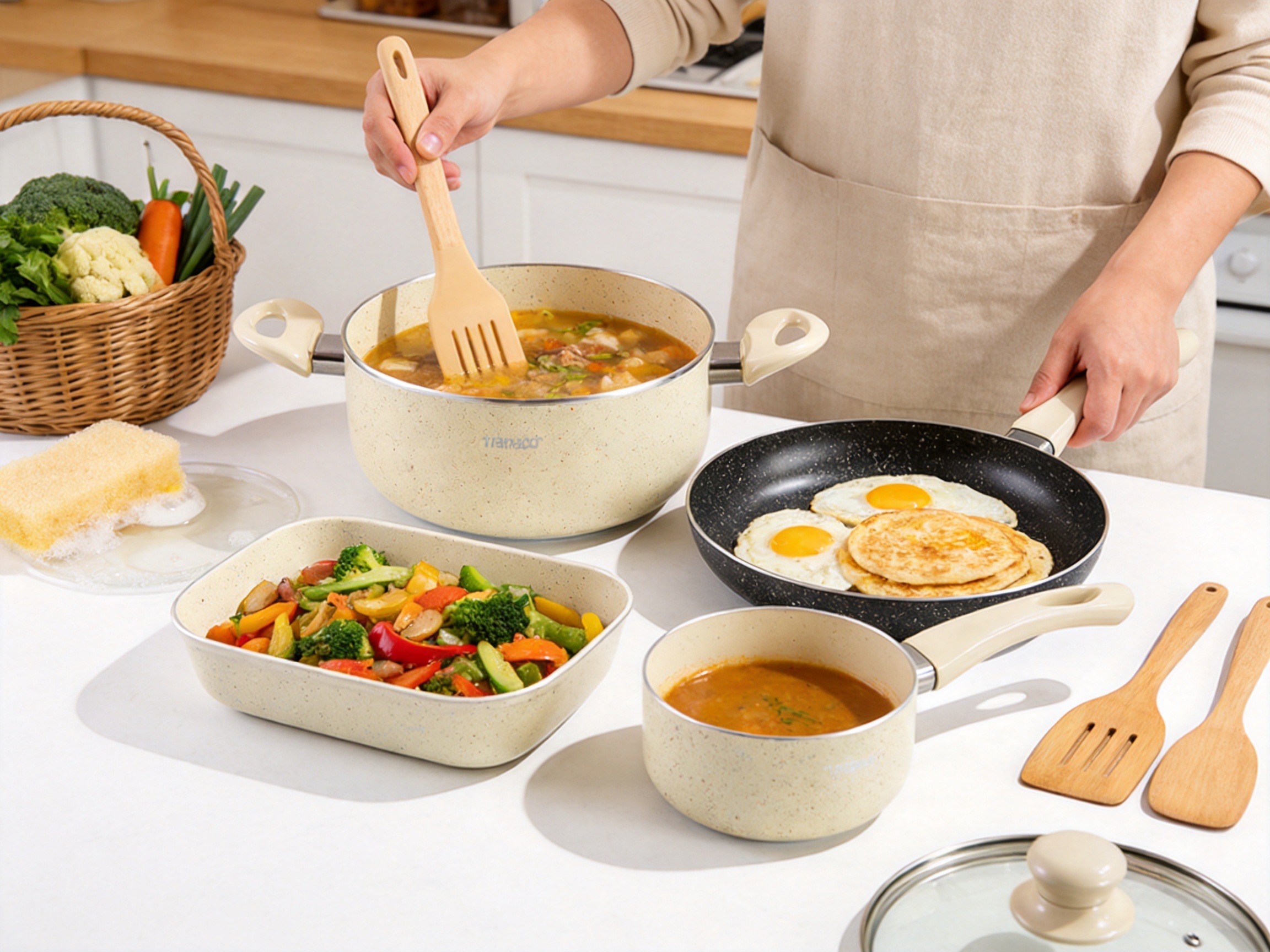
The food-grade non-stick interior is intended to make cooking and cleaning easier. During cooking, the surface helps reduce adhesion between food and the pan. This is particularly useful when preparing foods that can stick easily, including eggs, pancakes, fish, thin meat portions, rice-based dishes, and sauces with a tendency to caramelize.
A non-stick surface can also support lower-oil cooking. While the amount of oil required depends on the recipe, ingredients, temperature, and cooking technique, a suitable non-stick interior may allow users to cook many foods with less added fat than they would use in an uncoated pan. This can be attractive to households that want lighter meals or more convenient preparation.
Cleaning is another important benefit. Food residue is generally easier to remove from a smooth non-stick surface than from a rough or untreated metal surface. The recommended method is to use hot, soapy water with a soft cloth or sponge. Gentle cleaning helps preserve the appearance and performance of the interior while reducing the need for aggressive scrubbing.
Users must understand that non-stick cookware requires appropriate care. Metal or sharp cooking utensils should not be used because they may scratch or damage the coating. Wooden, nylon, or other utensils specifically designed for non-stick cookware are recommended. The cookware should not be overheated when empty, and it should not be placed in a microwave. These instructions are not minor details; they are central to preserving the usable life of the set.
A non-stick coating is also not a substitute for correct temperature management. Users should begin with a suitable heat setting, avoid prolonged empty heating, and follow the cooking recommendations provided with the product. If a pan severely overheats, the cooker should be turned off and the cookware should be left to cool completely. The pan should not be touched while it is dangerously hot.
Versatility Across Common Cooking Tasks
The main strength of a multi-piece cookware set is versatility. Different foods require different shapes and capacities. A saucepan is convenient for heating milk, making sauces, cooking grains, preparing small portions, and reheating leftovers. A frypan is useful for sautéing, frying, searing at appropriate temperatures, cooking eggs, and preparing quick meals. A casserole or stockpot can support soups, stews, pasta, vegetables, braised dishes, and larger family portions.
The 16-centimeter and 18-centimeter casserole sizes are suitable for smaller portions and everyday side dishes. They can be practical for one or two servings, sauces, grains, vegetables, and reheating. A 22-centimeter casserole offers a more flexible middle capacity for routine family cooking. The 26-centimeter casserole is more appropriate for larger portions, while the 26-centimeter shallow casserole can provide a broad cooking surface for sautéing, shallow frying, braising, and dishes that benefit from even ingredient distribution.
Having several sizes helps reduce the need to force every recipe into one oversized pot or one small pan. Smaller pieces can be used for focused tasks, while larger pieces are available when a meal requires more capacity. This improves workflow and can reduce the number of separate cookware purchases a household needs to make.
The set can also help coordinate multi-dish meal preparation. For example, a cook may use the saucepan for sauce, a frypan for vegetables, and a casserole for the main dish. Since the cookware shares a common appearance, it can remain visually consistent even when several pieces are used on the stovetop at the same time.
Stovetop Compatibility
The product description states that the cookware is compatible with all stovetops. This broad compatibility is a significant market advantage because modern households use different heating technologies, including gas, electric, ceramic, and induction-style cooking surfaces. Buyers should confirm the exact technical construction and compatibility requirements for their intended market, especially where induction performance must be verified through product testing.
Stovetop compatibility expands the potential customer base. A consumer who moves from one home to another may continue using the set even if the cooking surface changes. Retailers can also market one coordinated product line across a broader range of kitchen environments rather than stocking completely different cookware collections for different heating systems.
Correct use remains important regardless of stovetop type. The flame or heat source should not extend beyond the base of the cookware. Excessive side heat can discolor handles, damage exterior surfaces, waste energy, and create unnecessary safety risks. Users should select a burner that is reasonably matched to the base diameter and avoid placing cookware on a heating element that is significantly larger than the pan.
Comparison with Competing Cookware Options
Cookware buyers often compare aluminum non-stick sets with stainless steel, cast iron, ceramic-coated, and low-cost thin-body alternatives. Each category has different strengths. The value of this set lies in combining several practical advantages in one coordinated product.
| Comparison Factor | Speckled Aluminum Non-Stick Set | Basic Stainless Steel Set | Cast Iron Set | Low-Cost Uncoated Aluminum Set |
|---|---|---|---|---|
| Handling weight | Generally lightweight and easy to move | Moderate, depending on construction | Heavy and demanding to lift | Usually lightweight |
| Cooking surface | Food-grade non-stick interior | Usually uncoated unless separately treated | Usually seasoned or enameled | Often uncoated |
| Cleaning convenience | Designed for easy cleaning with soft tools | May require soaking or more scrubbing | Requires specialized care | Can be easy to clean but may have residue adhesion |
| Visual identity | Granite-speckled coordinated finish | Traditional metallic appearance | Heavy traditional appearance | Often basic and utilitarian |
| Cooking versatility | Multiple sizes for daily tasks | Broad, but depends on user technique | Excellent heat retention, less convenient for quick handling | Suitable for basic tasks |
| Retail positioning | Practical mid-range or premium everyday set | Wide range of price positions | Specialty or premium heavy cookware | Value-focused entry level |
Compared with basic stainless steel cookware, the non-stick interior may be easier for inexperienced cooks to use. Stainless steel can offer excellent durability, but food may adhere if the pan is not preheated and managed correctly. The aluminum set reduces some of this learning curve for routine foods and simplifies cleaning after use.
Compared with cast iron, the aluminum set is easier to lift and faster to maneuver. Cast iron is valued for heat retention and traditional cooking performance, but its weight and maintenance requirements are not ideal for every user. The aluminum set is designed for convenience, speed, and everyday accessibility rather than maximum thermal mass.
Compared with very low-cost uncoated aluminum cookware, the product offers a more coordinated appearance, a non-stick cooking surface, and a broader set concept. The granite-speckled exterior and matching handles may support stronger shelf appeal and a more premium customer impression. For buyers competing on value rather than the lowest possible price, these features can help justify a higher retail position.
Manufacturing Strengths and Production Approach
The product is supplied by a Zhejiang-based kitchenware manufacturer with experience across several cookware categories. Zhejiang is recognized as an important manufacturing and export region in China, with established industrial networks supporting metal forming, cookware production, surface treatment, packaging, logistics, and international trade. A supplier operating within this environment can coordinate multiple stages of product development and fulfillment more efficiently than a trading company with no direct product focus.
The company’s product scope includes aluminum cookware, stainless steel cookware, cast iron cookware, and kitchen utensils. This broad category coverage creates opportunities for buyers to consolidate sourcing. Instead of coordinating separate suppliers for pots, pans, kitchen tools, and complementary cookware, a buyer may be able to build a broader kitchenware program through one supply relationship, subject to product-specific capacity and quality requirements.
Cookware manufacturing involves a series of controlled stages. These may include material preparation, forming or shaping of the cookware body, edge treatment, surface finishing, coating application, handle assembly, inspection, cleaning, packaging, and shipment preparation. The product’s final performance depends on consistency across all of these stages. A strong supplier must therefore coordinate not only the visible appearance but also dimensions, coating coverage, handle attachment, packaging protection, and batch-to-batch repeatability.
For an aluminum cookware set, body forming must produce consistent shapes and dimensions so that the pieces sit securely on cooking surfaces and pack efficiently. The rim should be finished carefully to reduce sharp edges and support a clean appearance. The base should be checked for flatness and stability. These details are especially important for multi-piece sets because one poorly formed component can affect the customer’s perception of the entire collection.
Surface treatment is another important manufacturing consideration. The granite-speckled exterior needs to maintain a consistent visual effect across different pieces and production batches. Color, texture, and speckle distribution should be evaluated against approved samples. A coordinated cookware set is most attractive when the casseroles, frypans, saucepan, and handles appear to belong to one collection.
Non-stick coating application requires controlled preparation and process discipline. The cooking surface must be appropriately cleaned and prepared before coating. Coating thickness, coverage, adhesion, curing, and visual uniformity should be monitored according to the applicable product specification. Although individual test methods may vary by market and coating system, the general objective is to achieve a stable, food-contact-appropriate surface that performs consistently under normal use.
Handle assembly also deserves attention. Handles must be aligned, firmly attached, and comfortable enough for normal use. A matching handle design creates visual consistency, but appearance cannot replace functional security. Production inspection should verify attachment strength, alignment, fastener condition where applicable, and the absence of sharp or unfinished areas.
Packaging design is especially important for a ten-piece set. Multiple cookware pieces must be arranged to minimize movement, prevent abrasion, and protect coated surfaces during domestic and international transportation. Efficient nesting can reduce carton volume, while dividers, protective materials, and appropriate labeling can reduce the risk of impact damage. The supplied carton information identifies a two-carton packing arrangement, a carton size of approximately 66.5 by 37 by 50.5 centimeters, and a carton weight of approximately 21 kilograms. Buyers should confirm final packing details before shipment because packaging can change with product configuration, accessories, and market requirements.
Supplier Capabilities for OEM and ODM Programs
Many cookware buyers require more than a standard product. Retailers may want a private label, a special exterior color, a customized handle, a different logo position, revised packaging, or a complete kitchen collection. The company identifies ODM and OEM customization as part of its service offering, making the product suitable for discussions about brand-specific development.
OEM production generally focuses on manufacturing according to a buyer’s specifications, branding, and packaging requirements. ODM development may involve adapting an existing design or developing a product solution around a buyer’s target market. For this cookware set, potential customization areas may include exterior colors, speckle style, handle colors, lid design, logo application, packaging artwork, instruction leaflets, carton markings, and the mix of pieces within the set.
Customization should be managed through a structured approval process. Buyers should request material specifications, product drawings, color references, coating information, packaging layouts, sample approval, and pre-production confirmation. Clear documentation helps ensure that the production team, quality-control personnel, and buyer are working from the same requirements.
Flexible minimum order quantities can be useful for small and medium-sized kitchenware buyers. New brands often need to test a product in one or several markets before committing to very large volumes. A supplier that can discuss flexible order arrangements may help reduce the initial inventory burden. The exact minimum order quantity, pricing, tooling requirement, sample fee, and production lead time should be confirmed for each customized program.
Product certification assistance is another valuable service for international buyers. Different markets may require specific documentation, test reports, labeling rules, packaging information, or food-contact compliance evidence. Certification assistance does not remove the buyer’s responsibility to verify destination-market requirements, but it can make the preparation process more organized and efficient.
Quality Control Considerations
A cookware set should be evaluated as both a collection and a group of individual products. Quality control should begin with incoming materials and continue through final packing. For aluminum cookware, buyers may review body thickness, dimensional consistency, base flatness, rim quality, surface finish, coating appearance, coating adhesion, handle security, and overall cleanliness.
Visual inspection is important for the granite-speckled exterior. Inspectors may check for color variation, excessive bare areas, blisters, scratches, uneven texture, stains, and other defects that could affect appearance. Since the product is sold as a coordinated set, consistency among pieces is especially important.
The interior should be inspected for complete and even coating coverage. Areas around the rim, sidewall, and base should receive particular attention. Any visible peeling, bubbling, exposed substrate, contamination, or significant surface irregularity should be evaluated against the approved quality standard.
Functional checks may include handle stability, pan balance, lid fit where lids are included, nesting performance, and compatibility with the specified cooking surfaces. Packaging inspections should confirm that pieces are protected from rubbing and that the carton can withstand normal handling conditions.
For export orders, buyers should agree on an inspection standard before production. This may include acceptable quality limits, sample size, critical defect definitions, major and minor defect classifications, and documentation requirements. A written quality agreement reduces ambiguity and provides a practical basis for pre-shipment review.
Care and Maintenance Recommendations
Proper care is essential for preserving the appearance and performance of the cookware. Before first use, every piece should be washed with warm water and a mild dishwashing detergent. Hand washing is recommended because it helps preserve the appearance of the cookware and allows the user to control the cleaning process more carefully.
Metal or sharp utensils should not be used on the non-stick interior. Wooden, nylon, silicone, or other utensils intended for non-stick cookware are preferable. Even when a coating is designed for regular household use, unnecessary scratching should be avoided.
The cookware should be cleaned with hot, soapy water and a soft cloth or sponge. Abrasive powders, steel wool, rough scouring pads, and harsh cleaning tools may damage the interior or exterior finish. If food residue remains, soaking the cooled cookware in warm soapy water is generally preferable to aggressive scrubbing.
Empty overheating should be avoided. A pan can become dangerously hot when left on an active burner without food or liquid. Users should select an appropriate heat level and avoid leaving cookware unattended for extended periods. If severe overheating occurs, the heat source should be switched off and the cookware should be allowed to cool completely before handling.
The flame or heat source should remain within the base area. Excessive flame extending up the sides may damage the exterior, heat the handle, or create a safety hazard. The cookware should never be used in a microwave, and users should follow any additional instructions supplied with the final product configuration.
These instructions are also important for retailers and distributors. Clear care guidance can reduce misuse-related complaints, improve customer satisfaction, and support the long-term reputation of a cookware collection. Instruction cards, packaging panels, and online product descriptions should communicate the main care requirements in simple language.
Packaging, Logistics, and Commercial Value
The product is supplied in a two-carton arrangement according to the provided logistics information. Each carton is identified with an approximate size of 66.5 by 37 by 50.5 centimeters and an approximate weight of 21 kilograms. These details are useful for freight planning, warehouse allocation, pallet calculation, and landed-cost estimation.
Multi-piece cookware sets can provide strong commercial value because they combine several products into one retail unit. The buyer can market the set as a complete kitchen solution instead of relying on separate sales of individual pots and pans. This can increase perceived value for consumers and simplify inventory management for retailers.
The set’s range of sizes may appeal to households with different cooking habits. Smaller pieces serve individual meals and side dishes, while larger pieces support family cooking. The granite-speckled exterior can improve shelf and online presentation, and the non-stick interior provides an easily understood functional benefit. Together, these features create a product story that is straightforward to communicate across retail channels.
For importers, packaging efficiency must be balanced against protection. Nested cookware can reduce shipping volume, but pieces should not rub against each other. Protective separators, sleeves, bags, or other suitable packing materials may be needed to protect non-stick interiors and decorative exteriors. Final packaging should be evaluated through sample packing and, where appropriate, transportation testing.
The two-carton configuration may also support more manageable warehouse handling than a single exceptionally heavy carton. However, buyers should ensure that the retail package clearly identifies the number of cartons when necessary, especially if the set is shipped or delivered as a complete unit. Carton labeling, barcodes, product names, country-of-origin marking, and handling instructions should be confirmed during the packaging approval stage.
Advantages for Retailers and Distributors
Retailers need cookware products that are easy to explain, attractive to display, and broad enough to meet common customer needs. This set offers a clear combination of benefits: a recognizable ten-piece format, multiple sizes, food-grade non-stick cooking surfaces, a decorative speckled exterior, matching handles, and broad stovetop compatibility.
The product can be positioned for several customer groups. First, it suits households setting up a kitchen and looking for a coordinated collection. Second, it appeals to consumers replacing old or mismatched cookware. Third, it may attract gift buyers who want a practical and visually appealing household product. Fourth, it can serve property managers, accommodation providers, and hospitality-related buyers who need standardized kitchen equipment.
Product photography can emphasize the coordinated appearance and range of pieces. Demonstration content can show easy food release, size variety, and simple cleaning. Retail descriptions should avoid exaggerated claims and instead explain the practical benefits supported by the product specifications. Care instructions should be displayed prominently to help customers use the cookware correctly.
For distributors, the supplier’s wider product range can support cross-selling. A buyer sourcing the aluminum cookware set may also be interested in stainless steel cookware, cast iron products, kitchen utensils, or complementary accessories. A broader catalog can help distributors develop complete kitchenware programs and reduce the administrative work associated with managing many unrelated suppliers.
Advantages for International Buyers
International buyers often need a supplier that understands product development, export documentation, packaging, communication, and production coordination. A Zhejiang-based kitchenware supplier with a stated focus on global export markets can provide a useful foundation for these requirements. The company’s one-stop sourcing approach is intended to serve small and medium-sized buyers that may not have large internal procurement teams.
International sourcing also requires attention to market-specific differences. Handle preferences, packaging languages, labeling rules, cooking surface compatibility, color trends, and consumer expectations can vary significantly. OEM and ODM support allows buyers to discuss market-specific adaptations rather than accepting a single fixed configuration.
Product certification assistance may help buyers organize testing and documentation, but the importer remains responsible for checking the regulations applicable to the destination country. Buyers should identify food-contact requirements, coating restrictions, packaging rules, labeling standards, and any requirements relating to stovetop compatibility before finalizing a purchase.
Communication quality is another important supplier strength. Specifications should be exchanged in writing, with drawings, photos, samples, and approval records used to reduce misunderstandings. A supplier that can provide structured feedback on customization, packaging, and production details can be especially valuable for buyers developing new cookware collections.
Sustainability and Responsible Product Development
Cookware sustainability involves more than the material used in the pan. Product lifespan, packaging efficiency, maintenance requirements, manufacturing waste, shipping volume, and responsible use all influence the overall environmental impact. A durable cookware set that remains useful for a long period can reduce the need for frequent replacement.
The aluminum body contributes to a relatively lightweight product format, which may support easier handling and potentially more efficient transport than very heavy cookware alternatives. However, actual transport efficiency depends on product dimensions, packing density, carton design, and shipping method. These factors should be reviewed using final packaging data rather than assumptions.
Responsible product development also includes creating cookware that is easy to maintain. A surface that can be cleaned with a soft sponge and ordinary dishwashing detergent may encourage users to keep the product in service instead of discarding it because of difficult cleaning. Clear care guidance can further extend product life by preventing avoidable coating damage.
The company identifies sustainable and healthy product development as part of its broader service direction. Buyers interested in these areas should discuss specific material choices, coating systems, packaging materials, production controls, and documentation during product development. Sustainability claims should be supported by appropriate evidence and should be communicated accurately in the final retail presentation.
How to Evaluate a Sample Before Ordering
Before placing a larger order, a buyer should inspect a physical sample under realistic conditions. The first review should confirm the appearance of the exterior, including color, speckle consistency, texture, handle coordination, and overall finish. The cookware should look like a unified collection rather than unrelated pieces placed in one carton.
The second review should focus on dimensions and capacity. Buyers should measure the stated diameters, check the usable interior space, and confirm that the pieces correspond to the intended ten-piece configuration. If lids or accessories are included, each item should be listed and matched to the correct cookware body.
The third review should evaluate handling. The pieces should feel balanced when empty and should remain manageable when filled with an appropriate amount of food or liquid. Handles should be aligned, secure, and comfortable. The base should sit steadily on the intended stovetop surface.
The fourth review should examine cooking performance under normal conditions. Test recipes may include eggs, vegetables, sauce, pasta, or pancakes. The purpose is not to make unsupported claims but to evaluate heat response, food release, balance, cleaning convenience, and user experience. Testing should follow the recommended care instructions and avoid overheating or unsuitable utensils.
The final review should examine packing. The buyer should open the shipping carton, inspect the arrangement, check for rubbing or impact marks, and confirm that the retail presentation is suitable for the intended sales channel. Any changes to the sample must be documented before mass production.
Q&A: Frequently Asked Questions
What type of cookware is included in the set?
The set is described as a ten-piece multi-size collection containing casserole-style cookware, frypans, a saucepan, and stockpot-style pieces. The supplied size information identifies 16-centimeter, 18-centimeter, 22-centimeter, and 26-centimeter casserole sizes, plus a 26-centimeter shallow casserole. Buyers should confirm the final piece-by-piece retail configuration before ordering.
What material is used for the cookware body?
The cookware body is made from aluminum. Aluminum is valued for its relatively light weight, practical heat transfer, and suitability for forming cookware in a range of shapes and sizes.
Does the cookware have a non-stick interior?
Yes. The product is described as having a food-grade non-stick interior. Users should use wooden, nylon, silicone, or other suitable non-stick utensils and should avoid metal or sharp tools.
Can the cookware be used on different stovetops?
The product description states that it is compatible with all stovetops. For commercial orders, buyers should confirm the specific technical requirements and testing for the target market, particularly when induction compatibility is important.
Is the cookware easy to clean?
The non-stick interior is designed to support easier cleaning. The recommended method is to use hot, soapy water with a soft cloth or sponge. Hand washing is recommended to preserve the appearance of the cookware.
Can the cookware be placed in a microwave?
No. The care instructions state that the cookware should not be used in a microwave.
Can metal utensils be used?
No. Metal or sharp utensils may scratch or damage the non-stick surface. Wooden, nylon, silicone, or non-stick-safe utensils are recommended.
What should a user do if a pan overheats?
If the pan severely overheats, the cooker should be turned off and the cookware should be left to cool completely. It should not be touched while it is dangerously hot.
What is the exterior finish?
The exterior has a granite-speckled textured finish. This gives the set a distinctive appearance and helps differentiate it from plain metallic or single-color cookware.
Are the handles matched to the cookware design?
Yes. The product description identifies matching handles that coordinate with the cookware body and contribute to the set’s unified appearance.
Is the cookware suitable for wholesale purchasing?
Yes. The product is supplied in a commercial carton configuration and is suitable for discussion with retailers, distributors, importers, and private-label buyers. Final quantities, packaging, pricing, lead time, and minimum order requirements should be confirmed with the supplier.
Can the set be customized?
The supplier identifies OEM and ODM customization as part of its service offering. Potential customization may include colors, handles, logos, packaging, labeling, and product configuration, subject to technical feasibility, minimum quantities, and sample approval.
Does the supplier offer other kitchenware categories?
Yes. The company’s stated product scope includes aluminum cookware, stainless steel cookware, cast iron cookware, and kitchen utensils. This may allow buyers to consolidate several kitchenware requirements with one supplier.
What should buyers confirm before placing an order?
Buyers should confirm the exact ten-piece breakdown, dimensions, lid and accessory inclusion, stovetop compatibility, material specifications, coating information, packaging details, carton quantity, quality standards, inspection procedures, lead time, minimum order quantity, labeling requirements, and destination-market compliance documentation.
Conclusion
The 10-Piece SpeckleEssential Aluminium Cookware Set is designed as a practical, visually coordinated solution for everyday cooking. Its main advantages include a lightweight aluminum body, food-grade non-stick interior, granite-speckled exterior, matching handles, multiple cookware sizes, and stated compatibility with all stovetops. These features position it between basic entry-level cookware and heavier specialty products, offering convenience and visual appeal without the handling burden associated with many cast iron collections.
Its multi-size configuration supports a wide range of cooking tasks, from preparing sauces and individual portions to cooking family meals in larger casseroles or stockpots. The non-stick surface can simplify food release and cleaning, while the textured exterior helps create a distinctive retail identity. Proper care, including avoiding metal utensils, preventing empty overheating, using soft cleaning tools, and hand washing, is essential to preserving the product’s performance.
For commercial buyers, the product is supported by a supplier with a broad kitchenware category range, export-oriented business direction, one-stop sourcing services, ODM and OEM capabilities, certification assistance, flexible MOQ discussions, and a focus on sustainable and healthy product development. The supplier’s location in Zhejiang provides access to an established manufacturing and export ecosystem that can support product development, production coordination, packaging, and international shipment preparation.
As with any cookware order, buyers should verify the final technical details through samples, written specifications, quality standards, and destination-market requirements. When properly specified and maintained, this cookware set can provide a compelling combination of daily usability, attractive design, product variety, and commercial flexibility for households and kitchenware businesses worldwide.
References
1. Product specification materials supplied for the 10-Piece SpeckleEssential Aluminium Cookware Set, including product dimensions, cookware categories, care instructions, and carton information.
2. General principles of aluminum cookware design, heat transfer, cookware forming, and household product usability.
3. General guidance for the care and maintenance of non-stick cookware, including the use of soft cleaning tools and non-metal utensils.
4. General considerations for cookware quality control, including dimensional inspection, coating appearance, handle security, packaging protection, and pre-shipment evaluation.
5. General international sourcing considerations for OEM, ODM, product certification assistance, packaging approval, and destination-market compliance.
Product: 10pcs SpeckleEssential Aluminium Cookware Set
Recommended Articles
Product Category
Related products
-
-
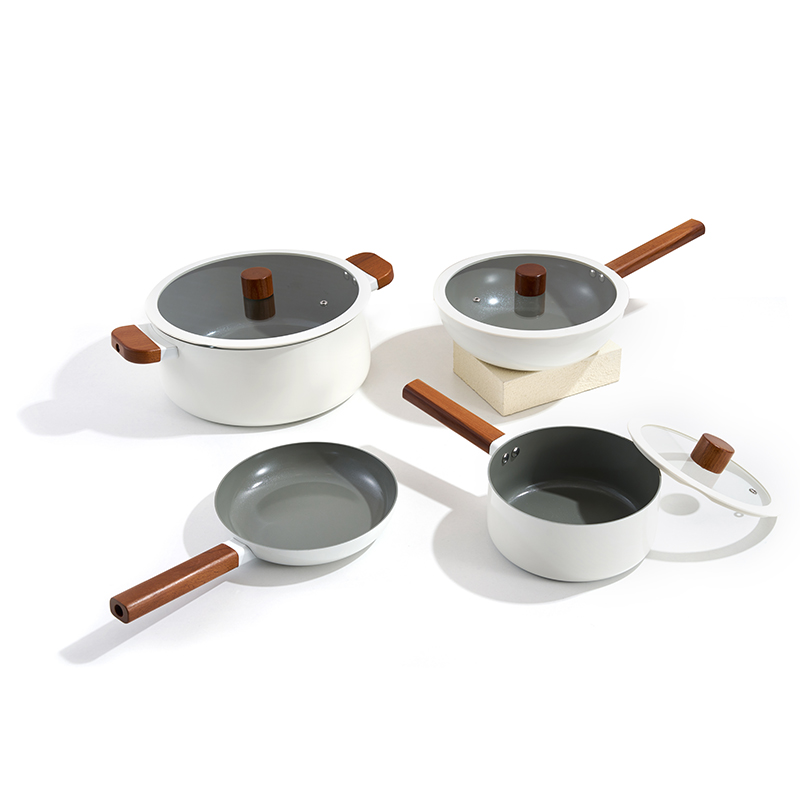
This cookware set has a ceramic non-stick inner liner, a heat-resistant wooden h...
See Details -
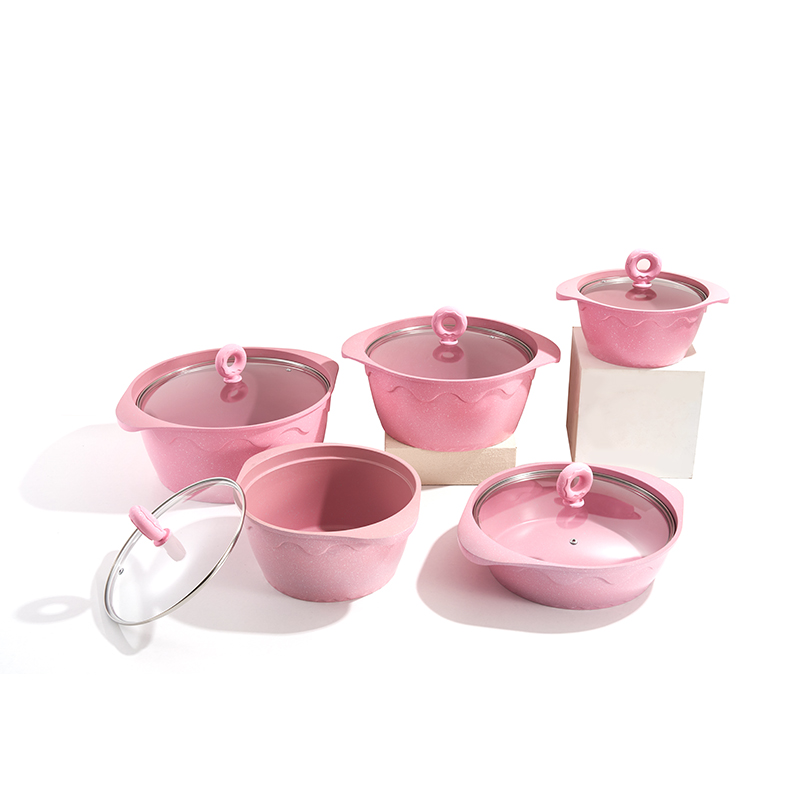
This cookware set is made of food-grade non-stick material, with a unique eye-ca...
See Details -
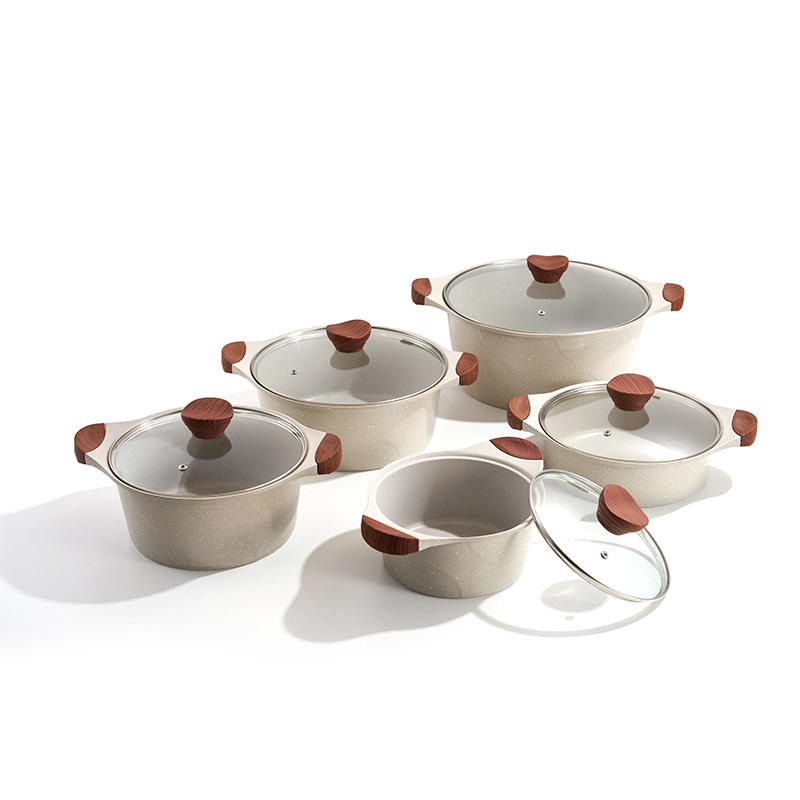
This off-white cookware set is made of wear-resistant non-stick material, with w...
See Details
Whether you're looking for bulk purchases or have any custom requirements, We are here to offer the best
solutions for you.
tiffany.zhong@echocn-trading.com
PHONE
+86-19561173975
+86-19557020621 (Hazel Wu)
ADD
Room 301, Unit 3014, No. 175 Qifeng Avenue, Wenqiao Town, Taizhou, Zhejiang, China
Fill Out the Form for More Information
Copyright © Zhejiang Echo Industry And Trade Co., Ltd.
All Rights Reserved.

China Cookware Set Manufacturer