
 en
 Español

This cookware set features a non-stick coating, even heat conduction, and multi-...
See Details
13-Piece Speckled Aluminum Cookware Set: A Practical Multi-Function Solution for Modern Kitchens
Date:Sep 23, 2026
Choosing a cookware set is not simply a matter of counting the number of pots and pans in a box. A well-designed set should support different cooking techniques, provide consistent heat performance, remain comfortable to use, and withstand the repeated demands of everyday meal preparation. It should also be easy to clean, practical to store, and suitable for the purchasing requirements of households, retailers, hospitality businesses, and kitchenware distributors.
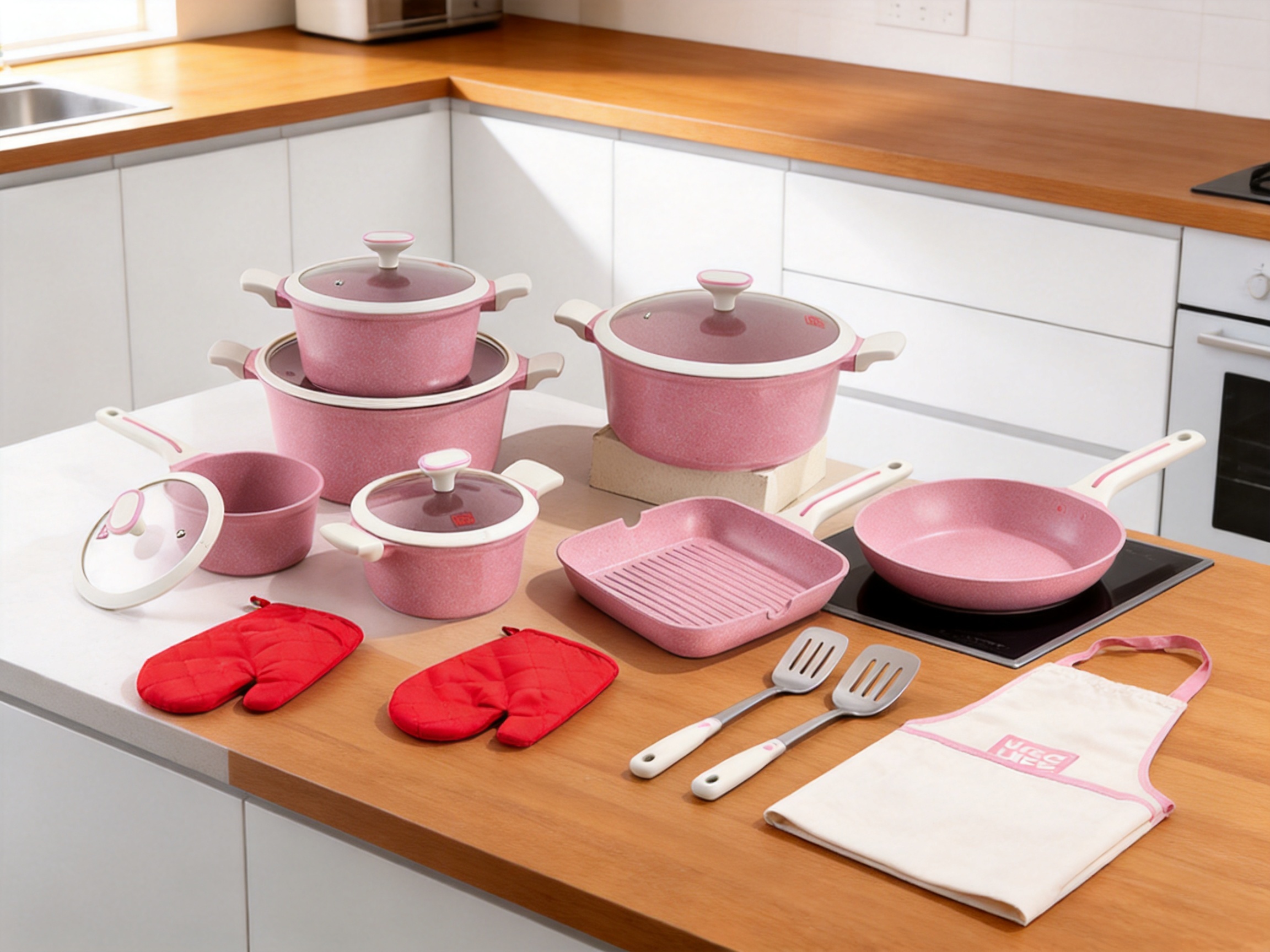
The 13-Piece SpeckleBlush Aluminium Cookware Set is designed around these needs. It combines a die-casting aluminum substrate, granite-style exterior and interior coatings, a carved bottom, heat-resistant handles, multiple cookware sizes, cooking tools, an apron, and anti-scald cotton gloves. Instead of offering only a basic pot-and-pan combination, the set presents a coordinated cooking solution that covers boiling, simmering, sautéing, frying, grilling, and general food preparation.
Its main value lies in the balance between functionality and presentation. The speckled finish gives the cookware a distinctive appearance, while the aluminum construction helps keep the set manageable for daily use. The food-grade non-stick interior is intended to make cooking and cleaning more convenient, and the included accessories allow users to begin cooking without purchasing every supporting item separately.
For importers and kitchenware buyers, the product also represents a flexible platform for private-label and wholesale programs. The supplier behind the product provides aluminum cookware, stainless steel cookware, cast iron cookware, and kitchen utensils, together with one-stop sourcing, ODM and OEM support, product certification assistance, flexible minimum order quantities, and sustainable product development initiatives.

13pcs SpeckleBlush Aluminium Cookware Set
1. Product Overview and Set Composition
The cookware set is built for users who want several essential cooking vessels in one coordinated package. Its listed configuration includes casseroles in multiple sizes, a grill pan, a sauce pan, two anti-scald cotton gloves, a two-piece tool set, and one apron. The product is presented as a 13-piece set, while the detailed specification lists the major cookware and accessory components. Buyers should confirm the final packing list, lid configuration, and exact piece-count calculation with the supplier before placing a production order.
The listed cookware sizes are centered on common household requirements. The casserole sizes are identified as 20, 24, 28, and 32 centimeters in the product specification, although the source formatting presents the dimensions as “20124/28/32CM.” This should be standardized on product packaging, quotations, technical sheets, and online listings. The sauce pan is listed as 18 centimeters, and the grill pan is listed as 28 centimeters.
| Component | Listed Specification | Primary Use |
|---|---|---|
| Casserole cookware | 20 cm, 24 cm, 28 cm, and 32 cm sizes as indicated in the specification | Soups, stews, pasta, braising, rice, and family-size meals |
| Grill pan | 28 cm | Grilling meat, vegetables, sandwiches, and seafood |
| Sauce pan | 18 cm | Sauces, reheating, porridge, small portions, and melting ingredients |
| Anti-scald cotton gloves | 2 pieces | Handling hot cookware and reducing contact with heat |
| Cooking tool set | 2 pieces | Stirring, serving, and handling food with suitable utensils |
| Apron | 1 piece | Protecting clothing during meal preparation |
The range of sizes is one of the strongest practical advantages of the set. A small sauce pan can be used for tasks that would be inefficient in a large casserole, while the larger casseroles can support family meals or batch cooking. The grill pan introduces a separate cooking surface for foods that benefit from direct contact with ridges or a textured base. This variety reduces the need to purchase unrelated cookware individually.
For retailers, a multi-size set is often easier to position than a single pan because it communicates broader value at the point of sale. It can be marketed to first-time home cooks, families moving into a new home, wedding and housewarming shoppers, seasonal gift buyers, and consumers replacing mismatched cookware. The included apron, gloves, and tools add visual completeness and make the package more suitable for gift-oriented retail presentation.
2. Die-Casting Aluminum Construction
The substrate of the cookware is die-casting aluminum. This manufacturing route is important because the body of a pan determines much of its handling, heat response, structural appearance, and coating foundation. Aluminum is valued in cookware production for its relatively low weight compared with many ferrous materials and for its ability to transfer heat efficiently across the cooking surface.
A die-cast body can provide a more substantial form than a thin, basic stamped pan. The process allows molten aluminum to be shaped inside a mold under controlled pressure, producing a cookware body with a defined profile and consistent external geometry. Depending on the mold design, the manufacturer can create rounded transitions, reinforced edges, handle connection areas, and a stable base shape within the same overall production system.
For consumers, this can translate into cookware that feels more solid while remaining easier to lift than heavy cast iron. For distributors, die casting offers a repeatable manufacturing method suitable for producing coordinated collections. The same design language can be applied across casserole sizes, sauce pans, and grill pans, helping a product line maintain consistent appearance and shelf presentation.
The use of aluminum also supports a responsive cooking experience. When heat is applied, aluminum generally reacts faster than heavier materials that take longer to warm. This can be useful when users need to adjust temperatures during sautéing, simmering, or sauce preparation. Fast response does not eliminate the need for proper heat control, however. Users should avoid overheating empty cookware and should ensure that the flame or heat source does not extend beyond the base.
One competitive benefit of die-cast aluminum cookware is the combination of perceived durability and everyday manageability. Cast iron may offer excellent heat retention but can be difficult for some users to lift, wash, or store. Very thin aluminum cookware may be light but can feel less substantial. A properly designed die-cast aluminum set occupies a practical middle ground: stable enough for regular cooking, but convenient enough for frequent handling.
3. Granite-Style Exterior and Interior Treatment
The product specification identifies granite coating on both the exterior and interior. The granite-style finish contributes to the visual identity of the set, while the interior treatment is associated with a smooth, food-contact cooking surface. The speckled appearance can help differentiate the product from plain black, silver, or solid-color cookware collections.
Exterior appearance has become increasingly important in the cookware market. Many consumers leave cookware visible on open shelving, hanging racks, kitchen islands, or countertop storage. A coordinated speckled surface can therefore act as part of the kitchen’s visual design rather than appearing only as a functional tool. The SpeckleBlush concept suggests a soft, decorative color direction that may appeal to buyers looking for cookware with a more expressive appearance.
The interior coating is intended to support non-stick cooking performance. A food-grade non-stick interior can reduce the amount of oil needed for many recipes, help release eggs and other delicate foods, and simplify the cleaning process. It can also make the cookware approachable for less experienced cooks who may find uncoated surfaces more demanding.
Coating performance depends on correct application and responsible use. The cookware should not be exposed to unnecessary overheating, and users should avoid metal or sharp utensils that may scratch the cooking surface. Wooden, nylon, or other utensils designed for non-stick cookware are recommended. These care instructions are not merely cosmetic advice; they are part of preserving the functional life of the coating.
Compared with uncoated aluminum cookware, a coated interior can offer a more convenient user experience and a more attractive retail proposition. Compared with some basic non-stick products, a granite-style finish may provide stronger shelf differentiation. The final performance of any coating system depends on factors such as surface preparation, coating formulation, application uniformity, curing conditions, thickness control, and inspection standards. These are important points for professional buyers to review during product development and quality approval.
3.1 Visual Differentiation in a Crowded Market
Cookware is a highly competitive category. Many sets include similar numbers of pots and pans, making color, texture, packaging, and perceived quality important purchase factors. A speckled finish provides a recognizable product signature without requiring an unusual cookware shape. It can be coordinated with kitchen textiles, utensils, storage accessories, and seasonal color collections.
The finish also offers a useful balance between premium appearance and broad market appeal. A highly decorative product may attract attention but limit the number of kitchens in which it feels appropriate. A subtle speckled surface can appear contemporary while remaining practical for everyday use. Retailers may position it in home essentials, giftware, apartment living, family kitchens, or lifestyle cookware categories.
3.2 Food Preparation Convenience
The combination of a non-stick interior and multiple vessel sizes allows users to prepare meals with fewer interruptions. A sauce can be made in the small pan while vegetables are cooked in another vessel. A large casserole can be reserved for family-size portions, while the grill pan can be used for foods that benefit from searing or visible grill marks.
Although no cookware set removes the need for cooking skill, the design can reduce routine friction. Food is easier to monitor when the surface is clean and accessible, and washing can be more straightforward when residue does not strongly adhere. For busy households, these small advantages can influence whether a cookware set is used daily or kept only for occasional meals.
4. Multi-Size Coverage for Different Cooking Tasks
The set’s most practical feature is its variety of cooking capacities. A cookware collection should serve both small and large tasks, because household cooking rarely involves one consistent portion size. One day the user may prepare a small amount of sauce or breakfast food; the next day the same kitchen may require a large soup, stew, or shared meal.
The 18-centimeter sauce pan is appropriate for smaller quantities and controlled cooking. It may be used for sauces, gravies, warming milk, preparing porridge, melting butter, reheating leftovers, or making a small side dish. Its smaller footprint can also help reduce unnecessary energy use when a large pan would be excessive for the quantity being prepared.
The 28-centimeter grill pan adds a different cooking function. Its surface can support grilling vegetables, meat, fish, toast-based foods, and other items that benefit from direct contact with a shaped cooking surface. A separate grill pan also allows users to prepare grilled foods without dedicating a casserole to a task it was not specifically designed to perform.
The casserole sizes provide flexibility for daily meals and larger portions. A smaller casserole can be convenient for one or two people, while the larger sizes may support family meals, meal preparation, entertaining, and batch cooking. This range is useful for households with changing needs and for retailers that want to offer a complete set rather than a narrowly focused specialty product.
Multiple sizes also support better kitchen organization. When each pan has a defined role, users can select the vessel that best matches the recipe instead of repeatedly adapting one oversized or undersized pan. This can improve handling, reduce splashing, and make portion control easier.
For commercial buyers, the range creates opportunities for different market segments. The same basic collection may be offered through department stores, home furnishing retailers, online marketplaces, kitchen specialists, gift channels, or hospitality supply distributors. Packaging and color can be adapted to different customer groups while maintaining a common manufacturing platform.
5. Heat-Resistant Handles and Included Protection
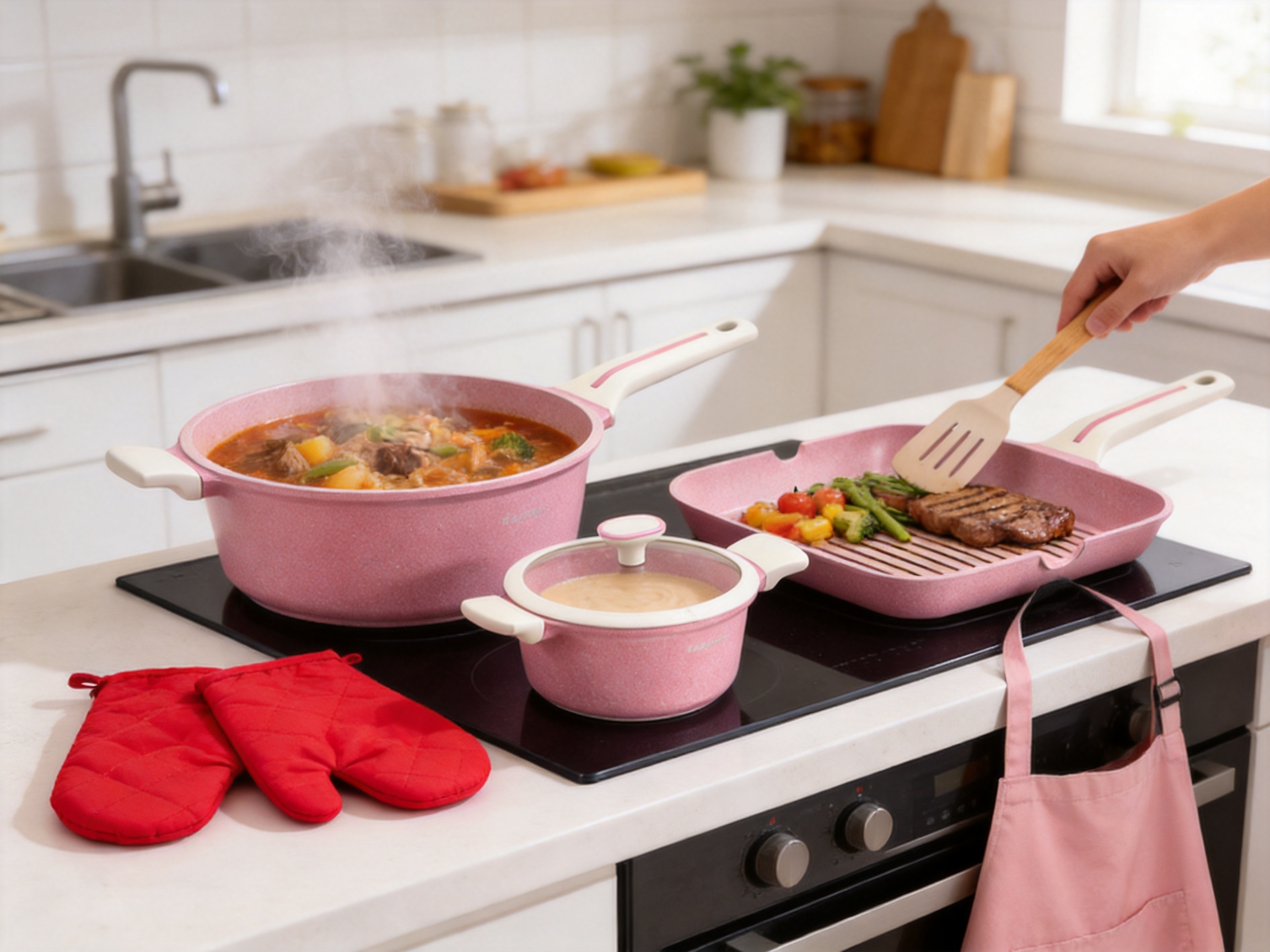
The cookware is described as having heat-resistant handles. Handle design is a central part of cookware safety and usability because a pan that performs well on the cooking surface can still be difficult to use if the grip becomes uncomfortable or unstable. Handles should support firm lifting, controlled movement, and safe transfer from one location to another.
Heat-resistant handle materials are intended to reduce heat transfer during normal cooking conditions. They do not mean that every handle remains cool under every situation. Users should still use caution, especially when cookware has been on the stove for an extended period, when the pan is placed near an oven or other hot surface, or when the handle is positioned close to a flame.
The two anti-scald cotton gloves included in the set add a practical safety accessory. They can help users handle hot cookware, move vessels, and protect their hands from brief contact with warm surfaces. Gloves should be used correctly and kept dry, because moisture can reduce the protective effect of many textile heat-resistant products.
Including protective accessories strengthens the complete-set proposition. Consumers do not need to purchase gloves separately, and retailers can communicate that the product includes more than cookware alone. The gloves also make the package more suitable for promotional campaigns centered on new homes, family cooking, holiday gifting, and beginner kitchen equipment.
The two-piece cooking tool set is another useful addition. Because the product care instructions recommend wooden, nylon, or non-stick-safe utensils, the included tools can be selected and packaged as compatible accessories. Buyers should confirm the exact tool materials and shapes before publication of product claims. If properly matched with the coated cooking surface, the tools can help users follow recommended care practices from the first use.
The apron completes the lifestyle-oriented presentation. It is not a cookware component in the technical sense, but it supports the idea of a coordinated cooking experience. In retail packaging, accessories can increase perceived value and create more opportunities for seasonal presentation, bundled promotions, and content marketing.
6. Care Instructions and Long-Term Product Value
Correct care is essential for preserving the appearance and performance of coated aluminum cookware. The product instructions recommend washing the cookware before first use and favor hand washing to preserve its appearance. Hot, soapy water and a soft cloth or sponge should be used for cleaning.
Metal or sharp cooking utensils should not be used. These tools can scratch or damage the non-stick surface, especially when force is applied during stirring, turning, or scraping. Wooden, nylon, or utensils specifically made for non-stick cookware are better choices.
Users should not overheat an empty pan. Empty cookware can heat much faster than cookware containing food or liquid, and excessive heat may affect the coating, handles, or external finish. The heat source should also remain within the footprint of the base rather than extending up the sides of the cookware.
The set is not intended for microwave use. This restriction should be stated clearly in manuals, packaging, e-commerce listings, and product training materials. Consumers should also avoid touching cookware that has severely overheated. The recommended action is to turn off the cooker and allow the pan to cool completely before handling or cleaning it.
These instructions provide an opportunity for retailers and distributors to improve customer satisfaction. Clear care guidance can reduce misuse, prevent avoidable complaints, and help consumers understand why certain utensils and cleaning methods are recommended. A well-designed instruction card can also reinforce the product’s quality positioning by showing that the supplier has considered the complete ownership experience.
| Recommended Practice | Reason |
|---|---|
| Wash before first use | Helps remove manufacturing and packaging residue before cooking |
| Use wooden, nylon, or non-stick-safe utensils | Helps protect the coated cooking surface |
| Clean with hot, soapy water and a soft sponge or cloth | Supports gentle cleaning and appearance retention |
| Hand wash when possible | Helps preserve the finish and reduce unnecessary abrasion |
| Do not heat an empty pan | Reduces the risk of overheating the coating and cookware body |
| Keep flames or heat sources within the base | Helps protect sidewalls, handles, and external finishes |
| Do not use in a microwave | Follows the product’s stated usage limitation |
| Allow severely overheated cookware to cool fully | Reduces handling and burn risks |
7. Manufacturing Process and Quality Considerations
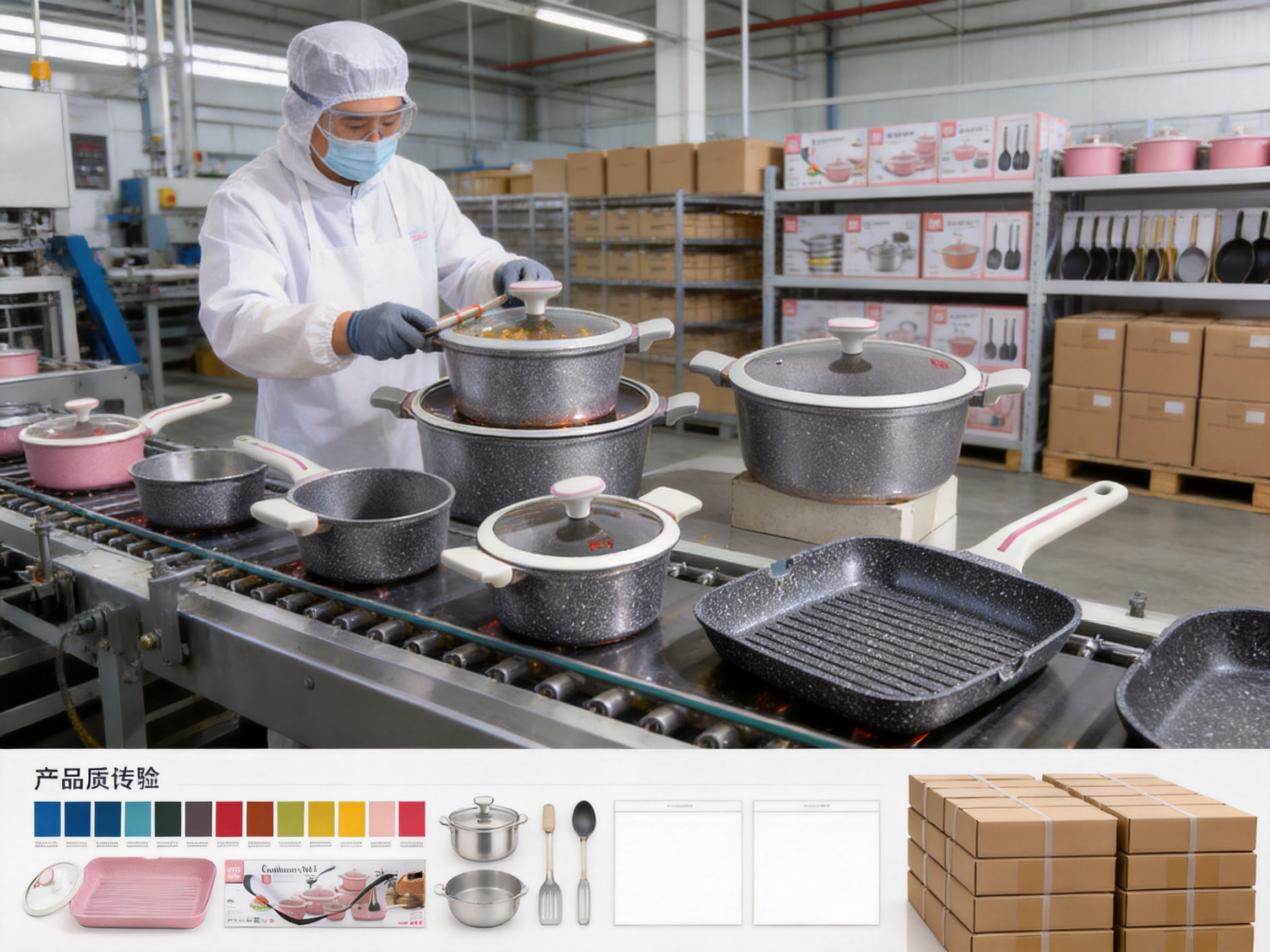
The performance of a cookware set begins long before it reaches the consumer. The manufacturing process must connect material selection, die design, casting, finishing, coating, assembly, inspection, packing, and documentation. The product’s die-casting aluminum body and granite-style treatment provide a foundation for a structured production process.
7.1 Mold and Die Development
Die-casting begins with the design of the cookware geometry. The mold must account for the body profile, rim, base, sidewall transitions, handle connection areas, and any external decorative details. Accurate tooling helps ensure that different pieces in the set share a consistent visual identity.
For a multi-size range, each vessel requires appropriate dimensional planning. The manufacturer must consider wall thickness, weight distribution, base flatness, cooling behavior, and compatibility with the intended coating process. Consistency is especially important when several products are sold together, because a mismatch in color, texture, or handle alignment can reduce the perceived value of the entire set.
7.2 Aluminum Die Casting
During die casting, aluminum is heated to a molten state and introduced into a prepared mold under pressure. Once the material fills the cavity and solidifies, the casting is removed for subsequent trimming and finishing. Process control at this stage can affect the body’s dimensional stability and surface condition.
Trimming removes excess material around casting points and edges. The body may then be machined, polished, or otherwise prepared to create a suitable foundation for coating. The rim and base require particular attention because these areas influence how the cookware sits, how it is handled, and how it appears after finishing.
7.3 Surface Preparation
Coating quality depends heavily on surface preparation. The aluminum body must be clean and appropriately conditioned before the granite-style coating is applied. Oils, dust, loose particles, or casting residue can interfere with adhesion and produce visible defects.
A professional manufacturing system should use defined preparation procedures and inspection checkpoints. These may include visual examination, cleaning control, surface uniformity checks, and dimensional verification. The exact methods depend on the supplier’s technical standards and the requirements agreed upon with the buyer.
7.4 Interior and Exterior Coating Application
The interior and exterior surfaces receive their specified granite-style treatment. Application must be controlled so that the coating is distributed evenly across the intended areas. The interior is especially important because it comes into contact with food and utensils, while the exterior must provide a consistent decorative finish across the cookware collection.
Curing or drying conditions are also significant. The coating system must be processed according to its technical requirements so that it develops the desired surface characteristics. Inconsistent temperature, insufficient curing, contamination, or uneven application can influence appearance and service life.
A well-organized supplier should be able to discuss the coating system, food-contact documentation, application standards, inspection procedures, and available compliance support with professional buyers. The provided company profile identifies product certification assistance as part of its service offering, which can help importers manage documentation requirements for different markets.
7.5 Assembly and Handle Installation
After coating and curing, handles and other components are assembled. Handle alignment, fastening security, surface cleanliness, and visual consistency should be checked. A handle that is not properly aligned may affect both comfort and storage, while an insecure connection may create a serious safety concern.
The accessory components, including gloves, tools, and apron, should be packed according to the agreed product configuration. Piece count, color matching, labeling, and packaging protection should be verified before shipment.
7.6 Final Inspection and Packing
Final inspection may include checks for coating uniformity, scratches, pinholes, stains, rough edges, deformation, handle alignment, base stability, and packaging damage. Product specifications should be compared with approved samples and purchase-order requirements.
For multi-piece sets, packing accuracy is particularly important. Missing one small accessory can make the package appear incomplete, even when the major cookware pieces are present. Carton labeling should identify the product name, quantity, dimensions, handling instructions, and any market-specific information requested by the buyer.
8. Competitive Advantages for Wholesale and Retail Buyers
The product competes through a combination of construction, variety, aesthetics, accessories, and supplier support. Each individual feature may be found in other cookware products, but the overall combination creates a more complete commercial proposition.
First, the die-cast aluminum body offers a useful alternative to both very thin cookware and heavier cast iron. It can provide a substantial feel without making the full set unnecessarily difficult to handle. This balance is attractive to households that want durability and convenience at the same time.
Second, the granite-style interior and exterior create a coordinated appearance. The speckled finish distinguishes the set from conventional solid-color collections and gives retailers a stronger visual story for product pages, catalogs, and in-store displays.
Third, the range of casseroles, grill pan, and sauce pan supports different cooking methods. A buyer receives more than several versions of the same vessel. The set covers small-portion cooking, family meals, simmering, grilling, and general preparation.
Fourth, the inclusion of gloves, cooking tools, and an apron strengthens the value proposition. Accessories can help justify a set-based purchase, especially when consumers compare the package with individual pan prices. They also support promotional messaging focused on convenience and readiness.
Fifth, the care instructions are clear and practical. A product that communicates proper use can help reduce avoidable coating damage. Retailers can adapt these instructions into care cards, online FAQs, product videos, or package inserts.
Sixth, the supplier’s broader product range can simplify sourcing. Buyers that need aluminum cookware, stainless steel cookware, cast iron cookware, and kitchen utensils may be able to consolidate development and communication through one kitchenware partner. This can reduce the administrative burden associated with managing multiple unrelated suppliers.
9. Supplier Capabilities and One-Stop Sourcing
The supplier is based in Zhejiang, China, a province with a strong manufacturing and export ecosystem. Its stated business focus includes cookware and kitchen accessories, with product categories covering aluminum cookware, stainless steel cookware, cast iron cookware, and kitchen utensils.
This category breadth is important for buyers developing a complete kitchenware program. Instead of sourcing one pan from one manufacturer, utensils from another, and cast iron products from a third, a buyer may coordinate a wider assortment through a supplier familiar with complementary products. This can support more consistent packaging, color planning, product photography, and collection design.
The company describes itself as an R&D-driven supply chain partner rather than only an order-taking business. This positioning is relevant to buyers that need more than a standard catalog item. Product development may involve selecting a body shape, adjusting sizes, refining handle styles, choosing colors, developing packaging, and preparing market-specific documentation.
ODM and OEM customization can be particularly valuable for retailers and brands seeking differentiation. A standard cookware category can become difficult to compete in when every seller offers nearly identical products. Custom color, surface appearance, accessory combinations, packaging artwork, logo placement, and set configuration may help a buyer develop a more distinctive market identity.
Flexible minimum order quantities may also support small and medium-sized buyers. New brands and regional distributors often need to test a product before committing to large-scale purchasing. A supplier able to discuss practical order quantities, sample development, and staged production can help reduce the risk associated with entering a new category.
Product certification assistance is another stated service. Certification requirements differ according to destination market, product construction, coating system, labeling rules, and food-contact regulations. Buyers remain responsible for confirming their own legal and compliance obligations, but supplier support can make the documentation process more organized.
The company also states a focus on sustainable and healthy product development. For cookware, this may involve attention to material selection, coating systems, packaging efficiency, product durability, and responsible use information. Any environmental or health-related claim should be supported by suitable technical documentation before being used in marketing materials.
10. OEM, ODM, and Collection Development Opportunities
The set can serve as a foundation for multiple product strategies. Under an OEM model, a buyer may use an approved design with its own branding, packaging, labels, or market presentation. Under an ODM model, the buyer may collaborate with the manufacturer on changes to color, dimensions, handle shape, surface finish, accessory selection, or package architecture.
Color is one of the simplest ways to adapt the product for different markets. The speckled concept may be developed in blush, cream, sage, gray, blue, black, or other coordinated tones, subject to the supplier’s available coating systems and minimum order requirements. Retailers can select colors based on seasonal trends, private-label identity, or existing kitchen textile collections.
The accessory combination can also be modified. Some markets may prefer a larger tool set, while others may prioritize storage protection, recipe cards, silicone accessories, or additional gloves. Buyers should confirm how accessory changes affect piece count, carton dimensions, shipping weight, cost, and retail labeling.
Packaging development is equally important. A gift-oriented package may emphasize the coordinated color and included accessories, while a professional foodservice package may focus on durability, dimensions, care information, and efficient carton packing. Online sellers may benefit from packaging designed to reduce damage during parcel delivery.
Technical communication should remain precise during customization. Buyers should confirm the exact substrate, coating description, handle material, applicable heat-source compatibility, included components, dimensions, gross and net weights, carton measurements, and available test documentation. Clear specifications help prevent discrepancies between samples, purchase orders, packaging, and final shipments.
11. Positioning for Different Customer Segments
11.1 Household Consumers
For household consumers, the set can be positioned as a practical kitchen upgrade. It offers several cookware sizes and cooking functions without requiring the customer to assemble a collection piece by piece. The coordinated appearance may appeal to consumers who want their cookware to match their kitchen style.
11.2 New Home and Apartment Buyers
People moving into a new home or apartment often need several kitchen essentials at once. A multi-piece set with cookware and accessories can simplify that first purchase. The range of sizes allows buyers to prepare both quick individual meals and larger dishes for guests.
11.3 Gift Buyers
The color, coordinated finish, gloves, tools, and apron make the product suitable for housewarming, wedding, birthday, holiday, and seasonal gifting. A well-designed package can emphasize completeness and presentation rather than requiring the gift buyer to understand every technical detail of cookware construction.
11.4 Retailers and Distributors
Retailers can use the set as a core cookware offering and build related sales around utensils, storage products, trivets, kitchen textiles, and food preparation accessories. Distributors may combine the cookware with other products from the supplier’s portfolio to create a wider kitchenware assortment.
11.5 Hospitality and Rental Housing
Although the product should be evaluated against the specific requirements of each commercial application, multi-size cookware can be useful in furnished apartments, guest accommodations, student housing, and selected hospitality settings. Commercial buyers should review expected usage intensity, cleaning procedures, replacement policies, and applicable safety standards before selecting the product for high-frequency operations.
12. Responsible Product Communication
Accurate product communication is essential. The set should be described according to confirmed specifications rather than assumptions. For example, buyers should verify whether the cookware is suitable for induction, gas, electric, ceramic, or other heat sources. The provided material identifies a carved bottom but does not specify every compatible cooking surface.
Similarly, the product should not be advertised as microwave-safe because the care instructions specifically state that it must not be used in a microwave. Oven use, dishwasher use, maximum temperature, lid construction, and exact coating technology should also be confirmed before being included in marketing copy.
Responsible communication benefits both the customer and the supplier. Clear instructions reduce misuse, support realistic expectations, and protect the credibility of the product line. They also give retailers a stronger basis for answering questions about cleaning, utensils, heating, storage, and handling.
13. Careful Comparison with Other Cookware Categories
Compared with stainless steel cookware, coated aluminum cookware may offer easier food release for many everyday preparations and may be more approachable for users who prefer simpler cleaning. Stainless steel can be valued for its uncoated surface and professional appearance, but it often requires greater attention to preheating, oil control, and food-release technique.
Compared with cast iron cookware, die-cast aluminum is generally easier to lift and maneuver. Cast iron may provide strong heat retention, but its weight and maintenance requirements can be barriers for some consumers. The aluminum set is oriented toward convenient daily cooking rather than the particular thermal behavior of heavy cast iron.
Compared with thin stamped aluminum cookware, die-casting can support a more substantial body and more defined product geometry. The actual advantage depends on wall thickness, base design, quality control, and overall construction, so buyers should assess samples and technical data rather than relying on material names alone.
Compared with buying individual pans, the 13-piece package offers coordinated design and potentially better overall value. It also reduces the time required to select compatible cookware. The trade-off is that customers receive a predefined assortment, so the set should be configured around broadly useful sizes and accessories.
14. Purchasing and Quality Checklist
Before confirming a commercial order, buyers should request a complete technical specification. This should include the cookware body material, coating description, dimensions, weight, handle material, accessory materials, packaging details, and confirmed piece count.
Samples should be reviewed for body balance, base stability, rim quality, handle alignment, coating appearance, color consistency, and overall finish. Buyers should test the cookware using appropriate non-stick-safe utensils and cleaning methods. If the product is intended for a particular market, the buyer should also confirm required labeling, food-contact documentation, and packaging language.
It is useful to establish an approved sample or golden sample before mass production. The approved reference should document the appearance and configuration that production must follow. Any changes to coating color, handle design, accessory materials, or packaging should be approved in writing.
Shipping preparation should include carton testing appropriate to the intended transport route. Cookware can be vulnerable to scratches, dents, and coating damage if pieces are not separated and protected correctly. Accessories should be secured so they do not move freely inside the package and damage the cookware during handling.
Finally, buyers should agree on inspection standards, defect classifications, quantity tolerances, delivery terms, replacement procedures, and communication points. These details create a more reliable commercial relationship and help both parties manage expectations.
15. Frequently Asked Questions
Q1: What material is used for the cookware body?
The cookware body is specified as die-casting aluminum. This material supports a practical balance of manageable weight, responsive heat behavior, and substantial body construction.
Q2: What type of surface treatment does the set have?
The specification identifies granite coating on both the exterior and interior. The interior is described as food-grade non-stick, while the exterior provides the speckled decorative appearance.
Q3: What cookware pieces are included?
The listed configuration includes casseroles in multiple sizes, a 28-centimeter grill pan, an 18-centimeter sauce pan, two anti-scald cotton gloves, a two-piece tool set, and one apron. The exact final packing list and piece-count calculation should be confirmed with the supplier.
Q4: What sizes are available in the set?
The specification lists casserole sizes of 20, 24, 28, and 32 centimeters, a 28-centimeter grill pan, and an 18-centimeter sauce pan. Because the original specification contains compressed formatting, buyers should confirm the dimensions before printing packaging or catalogs.
Q5: Can metal utensils be used?
No. Metal or sharp utensils should be avoided because they may scratch the non-stick cooking surface. Wooden, nylon, or utensils designed for coated cookware are recommended.
Q6: How should the cookware be cleaned?
Use hot, soapy water with a soft cloth or sponge. Hand washing is recommended to help preserve the appearance of the cookware.
Q7: Can the cookware be used in a microwave?
No. The care instructions specifically state that the cookware must not be used in a microwave.
Q8: Can the pan be heated while empty?
No. Users should not overheat an empty pan. Empty cookware can become excessively hot and may affect the coating or other components.
Q9: Are the handles heat resistant?
The product is described as having heat-resistant handles. Users should still exercise caution, because handle temperature depends on cooking conditions, heat source position, cooking time, and surrounding surfaces.
Q10: What should a user do if the cookware severely overheats?
The cooker should be turned off, and the cookware should be left to cool completely. It should not be touched while it is severely overheated.
Q11: Is the cookware suitable for every type of stove?
The provided information does not list every compatible heat source. Buyers should request confirmation of compatibility with gas, electric, ceramic, induction, or other cooking systems before making a specific claim.
Q12: Is the set suitable for private-label programs?
The supplier states that it provides ODM and OEM customization. Buyers can discuss branding, packaging, color, accessories, specifications, minimum order quantities, and documentation requirements.
Q13: Can buyers source other kitchen products from the same supplier?
Yes. The supplier’s stated product categories include aluminum cookware, stainless steel cookware, cast iron cookware, and kitchen utensils. This supports one-stop sourcing for broader kitchenware programs.
Q14: Why is the set attractive for retail?
It combines a distinctive speckled appearance, multiple cookware sizes, a non-stick interior, cooking accessories, protective gloves, and an apron. These features create a complete package that can be positioned for household use, gifting, and kitchen upgrades.
Q15: What should importers confirm before ordering?
Importers should confirm the final component list, exact dimensions, coating documentation, handle materials, heat-source compatibility, packaging, labeling, certification requirements, minimum order quantity, sample approval process, inspection standards, and shipping details.
Conclusion
The 13-Piece Speckled Aluminum Cookware Set is designed as a complete and visually coordinated cooking solution. Its die-casting aluminum body supports a practical balance of strength, weight, and heat responsiveness. Granite-style treatment on the interior and exterior adds a distinctive appearance, while the food-grade non-stick surface is intended to simplify cooking and cleaning.
The combination of casserole sizes, sauce pan, grill pan, cooking tools, gloves, and apron gives the set broad everyday usefulness. It can support small meals, family-size cooking, simmering, grilling, food preparation, and kitchen gifting. Its value is therefore not limited to the number of pieces; it lies in the way the components work together as a coordinated collection.
From a manufacturing perspective, the product reflects the importance of die design, aluminum casting, surface preparation, coating control, handle assembly, inspection, and protective packaging. These stages create opportunities for quality differentiation and provide a foundation for OEM, ODM, and private-label development.
For professional buyers, the supplier’s broader strengths are equally significant. Its product coverage includes aluminum, stainless steel, and cast iron cookware as well as kitchen utensils. Its stated services include one-stop sourcing, customization, certification assistance, flexible minimum order quantities, and sustainable product development. These capabilities can help small and medium-sized kitchenware buyers build differentiated product programs while coordinating development through a specialized supply-chain partner.
With accurate specifications, appropriate care instructions, reliable quality control, and market-specific packaging, this cookware set can serve as a strong option for retailers, distributors, importers, and brands seeking a practical multi-function cookware collection with a distinctive visual identity.
References
1. Product specification and care instructions supplied for the 13-Piece Speckled Aluminum Cookware Set.
2. Supplier information concerning aluminum cookware, stainless steel cookware, cast iron cookware, kitchen utensils, ODM, OEM, certification assistance, and one-stop sourcing.
3. General manufacturing principles for aluminum die casting, cookware surface preparation, coating application, curing, assembly, and inspection.
4. General consumer guidance for the care and use of non-stick cookware, including utensil selection, hand washing, heat control, and safe handling.
5. General kitchenware merchandising principles relating to cookware assortment planning, accessory bundling, retail presentation, private-label development, and packaging communication.
Product: 13pcs SpeckleBlush Aluminium Cookware Set
Recommended Articles
Product Category
Related products
-
-
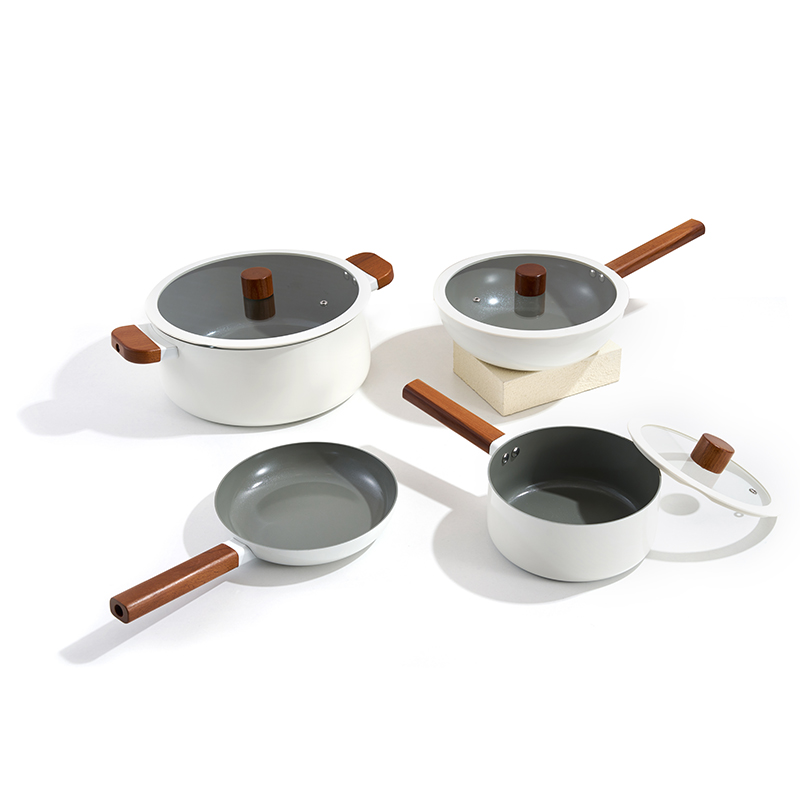
This cookware set has a ceramic non-stick inner liner, a heat-resistant wooden h...
See Details -
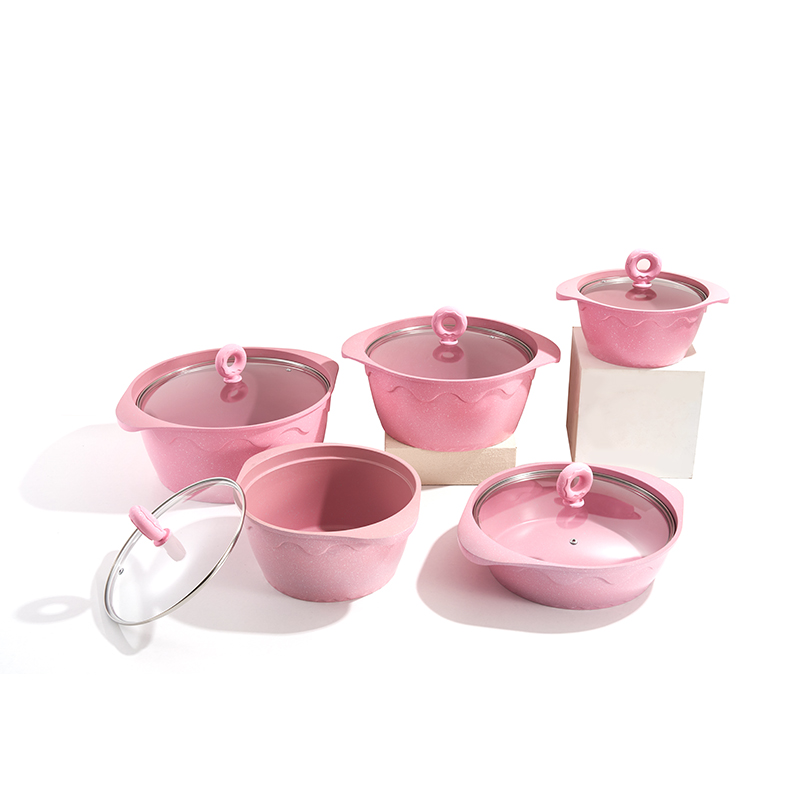
This cookware set is made of food-grade non-stick material, with a unique eye-ca...
See Details -
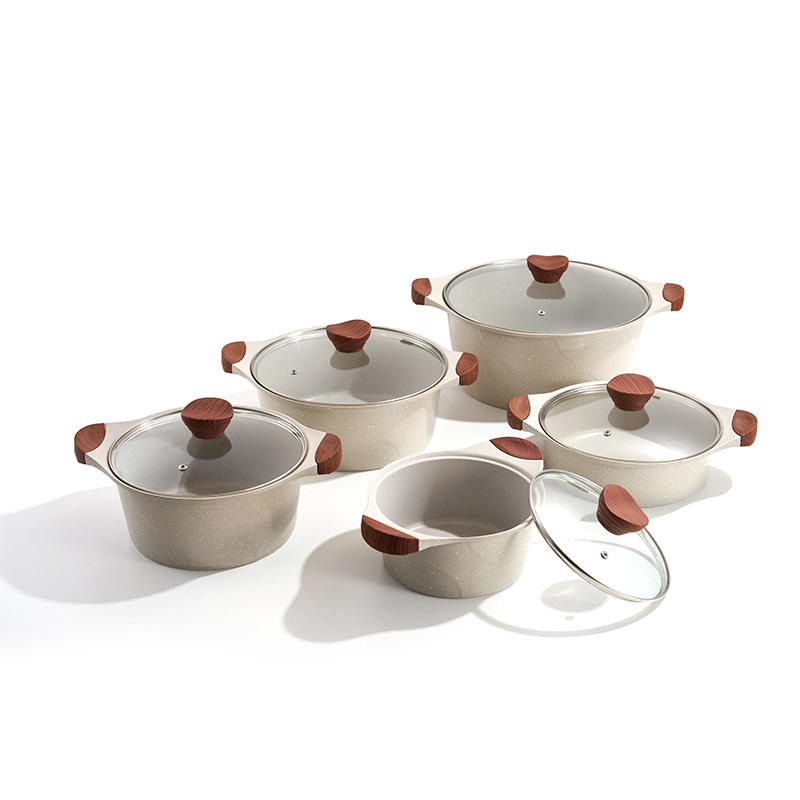
This off-white cookware set is made of wear-resistant non-stick material, with w...
See Details
Whether you're looking for bulk purchases or have any custom requirements, We are here to offer the best
solutions for you.
tiffany.zhong@echocn-trading.com
PHONE
+86-19561173975
+86-19557020621 (Hazel Wu)
ADD
Room 301, Unit 3014, No. 175 Qifeng Avenue, Wenqiao Town, Taizhou, Zhejiang, China
Fill Out the Form for More Information
Copyright © Zhejiang Echo Industry And Trade Co., Ltd.
All Rights Reserved.

China Cookware Set Manufacturer