
 en
 Español

This cookware set features a non-stick coating, even heat conduction, and multi-...
See Details
10-Piece NeroGranite Aluminum Square Pot Set: A Practical Multi-Function Cookware Solution for Modern Kitchens
Date:Nov 20, 2026
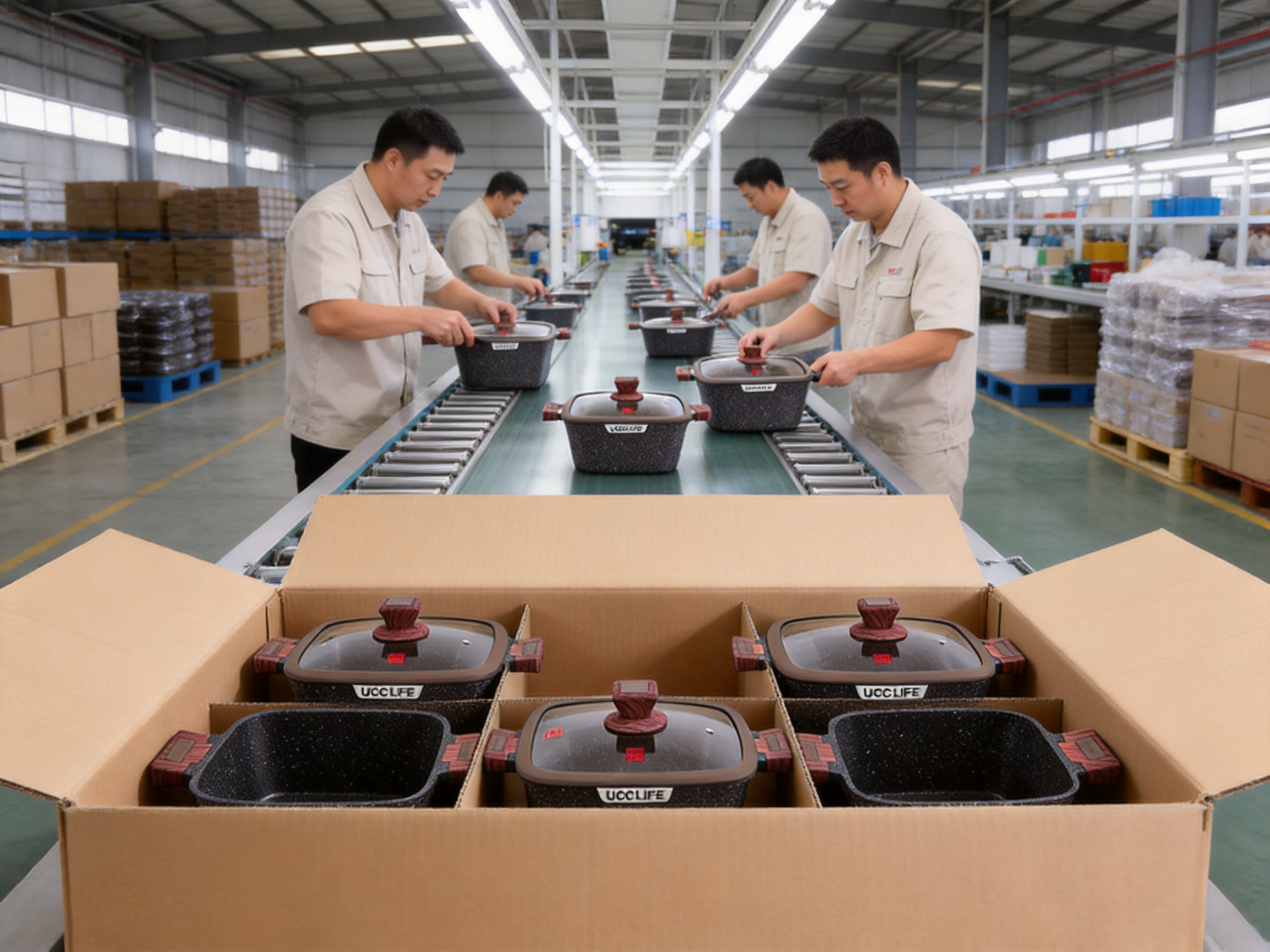
Choosing the right cookware set is an important decision for households, professional buyers, hospitality businesses, and kitchenware distributors. A cookware collection must do more than look attractive. It should support different cooking methods, make efficient use of storage space, distribute heat effectively, remain comfortable to handle, and provide dependable performance over repeated use. The 10-piece NeroGranite Aluminum Square Pot Set has been designed around these practical requirements.
Combining a granite non-stick cooking surface, lightweight aluminum construction, a space-saving square profile, wood-grain heat-resistant handles, and carefully fitted lids, this set is positioned as a versatile solution for frying, stewing, braising, simmering, and everyday meal preparation. Its range of casserole sizes and shallow casserole format gives users more flexibility than a single-purpose pot or a basic round cookware collection.
For importers and kitchenware distributors, the product also offers a useful balance between visual appeal, product variety, packaging efficiency, and broad market suitability. It belongs to a cookware category that can serve family kitchens, apartment kitchens, restaurants, food-service operations, retail stores, and gift-oriented kitchenware programs.
Product Overview
The 10-piece NeroGranite Aluminum Square Pot Set is an aluminum cookware collection with a granite-style non-stick interior and square-shaped bodies. The square design gives the cookware a distinctive appearance while also helping users make efficient use of stovetop and cabinet space. The set includes casserole sizes of 20 cm, 24 cm, 28 cm, and 32 cm, together with a 28 cm shallow casserole.
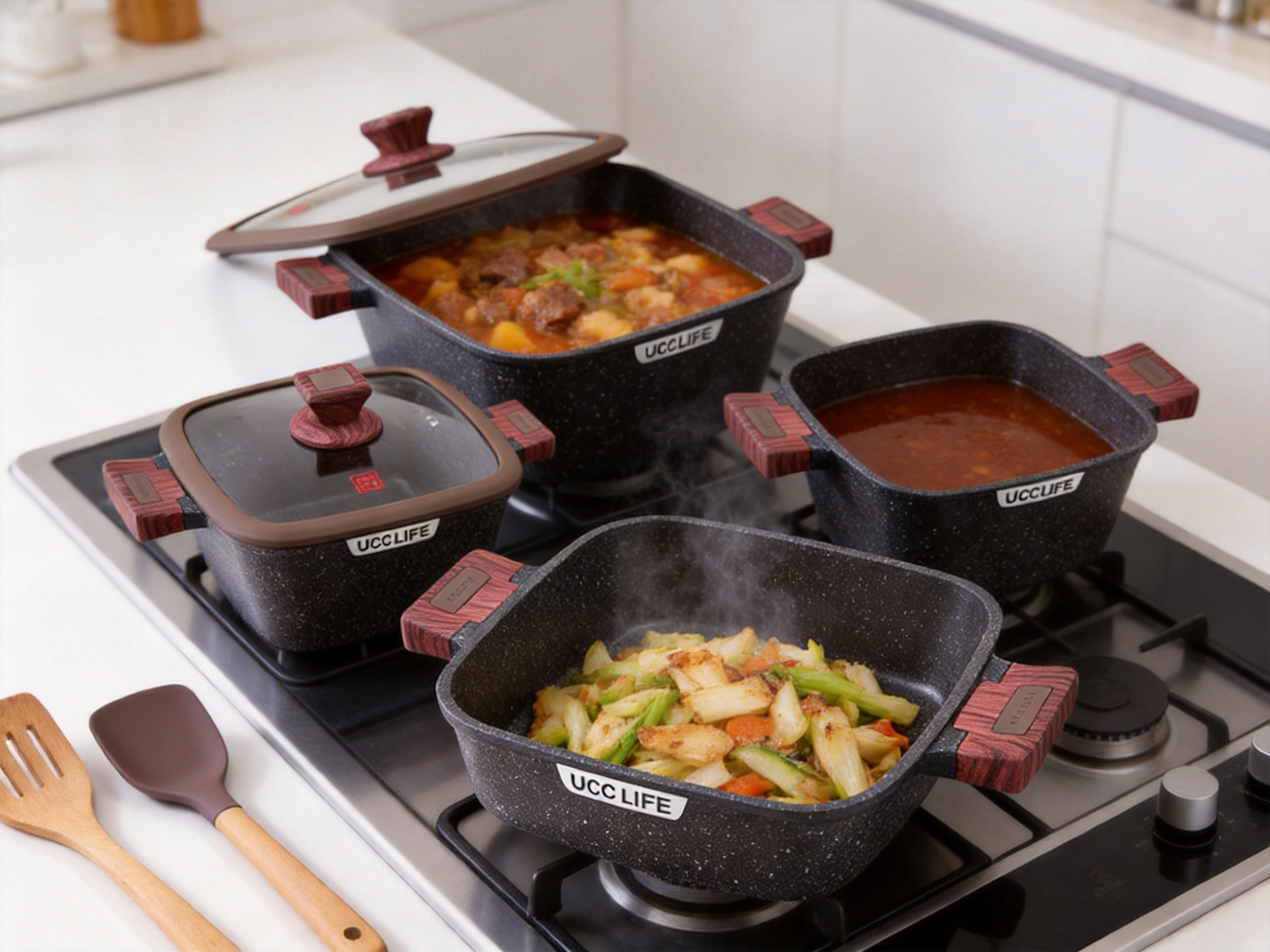
The product is intended for multiple cooking applications. Smaller pieces can be used for sauces, side dishes, small portions, and reheating. Medium-sized casseroles are suitable for family meals, vegetables, rice dishes, pasta sauces, and braised foods. The larger casserole is useful for soups, stews, shared dishes, and batch cooking. The shallow casserole provides a broad cooking surface for frying, searing, sautéing, reducing sauces, and preparing dishes that benefit from quick evaporation.
The construction combines several features that are often requested by cookware buyers:
- Granite non-stick cooking material for easier food release and cleaning.
- Aluminum bodies for practical handling and efficient heat response.
- Square profiles for a modern appearance and space-conscious storage.
- Wood-grain handles designed to provide a comfortable visual and tactile experience.
- Lids with silicone-wrapped edges for improved contact and sealing.
- Compatibility with all stoves, subject to correct use and the specifications of the final production model.
- A multi-size configuration that supports frying, stewing, braising, simmering, and general cooking.
With SKU UCC01, the collection can be managed as a defined product line for wholesale, private-label, and distribution programs. Its packaging information lists two cartons, with carton dimensions of approximately 69.5 × 44 × 34.5 cm and a total carton weight of approximately 23 kg. These details are useful for logistics planning, container loading, warehouse management, and quotation preparation.
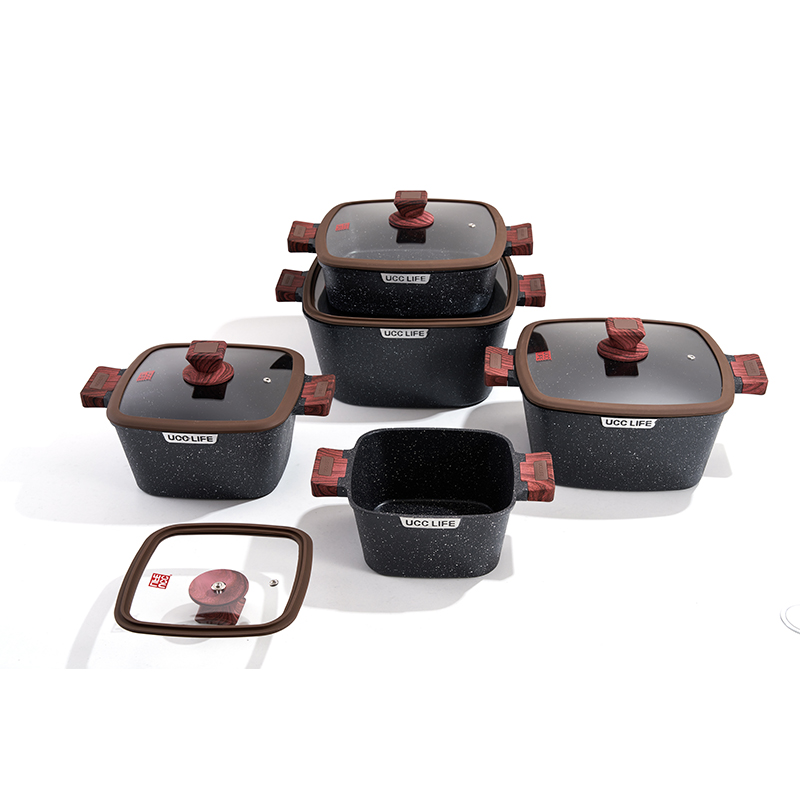
10pcs NeroGranite Aluminum Square pot Set
Why the Square Cookware Design Matters
Most traditional cookware is round, so a square pot set immediately offers a different user experience. The shape is not only an aesthetic feature. It can also influence how cookware is placed on a stovetop, how ingredients are arranged inside the pan, and how pieces are stored after use.
A square cooking body can provide useful corner areas for food placement, particularly when preparing vegetables, meat portions, tofu, noodles, or ingredients that are arranged in layers. The broad side walls may also make the usable cooking area feel more generous compared with a round pan of a similar nominal size. For shallow frying and braising, the shape can help users organize ingredients across the cooking surface.
Square cookware can also be appealing in compact kitchens. When stored in a cabinet or on a shelf, straight sides may allow more efficient use of available space than curved bodies. This can be valuable in apartments, student housing, vacation rentals, and smaller food-service kitchens where every storage area must be used effectively.
From a retail perspective, the square format creates a visual difference on the shelf. Many cookware collections compete through similar round silhouettes and conventional black finishes. A granite-style square set can provide stronger product recognition and help retailers build a modern, coordinated kitchenware display.
The design also supports a more contemporary product position. It can appeal to customers who want cookware that looks suitable for both cooking and serving. A casserole may be moved directly from the stove to the dining table, depending on the recipe and safe handling conditions. The clean geometry and wood-grain handle appearance allow the cookware to fit naturally into modern kitchen interiors.
Granite Non-Stick Cooking Surface
The granite non-stick surface is one of the central features of the set. Non-stick cookware is valued because it can reduce food adhesion during cooking and make cleanup easier after the meal. This is particularly helpful when preparing eggs, pancakes, fish, vegetables, sautéed foods, sticky sauces, or dishes containing reduced ingredients.
A granite-style finish also contributes to the product’s visual identity. Compared with a plain single-color interior, a granite appearance can suggest a premium, durable, and contemporary product character. For buyers, the finish may provide an attractive alternative to ordinary black non-stick cookware while remaining suitable for everyday kitchen use.
The non-stick surface supports cooking with less added oil in many recipes. Users can often achieve good results with a smaller quantity of fat when the cookware is properly preheated and used at an appropriate temperature. This can be attractive to consumers who are looking for lighter cooking methods without giving up familiar fried and sautéed dishes.
However, the performance and service life of any non-stick cookware depend on correct handling. The supplied care guidance recommends using wooden, nylon, or non-stick-safe utensils rather than metal or sharp tools. This is important because cutting, scraping, or striking the cooking surface can damage the coating. A non-stick surface should be treated as a functional performance layer rather than as a surface intended to withstand sharp contact.
Cleaning should be carried out with hot, soapy water and a soft cloth or sponge. Abrasive pads, aggressive scouring powders, and sharp cleaning tools should be avoided. Hand washing is recommended to help preserve the appearance of the cookware and maintain the condition of the exterior and handles.
Aluminum Construction and Heat Response
Aluminum is widely used in cookware because it offers a practical combination of low weight, good heat response, and easy handling. Compared with heavier materials such as cast iron, aluminum cookware is generally easier to lift, move, wash, and store. This matters when a set contains several large pieces, including a 32 cm casserole.
The material also responds relatively quickly to changes in heat. When a user adjusts the burner, the cookware can react without the extended heat retention associated with some heavier materials. This can be useful for cooking techniques that require temperature adjustment, such as simmering, reducing, frying, and braising.
The range of sizes allows the user to match the pan to the quantity of food being prepared. Choosing an appropriately sized pan can help prevent overcrowding, support more even cooking, and reduce unnecessary energy use. A small casserole is more appropriate for a small portion, while the larger casserole can accommodate family-size or batch cooking.
Lightweight aluminum construction is also valuable for wholesale markets. Products that are easier to handle can reduce customer hesitation at the point of sale. They may be more attractive to older consumers, users with limited lifting strength, and households that prefer cookware which can be moved easily from the stove to the sink.
The square body, aluminum construction, and non-stick surface work together to create a product that is versatile without being excessively heavy. This combination distinguishes the set from very heavy cast iron collections and from basic thin cookware that may offer fewer features or a less refined appearance.
Versatility Across Cooking Methods
A major advantage of the set is its suitability for several cooking styles. A cookware collection becomes more valuable when users can prepare different types of food without needing to purchase separate pans for every task.
Frying and Sautéing
The shallow casserole is particularly useful for frying and sautéing. Its broad surface can provide room for ingredients to be spread rather than stacked. This may help vegetables brown more effectively and give users better access when stirring or turning food.
The non-stick surface is suitable for many everyday frying applications, including eggs, pancakes, fish, meat portions, vegetables, and prepared foods. As with all coated cookware, moderate heat and suitable utensils should be used to protect the surface.
Stewing
The deeper casseroles are suitable for stews containing meat, vegetables, legumes, broth, and sauce. Their larger capacities allow ingredients and liquid to cook together over time. A fitted lid can help retain moisture and heat, which is important for slow cooking and tenderizing ingredients.
Using the correct size is important. A pan that is too small may become crowded, while a pan that is too large may not provide the best cooking efficiency for a small portion. The availability of several sizes gives users practical flexibility.
Braising
Braising commonly involves browning ingredients before cooking them slowly with a smaller quantity of liquid. The shallow casserole can be used for the initial browning stage, while the deeper casserole may be preferred when the recipe requires more liquid or a greater volume of ingredients.
The lid helps reduce moisture loss during the covered cooking stage. The silicone-wrapped edge is intended to support closer contact between the lid and cookware body, helping improve sealing during ordinary stovetop use.
Simmering and Sauce Preparation
Medium-sized casseroles are useful for tomato sauces, curries, gravies, soup bases, grains, and other dishes that require steady simmering. The non-stick interior can make it easier to stir and clean foods that might otherwise adhere to the base.
Users should avoid excessive heat, especially when the pan is empty. Empty cookware can heat rapidly and may suffer damage if left unattended. Recipes should be started with suitable ingredients or liquid, and heat should be controlled according to the cooking method.
Lid Design and Everyday Functionality
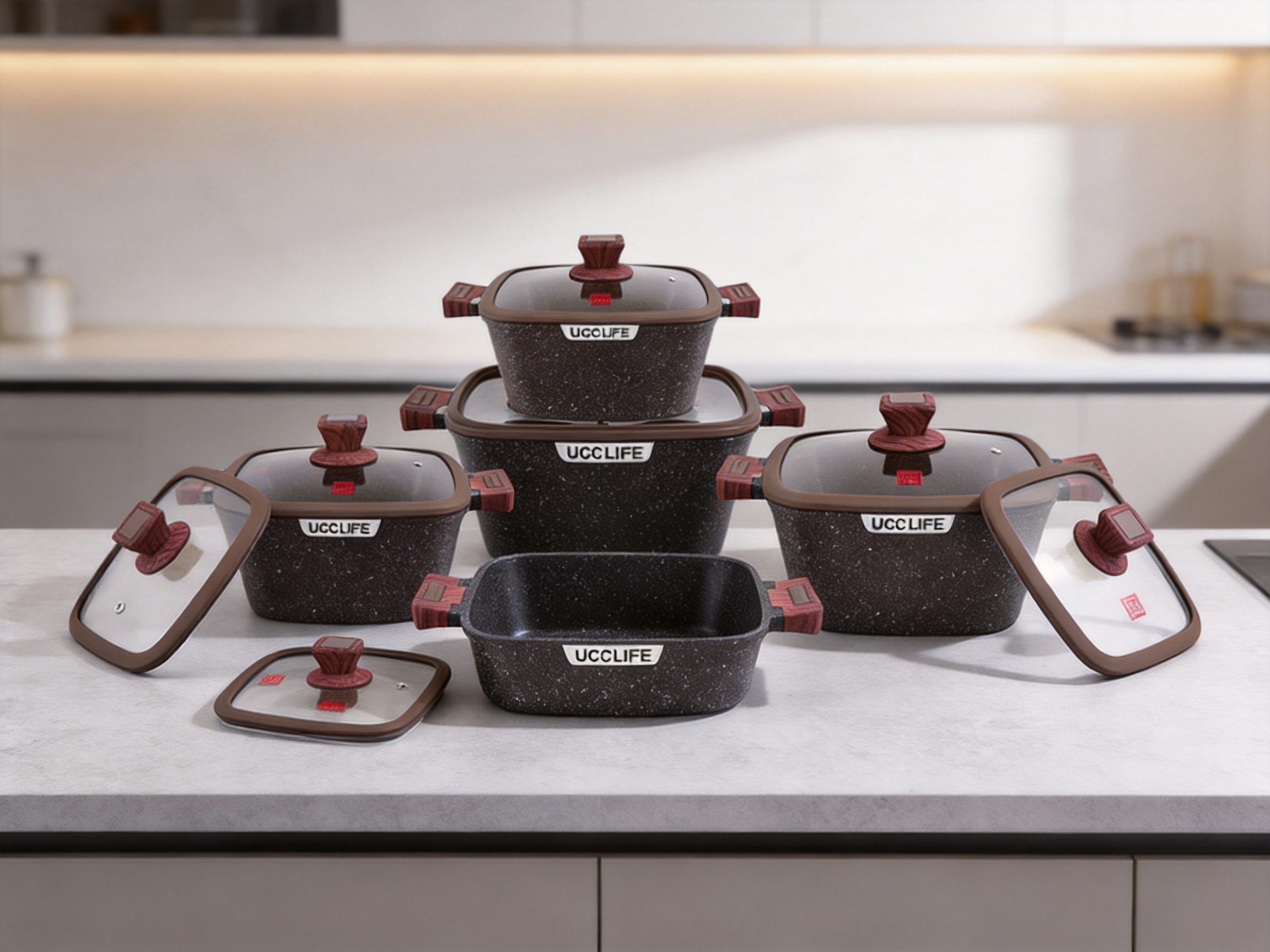
Lids play an important role in cookware performance. They help retain heat, reduce evaporation, protect food from splashing, and support slow cooking. The lids supplied with this collection feature silicone-wrapped edges, a design intended to improve contact and sealing between the lid and the cooking body.
A closer lid fit can be helpful when preparing stews, braised dishes, soups, and sauces. Retaining steam may help ingredients cook more evenly and maintain moisture. It can also reduce the need to add extra liquid during longer cooking periods, although the correct amount depends on the recipe.
The silicone-wrapped edge adds a softer contact point than a bare metal edge. This may help reduce harsh contact between the lid and cookware body during normal use. It can also contribute to a more refined appearance and provide a visible design detail that distinguishes the set from basic cookware collections.
Users should still handle hot lids carefully. Steam can escape when a lid is lifted, and the handle may become warm during cooking. Safe kitchen practice requires the use of appropriate protection and careful positioning when opening a lid.
Handle Design and User Comfort
The heat-resistant wood-grain handles contribute to both appearance and handling comfort. The wood-grain finish gives the set a warm, natural visual character while maintaining the convenience of a manufactured cookware handle.
Handles should be held securely and kept away from direct flame. The care instructions specifically advise users not to allow the flame or heat source to extend beyond the base of the cookware. This protects the sides and handles from unnecessary heat exposure and helps maintain safe operation.
The handle design can be especially beneficial for customers who want cookware that transitions visually from the kitchen to the dining table. A wood-grain appearance often gives cookware a more home-oriented and less industrial character. This can support premium retail presentation and make the set suitable for housewarming, wedding, and seasonal gift programs.
Even when handles are described as heat-resistant, users should remember that heat resistance does not mean complete immunity to high temperatures. Handles should not be placed over an open flame, under direct grill heat, or against another hot surface. Correct use is essential for maintaining both appearance and function.
Compatibility with Different Stoves
The product is described as suitable for all stoves. This broad compatibility is an important advantage for retailers because it allows the set to be marketed to a wider group of customers rather than only to users of one specific cooking technology.
Depending on the final production specification, users may employ the cookware on gas, electric, ceramic, halogen, and induction stovetops. Buyers should confirm the exact induction compatibility construction and labeling for the production batch before making technical claims in a sales listing. Stove compatibility should always follow the manufacturer’s final specification.
On any stovetop, the cooking zone should be appropriately matched to the base. A burner or heating element that is significantly larger than the base can direct heat toward the side walls and handles. The supplied instructions therefore recommend keeping the flame or heat source within the base area.
Correct positioning also helps improve energy efficiency. When the heating element is aligned with the base, more of the heat can be transferred to the food, while unnecessary heat exposure to the sides is reduced.
Advantages Compared with Conventional Cookware Collections
The set offers several potential advantages compared with simple cookware bundles or single-purpose pan collections. These advantages should be understood as a combination of design, function, visual presentation, and product range.
| Feature | 10-Piece Square Pot Set | Basic Conventional Set | Practical Benefit |
|---|---|---|---|
| Cooking body | Aluminum construction with granite non-stick surface | May use plain aluminum, stainless steel, or basic coated interiors | Combines practical heat response with easier food release |
| Shape | Modern square profile | Usually round | Distinctive appearance and potentially more efficient storage |
| Size range | 20 cm, 24 cm, 28 cm, and 32 cm casseroles plus a 28 cm shallow casserole | Often includes fewer sizes or less specialized pieces | Supports small portions, family meals, frying, stewing, and braising |
| Lid design | Silicone-wrapped lid edges | May use basic glass or metal contact edges | Designed to support closer contact and improved sealing |
| Handle appearance | Heat-resistant wood-grain handles | Often plain metal or standard plastic handles | Provides a warmer visual style and comfortable handling |
| Retail positioning | Contemporary multi-function cookware collection | General-purpose cookware bundle | Supports stronger visual differentiation in stores and online listings |
Unlike a collection that focuses only on one pot size, this set supports a broader cooking routine. Unlike a heavy cast iron collection, it is designed for easier everyday handling. Unlike a basic round set, it offers a distinctive square profile. These combined qualities may give distributors more opportunities to position the product in different market segments.
Manufacturing and Product Development Strengths
The product is supplied by Zhejiang Echo Industry And Trade Co., Ltd., a kitchenware supplier based in Zhejiang, China. Zhejiang is recognized as an important manufacturing and export region with extensive experience in household goods, cookware, metal products, and kitchen accessories.
The company describes itself as a professional kitchenware supplier offering aluminum cookware, stainless steel cookware, cast iron cookware, and kitchen utensils. This category breadth is important because it indicates an ability to support buyers who want to develop a coordinated kitchenware assortment rather than purchase one isolated product.
A broad product portfolio can strengthen product development in several ways. Experience with different materials can help a supplier understand the processing, finishing, packaging, and quality-control requirements associated with each category. It can also support more efficient sourcing when a buyer requires multiple cookware materials in one program.
The company’s stated services include one-stop sourcing, ODM and OEM customization, product certification assistance, flexible minimum order quantities, and sustainable and healthy product development. These services are relevant to importers and distributors that need more than a standard catalog item.
Material and Component Coordination
Manufacturing a multi-component cookware set requires coordination between the aluminum body, non-stick surface, handles, lids, silicone elements, packaging materials, and final product presentation. Each component must be considered as part of the complete user experience.
For example, the body must accept the intended coating system, the handles must be firmly attached, the lids must align with the cookware openings, and the silicone-wrapped edges must be formed consistently. The set also needs to be packed in a way that protects the surfaces and prevents movement during transport.
Supplier experience in cookware categories can help coordinate these details. A buyer discussing an OEM program can review handle styles, color options, surface finishes, lid configurations, packaging artwork, labeling requirements, and carton arrangements with one manufacturing partner.
Process Control for Coated Cookware
Coated cookware requires careful process control because the surface finish directly affects food release, cleaning convenience, appearance, and perceived quality. A typical manufacturing program may include body preparation, surface cleaning, coating application, curing, visual inspection, dimensional checks, assembly, and packaging inspection.
The specific coating formula and production parameters should be confirmed with the supplier for each order. However, the general objective is to create a consistent cooking surface across all sizes. Uniformity is especially important in a set because customers compare the pieces with one another. A difference in color, texture, or coating appearance can affect the perceived value of the complete collection.
Quality checks may include examination for visible coating defects, incomplete coverage, scratches, uneven finish, edge issues, and contamination. The cookware may also be checked for correct lid fit, handle attachment, body dimensions, and packaging protection. Buyers can request the supplier’s inspection standards and quality documentation before production.
Assembly and Functional Inspection
Assembly is another important stage. The handle must be mounted securely and positioned correctly. The lid must sit properly on the corresponding casserole. Silicone-wrapped edges should be checked for consistent placement and acceptable appearance. Components must be matched to the correct size before packing.
Functional inspection can help identify issues that may not be visible in a basic visual check. Examples include loose handles, unstable bases, poor lid fit, sharp edges, mismatched components, or damage caused during assembly. A structured inspection plan helps reduce the risk of customer complaints after shipment.
Packaging and Export Readiness
Cookware is vulnerable to scratches, impact, and movement during transportation. A professional export-oriented supplier must consider inner protection, separation between pieces, carton strength, labeling, and efficient use of shipping space.
The listed carton dimensions and weight provide a starting point for logistics planning. Importers can use this information when calculating freight, warehouse requirements, pallet arrangements, and container utilization. Final shipping data should be confirmed after packaging design and production quantities are finalized.
The company’s focus on export business and international buyers is also relevant. Export-oriented product development generally requires attention to documentation, packaging communication, destination-market requirements, and coordination with freight partners. These capabilities can simplify the process for overseas buyers, especially those developing a private-label cookware range.
OEM, ODM, and Wholesale Opportunities
The square cookware set can serve as a ready-made catalog product, but it may also provide a base for customization. Buyers may consider variations in external color, coating appearance, handle finish, lid treatment, packaging design, logo placement, and set composition, subject to production feasibility and minimum order requirements.
OEM programs are useful for retailers and distributors that want to sell cookware under their own brand. The supplier’s stated OEM and ODM capabilities may support the development of product artwork, packaging, configuration, and presentation. Before confirming an order, buyers should discuss the available customization range, tooling requirements, sample approval process, production lead time, carton quantities, and quality standards.
For wholesalers, the standard SKU can be attractive because it is already organized as a complete product concept. The five cookware bodies and associated components create a set that can be sold as a higher-value collection rather than as separate low-price items. This may improve shelf presentation and simplify inventory management.
Retailers can position the set in several ways:
- As a complete cookware solution for new households.
- As a practical gift for weddings, housewarmings, and seasonal occasions.
- As a modern upgrade from basic non-stick cookware.
- As a space-conscious collection for apartments and compact kitchens.
- As a multi-function set for consumers who want fewer products with broader uses.
- As part of a coordinated kitchenware range that includes utensils and accessories.
Its appearance may also support online retail. Product images can show the square profile, granite-style interior, wood-grain handles, size range, and lid design. Clear educational content about care, cooking applications, and storage can help customers understand the value of the collection before purchase.
Care and Maintenance Guidelines
Proper care is essential for maintaining the appearance and performance of the set. The supplied instructions should be communicated clearly to end users and included in packaging or product documentation where appropriate.
Use Suitable Utensils
Do not use metal or sharp cooking utensils on the non-stick surface. Wooden, nylon, silicone, or other cookware-safe utensils are recommended. Sharp tools can scratch or cut the coating, while metal edges may create marks during stirring, turning, or serving.
Control the Heat
Do not overheat an empty pan. Empty cookware can reach a high temperature quickly, which may damage the coating or other components. Begin cooking with the appropriate ingredients or liquid and select a heat level suitable for the recipe.
Do not allow the flame or heating element to extend beyond the base. Excessive side heat can discolor the exterior and expose the handles or lid components to unnecessary temperatures.
Respond to Severe Overheating
If the cookware severely overheats, users should turn off the cooker and leave the pan in place until it has cooled completely. The pan should not be touched immediately, moved abruptly, or immersed in cold water while extremely hot. Sudden temperature changes may create safety risks and can damage cookware components.
Clean Gently
Use hot, soapy water with a soft cloth or sponge. Avoid abrasive cleaners, steel wool, hard scouring pads, and sharp scraping tools. Gentle cleaning is generally sufficient for a non-stick cooking surface when food is not allowed to burn onto the pan.
Wash Before First Use
Each piece should be washed before its first use. Hand washing is recommended to preserve the appearance of the cookware and help protect the finish, handles, lid edges, and other components.
Do Not Use in a Microwave
The cookware should not be placed in a microwave. It is designed for stovetop cooking, not microwave use. Users should also follow any additional instructions supplied with the final product.
Quality Expectations for Buyers
Professional buyers should establish clear quality expectations before placing an order. These expectations may cover coating appearance, color consistency, body thickness, dimensional tolerance, base stability, handle strength, lid fit, silicone edge placement, packaging quality, and labeling.
Sample approval is an important stage in an OEM or wholesale program. The approved sample should represent the expected production standard. Buyers can use it as a reference for color, finish, component matching, logo placement, and packaging appearance.
It is also useful to agree on inspection procedures. A pre-shipment inspection may include quantity verification, carton review, visual inspection, functional checks, and random sampling. For larger programs, buyers may request production photographs, inspection reports, material declarations, or test documentation as appropriate for the destination market.
Certification assistance is listed among the supplier’s services. Because regulatory requirements vary by country and product category, buyers should identify the documents required for their market at the beginning of the project. Requirements may concern food-contact materials, coating safety, labeling, packaging, chemical restrictions, and general consumer-product compliance.
Clear communication is particularly important when the product is sold under a private label. The buyer should confirm the brand name, artwork, language requirements, warning information, care instructions, barcode details, carton markings, and country-of-origin statements before mass production begins.
Logistics and Commercial Planning
The listed packaging information indicates two cartons, approximately 69.5 × 44 × 34.5 cm, with a total carton weight of approximately 23 kg. These figures can help buyers estimate freight costs and warehouse requirements. They should be treated as planning information and reconfirmed after final packaging approval.
Because cookware is relatively dense and can contain several nested pieces, packaging design has a direct effect on transportation efficiency. Proper nesting can reduce unused volume, while protective separation helps prevent surface scratches. The packing arrangement should balance protection with carton size and handling weight.
Distributors should also consider inventory planning by size. The 20 cm and 24 cm pieces may appeal to users preparing smaller portions, while the 28 cm and 32 cm casseroles may be more important for family cooking. The shallow casserole can serve a distinct need and should be presented as more than an extra piece; it is a functional frying and sautéing tool.
Product education can improve sales performance. Retail descriptions should explain the difference between the deep casseroles and the shallow casserole, the benefits of the square form, the role of the lids, and the care requirements of the non-stick surface. Clear information reduces misuse and helps customers choose the right product for their cooking habits.
Positioning Against Different Cookware Materials
Compared with Stainless Steel Cookware
Stainless steel is valued for durability, resistance to staining, and a polished appearance. However, food can adhere more readily if heat and oil are not managed correctly. The granite non-stick aluminum set may be more convenient for users who prioritize easy food release and simple cleaning.
Aluminum cookware is also generally lighter than many stainless steel constructions. This can make the set more comfortable for frequent handling. The best choice depends on the user’s priorities, but this product is well positioned for everyday convenience.
Compared with Cast Iron Cookware
Cast iron offers strong heat retention and is popular for searing and slow cooking. Its disadvantages may include substantial weight, longer heating time, and more demanding maintenance. The aluminum square set provides a lighter alternative for users who want multi-function cooking without the physical demands of heavy cast iron.
Compared with Basic Aluminum Cookware
Basic aluminum cookware can be economical and lightweight, but it may not provide the same level of visual refinement or non-stick convenience. The granite-style surface, wood-grain handles, silicone-wrapped lid edges, and coordinated square design give this collection a more developed product identity.
Q&A
What is included in the cookware set?
The product information identifies the set as a 10-piece NeroGranite Aluminum Square Pot Set. The listed cookware sizes include 20 cm, 24 cm, 28 cm, and 32 cm casseroles, plus a 28 cm shallow casserole. The complete piece breakdown should be confirmed with the supplier because handles, lids, and other components may be included in the total piece count.
What material is used for the cookware body?
The cookware body is made from aluminum and features a granite non-stick cooking surface.
What cooking methods are supported?
The set is suitable for frying, stewing, braising, simmering, sautéing, and general stovetop cooking. The shallow casserole is especially useful for frying and sautéing, while the deeper casseroles are suitable for stews, braised dishes, sauces, and larger meals.
Can the cookware be used on all stoves?
The product is described as suitable for all stoves. Buyers should confirm the final production specification, especially the exact induction compatibility details, before publishing market-specific technical claims.
Are the handles heat-resistant?
The product features heat-resistant wood-grain handles. Users should still keep the handles away from direct flames and avoid allowing the heat source to extend beyond the base of the cookware.
Can metal utensils be used?
No. Wooden, nylon, silicone, or other non-stick-safe utensils should be used. Metal or sharp utensils may scratch or damage the cooking surface.
How should the cookware be cleaned?
Wash the cookware with hot, soapy water and a soft cloth or sponge. Hand washing is recommended to help preserve the appearance and condition of the set.
Can the cookware be placed in a microwave?
No. The cookware should not be used in a microwave.
What should users do if a pan overheats?
Turn off the cooker and allow the pan to cool completely before touching or moving it. Do not pour cold water into severely overheated cookware.
Is the square shape only for appearance?
No. In addition to providing a modern appearance, the square shape can support efficient storage, provide useful cooking corners, and create a broad, practical cooking area.
Is the product suitable for private-label programs?
The supplier states that it provides OEM and ODM customization. Buyers should discuss available options for colors, packaging, logos, handle styles, set configurations, minimum order quantities, samples, and production schedules.
What is the product SKU?
The listed SKU is UCC01.
What are the listed carton details?
The information lists two cartons, with dimensions of approximately 69.5 × 44 × 34.5 cm and a carton weight of approximately 23 kg. Final shipping details should be confirmed before ordering.
Conclusion
The 10-piece NeroGranite Aluminum Square Pot Set is designed as a complete and flexible cookware solution for modern kitchens. Its combination of aluminum construction, granite non-stick cooking surface, square body design, multiple sizes, shallow casserole, wood-grain handles, and silicone-wrapped lid edges gives it a strong position in the multi-function cookware market.
For consumers, the set offers practical support for frying, stewing, braising, simmering, and everyday meal preparation. For retailers, it provides a visually distinctive product with broad household appeal. For importers and distributors, it offers a structured SKU that can be developed through wholesale, OEM, ODM, and coordinated kitchenware programs.
The supplier’s strengths include a broad kitchenware portfolio, Zhejiang manufacturing experience, export orientation, one-stop sourcing, customization support, certification assistance, and flexible purchasing options. These capabilities can be valuable for buyers that need a reliable supply partner rather than a single transaction.
As with all non-stick cookware, correct care is essential. Using suitable utensils, avoiding overheating, washing gently, keeping flames within the base, and following the supplied instructions will help maintain the product’s appearance and performance. With appropriate manufacturing control, packaging protection, quality inspection, and after-sales guidance, this square cookware collection can serve as a practical and attractive addition to international kitchenware markets.
References
1. Product specification sheet for the 10-Piece NeroGranite Aluminum Square Pot Set, SKU UCC01.
2. Supplied cookware care and maintenance instructions.
3. General principles of aluminum cookware construction and heat-transfer behavior.
4. General guidance for the use and maintenance of non-stick cookware.
5. Supplier information concerning aluminum cookware, stainless steel cookware, cast iron cookware, kitchen utensils, OEM, ODM, and export services.
6. General food-contact cookware quality-control and packaging practices.
Product: 10pcs NeroGranite Aluminum Square pot Set
Recommended Articles
Product Category
Related products
-
-
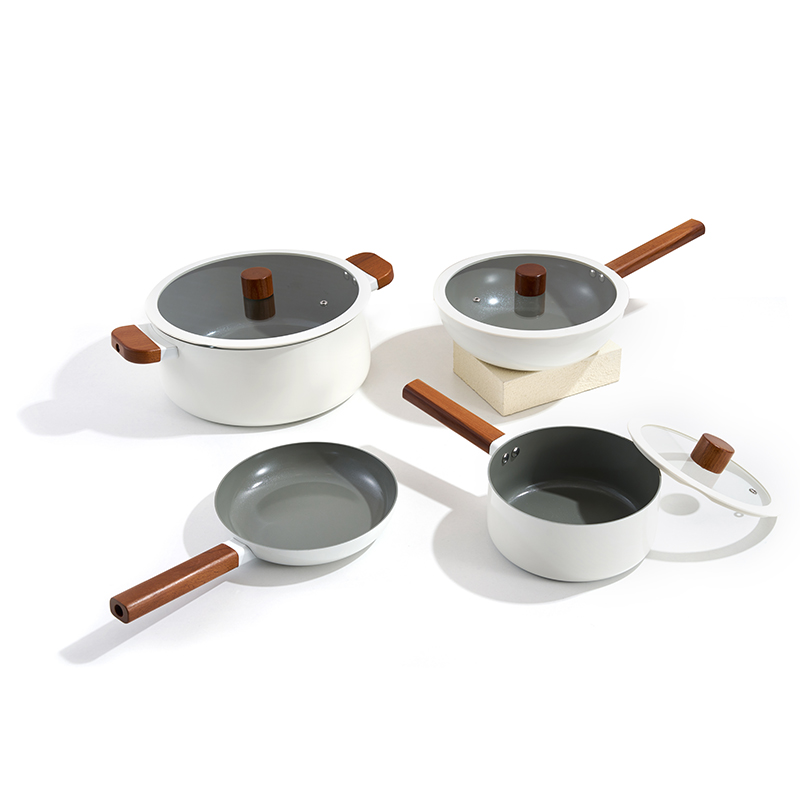
This cookware set has a ceramic non-stick inner liner, a heat-resistant wooden h...
See Details -
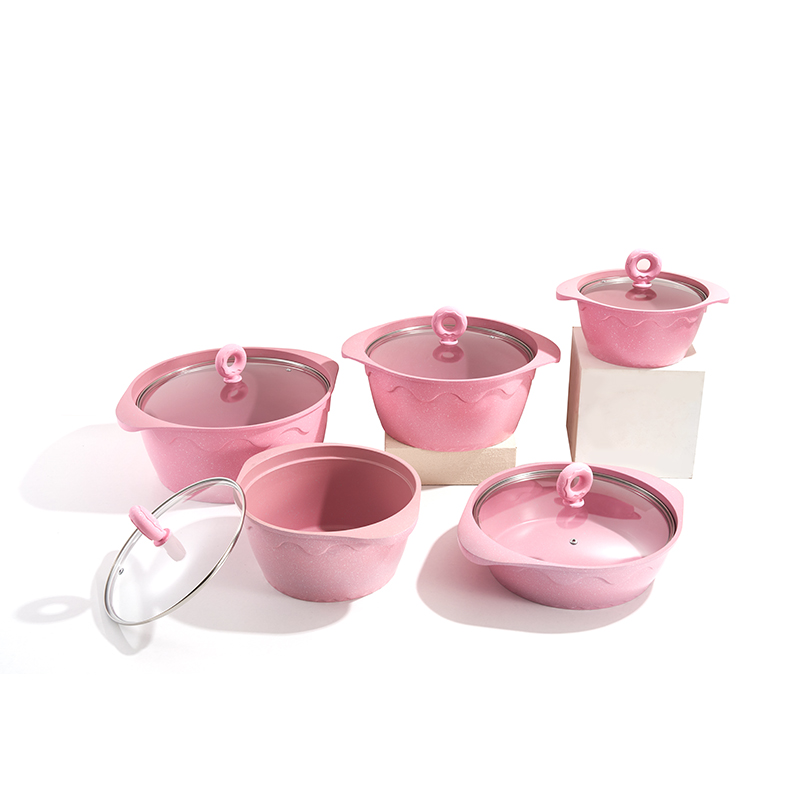
This cookware set is made of food-grade non-stick material, with a unique eye-ca...
See Details -
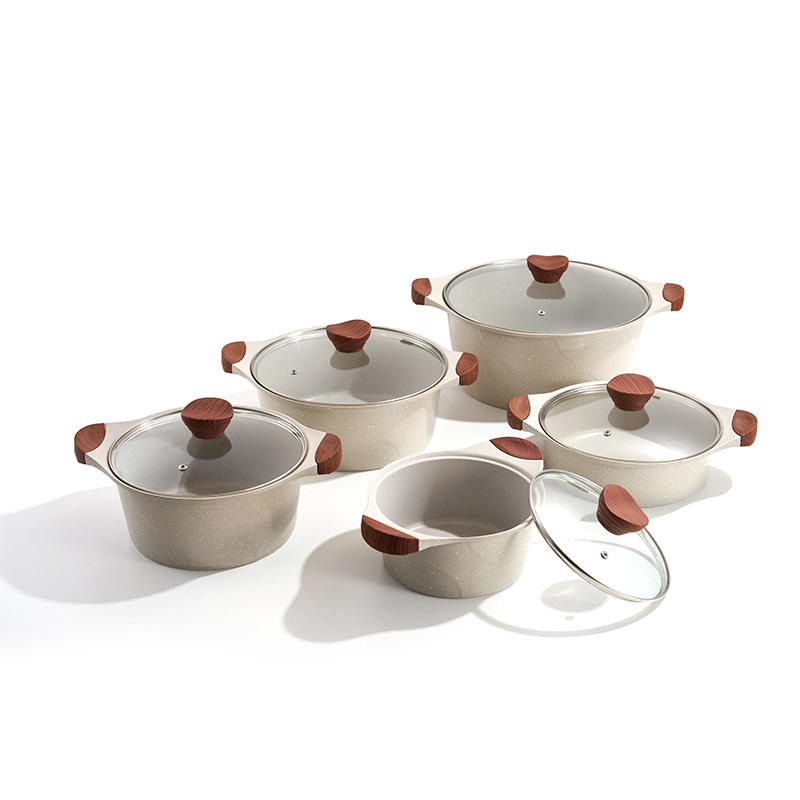
This off-white cookware set is made of wear-resistant non-stick material, with w...
See Details
Whether you're looking for bulk purchases or have any custom requirements, We are here to offer the best
solutions for you.
tiffany.zhong@echocn-trading.com
PHONE
+86-19561173975
+86-19557020621 (Hazel Wu)
ADD
Room 301, Unit 3014, No. 175 Qifeng Avenue, Wenqiao Town, Taizhou, Zhejiang, China
Fill Out the Form for More Information
Copyright © Zhejiang Echo Industry And Trade Co., Ltd.
All Rights Reserved.

China Cookware Set Manufacturer