
 en
 Español
This cookware set features a non-stick coating, even heat conduction, and multi-...
See Details
Multicolor Silicone Kitchen Utensils: Practical Design, Reliable Performance, and Efficient Wholesale Supply
Date:Aug 08, 2026
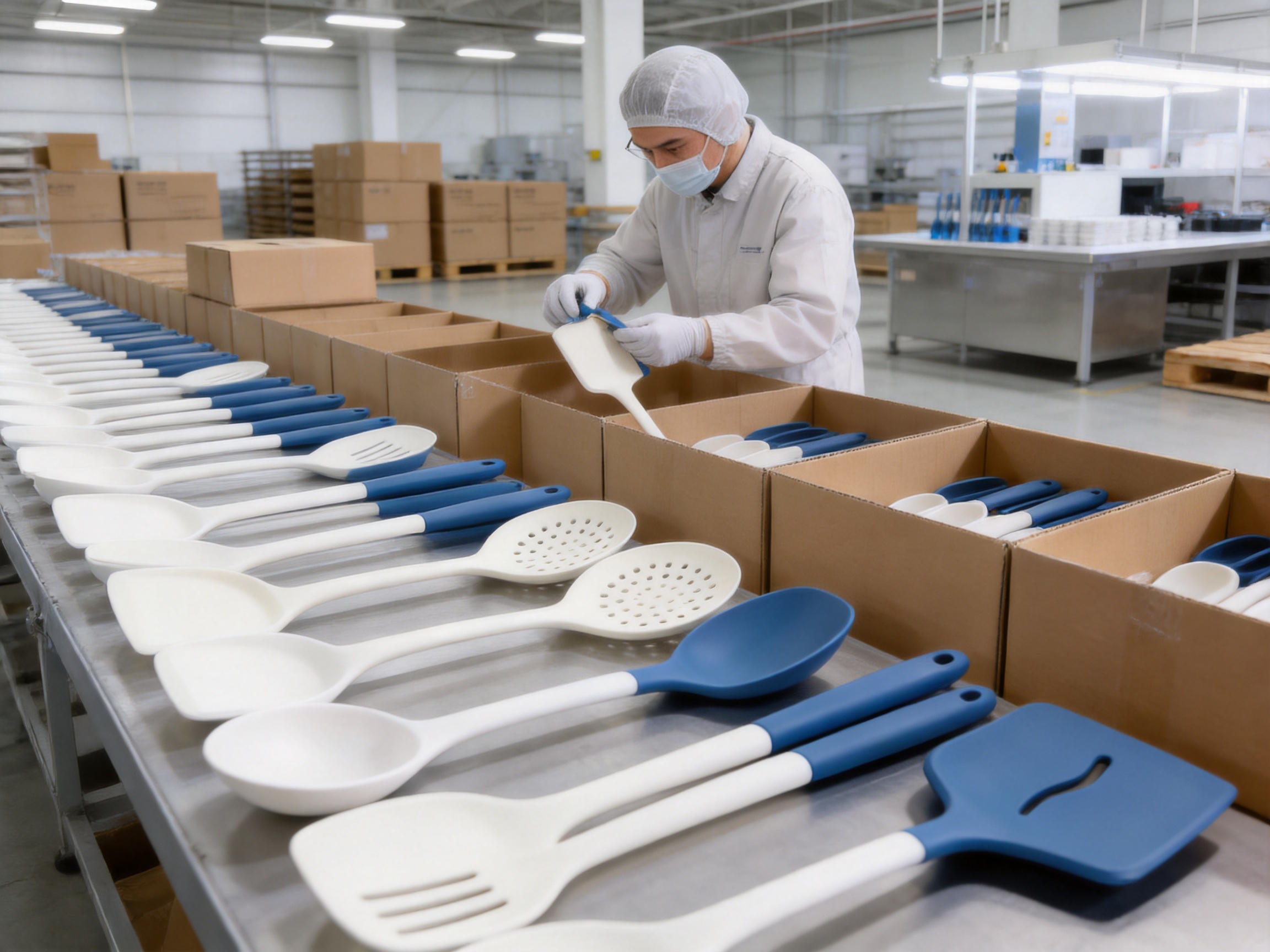
Modern kitchens require tools that are safe, comfortable, durable, and adaptable to different cooking methods. A well-designed utensil should do more than move food from one place to another. It should protect cookware surfaces, provide dependable control, tolerate repeated use, and remain easy to clean after demanding cooking tasks. The Multicolor Silicone Kitchen Utensil collection is designed around these practical requirements, combining silicone and nylon in a lightweight, functional range for homes, restaurants, hospitality businesses, retailers, and kitchenware distributors.
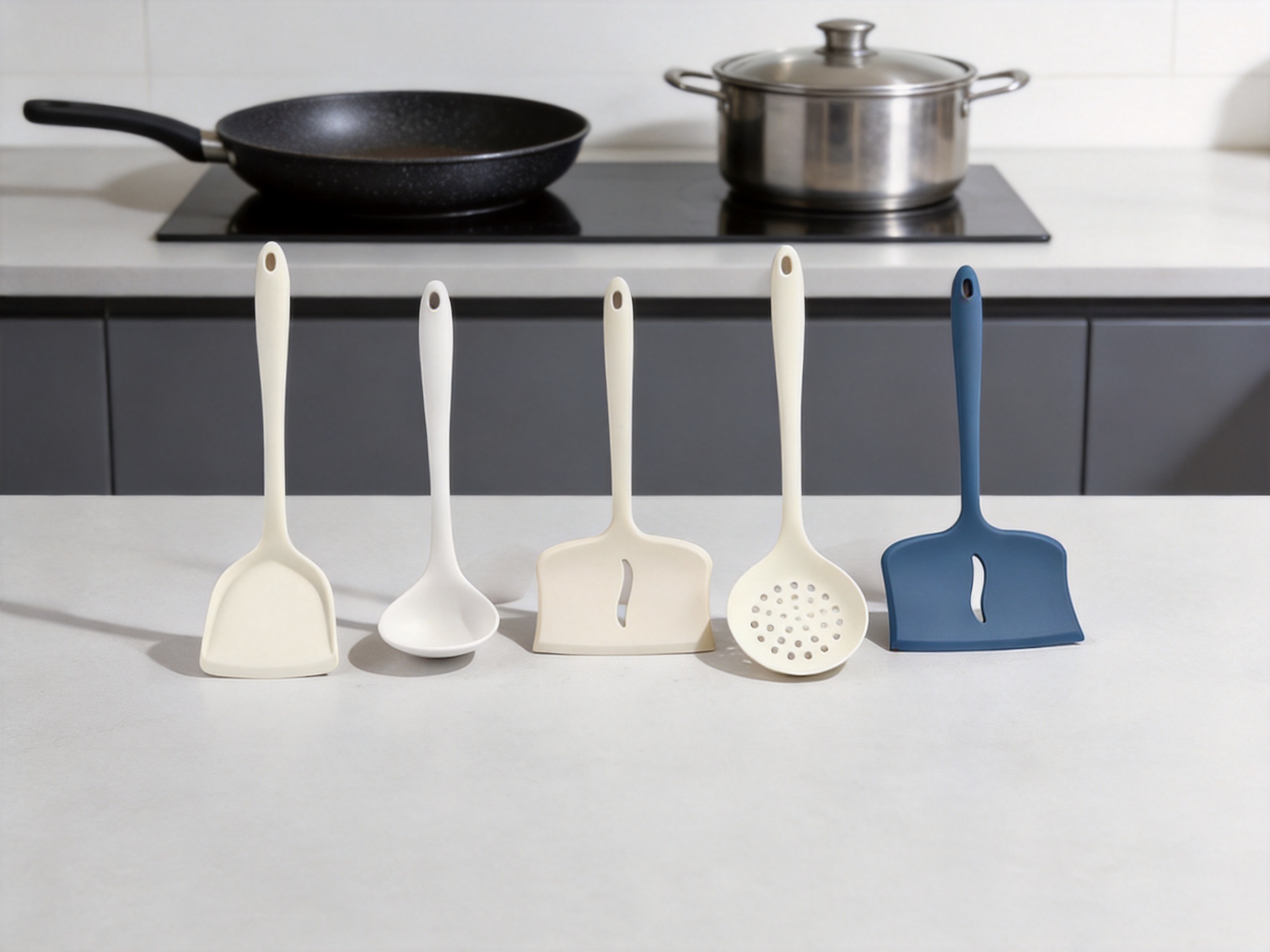
The collection includes a spatula, soup ladle, strainer, and pancake shovel. Each utensil has a dedicated shape and working purpose, while the coordinated color concept gives the set a modern and attractive appearance. White and blue color options are available, creating a clean visual style that can fit contemporary kitchens, rental properties, food-service environments, and retail product assortments.
Behind the product is a Zhejiang-based kitchenware supplier with experience in aluminum cookware, stainless steel cookware, iron cookware, and kitchen utensils. Its broader product range supports one-stop sourcing for buyers who want to combine utensils with pots, pans, and other cooking accessories. This article examines the product’s material structure, design advantages, manufacturing considerations, wholesale specifications, and suitability for different markets.
1. Product Overview and Core Configuration
The Multicolor Silicone Kitchen Utensil collection is supplied under the product codes ZY01, ZY02, ZY03, and ZY05. The collection uses silicone and nylon as its primary materials. This combination is widely valued in modern utensil manufacturing because it offers a balance between soft contact performance and structural support.
Silicone provides a flexible, cookware-friendly working surface. Nylon contributes shape stability and helps the utensil maintain its form during routine kitchen use. When properly designed and manufactured, the combination is suitable for common cooking tasks such as stirring, serving, turning, draining, lifting, and flipping.
The product range includes four practical forms:
The spatula measures approximately 32.5 by 10 centimeters. Its broad working face is suitable for turning, stirring, scraping, and serving food. It can be used for many everyday tasks involving frying pans, saucepans, baking trays, and flat cooking surfaces.
The soup ladle measures approximately 30 by 8.5 centimeters. Its deep bowl is designed for transferring soups, sauces, stews, gravies, and other liquid or semi-liquid foods. The length provides a useful distance between the user’s hand and the heat of the cooking vessel.
The strainer measures approximately 29 by 13 centimeters. Its perforated structure allows users to lift food while allowing excess liquid or oil to drain away. It is suitable for vegetables, noodles, dumplings, fried foods, and other ingredients that require separation from cooking liquid.
The pancake shovel measures approximately 29 by 13 centimeters. Its wide, flat working surface supports pancakes, eggs, crepes, pastries, burgers, and other foods that need careful turning or lifting. The broad face can help distribute pressure and reduce the risk of breaking delicate food.
| Product Item | Approximate Size | Primary Function | Typical Applications |
|---|---|---|---|
| Spatula | 32.5 × 10 cm | Turning, stirring, scraping, and serving | Frying, sautéing, baking, and general cooking |
| Soup Ladle | 30 × 8.5 cm | Scooping and serving liquids | Soup, stew, sauce, gravy, and punch |
| Strainer | 29 × 13 cm | Lifting and draining food | Noodles, vegetables, dumplings, and fried foods |
| Pancake Shovel | 29 × 13 cm | Flipping and lifting flat foods | Pancakes, eggs, crepes, burgers, and pastries |
The set is particularly suitable for buyers seeking an affordable, coordinated utensil assortment rather than a single isolated product. Retailers can present the items as a collection, while food-service purchasers can select individual pieces according to their operational needs.
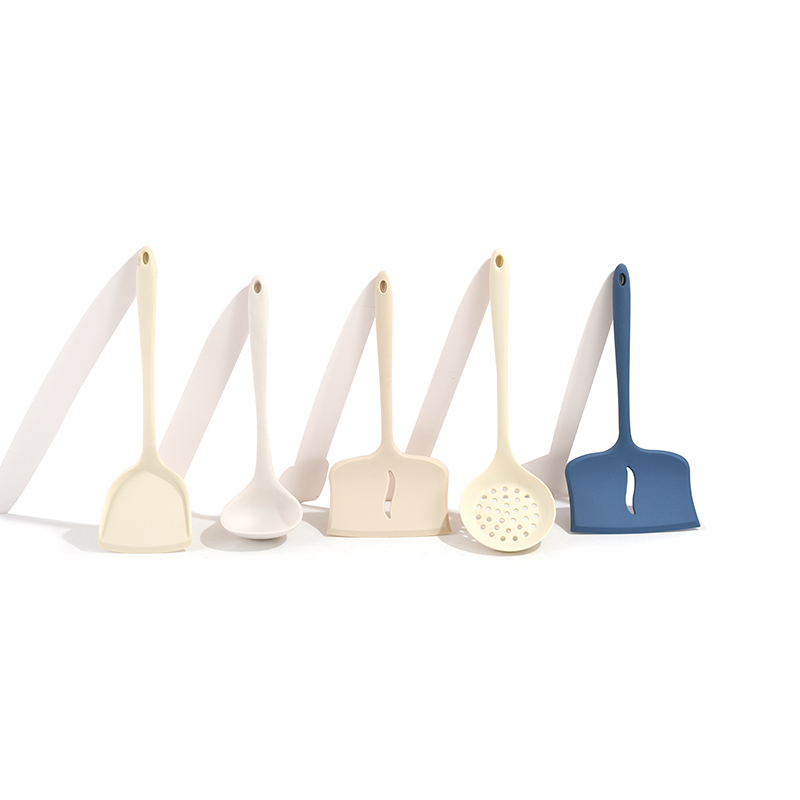
Multicolor Silicone Kitchen Utensil
2. Advantages of the Silicone and Nylon Material Combination
The material selection is one of the most important advantages of this utensil collection. Silicone and nylon address different performance requirements, allowing the product to combine softness, flexibility, strength, and user comfort in one design.
2.1 Cookware-Friendly Contact Performance
One major concern when selecting kitchen utensils is the possibility of scratching cooking surfaces. Metal tools can be effective, but they may damage nonstick coatings or create visible marks when used aggressively. Silicone is softer than metal and is therefore better suited to cookware surfaces that require gentle handling.
The silicone working edge can help reduce direct abrasion during stirring, turning, or scraping. This makes the utensils suitable for use with many aluminum, coated, and other modern cookware products. For retailers, this compatibility is commercially important because consumers increasingly purchase cookware with nonstick or treated surfaces and expect utensils that will not compromise the finish.
Compared with hard plastic tools, silicone can offer a more flexible contact area. The working edge may conform more closely to the surface of a pan or tray, which can assist with lifting food and collecting sauces. Compared with stainless steel utensils, the softer contact surface can provide a more cookware-conscious alternative for everyday use.
2.2 Balanced Flexibility and Structural Support
A utensil that is too rigid may be difficult to use around curved cookware, while one that is too flexible may feel weak when lifting heavier food. The silicone and nylon combination is intended to create a useful middle ground. Silicone supports a degree of flexibility, while nylon contributes to the internal structure and overall shape retention.
This balance is especially valuable for spatulas and pancake shovels. These utensils need enough flexibility to slide under food but sufficient stability to lift it without excessive bending. The same principle benefits the strainer, which must support the weight of ingredients while allowing liquid to pass through its openings.
For a soup ladle, structural stability helps the bowl retain its useful shape while carrying liquid. A stable bowl makes serving more controlled and helps reduce accidental spills. The long form also allows the user to work inside deeper pots without placing the hand too close to heat.
2.3 Lightweight Handling
Kitchen utensils are used repeatedly, sometimes for long periods. Excessive weight can create fatigue, particularly in commercial kitchens, catering operations, and households where several dishes are prepared at once. Silicone and nylon are generally lighter than solid metal alternatives, making them practical for repeated stirring, serving, and flipping.
Lightweight construction also benefits storage and distribution. Retail customers often prefer tools that feel easy to handle immediately after picking them up. For wholesalers, a lightweight product can contribute to efficient carton utilization and manageable shipping weight, although final transport calculations should always be based on confirmed production and packaging data.
2.4 Easy-Care Surface Characteristics
Kitchen utensils must be cleaned frequently. Smooth silicone surfaces are generally easy to wipe, rinse, and wash after use. The absence of complex decorative structures on the working areas can help reduce the accumulation of food residue.
Easy-care performance supports both household convenience and commercial workflow. A utensil that can be cleaned quickly between tasks is useful in restaurants, canteens, food stalls, and catering environments. Buyers should still follow the supplier’s final care instructions and confirm dishwasher suitability before making specific consumer claims on packaging.
2.5 Heat-Use Practicality
Silicone is commonly selected for cooking utensils because it can tolerate the warmth associated with normal cooking tasks. However, heat resistance depends on the specific grade, formulation, thickness, construction, and testing method. Therefore, responsible product communication should use confirmed technical data rather than unsupported temperature claims.
The product’s value lies in its practical design for routine kitchen use. Buyers who require exact heat-resistance figures, food-contact documentation, or dishwasher testing can request the relevant specifications and test records during the purchasing process. This approach helps ensure that marketing statements match the actual production configuration.
3. Functional Benefits of the Four Utensil Shapes
3.1 Spatula for Everyday Cooking
The spatula is one of the most versatile pieces in the collection. Its 32.5-centimeter length offers useful reach, while the approximately 10-centimeter width provides a practical working area for turning and serving food.
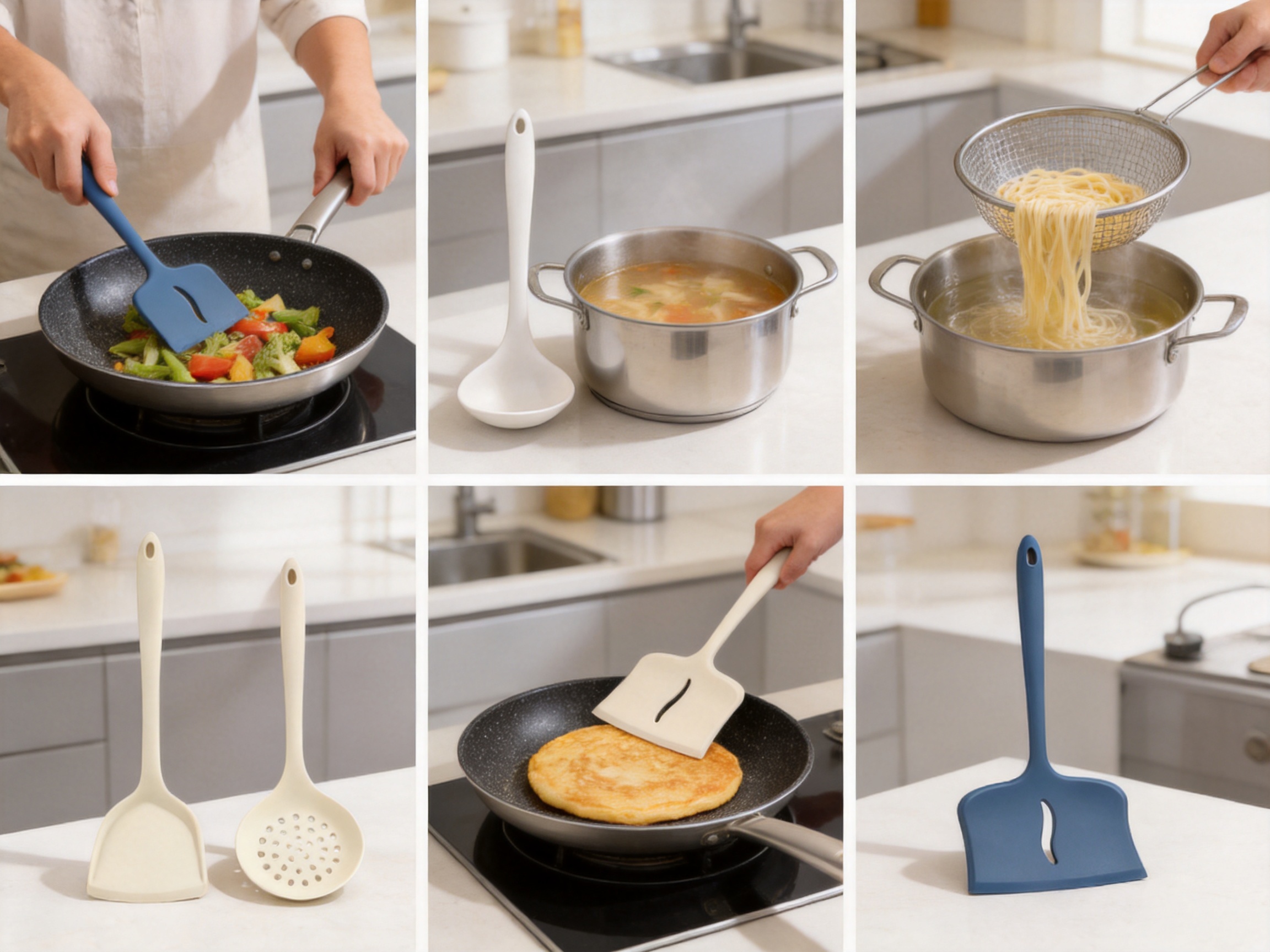
A spatula of this form can support many cooking activities. It can turn vegetables in a sauté pan, lift fried eggs, stir ingredients during shallow frying, move baked items from a tray, and scrape food from a flat surface. The working face is also useful for portioning soft foods and transferring ingredients to a serving plate.
The silicone contact surface is particularly helpful when working with coated pans. Rather than relying on a hard metal edge, the user can slide the utensil beneath food with a softer interface. This can improve confidence during cooking and help preserve the appearance of the cookware.
3.2 Soup Ladle for Liquids and Serving
The soup ladle has an approximately 30-centimeter length and an 8.5-centimeter size specification. Its primary role is to scoop and serve liquids, but its usefulness extends to sauces, gravies, stews, porridge, punch, and other foods that require a deeper serving bowl.
The long form helps create distance from hot liquid and steam. A controlled ladle can also support more consistent portioning in restaurants, buffet service, and home dining. For retailers, the soup ladle adds an important category function to the collection because it expands the assortment beyond flat tools.
When selling the ladle, distributors may emphasize its suitability for everyday serving rather than limiting it to soup alone. The broader application range increases the product’s appeal and helps consumers understand why it belongs in a coordinated utensil set.
3.3 Strainer for Lifting and Draining
The strainer measures approximately 29 by 13 centimeters and is designed to separate food from liquid. This makes it helpful for lifting noodles from boiling water, removing dumplings, transferring vegetables, and collecting fried foods from cooking oil or broth.
Its open structure reduces the amount of liquid carried with the food. This can make serving cleaner and more efficient. In a commercial kitchen, the strainer can assist with repetitive preparation tasks. In a household, it can be useful when a separate colander would be too large for a small portion.
The strainer also adds functional variety to the product collection. Many utensil sets include only spatulas and spoons, while a draining tool gives the assortment a more complete appearance. Buyers can therefore position the collection as a practical multi-function kitchen solution.
3.4 Pancake Shovel for Delicate and Flat Foods
The pancake shovel measures approximately 29 by 13 centimeters. Its broad, flat design is intended for foods that need to be turned or lifted with support across a wider surface.
Pancakes and crepes can tear when lifted with a narrow tool. A wider shovel can distribute contact over more of the food’s surface, helping the user turn it with greater control. The same design is suitable for eggs, burgers, fish fillets, pastries, grilled sandwiches, and other flat foods.
For retail presentation, the pancake shovel can appeal to consumers who enjoy breakfast cooking, baking, and casual home entertaining. Its shape is immediately recognizable, and its use is easy to demonstrate in product photography or point-of-sale displays.
4. Design Advantages Compared with Common Alternatives
The kitchen utensil market includes stainless steel, wood, bamboo, hard plastic, nylon, and silicone products. Each material has strengths, but the silicone and nylon configuration offers a compelling balance for buyers who want a modern, surface-conscious, and visually coordinated collection.
4.1 Compared with Metal Utensils
Metal utensils are known for strength and durability, but they can be unnecessarily hard for certain cookware surfaces. They may also become hot when left in a pan and can feel heavier during extended use. Silicone-based working surfaces offer a softer alternative for users who prioritize nonstick cookware care and comfortable handling.
The collection does not attempt to replace every metal tool in every professional kitchen. Instead, it provides a practical option for routine cooking, serving, and food preparation where surface protection, low weight, and ease of use are important.
4.2 Compared with Wooden Utensils
Wooden tools have a natural appearance and can be attractive in traditional kitchens. However, they may absorb moisture, retain food odors, require more careful drying, and develop surface wear over time. Silicone and nylon offer a more contemporary appearance and can be easier to clean after contact with sauces, oil, and colored ingredients.
The white and blue color options also provide a consistent visual identity that is difficult to achieve with natural wood, where grain and tone vary from piece to piece.
4.3 Compared with Basic Hard Plastic
Hard plastic utensils can be economical, but they may feel less flexible and less refined when used on curved or coated cooking surfaces. Silicone can provide a softer edge and a more comfortable tactile experience. The nylon component helps maintain practical structure, avoiding the overly soft behavior that some consumers associate with low-grade flexible tools.
4.4 Compared with Single-Function Tools
Many low-cost kitchen tools are sold as isolated products with limited application. This collection offers several complementary shapes that cover common cooking and serving tasks. A retailer can sell the items individually, create a four-piece assortment, or combine them with cookware and other kitchen accessories.
This flexibility supports different sales strategies. A budget retailer may offer the utensils as affordable individual additions. A homeware store may present them as a coordinated collection. A cookware distributor may include them as complementary accessories in a broader cookware package.
5. Manufacturing Process and Quality-Oriented Product Development
Reliable kitchen utensils depend not only on the chosen materials but also on how those materials are processed, assembled, inspected, and packed. The product’s silicone and nylon construction requires attention to dimensional accuracy, material consistency, bonding or integration quality, surface finish, and final cleanliness.
5.1 Product Engineering and Mold Development
The manufacturing process begins with product engineering. Each utensil must be developed around its intended task. The spatula requires a working face that can slide beneath food. The ladle requires a bowl capable of holding liquid. The strainer requires a controlled opening pattern. The pancake shovel requires a broad surface that supports turning.
These functional requirements influence mold geometry, thickness distribution, edge shape, connection areas, and overall balance. A professional supplier can use product drawings, samples, and application feedback to refine the design before mass production.
Tooling accuracy is important because repeated production depends on consistent molds. If dimensions vary excessively, utensils may have inconsistent fit, uneven edges, or different handling characteristics. A controlled mold-development process helps maintain repeatability across production batches.
5.2 Material Preparation
Silicone and nylon materials must be prepared according to the intended manufacturing method and product specification. Material preparation may include color matching, moisture management where applicable, weighing, mixing, and batch identification.
Color consistency is particularly important for a multicolor collection. White and blue products should maintain a stable appearance across the same order. Small variations may be acceptable depending on the buyer’s standard, but professional production should establish reference samples and approval procedures before mass manufacturing.
Material traceability also supports quality management. Batch records can help manufacturers identify the source of materials, production dates, and relevant processing conditions. Buyers requiring formal documentation can discuss available records and testing arrangements before placing an order.
5.3 Forming and Integration
The forming stage gives each utensil its working shape. Depending on the final construction, silicone and nylon may be molded, integrated, assembled, or produced through a combination of processes. The goal is to create a stable utensil with smooth surfaces and reliable connection points.
For a spatula or pancake shovel, the edge should be formed without sharp flash, rough projections, or irregular deformation. For the ladle, the bowl should be smooth and sufficiently uniform to support liquid handling. For the strainer, openings should be clean and consistent so that food can pass or drain as intended.
Process control at this stage directly affects user experience. A smooth edge feels better in the hand and against cookware. A uniform bowl supports predictable serving. A clean strainer pattern improves appearance and function. These details distinguish a carefully manufactured utensil from a basic product made with limited process control.
5.4 Trimming and Surface Finishing
After forming, utensils may require trimming, edge finishing, cleaning, and visual inspection. Excess material around parting lines or openings should be removed. Surfaces should be checked for visible marks, contamination, distortion, bubbles, or color defects.
Finishing is especially significant for kitchen products because consumers hold them close to the face and use them around food. A clean, smooth, odor-controlled product creates a stronger impression of quality. Retail buyers also benefit from consistent appearance because uniform products are easier to display and sell.
5.5 Dimensional and Functional Inspection
Inspection can include checking length, width, shape, color, edge condition, connection strength, and overall appearance. The stated dimensions provide a useful reference for production control, while reasonable manufacturing tolerances should be confirmed in the buyer’s technical agreement.
Functional checks may include placing the utensil on a flat surface, applying normal hand pressure, testing the movement of the working edge, checking the ladle bowl for leakage, and examining the strainer for blocked or incomplete openings. Packaging inspection is also important because even a well-made product can be damaged by poor carton loading or excessive compression.
5.6 Packaging and Carton Efficiency
The stated carton configuration is 100 pieces per carton. The carton size is approximately 50 by 30 by 15 centimeters, with a calculated volume of 0.0225 cubic meters and a carton weight of approximately 13.5 kilograms.
These specifications are useful for importers planning warehouse capacity, container loading, freight quotations, and distribution. However, carton dimensions and weight should be reconfirmed for the final mix of colors, individual packaging, labels, and accessories. Packaging changes can affect both carton volume and gross weight.
Efficient carton packing is an important commercial advantage. A compact carton can reduce storage requirements and help buyers organize mixed product shipments. The supplier’s broader kitchenware portfolio may also support consolidated purchasing, allowing cookware and utensils to be planned within one sourcing program.
6. Supplier Strengths and One-Stop Kitchenware Sourcing
The supplier behind this collection operates from Zhejiang, China, a region widely associated with manufacturing, trading, and export-oriented production. Its product scope includes aluminum cookware, stainless steel cookware, iron cookware, and kitchen utensils.
This category breadth is valuable to buyers who do not want to manage multiple small suppliers for every kitchen product. A single sourcing partner can coordinate cookware and utensil selections, discuss compatible colors and packaging, and support a more unified product strategy.
6.1 Broad Product Coverage
A supplier offering multiple cookware materials can help buyers build a more complete assortment. Aluminum cookware can serve customers looking for lightweight cooking products. Stainless steel cookware can target durability and polished appearance. Iron cookware can appeal to consumers who prefer heat retention and traditional cooking performance. Kitchen utensils complete the practical use of these cookware categories.
This product coverage enables retailers to develop collections rather than isolated stock keeping units. For example, a cookware set can be paired with a blue utensil range, or a cast iron product line can be supported by silicone tools that protect cooking surfaces and improve handling comfort.
6.2 Flexible Customization Support
The supplier identifies OEM and ODM customization as part of its service capability. For buyers, this may include adjustments to color, packaging, labeling, product combinations, and other agreed specifications. The exact scope depends on order quantity, tooling requirements, material availability, and production feasibility.
Customization can be especially useful for private-label retailers. A buyer may request a particular shade of blue, a custom carton design, multilingual packaging, or a selected combination of the spatula, ladle, strainer, and pancake shovel. Product modifications should be documented through approved samples and written specifications before production begins.
6.3 Certification Assistance
The supplier also provides product certification assistance. This is important because kitchen utensils may be subject to food-contact, labeling, packaging, chemical, and market-specific requirements. Requirements differ between countries and sales channels, so buyers should identify the destination market at the quotation stage.
Certification assistance should be understood as support in arranging or preparing documentation, not as an automatic guarantee that every product configuration meets every regulation. The final compliance responsibility depends on the product specification, testing scope, destination market, and importer’s obligations.
6.4 Flexible Minimum Order Planning
Flexible minimum order quantities can benefit small and medium-sized kitchenware buyers. Large retailers may require substantial volume, while emerging brands may prefer to test the market with a smaller initial shipment. Flexible order planning can help buyers reduce inventory risk and evaluate customer response before expanding.
Order quantities should be discussed together with color ratios, packaging options, sample requirements, production lead time, and shipment terms. A low quantity for one color or one individual item may require different planning from a mixed order containing all four utensils.
6.5 Supply Chain Partnership
The supplier’s stated objective is to develop into an R&D-driven supply chain partner rather than simply accept orders. This approach is relevant to buyers seeking long-term product development. A supply chain partner can contribute to product selection, market positioning, packaging improvements, sample evaluation, and assortment planning.
For kitchenware businesses, such cooperation can reduce the time required to move from an idea to a saleable product. It can also help buyers identify complementary items and avoid unnecessary duplication across their assortment.
7. Commercial Applications and Target Markets
The Multicolor Silicone Kitchen Utensil collection can serve several market segments because its forms are familiar, its material combination is practical, and its packaging data supports wholesale distribution.
7.1 Household Retail
Home consumers need utensils for daily cooking, breakfast preparation, serving, and cleaning up. The four-piece range covers several common tasks without requiring an overly large set. White and blue colors can appeal to buyers who prefer clean, simple, and modern kitchen accessories.
Retail packaging can emphasize the product’s compatibility with everyday cookware, lightweight handling, coordinated appearance, and multi-function use. Care instructions and any confirmed food-contact or heat-related information should be presented clearly.
7.2 Online Retail
Online sellers can present the utensils individually or as a bundle. Product pages can include measurements, material information, close-up images, usage examples, color options, and carton details for business customers.
Because the shapes are visually distinct, the collection is suitable for image-led merchandising. A shopper can understand the purpose of the spatula, ladle, strainer, and pancake shovel quickly when each item is shown from a clear angle. Accurate dimensions are important because online buyers cannot physically hold the product before purchase.
7.3 Restaurants and Catering Businesses
Restaurants, cafeterias, catering companies, and food stalls require utensils that support repetitive preparation and serving. The collection can be used in cooking stations, preparation areas, buffet service, and back-of-house operations.
Commercial users may purchase multiple pieces of the same item, particularly spatulas, ladles, and strainers. The stated carton quantity of 100 pieces can be useful for distributors supplying food-service accounts, though the final packing arrangement should be confirmed for each order.
7.4 Hospitality and Rental Properties
Hotels, serviced apartments, student residences, holiday rentals, and property-management companies often need practical kitchen accessories for many rooms or units. A coordinated utensil collection helps standardize the guest experience and simplifies replenishment.
The compact carton volume can support centralized storage and scheduled replacement programs. Buyers serving this market may also combine the utensils with cookware, cutlery, storage products, and other kitchen essentials from the same supplier.
7.5 Promotional and Private-Label Programs
Kitchen utensils are suitable for promotional campaigns because they are practical, easy to distribute, and frequently used. Retail brands, food companies, home appliance businesses, and cookware sellers may use a customized utensil as a promotional item or an add-on product.
Private-label programs can use the collection to strengthen brand recognition through custom packaging, coordinated color schemes, and carefully selected product bundles. The feasibility of logo printing, packaging changes, or product adjustments should be reviewed with the supplier before quotation approval.
8. Purchasing, Inspection, and Import Considerations
Professional purchasing requires more than confirming the product name and unit price. Buyers should establish a clear specification covering materials, dimensions, colors, packaging, labeling, quantity, inspection standards, and destination-market requirements.
8.1 Confirming the Product Specification
The buyer should confirm whether the order includes all four item types or only selected products. The codes ZY01, ZY02, ZY03, and ZY05 should be matched to the correct utensil names in the purchase documentation. This prevents confusion when preparing invoices, cartons, labels, and warehouse records.
Color selection should also be recorded. The available colors are white and blue, but the buyer should clarify the color ratio and whether a specific color reference or approved sample is required. If the products are intended for a private-label program, packaging colors should be coordinated with the utensil colors.
8.2 Confirming Material and Compliance Documentation
The listed material is silicone plus nylon. Buyers should request the final material specification and determine whether the product is intended for food contact in the target market. Where required, the supplier can assist with relevant certification or testing procedures.
Documents may include material declarations, test reports, inspection records, packaging information, and certificates appropriate to the destination market. The exact document list should be agreed before mass production so that testing does not delay shipment.
8.3 Sample Approval
Pre-production samples are valuable for checking color, dimensions, flexibility, edge finish, surface appearance, and packaging. The approved sample should be retained as a reference for mass production inspection.
For buyers ordering several colors or product types, each variation should be checked. A white spatula may show surface marks more clearly than a blue utensil, while a strainer may require more detailed inspection of openings and edges. Sample approval reduces the possibility of misunderstandings between buyer and supplier.
8.4 Quality Inspection Points
Common inspection points include correct product type, correct quantity, color consistency, dimensional accuracy, smooth edges, clean surfaces, absence of visible contamination, stable connections, and appropriate packaging. The utensil should also be checked for deformation caused by storage or carton compression.
Buyers may use a pre-shipment inspection company or an internal quality team. Inspection criteria should be written in advance, including acceptable defect limits and the treatment of minor cosmetic variations.
8.5 Logistics Planning
The carton specification of 50 by 30 by 15 centimeters, approximately 0.0225 cubic meters, and approximately 13.5 kilograms provides a starting point for logistics planning. With 100 pieces per carton, buyers can estimate warehouse volume and approximate unit packing efficiency.
Actual freight planning should account for outer packaging, pallets, mixed cartons, loading method, destination port, and shipping terms. Buyers should request final carton measurements and gross weight after packaging artwork and product quantities are confirmed.
9. Merchandising and Product Positioning
The product can be positioned as a practical, modern, and cookware-friendly utensil collection. Its strongest commercial messages should focus on clear consumer benefits rather than exaggerated technical claims.
Suitable positioning themes include everyday cooking convenience, soft contact for compatible cookware, lightweight handling, coordinated colors, multi-function use, easy cleaning, and efficient storage. The four utensil shapes allow sellers to explain the collection through real cooking scenarios.
Retail displays can place the spatula and pancake shovel together as turning tools, the ladle as a serving tool, and the strainer as a draining tool. This grouping helps shoppers understand the logic of the collection and encourages multi-item purchases.
For business-to-business catalogs, product pages should include the SKU, material, color options, dimensions, carton quantity, carton size, volume, and carton weight. Complete information makes it easier for distributors to calculate landed cost, shelf allocation, and order quantities.
Online descriptions should avoid unsupported claims such as guaranteed extreme-temperature resistance, universal dishwasher safety, or compliance with every international regulation. Such statements should only be used when supported by the final product specification and appropriate testing.
10. Sustainability and Responsible Product Development
Responsible kitchenware development involves durability, material efficiency, packaging control, and transparent communication. A utensil that remains useful over repeated cooking cycles can reduce the need for frequent replacement. Lightweight construction may also reduce material use and transport weight compared with heavier alternatives, although environmental performance should be evaluated using complete product data.
The supplier’s stated interest in sustainable and healthy product development creates an opportunity for buyers to discuss improved packaging, reduced unnecessary inserts, recyclable carton materials, and longer-lasting product designs. Sustainability goals should be translated into measurable specifications whenever possible.
Packaging optimization is another practical area. The stated carton dimensions suggest a compact wholesale format, but buyers can review whether individual plastic bags, paper sleeves, printed cartons, or bulk packing best suit their market. Packaging should protect the product without creating unnecessary waste.
Clear care instructions can also extend product life. Consumers should be advised to use the utensils for their intended cooking tasks, avoid direct contact with open flames unless specifically approved, and follow the confirmed cleaning recommendations. Accurate guidance supports both product satisfaction and responsible use.
11. Why This Collection Is a Strong Wholesale Choice
The Multicolor Silicone Kitchen Utensil collection combines several qualities that are important in wholesale purchasing. It has recognizable product forms, broad everyday applications, manageable specifications, coordinated colors, and a material combination suited to modern cookware.
Its main competitive advantage is balance. The collection is not limited to one specialty cooking task, and it does not depend on a single material benefit. Silicone contributes a soft, cookware-conscious working surface. Nylon supports structure. The four utensil shapes cover cooking, serving, draining, and flipping. White and blue options provide visual variety without creating an overly complicated assortment.
The collection is also supported by a supplier capable of offering broader kitchenware sourcing. Buyers can discuss cookware, utensils, customization, certification assistance, flexible minimum order planning, and product development with one manufacturing partner.
For small and medium-sized kitchenware businesses, this combination can simplify procurement and reduce the effort required to build a complete product line. For larger distributors, the collection can function as a complementary accessory range alongside aluminum, stainless steel, or iron cookware.
12. Frequently Asked Questions
Q1: What products are included in the collection?
The collection includes a spatula, soup ladle, strainer, and pancake shovel. Buyers may request the complete assortment or discuss purchasing selected items, subject to order and production conditions.
Q2: What materials are used?
The listed material is silicone plus nylon. The silicone supports a softer contact surface and flexible handling, while nylon contributes structural support. Buyers should confirm the final material grade and available documentation for their target market.
Q3: What colors are available?
The listed colors are white and blue. Color ratios, shade references, and packaging coordination should be confirmed before production.
Q4: Are the utensils suitable for nonstick cookware?
The silicone working surfaces are designed to provide a softer contact option than hard metal tools and are suitable for use with many compatible cookware surfaces. Buyers should follow the care instructions and avoid using the product in ways not covered by the final specification.
Q5: What are the product dimensions?
The spatula is approximately 32.5 by 10 centimeters, the soup ladle is approximately 30 by 8.5 centimeters, the strainer is approximately 29 by 13 centimeters, and the pancake shovel is approximately 29 by 13 centimeters.
Q6: How many pieces are packed in one carton?
The stated carton quantity is 100 pieces. The exact quantity may depend on the final product mix and packaging configuration, so it should be confirmed on the commercial order documents.
Q7: What are the carton dimensions and weight?
The stated carton size is approximately 50 by 30 by 15 centimeters. The carton volume is approximately 0.0225 cubic meters, and the carton weight is approximately 13.5 kilograms.
Q8: Can the product be customized?
The supplier supports OEM and ODM customization. Possible options may include colors, product combinations, labels, packaging, and selected design adjustments. Feasibility depends on order quantity, tooling, materials, and production requirements.
Q9: Can the supplier assist with certifications?
Certification assistance is available as part of the supplier’s service capabilities. Buyers should identify the destination country and sales channel early so that the correct testing and documentation requirements can be reviewed.
Q10: Is the collection suitable for commercial kitchens?
The utensils are suitable for many routine commercial cooking and serving tasks. Restaurants, caterers, cafeterias, and hospitality businesses should evaluate the products against their specific heat, cleaning, durability, and regulatory requirements before making a large purchase.
Q11: Can the utensils be purchased together with cookware?
Yes. The supplier provides aluminum cookware, stainless steel cookware, iron cookware, and kitchen utensils. This allows buyers to explore coordinated cookware and utensil sourcing through one kitchenware supply channel.
Q12: What should buyers inspect before shipment?
Buyers should inspect product type, quantity, dimensions, colors, surface finish, edge smoothness, structural stability, packaging quality, carton markings, and any required compliance documents. An approved sample should be used as the production reference whenever possible.
Conclusion
The Multicolor Silicone Kitchen Utensil collection is a practical solution for buyers seeking a coordinated range of everyday cooking tools. Its silicone and nylon construction offers a useful balance of soft cookware contact, structural support, lightweight handling, and modern appearance. The spatula, soup ladle, strainer, and pancake shovel cover a broad range of cooking and serving activities, making the collection suitable for household retail, online sales, hospitality, food service, promotional programs, and private-label distribution.
The product’s wholesale value is strengthened by clear specifications, compact carton packing, white and blue color options, and support for customization. The supplier’s broader capabilities in cookware and kitchen accessories also create opportunities for one-stop sourcing, product development, OEM and ODM programs, flexible minimum order planning, and certification assistance.
For the strongest purchasing result, buyers should confirm the final material grade, dimensions, color references, packaging structure, compliance documents, inspection standards, and shipping details before production. When these elements are carefully managed, the collection can become a reliable and commercially attractive addition to a modern kitchenware assortment.
References
1. General principles of silicone and nylon material selection for household kitchen utensils.
2. Common quality-control practices for molded kitchenware and food-contact accessories.
3. Product specification information supplied for the Multicolor Silicone Kitchen Utensil collection.
4. Standard considerations for cookware-compatible utensil design and nonstick surface protection.
5. Wholesale packaging and carton-volume planning practices for kitchenware distribution.
6. General guidance on OEM, ODM, product sampling, inspection, and market-specific certification support.
Product: Multicolor Silicone Kitchen Utensil
Recommended Articles
Product Category
Related products
-
-
This cookware set has a ceramic non-stick inner liner, a heat-resistant wooden h...
See Details -
This cookware set is made of food-grade non-stick material, with a unique eye-ca...
See Details -
This off-white cookware set is made of wear-resistant non-stick material, with w...
See Details
Whether you're looking for bulk purchases or have any custom requirements, We are here to offer the best
solutions for you.
tiffany.zhong@echocn-trading.com
PHONE
+86-19561173975
+86-19557020621 (Hazel Wu)
ADD
Room 301, Unit 3014, No. 175 Qifeng Avenue, Wenqiao Town, Taizhou, Zhejiang, China
Fill Out the Form for More Information
Copyright © Zhejiang Echo Industry And Trade Co., Ltd.
All Rights Reserved.

China Cookware Set Manufacturer