
 en
 Español

This cookware set features a non-stick coating, even heat conduction, and multi-...
See Details
How a Multi-Function Nonstick Cookware Set Improves Modern Kitchen Performance
Date:Oct 15, 2026

Choosing cookware for a home, restaurant, hospitality project, or retail program involves much more than selecting attractive shapes. A dependable cookware set must distribute heat effectively, release food cleanly, withstand repeated use, support several cooking methods, and remain practical to wash and store. The OCEAN WAVE Nonstick Aluminium Pot and Pan Set is designed around these everyday requirements, combining a light beige granite-speckled appearance with several useful pan formats and capacities.
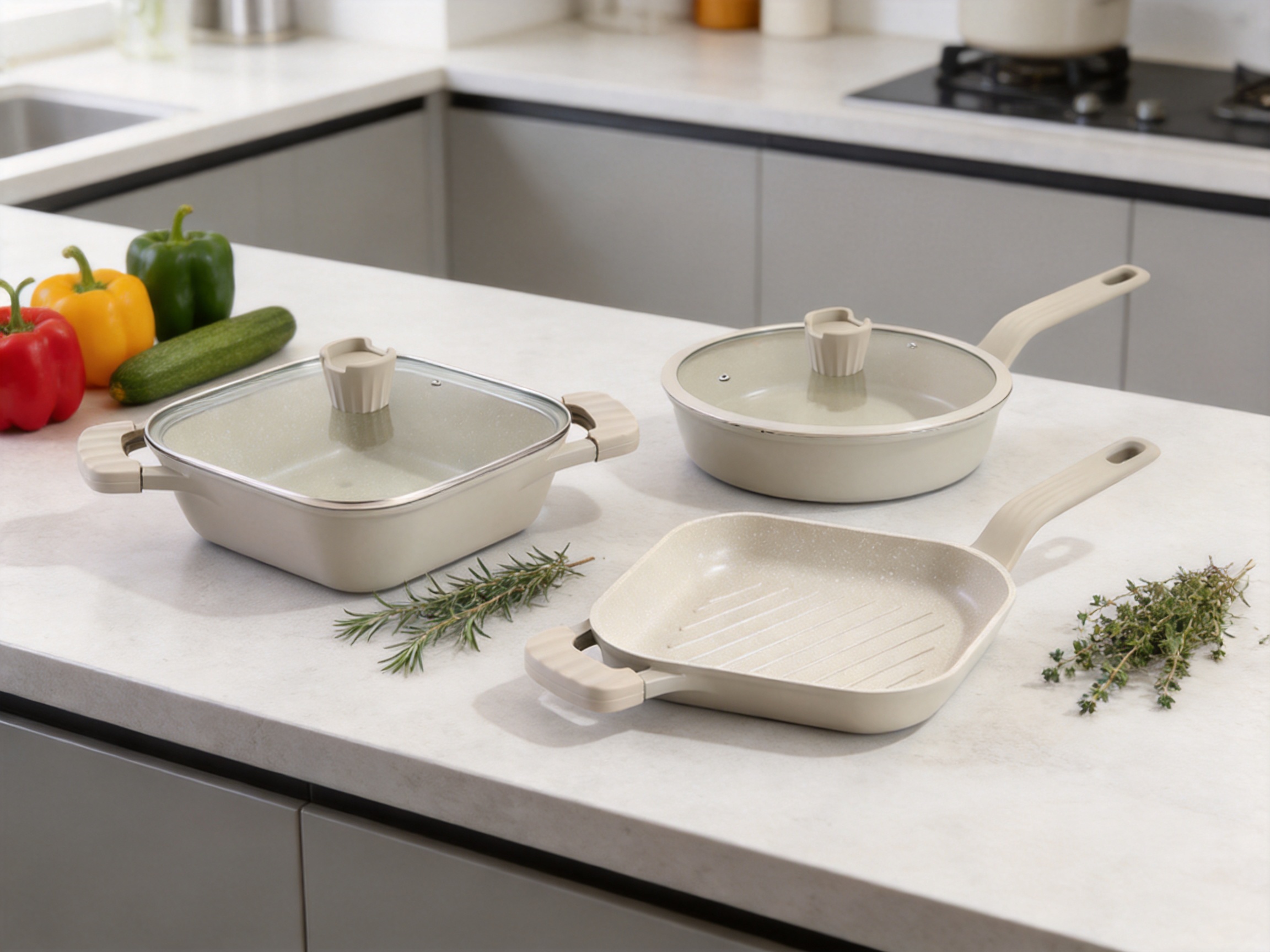
The collection is positioned as a multi-function cookware solution rather than a single-purpose frying pan or basic pot set. Its product range includes a square deep pot, a round frypan with glass lid, and a square grill pan. This combination enables users to prepare sauces, stews, stir-fries, grilled foods, fried dishes, one-pan meals, and family-sized recipes with a coordinated group of utensils.
For buyers comparing cookware suppliers, the set also represents a broader sourcing opportunity. Zhejiang Echo Industry And Trade Co., Ltd., operating under the ECHO KITCHENWARE name, supplies aluminum cookware, stainless steel cookware, iron cookware, and kitchen utensils. Its business model combines product variety, OEM and ODM support, flexible minimum order quantities, product certification assistance, and one-stop sourcing for buyers in different markets.
The following article examines the design, construction, cooking performance, maintenance requirements, commercial advantages, and supplier strengths associated with this cookware set.

OCEAN WAVE Nonstick Aluminium Pot and Pan Set
1. Product Overview and Design Concept
The OCEAN WAVE set uses a light beige body with a granite-speckled surface. This color direction gives the cookware a softer and more contemporary appearance than the traditional black or metallic finish commonly seen in mass-market cookware. The Nordic-inspired styling is minimalist, making the set suitable for modern kitchens where cookware may be stored visibly on open shelves, racks, or counters.
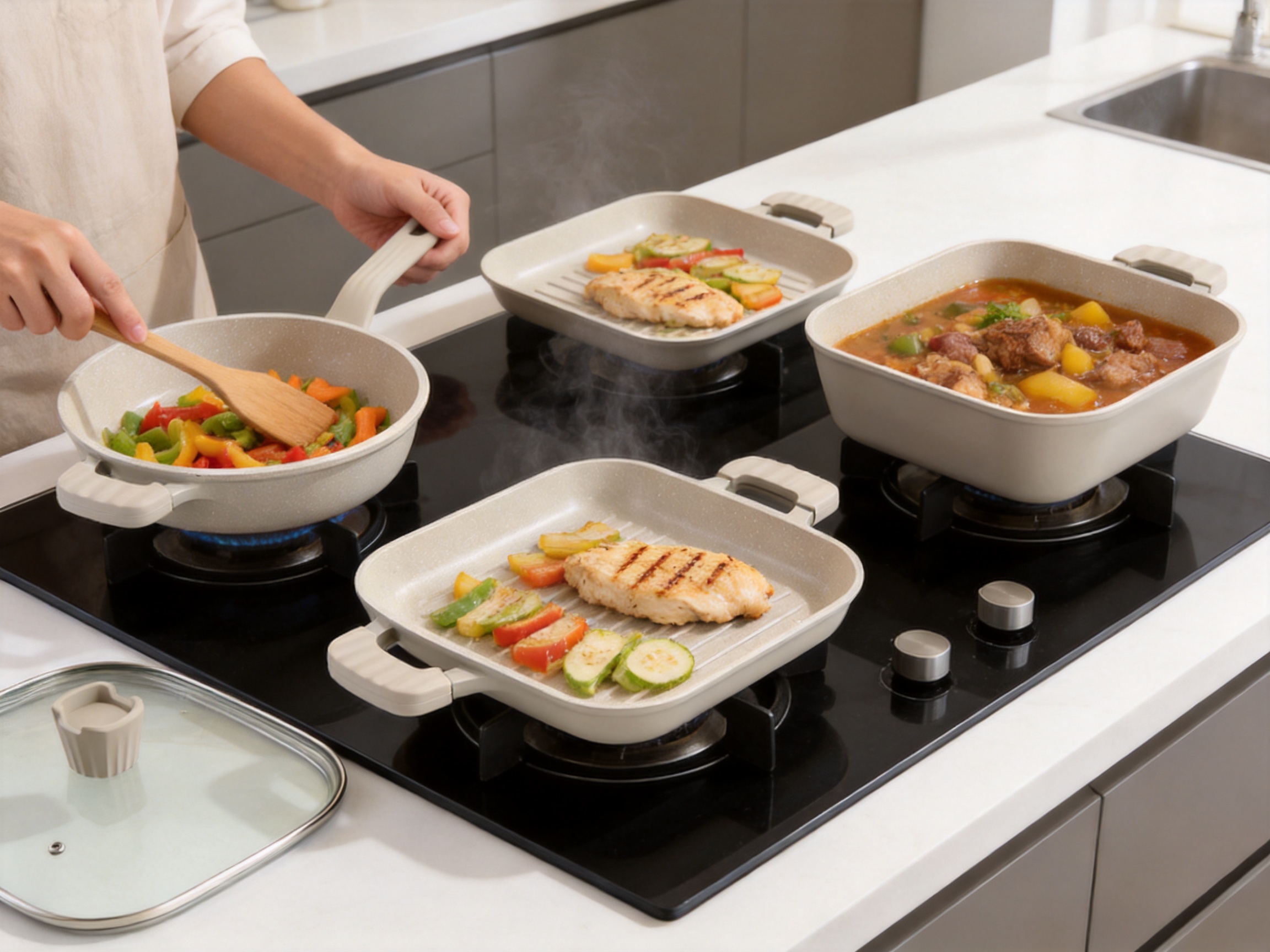
Although visual appearance is important, the main value of the set comes from its combination of form and function. Different cookware shapes serve different culinary purposes. A grill pan provides raised cooking surfaces for meat, vegetables, sandwiches, and seafood. A frypan supports sautéing, frying, reheating, and shallow cooking. A square casserole or deep pot creates additional volume for soups, braised dishes, pasta, rice-based meals, and family recipes.
Many basic cookware packages focus on quantity by including several pieces with overlapping uses. This set takes a more practical multi-shape approach. The square deep pot and square grill pan provide cooking surfaces that differ from the usual round formats, while the round frypan remains familiar and versatile. The result is a collection that can support both everyday cooking and presentation-oriented meal preparation.
The food-grade nonstick interior is another central feature. A nonstick surface helps reduce the amount of oil needed for many recipes and allows food to separate from the cooking surface more easily. It can also make cleaning faster when the cookware is handled correctly. For busy households, catering operations, and retail customers seeking convenient cookware, these benefits are important purchasing considerations.
Core Product Characteristics
| Feature | Product Benefit | Practical Application |
|---|---|---|
| Aluminum construction | Lightweight handling and responsive heating | Daily cooking, food service, and household use |
| Granite-speckled exterior | Contemporary appearance and coordinated visual identity | Modern retail collections and kitchen displays |
| Food-grade nonstick interior | Easy food release and reduced cleaning effort | Frying, sautéing, grilling, and low-oil cooking |
| Multiple cookware shapes | Supports different preparation methods | Soups, stews, grilled foods, fried dishes, and sauces |
| Glass lid option for frypan | Allows cooking visibility and moisture control | Simmering, covered frying, and one-pan meals |
| All-stovetop compatibility | Broadens market and household suitability | Gas, electric, and other compatible stovetop formats |
The available sizes provide flexibility for different household and commercial requirements. The grill pan is offered in 24 by 24 by 4.5 centimeters with a 1.7-liter capacity and 28 by 28 by 5 centimeters with a 3.0-liter capacity. The frypan with glass lid is available in 24 by 6.5 centimeters with a 2.2-liter capacity, 26 by 6.9 centimeters with a 2.7-liter capacity, and 28 by 7.5 centimeters with a 3.5-liter capacity.
The square casserole is offered in 28 by 28 by 8.9 centimeters with a 5.3-liter capacity and 24 by 24 by 8.5 centimeters with a 3.5-liter capacity. These specifications allow importers, distributors, and retailers to select a suitable assortment instead of ordering a single fixed configuration for every market.
2. Why Aluminum Is a Practical Cookware Material
Aluminum is widely used in cookware because it provides a useful balance between weight, thermal responsiveness, and production flexibility. Compared with many heavier cookware materials, aluminum products are easier to lift, move, stack, and handle during cooking. This advantage is particularly relevant for large pots and deep casserole formats.
Aluminum also responds relatively quickly to changes in heat. When a cook adjusts the burner, a responsive cooking body can help the cookware adapt without the long waiting period associated with some heavier materials. This is helpful for sautéing, pan-frying, simmering, and recipes that require frequent temperature changes.
The lightweight nature of aluminum can improve the user experience. A large 5.3-liter square casserole, for example, may be used to prepare food for a family or group, but it should still be manageable when empty and reasonably practical when being transferred from the stovetop to a serving area. Product weight, handle design, balance, and user technique remain important, but aluminum provides a strong foundation for manageable cookware.
Aluminum is also suitable for forming products in different geometries. This supports the set’s distinctive square casserole and square grill pan designs. A supplier with experience in aluminum cookware can develop multiple shapes, sizes, finishes, and surface treatments while maintaining a coherent product family.
Heat Responsiveness and Cooking Control
Heat control is one of the most important factors in everyday cooking. A frying pan that responds predictably helps users brown ingredients, soften vegetables, reduce sauces, and cook delicate foods with greater confidence. The aluminum body of the OCEAN WAVE cookware is intended to support this type of responsive cooking experience.
Users should still select an appropriate burner size and avoid allowing the flame or heat source to extend beyond the cookware base. Excessive side heat can damage exterior finishes, handles, and surrounding surfaces. Good performance depends not only on the cookware material but also on suitable heat settings and correct stovetop use.
The all-stovetop compatibility claim broadens the potential use of the set. However, buyers should verify the exact compatibility requirements for their local cooking equipment, particularly where specialized or unusually configured stovetops are involved. Product instructions, retailer guidance, and market-specific testing should be used as part of responsible product communication.
3. The Multi-Shape Advantage
The key competitive advantage of this cookware collection is not simply that it contains multiple pieces. Its stronger advantage is that the pieces perform different roles. A well-planned cookware set can reduce the need to purchase separate pans for every cooking method, while still offering more useful formats than a collection made entirely from similar round saucepans.
Square Grill Pan
The square grill pan creates a broad cooking surface suitable for grilled meat, poultry, seafood, vegetables, sandwiches, and other foods that benefit from direct contact with raised ridges. The square format can make efficient use of stovetop space and may provide more usable surface area than a small round pan of a similar nominal dimension.
The 24-centimeter model has a 1.7-liter capacity and a depth of 4.5 centimeters. It is suitable for individual servings, compact kitchens, couples, and smaller meals. The 28-centimeter model has a 3.0-liter capacity and a depth of 5 centimeters, making it more appropriate for larger portions or shared meals.
Raised grill surfaces can help create visual searing lines and allow some rendered fat or cooking moisture to collect away from the primary contact points. Users should preheat carefully, avoid overheating the empty pan, and select cooking temperatures that match the recipe. Because the interior is nonstick, metal tools and sharp utensils should not be used.
Round Frypan with Glass Lid
The round frypan is the most familiar and widely useful component in the set. It can be used for eggs, pancakes, vegetables, meat, fish, sauces, reheating, and quick one-pan meals. The glass lid adds another layer of flexibility by allowing users to monitor food without removing the cover repeatedly.
A lid is particularly useful when a dish needs to retain moisture, simmer gently, or finish cooking after initial browning. It can also reduce splashing during covered cooking. The available sizes range from 2.2 liters to 3.5 liters, giving buyers several options for different customer groups and sales channels.
The 24-centimeter frypan is suitable for smaller households and individual meal preparation. The 26-centimeter option provides a middle size for common daily cooking. The 28-centimeter frypan offers greater capacity for families, larger portions, or recipes requiring more surface area.
Square Casserole
The square casserole is the largest-volume format within the collection. With capacities of 3.5 liters and 5.3 liters, it is suitable for stews, curries, soups, braised dishes, pasta meals, rice dishes, and other recipes that benefit from depth.
The square design can be especially useful when arranging ingredients in rows or layers. It may also create a distinctive serving presentation when the cookware is brought directly to the table, provided safe handling procedures are followed. The deeper body gives users greater capacity while the nonstick interior can help reduce sticking during longer cooking processes.
For retail and wholesale buyers, the casserole also helps position the set above entry-level frying-pan packages. It demonstrates that the product line is intended for complete meal preparation rather than occasional shallow frying alone.
4. Nonstick Performance and Everyday Convenience
The food-grade nonstick interior is designed to make cooking and cleaning more convenient. Food release is especially helpful for ingredients such as eggs, fish, pancakes, vegetables, and foods prepared with limited oil. A smooth release surface can also reduce the amount of residue left behind after cooking.
Nonstick cookware is often compared with uncoated stainless steel or traditional iron cookware. Stainless steel can provide excellent durability and high-temperature performance, but it may require more oil, stronger preheating control, and more cleaning effort to prevent sticking. Iron cookware can deliver strong heat retention, but it is heavier and generally requires more deliberate seasoning and maintenance. Nonstick aluminum cookware provides a different balance: lighter handling, quick heat response, and convenient food release.
These comparisons do not mean that one material is suitable for every recipe. High-temperature searing, oven use, induction requirements, and long-term maintenance must be evaluated according to the product’s specifications. The strength of the OCEAN WAVE set lies in its suitability for everyday stovetop cooking where convenience, versatility, and easy maintenance are priorities.
Advantages Over Basic Competitor Sets
Compared with low-cost sets that rely on thin, visually generic pans, this collection offers several points of differentiation. The granite-speckled finish gives the product a more coordinated retail appearance. The combination of square and round shapes creates a stronger multi-function proposition. The inclusion of several capacities makes the range easier to match with different customer requirements.
The set also provides a clear lifestyle message. It is not limited to professional chefs or specialty cooking techniques. It is intended for modern users who value simple cleaning, attractive design, flexible meal preparation, and cookware that can support several types of dishes.
For distributors, these features can support product segmentation. Smaller frypans and grill pans may appeal to compact households, while larger casseroles and complete combinations may suit family-oriented retail, housewarming promotions, hospitality packages, or kitchen renovation projects.
Product differentiation is most effective when it is supported by clear usage instructions. Retailers should communicate the benefits of the nonstick surface while also explaining appropriate utensil selection, heat control, cleaning, and storage. This creates realistic customer expectations and can help reduce avoidable product damage.
5. Manufacturing and Product Development Strengths
Zhejiang Echo Industry And Trade Co., Ltd. is based in Taizhou, Zhejiang, China, a region known for manufacturing and export activity. The company’s stated business direction is to provide kitchenware solutions for small and medium-sized buyers worldwide rather than functioning only as an order-taking intermediary.
This positioning is important because cookware buyers often require more than a catalog product. They may need a particular color, handle configuration, assortment, packaging format, logo application, capacity mix, or compliance document. A supplier capable of coordinating product development and supply-chain services can reduce the number of separate vendors involved in a project.
Aluminum Forming and Shape Development
Aluminum cookware production requires controlled forming to create consistent walls, bases, corners, rims, and cooking surfaces. The square casserole and square grill pan require particular attention to corner geometry and surface continuity. Consistency is important because uneven edges or irregular surfaces can affect appearance, handling, cleaning, and packaging.
A capable product development process begins with design drawings, dimensional confirmation, prototype review, and sample approval. Once the product specification is accepted, production teams can organize tooling, forming, finishing, coating, assembly, inspection, and packing according to the approved standard.
For buyers, the ability to develop multiple shapes within one visual collection is a useful manufacturing strength. It helps maintain consistency in color, surface appearance, handle style, branding, and packaging across different product formats.
Surface Treatment and Nonstick Coating Management
Nonstick cookware requires careful coordination between the aluminum body and the interior surface treatment. The cooking surface must be properly prepared before coating, and the coating process must be controlled to achieve an even finish. Visual consistency, adhesion, coverage, and resistance to normal use are all relevant quality considerations.
Granite-speckled finishes also require attention to color consistency and decorative particle distribution. Buyers usually expect pieces from the same collection to look coordinated. A reliable supplier should therefore manage sample confirmation and production comparison so that the final goods remain close to the approved appearance.
The available product information identifies the interior as food-grade nonstick. For specific markets, buyers may request documentation or testing related to food-contact requirements, coating composition, heavy metals, migration, or other applicable regulations. ECHO KITCHENWARE states that it can assist with product certification, which can support importers as they organize market-specific compliance requirements.
Inspection and Production Coordination
Cookware quality is influenced by many production stages. Dimensional inspection helps confirm that the product matches the approved size. Visual inspection can identify scratches, coating defects, color variation, edge irregularities, and assembly issues. Functional checks may include lid fit, handle stability, surface condition, and packaging protection.
Although detailed factory inspection procedures should be confirmed for each order, the company’s one-stop sourcing model creates a framework for coordinating these activities. Buyers can establish inspection standards before production begins and identify which characteristics are critical, major, or minor defects.
Production coordination is particularly valuable when an order includes several sizes and shapes. Each variation must be tracked accurately to prevent mixing during assembly and packing. Clear product codes, such as the SKU DL07 associated with this collection, can support internal organization and purchasing communication.
ODM, OEM, and Customization Support
The company offers ODM and OEM customization. OEM service may be useful for buyers who already have a product concept, brand identity, or packaging system and need a manufacturing partner to produce according to agreed specifications. ODM service can help buyers who want to select from an existing design platform while adapting color, assortment, branding, or packaging.
Customization may include logo placement, carton design, color development, product combinations, size assortment, instruction materials, and retail presentation. Every customization should be confirmed through approved samples and written specifications so that design expectations are clear before mass production.
Flexible minimum order quantities can be helpful for small and medium-sized buyers testing a new range. A lower-risk launch may begin with selected sizes or a limited color program before expanding into additional cookware categories. MOQ terms depend on the requested customization, tooling, packaging, and production plan, so buyers should request a project-specific quotation.
6. Supplier Advantages for Global Buyers
International cookware sourcing involves product quality, communication, documentation, lead times, packaging, shipping, and after-sales coordination. A supplier that offers several related categories can simplify procurement. Instead of sourcing aluminum cookware from one factory, stainless steel cookware from another, iron cookware from a third, and utensils from a fourth, buyers can explore a broader range through one kitchenware partner.
ECHO KITCHENWARE’s product coverage includes aluminum cookware, stainless steel cookware, cast iron cookware, and kitchen utensils. This variety enables buyers to develop coordinated collections that include nonstick everyday pans, durable stainless steel items, heavier iron cookware, and accessory products.
The company’s location in Zhejiang supports access to an established manufacturing and export environment. Zhejiang has a strong industrial base and extensive experience serving international customers. For overseas buyers, regional supplier experience can help with export documentation, packaging expectations, and communication about product specifications.
The company also presents itself as an R&D-driven supply-chain partner. This is relevant to buyers who want to develop products that respond to market trends such as healthier cooking, sustainable materials, compact kitchens, modern colors, multifunctional designs, and improved storage efficiency.
Support for Retail and Distribution Programs
Retailers need cookware that can be explained quickly and displayed attractively. The OCEAN WAVE set offers several straightforward selling points: a contemporary beige granite appearance, multiple pan shapes, nonstick cooking, broad stovetop compatibility, practical capacities, and easy-cleaning instructions.
Distributors may choose to sell individual pieces, selected combinations, or complete sets. The SKU and product specification structure can help organize catalogs and wholesale quotations. Product photography, packaging, instruction leaflets, and point-of-sale copy should all use consistent dimensions and feature descriptions.
For hospitality and project buyers, the larger casserole and frypan sizes may be useful for furnished apartments, guest kitchens, serviced residences, and other environments where users need practical cookware without overly complex maintenance requirements.
Support for Private-Label Development
Private-label cookware programs require strong control over visual identity. The speckled finish, product shape, packaging, and logo placement must work together. A supplier that can coordinate OEM production and related kitchenware categories can help buyers build a coherent private-label range rather than purchasing disconnected products.
Buyers should prepare a clear private-label brief including target market, price level, product assortment, preferred colors, logo artwork, packaging language, required testing, carton markings, estimated annual volume, and delivery expectations. The supplier can then evaluate feasibility and provide samples or development recommendations.
7. Care Instructions for Longer Product Life
Correct care is essential for preserving a nonstick cooking surface. The product instructions recommend not using metal or sharp cooking utensils. Wooden, nylon, or nonstick-safe utensils are better choices because they reduce the risk of scratching the interior.
Cleaning should be carried out with hot, soapy water and a soft cloth or sponge. Abrasive pads, harsh scouring powders, and sharp cleaning tools can damage the surface. Even when food appears stuck, users should avoid scraping aggressively. Soaking the pan briefly in warm soapy water can help loosen residue.
Hand washing is recommended to preserve the appearance of the cookware. While some consumers prefer automatic dishwashing for convenience, repeated exposure to strong detergents, high temperatures, and contact with other items may affect the finish over time. Retailers should communicate the recommended care method clearly.
Heat Management
The cookware should not be overheated while empty. Heating an empty nonstick pan for an extended time can place unnecessary stress on the coating and may create excessive temperatures. Users should add ingredients, oil, or liquid according to the recipe and begin with a moderate heat setting.
The flame or heat source should not extend beyond the base of the item. Excessive side flame can discolor the exterior, damage handles, and create unnecessary hazards. This instruction is especially important when using gas burners.
If a pan severely overheats, users should turn off the cooker and allow the cookware to cool completely. They should not touch the pan immediately or attempt to move it without suitable protection. Sudden contact with cool water may also cause thermal shock or create a safety risk.
First Use and Storage
The cookware should be washed before first use. This removes dust or residues associated with manufacturing, handling, and packaging. A gentle wash with hot, soapy water and a soft sponge is appropriate, followed by thorough drying.
When stacking cookware, users should avoid dragging one piece across another. If storage space is limited, a soft separator may help protect the exterior and interior surfaces. Lids should be stored in a way that prevents pressure on handles or rims.
Care instructions are not merely after-sales information. They are part of the product value proposition. A retailer that provides clear guidance can help customers receive better performance and extend the useful life of the cookware.
8. Product Selection by Cooking Requirement
Different customers may require different combinations from the available sizes. A compact household may prefer the 24-centimeter frypan and 24-centimeter grill pan. These sizes are easier to handle and store while still supporting a broad range of daily meals.
A family-oriented customer may prefer the 26- or 28-centimeter frypan together with the 28-centimeter grill pan. The larger cooking surfaces can support more portions and reduce the need to cook ingredients in several batches.
Customers preparing soups, stews, and high-volume dishes may prioritize the 24-centimeter square casserole with 3.5-liter capacity or the 28-centimeter version with 5.3-liter capacity. Retailers can present these products as complementary rather than competing sizes.
| Customer Type | Recommended Focus | Reason |
|---|---|---|
| Single user or couple | 24 cm frypan and 24 cm grill pan | Compact size and manageable portions |
| Small family | 26 cm frypan and 24 cm casserole | Balanced everyday capacity |
| Large family | 28 cm frypan and 28 cm casserole | Greater volume for shared meals |
| Health-conscious home cook | Nonstick frypan and grill pan | Supports lower-oil cooking and easy release |
| Retail starter assortment | One frypan, one grill pan, and one casserole | Shows the main functions of the collection |
| Private-label program | Coordinated multi-size selection | Creates a consistent product family |
9. Sustainability and Responsible Product Development
Cookware sustainability involves product life, material efficiency, packaging, shipping, use, and end-of-life considerations. A pan that remains attractive and functional through repeated use can provide better long-term value than a product that needs frequent replacement. Proper care therefore contributes to sustainability by protecting the nonstick surface and exterior finish.
Aluminum is also relevant to discussions about cookware material efficiency because it offers a useful performance-to-weight relationship. Lighter products may reduce handling demands and can potentially improve transport efficiency, although the overall environmental impact depends on the complete manufacturing and logistics chain.
ECHO KITCHENWARE identifies sustainable and healthy product development as part of its future direction. For buyers interested in responsible sourcing, this creates an opportunity to discuss material choices, coating requirements, packaging reduction, carton optimization, product durability, and market-specific environmental expectations.
Responsible claims should be supported by documentation. Buyers should request information appropriate to their market rather than relying on broad statements alone. Areas of discussion may include packaging materials, recycled content where applicable, food-contact compliance, coating safety documentation, factory practices, and shipment consolidation.
10. Quality Communication Between Buyer and Supplier
A successful cookware order begins with an accurate product brief. The buyer should define the required sizes, capacities, colors, logo specifications, packaging format, destination market, target price, order quantity, delivery schedule, and testing expectations.
Product dimensions should be reviewed carefully. For example, the grill pan measurements are listed as 24 by 24 by 4.5 centimeters and 28 by 28 by 5 centimeters, while the frypan measurements use diameter and depth formats such as 24 by 6.5 centimeters and 28 by 7.5 centimeters. Buyers should confirm how dimensions are measured and how capacity is calculated before placing an order.
Samples are particularly important when the product includes a decorative granite-speckled finish. Color perception can vary depending on lighting, photography, screen settings, and surrounding materials. An approved physical sample provides a more reliable production reference than a digital image alone.
Packaging should also be tested. Cookware is vulnerable to scratches, impact, and movement during transport. Internal separators, protective sleeves, lid protection, and suitable outer cartons can help reduce transit damage. Buyers should consider drop testing or shipment simulation for new packaging programs.
Recommended Pre-Order Checklist
Confirm the exact cookware pieces and sizes included in the order.
Confirm capacities, dimensions, weight targets, and acceptable tolerances.
Approve the granite-speckled color and exterior finish through a physical sample.
Confirm the nonstick coating description and required food-contact documentation.
Confirm stovetop compatibility for the intended market.
Approve handle, lid, logo, label, and packaging details.
Define inspection standards and acceptable defect levels.
Confirm carton quantity, shipping marks, and export documentation.
Review care instructions and required translation for retail packaging.
Confirm MOQ, production schedule, payment terms, and shipment plan.
11. Positioning Against Aluminum, Stainless Steel, and Iron Alternatives
Cookware buyers often compare material categories before selecting a range. Aluminum nonstick cookware is attractive to users who want easy food release and lighter handling. Stainless steel is often selected for its clean metallic appearance, resistance to surface wear, and broad cooking applications. Iron cookware is valued for its heat retention and traditional cooking characteristics.
The OCEAN WAVE set should therefore be positioned according to the needs it serves best. It is a practical everyday collection for users who prioritize convenience, accessible handling, easy cleaning, and a modern appearance. It is not intended to replace every specialist piece in a kitchen.
Compared with plain stainless steel, the nonstick aluminum interior can make delicate food easier to cook and clean. Compared with heavy iron, the aluminum body is more convenient for routine lifting and movement. Compared with basic aluminum pans with no coordinated design, the granite-speckled finish and multi-shape assortment provide stronger visual and functional differentiation.
For retailers, this positioning allows the product to occupy a clear middle ground. It can be presented as more versatile and design-conscious than a basic entry-level pan, while remaining more approachable and easier to handle than heavier traditional cookware.
12. Commercial Opportunities for the Cookware Collection
The collection can be marketed through several channels. Home and kitchen retailers may display the pieces together as a coordinated set. Online sellers can emphasize the variety of sizes, product capacities, and cooking uses. Distributors can combine the cookware with utensils, storage accessories, or related kitchen products.
Housewarming and wedding gift programs may benefit from the contemporary appearance and broad functionality. The beige granite-speckled finish has a neutral quality that can suit many kitchen color schemes. Hospitality buyers may also appreciate a cookware line that is easy for different users to understand and maintain.
Seasonal promotions can focus on grilling, family meals, holiday cooking, back-to-school kitchens, or home renovation. The square casserole may be highlighted during soup and stew seasons, while the grill pan can be featured in summer cooking campaigns.
For international buyers, the supplier’s ability to provide different cookware categories can support a broader annual purchasing plan. A buyer may begin with the aluminum nonstick collection and later add stainless steel cookware, iron cookware, or kitchen utensils under the same sourcing relationship.
13. Frequently Asked Questions
What type of cookware is included in the collection?
The collection includes a square grill pan, a round frypan with glass lid, and a square casserole. Several sizes and capacities are available across these product formats.
What is the main material?
The cookware is made from aluminum and features a food-grade nonstick interior. The exterior has a light beige granite-speckled appearance.
What are the available grill pan sizes?
The grill pan is available in 24 by 24 by 4.5 centimeters with a 1.7-liter capacity and 28 by 28 by 5 centimeters with a 3.0-liter capacity.
What are the available frypan sizes?
The frypan with glass lid is available in 24 by 6.5 centimeters with a 2.2-liter capacity, 26 by 6.9 centimeters with a 2.7-liter capacity, and 28 by 7.5 centimeters with a 3.5-liter capacity.
What are the available square casserole sizes?
The square casserole is available in 28 by 28 by 8.9 centimeters with a 5.3-liter capacity and 24 by 24 by 8.5 centimeters with a 3.5-liter capacity.
Can the cookware be used on different stovetops?
The product is described as compatible with all stovetops. Buyers should still confirm the exact requirements of their market and intended cooking equipment before finalizing product communication.
Can metal utensils be used?
No. Metal or sharp utensils should not be used because they may scratch the nonstick surface. Wooden, nylon, or nonstick-safe utensils are recommended.
How should the cookware be cleaned?
Use hot, soapy water with a soft cloth or sponge. Hand washing is recommended to help preserve the appearance and condition of the cookware.
Can the pan be heated while empty?
The pan should not be overheated while empty. Users should select a suitable heat level and avoid leaving empty cookware on an active burner.
What should users do if the cookware overheats?
Turn off the cooker and allow the cookware to cool completely. Do not touch or move a severely overheated pan immediately, and avoid unsafe contact with hot surfaces.
Can the cookware be used in a microwave?
No. The care instructions specify that the cookware should not be used in a microwave.
Does the supplier support OEM and ODM projects?
Yes. The company states that it provides OEM and ODM customization, along with product variety, flexible MOQs, certification assistance, and one-stop cookware sourcing.
What other products can the supplier provide?
The company supplies aluminum cookware, stainless steel cookware, cast iron cookware, and kitchen utensils. This allows buyers to develop broader kitchenware collections through one supplier.
What is the product SKU?
The listed SKU for the OCEAN WAVE Nonstick Aluminium Pot and Pan Set is DL07.
14. Final Assessment
The OCEAN WAVE Nonstick Aluminium Pot and Pan Set combines several qualities that are important in modern cookware purchasing: practical shapes, useful capacities, lightweight aluminum construction, food-grade nonstick cooking surfaces, contemporary styling, and broad stovetop suitability.
Its strongest advantage over basic competitor sets is the balance between function and presentation. The square grill pan, round frypan, and deep square casserole are not simply repeated versions of the same product. They form a complementary collection that supports different cooking methods and meal sizes.
The light beige granite-speckled design can help the cookware stand out in retail environments while remaining neutral enough for a wide range of kitchen styles. The nonstick interior supports easy food release and convenient cleanup, while the available sizes enable buyers to develop targeted assortments.
From a sourcing perspective, ECHO KITCHENWARE offers broader value through its manufacturing and supply-chain capabilities. Its product coverage, OEM and ODM services, flexible MOQ approach, certification assistance, and ambition to become an R&D-driven partner make it relevant to importers, distributors, private-label brands, and other professional kitchenware buyers.
As with all nonstick cookware, long-term performance depends on correct use. Avoiding metal utensils, preventing empty overheating, using moderate heat, washing with soft materials, and following the care instructions will help preserve the product’s appearance and cooking performance.
For buyers seeking a contemporary, multi-function cookware range with supplier support beyond a single catalog item, this collection offers a practical foundation for household, retail, hospitality, and private-label applications.
References
1. Product specification sheet for the OCEAN WAVE Nonstick Aluminium Pot and Pan Set, SKU DL07.
2. Product care instructions supplied for the nonstick aluminum cookware collection.
3. Internal company information regarding ECHO KITCHENWARE product categories, sourcing services, OEM and ODM support, flexible MOQs, and certification assistance.
4. General cookware material and food-contact product development principles for aluminum, stainless steel, iron, and nonstick kitchenware.
5. General retail and supply-chain practices for cookware product inspection, packaging, customization, and international distribution.
Product: OCEAN WAVE Nonstick Aluminium Pot and Pan Set
Recommended Articles
Product Category
Related products
-
-
This cookware set has a ceramic non-stick inner liner, a heat-resistant wooden h...
See Details -
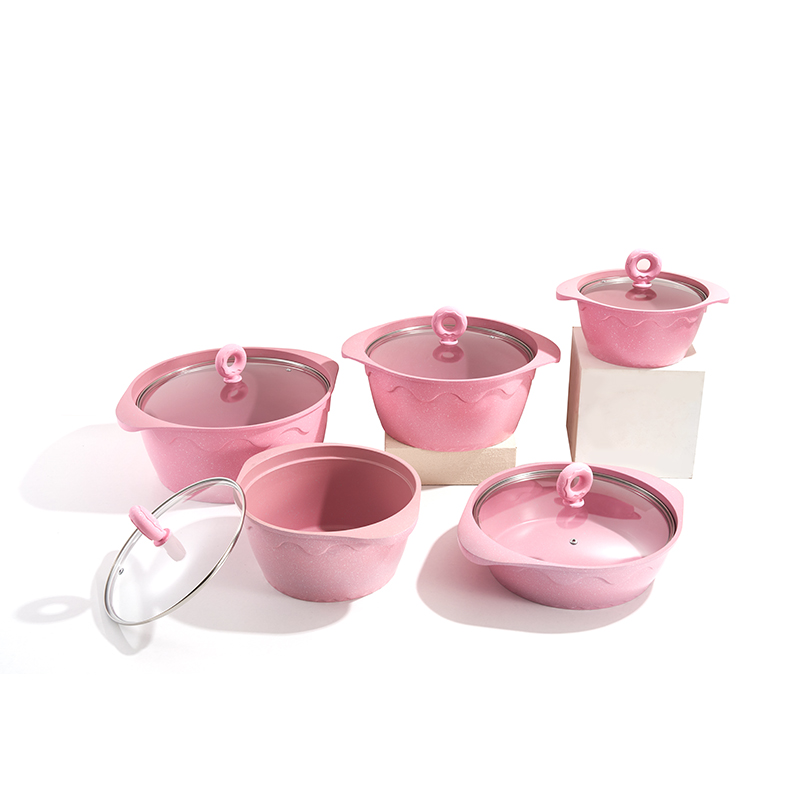
This cookware set is made of food-grade non-stick material, with a unique eye-ca...
See Details -
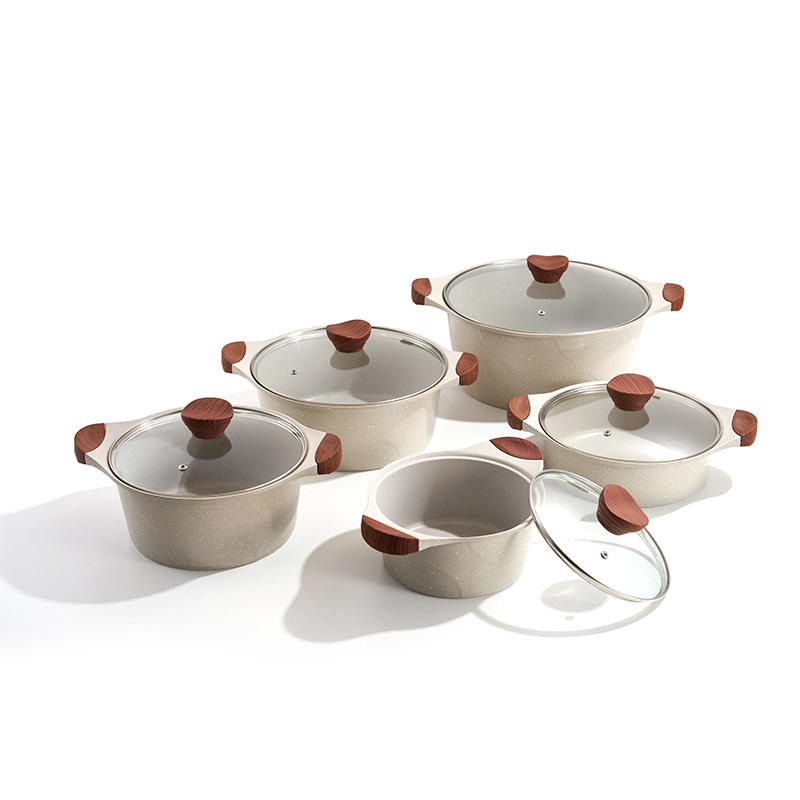
This off-white cookware set is made of wear-resistant non-stick material, with w...
See Details
Whether you're looking for bulk purchases or have any custom requirements, We are here to offer the best
solutions for you.
tiffany.zhong@echocn-trading.com
PHONE
+86-19561173975
+86-19557020621 (Hazel Wu)
ADD
Room 301, Unit 3014, No. 175 Qifeng Avenue, Wenqiao Town, Taizhou, Zhejiang, China
Fill Out the Form for More Information
Copyright © Zhejiang Echo Industry And Trade Co., Ltd.
All Rights Reserved.

China Cookware Set Manufacturer