
 en
 Español

This cookware set features a non-stick coating, even heat conduction, and multi-...
See Details
10-Piece Granite-Textured Aluminum Cookware Set: A Practical Guide to Versatile, Durable Kitchen Performance
Date:Oct 23, 2026
Choosing a cookware set is an important decision for households, professional kitchens, hospitality buyers, retailers, and distributors. A well-designed set should do more than provide several pots and pans in one package. It should support different cooking methods, offer reliable heat performance, simplify cleaning, remain comfortable to use, and maintain an attractive appearance over time. The 10-Piece GranitePro Aluminium Cookware Set is designed around these practical requirements, combining die-casting aluminum construction, granite-style interior and exterior coatings, multiple casserole sizes, and a dedicated frying pan.
Modern consumers are increasingly looking for cookware that balances performance, appearance, convenience, and value. Traditional cookware materials each have clear strengths, but they may also introduce limitations. Stainless steel can be durable but sometimes requires more oil and careful temperature control to prevent sticking. Cast iron offers excellent heat retention but is heavy and requires seasoning and maintenance. Lightweight stamped aluminum can be affordable, but it may not provide the same structural feel as a thicker die-cast body. A granite-coated die-cast aluminum set aims to combine several desirable characteristics in one coordinated collection.
This article examines the product’s construction, cooking applications, coating system, manufacturing advantages, care requirements, packaging information, and suitability for different buyers. It also explains how the product compares with common cookware alternatives and why a supplier with integrated product development, sourcing, customization, and export capabilities can be valuable for wholesale customers.

10pcs GranitePro Aluminium Cookware Set
Product Overview
The 10-Piece GranitePro Aluminium Cookware Set belongs to the aluminum cookware category. Its body is made from die-casting aluminum, while the exterior and interior are treated with a granite coating. The granite-textured appearance provides a modern, understated aesthetic that can fit contemporary kitchens, rental properties, restaurants, and retail product lines.
The set includes casserole pieces in four sizes: 20 cm, 24 cm, 28 cm, and 32 cm. It also includes a 28 cm fry pan. The collection is intended to support common cooking activities such as boiling, simmering, stewing, sautéing, shallow frying, reheating, and family-style meal preparation. The combination of several casserole capacities and one large frying pan gives users flexibility without requiring them to purchase multiple unrelated cookware items.
The product is identified by SKU HT02. Its stated specifications include a die-casting aluminum substrate, granite treatment on both the exterior and interior, and compatibility with all stovetops. The set is designed to be minimalist, durable, easy to clean, and suitable for everyday use.
For wholesale handling, the set is packed in two cartons. The listed carton dimensions are 71 × 36 × 30.5 cm, and the carton weight is approximately 18 kg. These details are relevant to importers, distributors, retailers, and purchasing departments planning warehouse space, freight arrangements, product listings, and order quantities.
| Product Element | Specification | Practical Benefit |
|---|---|---|
| Cookware body | Die-casting aluminum | Strong structure with efficient heat distribution |
| Exterior treatment | Granite coating | Modern textured appearance and an additional protective surface |
| Interior treatment | Granite coating | Easy-release cooking surface and simpler cleaning |
| Casserole sizes | 20 cm, 24 cm, 28 cm, and 32 cm | Suitable for different portions and cooking tasks |
| Fry pan | 28 cm | Useful for frying, sautéing, browning, and everyday pan cooking |
| Stovetop compatibility | All stovetops, according to product specification | Broad appeal across different household kitchens and markets |
| Packaging | Two cartons | Organized wholesale packing for shipping and distribution |
Die-Casting Aluminum Construction
The foundation of the cookware set is its die-casting aluminum body. Die casting is an industrial forming process in which molten aluminum is introduced into a prepared mold under controlled pressure. Once the material cools and solidifies, it forms a cookware body with a consistent shape and defined dimensions. Compared with thinner stamped construction, die casting can provide a more substantial structure and a more stable base.
Aluminum is widely used in cookware because it transfers heat efficiently. Efficient heat transfer allows the cooking surface to respond relatively quickly when the user adjusts the burner. This is helpful when preparing foods that require temperature changes, including sauces, vegetables, eggs, pancakes, stir-fried ingredients, and simmered dishes. A responsive pan can also make everyday cooking easier for users who do not want to wait for heavy cookware to heat or cool.
The die-casting process supports repeatability. When the mold design, material conditions, pressure, cooling, and finishing steps are properly controlled, manufacturers can produce multiple cookware bodies with consistent dimensions. Consistency is important for coordinated sets because lids, packaging inserts, handles, and display cartons must align with the cookware body. It is also essential for wholesale buyers who need uniformity across a large purchase order.
Another advantage of aluminum construction is its relatively manageable weight compared with many cast iron products. A cookware set must be practical for lifting, storing, washing, and moving between the countertop and stovetop. The aluminum body provides a useful balance between structural substance and daily handling convenience. For distributors, the lighter material can also help control shipping weight compared with heavier alternatives, although final freight calculations should always be based on the confirmed packed order.
Heat Distribution and Everyday Control
Even heat distribution is one of the most important performance characteristics in cookware. A pan that concentrates heat in a small area can create hot spots, causing food to brown unevenly or burn before the rest of the meal is ready. The broad aluminum body of this set is designed to help spread heat across the cooking surface more effectively than many very thin pans.
The practical value of this design can be seen in several cooking situations. A 28 cm fry pan can provide a generous surface for sautéing vegetables, cooking meat portions, preparing omelets, or browning ingredients before adding them to a sauce. The 20 cm and 24 cm casserole pieces are suitable for smaller household portions, side dishes, oatmeal, soups, and reheating. The 28 cm and 32 cm casseroles can accommodate larger meals, stews, family portions, and batch cooking.
Good heat performance does not eliminate the need for correct cooking technique. Users should select an appropriate burner size, avoid extending the flame beyond the cookware base, and avoid overheating an empty pan. These practices protect the coating, improve energy efficiency, and help preserve the appearance of the cookware.
Granite Coating for a Modern Cooking Surface
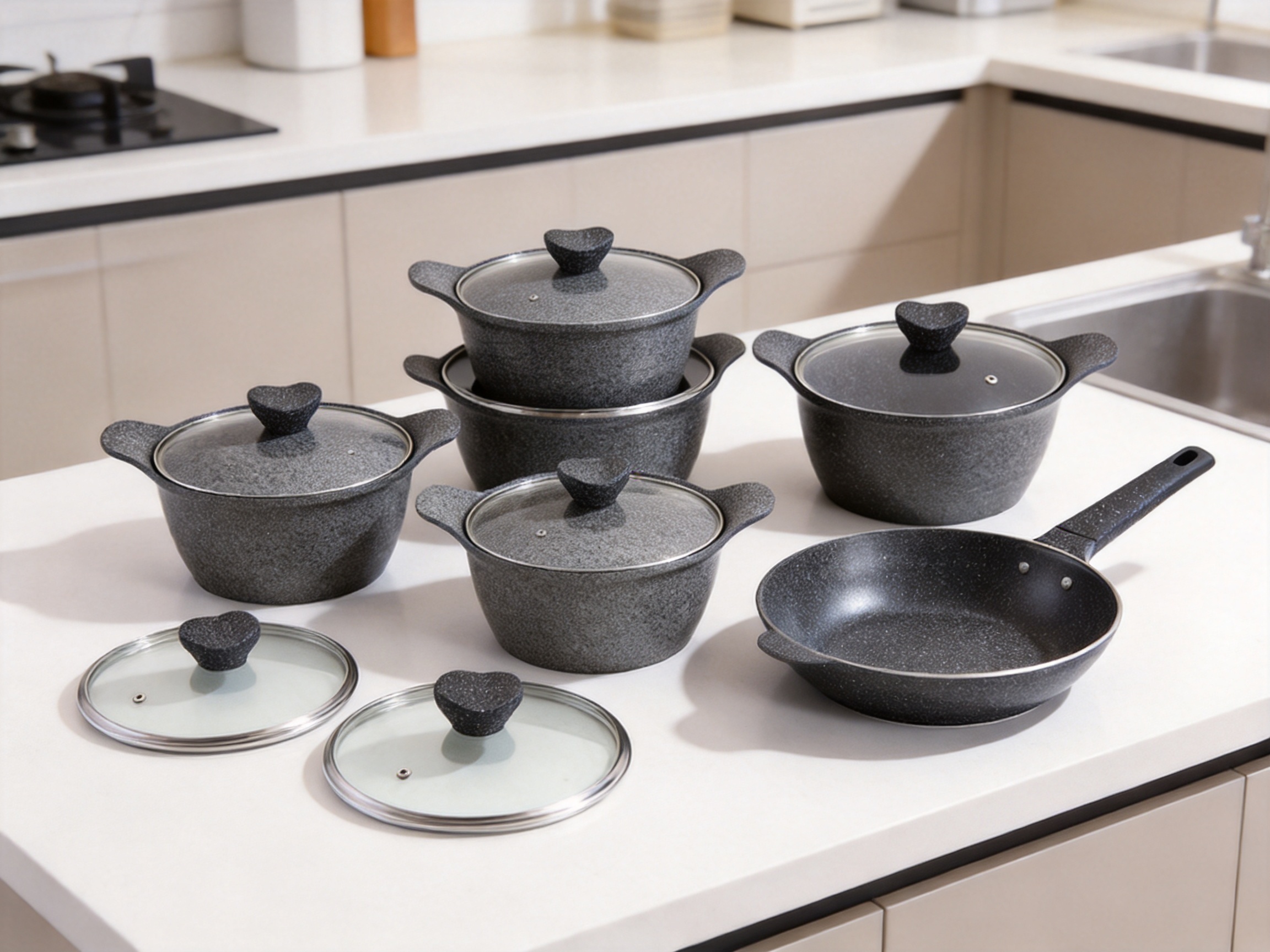
The interior and exterior of the set are treated with a granite coating. The term “granite” in cookware generally refers to a granite-textured or stone-inspired coating appearance rather than a solid granite body. This treatment gives the cookware a distinctive visual character while supporting a smooth, convenient cooking surface.
The interior coating is intended to provide non-stick-style performance, helping food release more easily during cooking. An easy-release surface can reduce the amount of oil needed for many recipes and make cleanup less demanding. This is particularly useful for foods that commonly adhere to cookware, such as eggs, pancakes, fish, delicate vegetables, and reduced sauces.
The exterior granite finish contributes to product presentation. Cookware is often displayed in open retail environments, online catalogues, kitchen showrooms, and hospitality supply exhibitions. A coordinated granite texture can make a set look more premium than basic single-color cookware, while the minimalist design remains suitable for a wide range of kitchen styles.
Coating Performance Depends on Proper Use
Non-stick and coated cookware performs best when it is treated as a specialized cooking surface. Metal utensils, sharp tools, abrasive cleaners, and excessive heat can damage the coating over time. For this reason, users should choose wooden, nylon, silicone, or other utensils specifically intended for non-stick cookware.
The manufacturer’s care guidance recommends washing the cookware with hot, soapy water and a soft cloth or sponge. Hand washing is recommended to preserve the appearance of the cookware. Even when a product is designed for convenient cleaning, gentle care remains important because repeated scratching or aggressive scouring can reduce the visual and functional life of the surface.
Users should also wash the cookware before its first use. This removes handling residue and prepares the cooking surface for normal kitchen use. After washing, cookware should be dried thoroughly before storage, especially if several pieces are nested together.
Advantages Compared with Common Cookware Alternatives
Compared with Basic Stamped Aluminum
Basic stamped aluminum cookware is produced by pressing sheet material into shape. It can be economical and lightweight, but thinner construction may feel less substantial and can be more vulnerable to distortion when exposed to rough handling or repeated temperature changes. Die-casting aluminum offers an alternative approach by forming the body as a more integrated structure.
The 10-piece set also adds granite treatment to both the inner and outer surfaces. This creates a more coordinated product appearance and provides an easy-release cooking surface. For retailers, the combination of die-cast construction and granite styling can make the collection easier to position as an upgraded alternative to entry-level aluminum cookware.
Compared with Stainless Steel
Stainless steel cookware is valued for durability, resistance to staining, and a polished appearance. However, uncoated stainless steel often requires more attention to preheating, oil control, and cooking temperature. Foods with high protein or sugar content can stick if the pan is not used correctly.
The granite-coated interior of this aluminum set is designed to offer simpler food release for routine cooking. The aluminum body also responds quickly to heat changes, which can be convenient for everyday users. Stainless steel may remain an excellent choice for certain high-temperature and professional applications, but a granite-coated aluminum collection can provide a more accessible experience for households seeking convenience.
Compared with Cast Iron
Cast iron is known for heat retention, durability, and strong searing performance. Its disadvantages can include considerable weight, slower temperature changes, and the need for seasoning when the surface is uncoated. Handling a large cast iron casserole may be difficult for some users, particularly in compact kitchens or households where cookware is washed by hand.
The aluminum set is designed to be easier to handle while still providing a stable cooking body. Its coating eliminates the need for traditional cast iron seasoning, and its granite appearance creates a contemporary alternative to the rustic look of bare or seasoned iron. For customers who prioritize manageable weight and simple cleaning, aluminum cookware may be more practical.
Compared with Ceramic-Style Cookware
Ceramic-style cookware can offer an attractive smooth surface and is often marketed for low-oil cooking. However, the performance and durability of any coated cookware depend heavily on the formulation, application process, usage conditions, and care routine. A die-cast aluminum body with a granite coating provides a different balance of structure, heat response, surface appearance, and handling.
For wholesale buyers, the best choice depends on the intended market. The 10-piece set is particularly suitable for customers seeking a modern appearance, broad stovetop compatibility, multiple pot sizes, and an easy-care interior without moving to heavier cast iron products.
| Comparison Factor | Granite-Coated Die-Cast Aluminum | Basic Stamped Aluminum | Uncoated Stainless Steel | Cast Iron |
|---|---|---|---|---|
| Heat response | Responsive and efficient | Generally very responsive | Moderate, depending on construction | Slower to heat and cool |
| Handling weight | Manageable for daily use | Very light | Moderate to heavy | Heavy |
| Food release | Designed for easy release | Depends on surface treatment | Requires technique and oil control | Depends on seasoning |
| Cleaning convenience | Simple with gentle hand washing | Generally simple | May require more scrubbing | Requires special maintenance |
| Appearance | Granite-textured and modern | Basic or utilitarian | Polished metal appearance | Traditional and rugged |
| Best suited to | Everyday multi-purpose cooking | Budget-focused use | Durability-focused cooking | High-retention cooking and searing |
Versatility Across Cooking Methods
A major strength of the set is its multi-size format. Instead of offering only one large pot and one frying pan, it provides four casserole diameters and one fry pan. This allows users to select a vessel according to portion size and cooking method.
The 20 cm casserole is practical for small servings, sauces, grains, side dishes, reheating, and compact household cooking. It may also be useful for single-person meals or small families who do not need a large vessel for every recipe.
The 24 cm casserole provides a middle size for everyday soups, vegetables, noodles, rice dishes, and moderate portions of stew. It can become a frequently used piece because it is large enough for many household tasks while remaining easy to handle.
The 28 cm casserole supports larger meals, family portions, braising, and stewing. It can also be used for recipes that need additional space for stirring. The matching 28 cm fry pan offers a broad cooking surface for sautéing, shallow frying, browning, breakfast preparation, and pan-based meals.
The 32 cm casserole is intended for larger-batch preparation. It can be useful for family gatherings, meal preparation, catering support, and households that prefer to cook once and serve several portions. Retail buyers can present this size range as a complete cooking solution rather than as a collection of unrelated pieces.
Suitable Recipes and Kitchen Tasks
The set can support a wide selection of cooking activities. Users may prepare soups, stews, curries, pasta sauces, braised vegetables, rice dishes, stir-fried ingredients, fried eggs, pancakes, sautéed meats, and reheated leftovers. The multiple casserole sizes also allow users to separate ingredients during meal preparation or prepare several dishes at the same time.
The cookware is not intended for microwave use. This is an important usage limitation that should be communicated clearly in product packaging, retailer descriptions, and customer service materials. Cookware should be used on an appropriate stovetop and should not be placed in a microwave oven.
Manufacturing Process and Quality Considerations
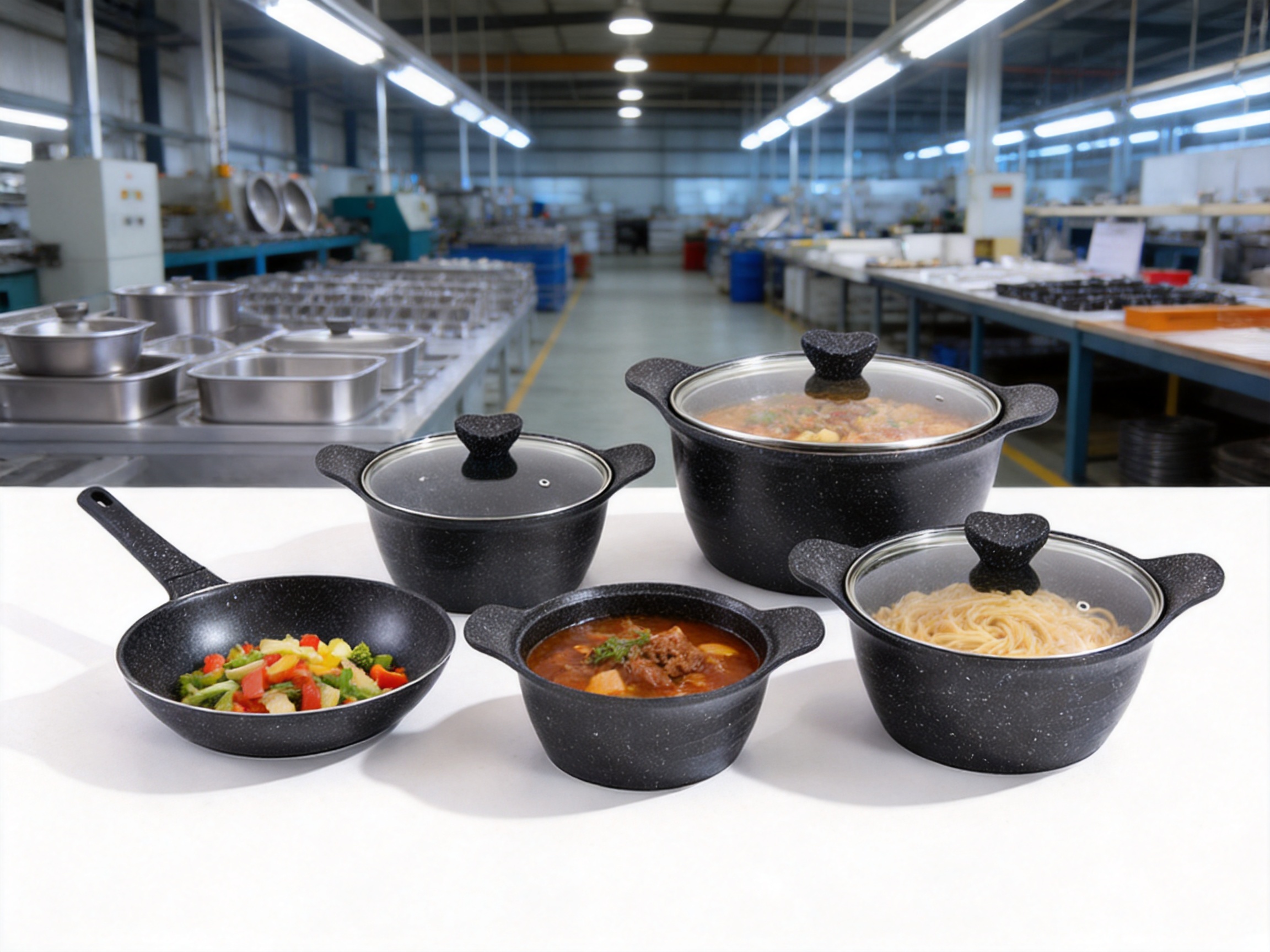
A cookware product’s performance depends not only on the material selected but also on the consistency of its manufacturing process. The production of a die-cast, coated cookware set generally involves several stages: material preparation, die casting, trimming, surface treatment, coating application, curing, assembly, inspection, and packaging.
Material Preparation
Aluminum must be prepared to meet the manufacturer’s internal requirements for casting performance and product consistency. Material condition affects fluidity, mold filling, surface quality, and the final strength of the cookware body. Controlled preparation helps reduce visible defects and supports repeatable production across a set.
Die Casting and Mold Formation
During die casting, aluminum is introduced into a mold that defines the body shape. Pressure-assisted filling helps the material reach the required contours and can produce a consistent cookware profile. Mold design influences wall thickness, base geometry, rim shape, cooking surface dimensions, and compatibility with later finishing operations.
Proper die-casting control is especially important for cookware because the body must remain dimensionally stable. A vessel that is not formed consistently may sit unevenly on a stovetop, fit poorly into packaging, or create difficulties during handle and accessory assembly. A professional production line therefore needs attention to mold maintenance, machine settings, cooling conditions, and dimensional inspection.
Trimming and Surface Preparation
After casting, excess material and unwanted edges are removed. The body is then prepared for coating. Surface preparation can include cleaning, smoothing, and other treatments designed to help the coating bond uniformly. This stage directly affects the appearance and durability of the finished product.
Before coating, manufacturers must pay attention to areas such as the rim, base, sidewalls, and interior transitions. Uneven preparation can lead to coating irregularities or visual differences between pieces. Consistent preparation is therefore essential for a coordinated multi-piece set.
Granite Coating Application
The granite coating must be applied in a controlled manner to create a consistent finish. Important considerations may include coating viscosity, spray or application technique, coverage, thickness, drying time, and environmental conditions. Interior and exterior surfaces require careful handling because the final appearance needs to be uniform while the interior must provide a practical cooking surface.
After application, the cookware is cured according to the coating system’s requirements. Controlled curing helps the coating develop its intended properties. In a professional manufacturing environment, operators and quality personnel can inspect the finish for uneven color, pinholes, scratches, bubbling, incomplete coverage, and other visible concerns.
Inspection and Assembly
Finished pieces can be inspected for dimensions, stability, coating appearance, surface defects, and general workmanship. Where applicable, handles and other components are assembled according to the product design. The cookware should sit securely, remain comfortable to handle, and maintain a coordinated appearance throughout the set.
Inspection is particularly important for export orders. International buyers often require predictable quality, consistent packaging, accurate labelling, and stable production across repeat orders. A supplier that combines manufacturing experience with order coordination can help reduce communication gaps between product development, production, quality control, and logistics.
Strengths of an Experienced Kitchenware Supplier
The manufacturer and supplier behind this product is Zhejiang Echo Industry And Trade Co., Ltd., based in Taizhou, Zhejiang, China. Zhejiang is widely recognized as an important manufacturing and export region, with extensive experience in metal products, household goods, cookware, and kitchen accessories.
The company describes itself as a professional kitchenware supplier serving customers in different countries and cities. Its product coverage includes aluminum cookware, stainless steel cookware, cast iron cookware, and kitchen utensils. This broad category knowledge can be useful to buyers who want to develop a complete kitchenware range rather than purchase a single product in isolation.
One-Stop Product Sourcing
A supplier with multiple cookware categories can help buyers coordinate product selection across different materials and price levels. For example, a retailer may want a granite-coated aluminum collection for everyday cooking, a stainless steel series for durability-focused customers, an iron cookware line for traditional cooking, and utensils to complete the kitchen assortment.
One-stop sourcing can simplify communication, product comparison, purchasing administration, and shipment planning. Instead of managing several unrelated supplier relationships, a buyer may be able to coordinate a broader product program through one experienced kitchenware partner.
ODM and OEM Support
The company also identifies ODM and OEM customization as part of its service offering. This can be important for importers, brand owners, supermarket groups, hospitality suppliers, and online retailers that require differentiated products. Potential customization areas may include colors, surface treatments, packaging structure, logo placement, product combinations, carton printing, and market-specific labelling, subject to technical and commercial confirmation.
Customization is most successful when the buyer provides clear information about the target market, expected order volume, packaging requirements, preferred dimensions, compliance expectations, and launch schedule. A structured development process allows the supplier to assess feasibility before production begins.
Certification Assistance and Market Preparation
Kitchenware products may be sold in markets with different requirements concerning materials, coatings, labelling, packaging, and product safety. The company states that it can assist with product certification. Buyers should discuss the exact destination market and required documentation at the beginning of a project because certification needs vary according to region, product construction, and sales channel.
Certification assistance does not replace the buyer’s responsibility to verify local regulations, but it can make the preparation process more organized. A supplier familiar with export documentation and product testing can help identify the information needed for technical files, packaging statements, and quality records.
Flexible MOQ and Sustainable Development
Flexible minimum order quantities can be valuable to small and medium-sized buyers. New brands, regional distributors, and online sellers may not want to commit immediately to very large volumes. A supplier willing to discuss flexible MOQs can make it easier to test a product, evaluate customer response, and expand gradually.
The company also describes an interest in sustainable and healthy product development. For cookware, sustainability can involve longer product use, responsible material selection, efficient manufacturing, durable packaging design, and reduced product replacement. Healthy product development requires attention to coating systems, material suitability, manufacturing cleanliness, and clear consumer care guidance.
Packaging, Logistics, and Wholesale Planning
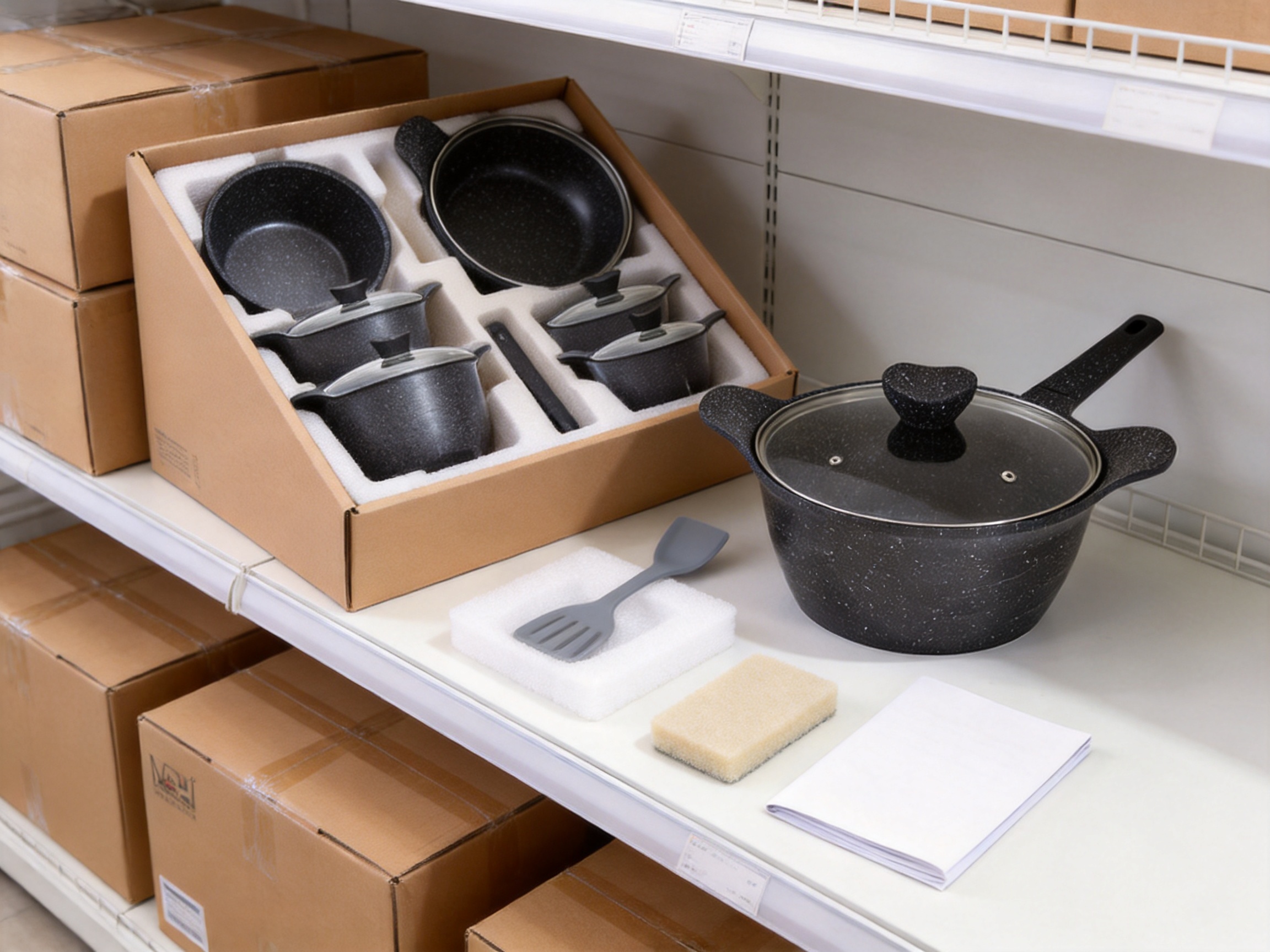
For a cookware set, packaging serves several purposes. It protects the coated surfaces, keeps the pieces organized, supports retail presentation, and reduces the risk of damage during handling and transportation. Since the product contains multiple pieces, internal separation and protective materials are especially important.
The listed packing information states that the product is shipped in two cartons, with carton dimensions of 71 × 36 × 30.5 cm and a carton weight of approximately 18 kg. Buyers should confirm whether these figures refer to a specific quantity per carton, a complete set arrangement, or a production packing configuration. Final shipping calculations should be based on the commercial invoice, packing list, confirmed carton count, and actual packed measurements.
Importers should also consider warehouse planning. Cookware sets occupy more space than individual pans because of their nested shapes, protective packaging, and retail cartons. Product managers should determine how many sets can be stored per pallet, how cartons will be stacked, and whether the outer packaging is suitable for the intended distribution channel.
For e-commerce sellers, packaging quality is particularly important because products may pass through several courier networks before reaching the end customer. Clear product information should include the set contents, dimensions, coating care, stovetop compatibility, microwave limitation, and recommended utensils. Accurate information can reduce returns and improve customer satisfaction.
Care and Maintenance Instructions
Correct care is essential for preserving coated cookware. Before first use, wash each piece with warm or hot soapy water and a soft cloth or sponge. This removes dust or residue from manufacturing, packaging, and handling.
During cooking, do not use metal or sharp utensils. Wooden, nylon, silicone, or non-stick-safe utensils are more appropriate. Sharp tools can scratch the coating, while metal edges may create visible marks on the interior surface.
Do not overheat the cookware when it is empty. Empty overheating can expose the coating and aluminum body to unnecessary thermal stress. Users should add food or cooking liquid at an appropriate stage and select a burner setting suited to the recipe.
The flame or heat source should not extend beyond the base of the cookware. Excess heat around the sides can discolor or damage exterior surfaces and may create a safety hazard. Proper burner selection also improves energy efficiency.
If a pan severely overheats, users should turn off the cooker and allow the pan to cool completely. They should not touch the cookware while it is dangerously hot or attempt to move it abruptly. Once cool, the pan can be inspected and cleaned according to the normal care instructions.
The cookware should not be used in a microwave. It is intended for compatible stovetop cooking, and users should follow the product’s stated compatibility information. Hand washing is recommended to preserve the appearance and condition of the granite coating.
To store the set, users should avoid dragging one piece across another. If the cookware is nested, soft separators may help reduce contact between coated surfaces. The pieces should be completely dry before storage, and heavy objects should not be placed on top of the coated interiors.
Retail and Commercial Positioning
The 10-piece format is suitable for several sales environments. In household retail, it can be positioned as a complete starter set for new homes, apartments, wedding gifts, and kitchen upgrades. In online retail, the multiple sizes provide strong content opportunities because product images and descriptions can show how each piece serves a different cooking purpose.
For regional distributors, the set can occupy a mid-range or upgraded everyday cookware segment, depending on packaging, coating specification, accessories, and final market positioning. Its granite appearance may appeal to customers who want a modern alternative to plain aluminum or polished metal.
Hospitality suppliers may also consider the set for apartments, rental properties, student accommodations, serviced residences, and light-use catering environments. Suitability will depend on the purchaser’s requirements for capacity, frequency of use, cleaning procedures, and local compliance. Commercial users should evaluate the product against their own operational conditions before placing a large order.
Retailers can emphasize several clear selling points: five useful cookware pieces in one coordinated set, multiple casserole sizes, die-cast aluminum construction, granite-style interior and exterior treatment, easy-release cooking performance, broad stovetop compatibility, and simple care requirements.
How Buyers Can Evaluate the Product Before Ordering
Wholesale buyers should begin by defining their target customer. A cookware set for budget-conscious households may require different packaging and color choices from a premium homeware collection. Understanding the buyer profile helps determine whether the granite finish, size range, and set configuration are suitable.
Next, buyers should review product samples. Sample evaluation should cover the cookware weight, balance, rim finish, surface appearance, base stability, handle comfort, coating uniformity, nesting arrangement, and packaging protection. The sample should also be tested using typical recipes and cleaning methods appropriate to the product.
Buyers should ask for clear confirmation of the coating system, available colors, packaging options, customization process, production lead time, minimum order quantity, inspection arrangements, and export documentation. It is also useful to confirm whether the product can be supplied with market-specific labels, instruction sheets, barcodes, or carton markings.
For repeat orders, purchasing teams should establish an agreed reference sample or specification sheet. This helps maintain consistency in color, dimensions, surface finish, packaging, and product contents. A documented standard is valuable when several production batches are ordered over time.
| Buyer Evaluation Area | Questions to Consider |
|---|---|
| Product construction | Is the die-cast body suitable for the target price and usage level? |
| Coating appearance | Is the granite texture uniform across the interior and exterior surfaces? |
| Cooking performance | Does the cookware heat evenly and release food as expected? |
| Set configuration | Do the five cookware pieces match the needs of the intended customers? |
| Stovetop use | Is the stated compatibility appropriate for the destination market? |
| Care information | Are utensil, cleaning, overheating, and microwave instructions clearly supplied? |
| Packaging | Can the packaging protect coated surfaces through normal logistics handling? |
| Customization | Are logo, color, carton, label, and instruction options available? |
| Compliance | Can the supplier support the documentation required by the destination market? |
| Commercial terms | Are MOQ, lead time, payment, inspection, and shipping terms acceptable? |
Frequently Asked Questions
What material is used for the cookware body?
The cookware body is made from die-casting aluminum. This construction is intended to provide a stable form, efficient heat response, and a manageable weight for everyday use.
What does the granite coating mean?
The granite coating is a stone-inspired surface treatment applied to the cookware. It gives the product a granite-textured appearance and is designed to support easy-release cooking and convenient cleaning. It is not a solid granite cookware body.
How many cookware pieces are included?
The product is marketed as a 10-piece cookware set. The listed cookware configuration includes four casserole sizes—20 cm, 24 cm, 28 cm, and 32 cm—and one 28 cm fry pan. Buyers should confirm the complete retail package contents, including any lids or accessories, with the supplier before ordering.
Can the set be used on all stovetops?
The product specification states that the cookware is compatible with all stovetops. Buyers should confirm the exact compatibility details for their intended market and cooking equipment, especially when planning a large commercial order.
Can metal utensils be used?
Metal and sharp utensils should not be used because they may scratch or damage the coated surface. Wooden, nylon, silicone, or other utensils designed for non-stick cookware are recommended.
Is the cookware dishwasher safe?
The care instructions recommend hand washing with hot, soapy water and a soft cloth or sponge. Buyers and users should follow the supplier’s confirmed care guidance rather than assume dishwasher suitability.
Can the cookware be placed in a microwave?
No. The care instructions specifically state that the cookware should not be used in a microwave.
How should severely overheated cookware be handled?
If the cookware severely overheats, turn off the cooker and allow the pan to cool completely. Do not touch or move it while it is dangerously hot. After cooling, inspect and clean it according to the normal care instructions.
Is the set suitable for wholesale distribution?
Yes. The multi-piece configuration, coordinated appearance, and stated two-carton packing format make it suitable for retailers, distributors, importers, hospitality suppliers, and online sellers. Buyers should confirm carton quantity, final dimensions, lead time, MOQ, and export documentation for their order.
Can the product be customized?
The supplier states that it provides ODM and OEM customization. Potential options may include colors, packaging, branding, labels, and product combinations. Specific customization depends on the required design, order quantity, production feasibility, and market regulations.
What makes this set different from a basic aluminum set?
The product combines a die-casting aluminum body with granite treatment on both the interior and exterior. It also provides four casserole sizes and a 28 cm fry pan in one coordinated collection. These features give it a more structured, modern, and versatile position than many basic single-layer aluminum sets.
Conclusion
The 10-Piece GranitePro Aluminium Cookware Set is designed to meet the needs of users who want broad cooking versatility, efficient heat response, manageable handling, modern styling, and simplified cleaning. Its die-casting aluminum body provides a stable foundation, while the granite coating creates a distinctive appearance and an easy-release interior for everyday recipes.
The set’s four casserole sizes and 28 cm fry pan support cooking for individuals, couples, families, and larger households. Its stated compatibility with all stovetops expands its potential appeal across different markets. At the same time, the product requires responsible care: users should avoid metal utensils, abrasive cleaning, empty overheating, excessive side flames, and microwave use.
From a wholesale perspective, the product benefits from a clear category position and a practical five-piece cookware configuration marketed as a 10-piece set. The supplier’s broader strengths include aluminum, stainless steel, cast iron, and kitchen utensil sourcing; ODM and OEM support; certification assistance; flexible MOQs; and export-oriented product development. These capabilities can help buyers create a wider kitchenware program and coordinate product development with manufacturing and logistics.
For the best results, buyers should request samples, confirm the complete set contents, review the coating and packaging specifications, verify destination-market requirements, and establish clear quality standards before mass production. With appropriate care and accurate market positioning, this granite-textured aluminum cookware collection can serve as a practical addition to household, retail, and commercial kitchenware ranges.
References
1. Product specification sheet for the 10-Piece GranitePro Aluminium Cookware Set, SKU HT02.
2. Manufacturer-provided care instructions for granite-coated aluminum cookware.
3. General manufacturing principles for die-cast aluminum cookware production.
4. General guidance on the use and maintenance of coated cookware surfaces.
5. General principles of cookware packaging, inspection, and export preparation.
Product: 10pcs GranitePro Aluminium Cookware Set
Recommended Articles
Product Category
Related products
-
-
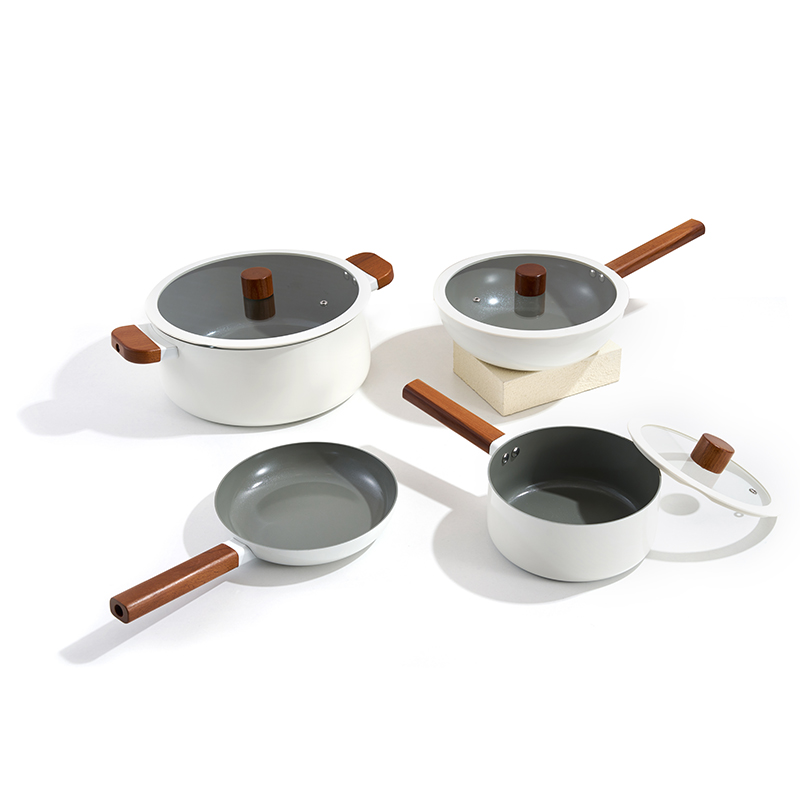
This cookware set has a ceramic non-stick inner liner, a heat-resistant wooden h...
See Details -
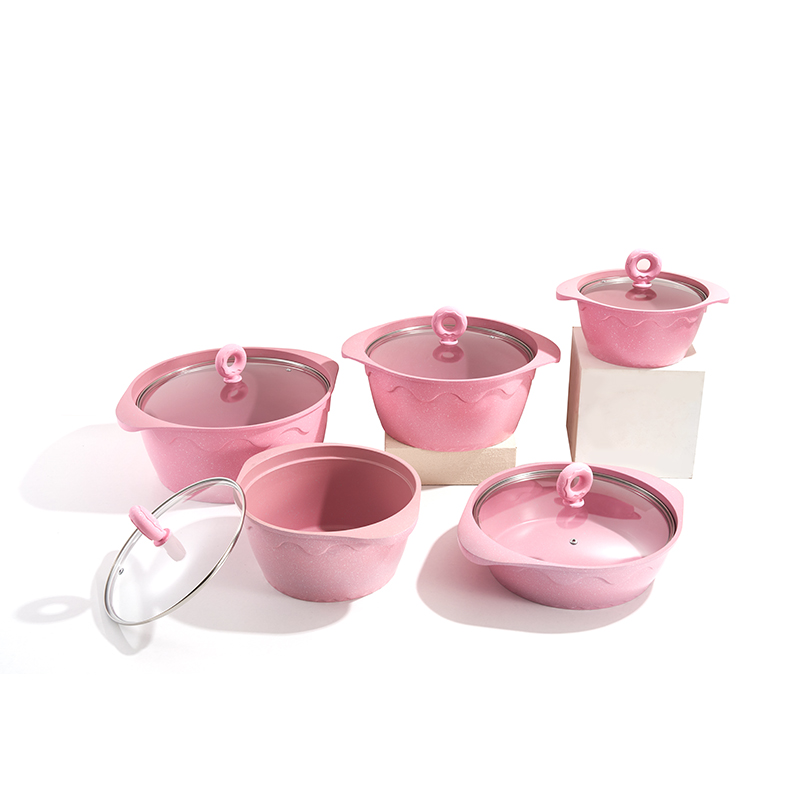
This cookware set is made of food-grade non-stick material, with a unique eye-ca...
See Details -
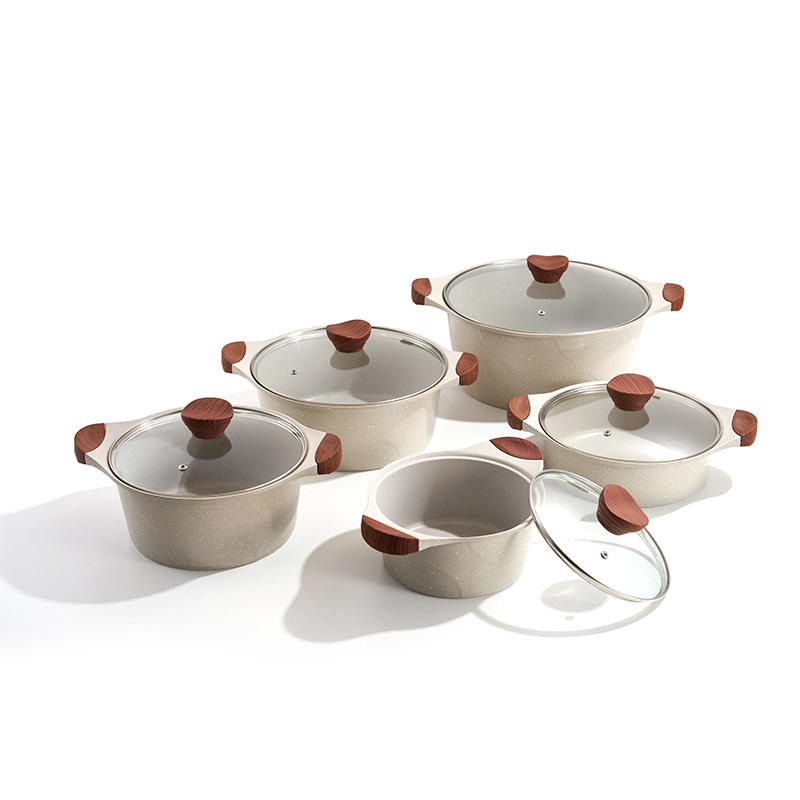
This off-white cookware set is made of wear-resistant non-stick material, with w...
See Details
Whether you're looking for bulk purchases or have any custom requirements, We are here to offer the best
solutions for you.
tiffany.zhong@echocn-trading.com
PHONE
+86-19561173975
+86-19557020621 (Hazel Wu)
ADD
Room 301, Unit 3014, No. 175 Qifeng Avenue, Wenqiao Town, Taizhou, Zhejiang, China
Fill Out the Form for More Information
Copyright © Zhejiang Echo Industry And Trade Co., Ltd.
All Rights Reserved.

China Cookware Set Manufacturer