
 en
en
 Español
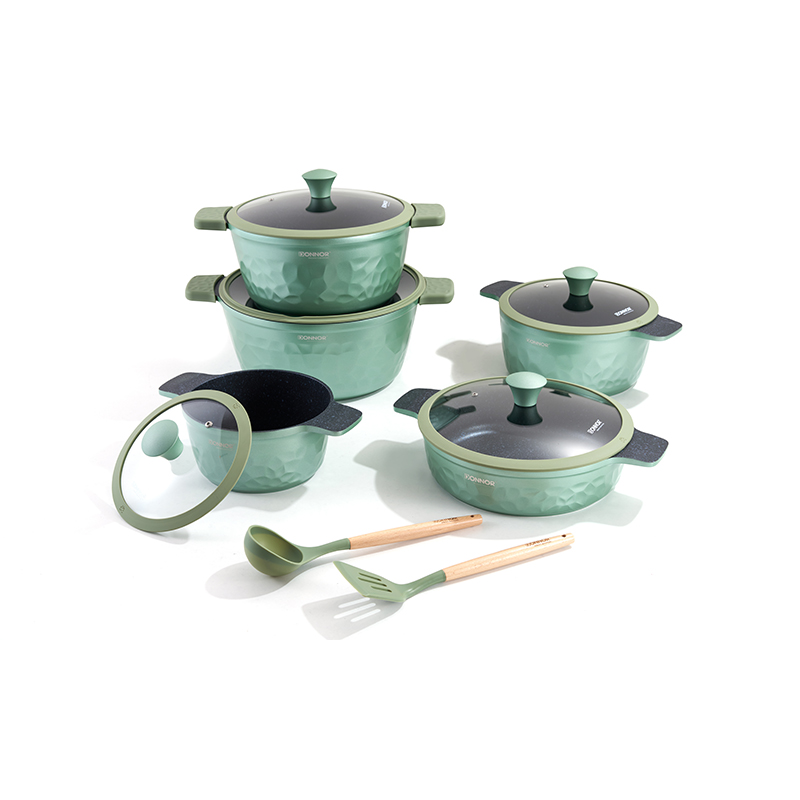
This cookware set features a non-stick coating, even heat conduction, and multi-...
See Details
Do Even Heat Sets Really Eliminate Hot Spots
Date:Jun 19, 2026
A cookware surface that heats unevenly changes everything about cooking outcomes. Oil gathers in warmer zones, proteins brown inconsistently, and sauces reduce at different speeds across the same pan. Even heat distribution cookware set designs are often promoted as a solution, yet real performance depends on how materials, structure, and burner interaction behave together rather than marketing descriptions.
Hot spots do not originate from cookware alone. Stove burners, metal conductivity, and base geometry all interact in ways that create temperature variation across a cooking surface. Aluminum-based cookware reduces much of this imbalance, though complete elimination of hot spots is rare in standard kitchen environments.
Heat Flow Behavior in Aluminum-Based Cookware
Thermal Spread Characteristics Across the Base
Aluminum conducts heat quickly, allowing energy from the burner to travel outward at a faster rate compared with stainless steel or ceramic materials.
- Central burner zone warms earlier than edges
- Heat diffuses outward across the base plate
- Temperature differences shrink after steady heating
Even with strong conductivity, infrared studies of cookware surfaces show that burner shape still influences heat concentration patterns during early heating stages .
Burner Interaction Pattern
Gas and electric burners rarely distribute energy uniformly. The cookware must compensate for:
- Circular flame concentration under center zones
- Electric coil contact points creating localized heating rings
- Induction fields concentrating energy within defined coil boundaries
This interaction explains why identical cookware performs differently on different stovetops.
Why Hot Spots Still Appear in “Even Heat” Cookware
Structural Thickness Variations
Even heat distribution cookware set designs often rely on layered bases. These structures improve spread but still contain micro differences in thickness.
- Base center may be slightly denser
- Rim areas cool at different speeds
- Handle-adjacent zones experience reduced direct heating
Such variations create subtle gradients that remain detectable under sensitive temperature conditions.
Material Physics Limitations
Heat transfer inside metal depends on conductivity and diffusivity. Aluminum performs well, but it still requires time to fully stabilize across a wide surface.
- Heat moves outward rather than instantaneously equalizing
- Temperature balance improves after preheating
- Rapid flame changes reset equilibrium temporarily
Scientific analysis of cookware materials confirms that conduction speed is only part of heat uniformity behavior; mass and geometry also influence distribution stability.
Design Engineering Behind Heat Balancing
Encapsulated Aluminum Core Systems
Many cookware sets use stainless steel shells with aluminum cores. This combination improves durability while maintaining conductivity.
- Stainless steel exterior adds rigidity
- Aluminum core spreads heat laterally
- Bonded layers reduce extreme temperature swings
Multi-layer construction is widely used to reduce cooking inconsistencies across the base surface.
Disc Base Reinforcement Strategy
Some designs use thick disc bases instead of full-body aluminum casting.
- Concentrated heat spread at bottom only
- Sidewall heating relies on conduction upward
- Performance varies depending on pan height
This structure improves flat surface heating but does not fully eliminate vertical temperature differences.
Comparative Heat Distribution Performance Table
| Cookware Structure Type | Heat Spread Speed | Hot Spot Visibility | Temperature Stability |
| Thin aluminum pan | Fast | Noticeable | Moderate |
| Die-cast aluminum set | Balanced | Mild | Stable |
| Clad stainless-aluminum | Controlled | Low | High |
| Ceramic coated cookware | Slow | Pronounced | Low |
| Cast iron | Slow spread | Strong early gradient | Stable after long preheat |
Real Cooking Scenarios Where Hot Spots Still Occur
Pancake and Batter Cooking
Liquid batters reveal heat inconsistency quickly.
- Center browns earlier on most burners
- Outer ring lags in temperature rise
- Flip timing varies across surface
Even heat cookware reduces this imbalance but cannot fully remove burner-driven gradients.
Searing Protein Surfaces
Meat searing highlights temperature variation:
- Fat renders faster in hotter zones
- Browning intensity differs across contact points
- Edge pieces of food may cook slower
Consistent preheating improves uniformity more than rapid heat application.
Sauce Reduction Patterns
Liquid-based cooking is less sensitive due to convection currents inside the pot:
- Fluid movement redistributes heat internally
- Surface temperature differences become less visible
- Reduction speed stabilizes over time
This is why sauces appear more evenly cooked compared with dry frying tasks.
Engineering Adjustments That Improve Uniformity
Optimized Base Diameter Matching
Cookware performance improves significantly when base size aligns with burner diameter.
- Oversized pans stretch heat zones outward unevenly
- Undersized pans concentrate heat centrally
- Matched sizing improves thermal balance across base
Controlled Preheating Phases
Gradual heating reduces sudden temperature spikes:
- Metal expands more uniformly
- Stress gradients remain lower
- Heat field stabilizes before food contact
Multi-Layer Heat Buffering
Advanced cookware uses layered metals to buffer heat fluctuations:
- Stainless exterior slows external cooling
- Aluminum core spreads internal energy
- Bonding layer reduces separation risk
Even heat distribution cookware set designs significantly reduce temperature imbalance but do not fully erase physical constraints created by burner geometry and metal physics. Heat still originates from specific points, and cookware must redistribute it across its surface.
Performance improves noticeably with better materials and thicker bases, yet true uniformity depends on a combination of cookware engineering and stove compatibility. Aluminum-based systems remain among the most balanced solutions available for everyday cooking, especially when paired with appropriate burner sizing and controlled heating habits.
Recommended Articles
Product Category
Related products
-
-
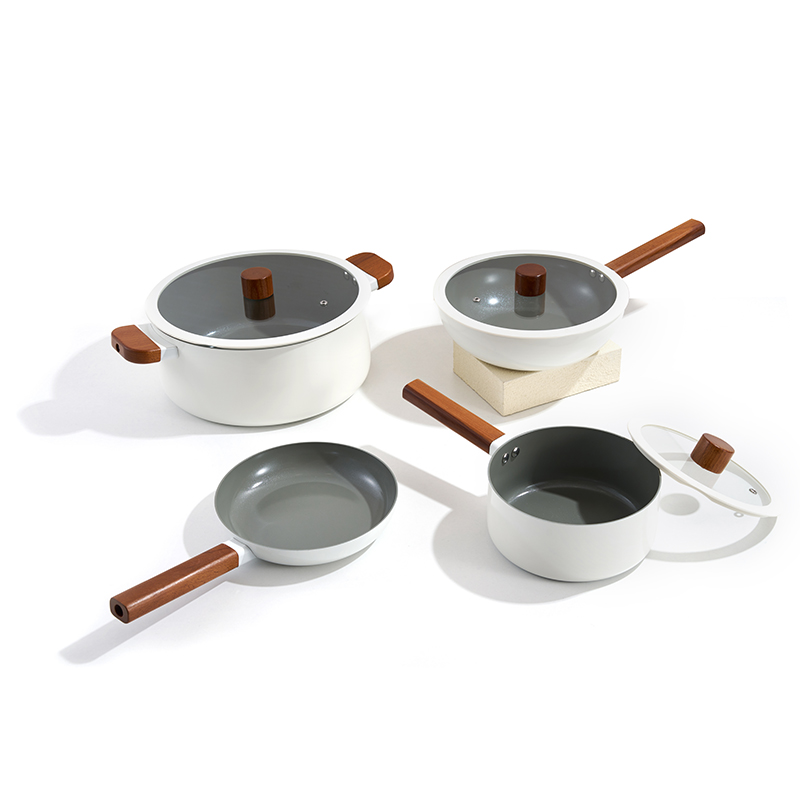
This cookware set has a ceramic non-stick inner liner, a heat-resistant wooden h...
See Details -
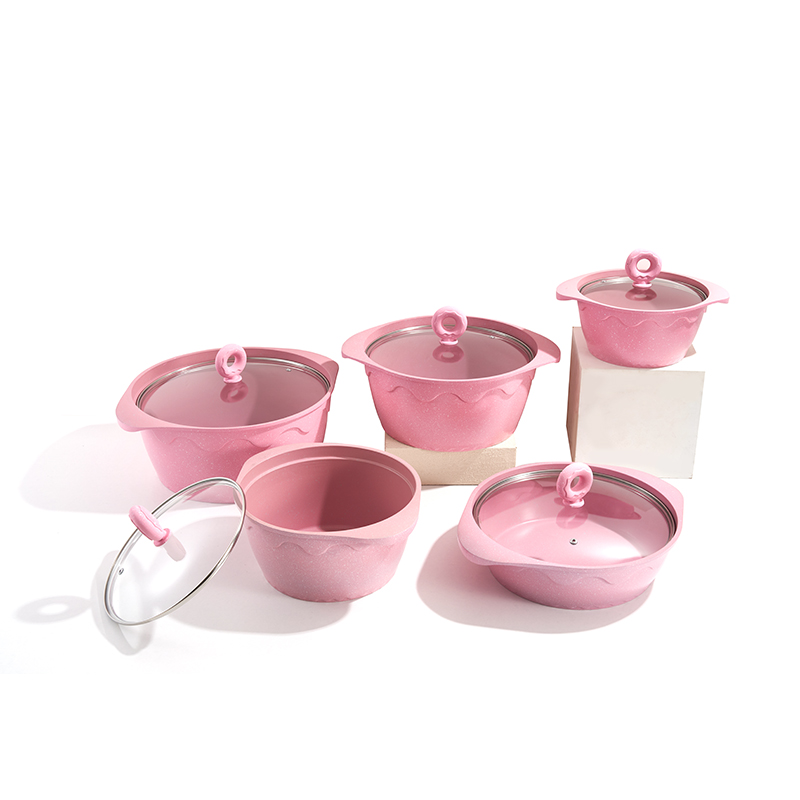
This cookware set is made of food-grade non-stick material, with a unique eye-ca...
See Details -
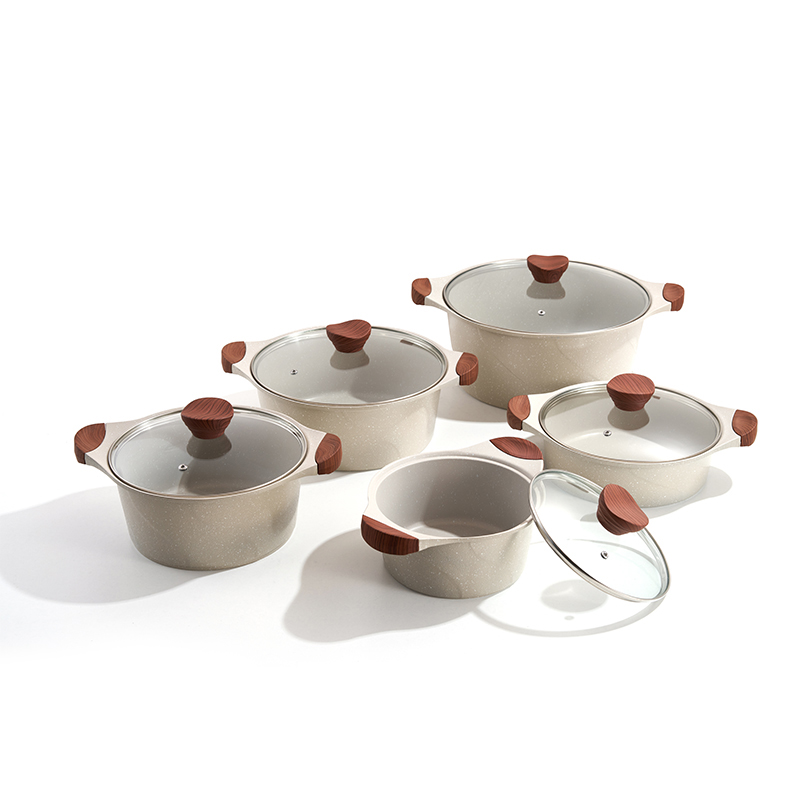
This off-white cookware set is made of wear-resistant non-stick material, with w...
See Details
Whether you're looking for bulk purchases or have any custom requirements, We are here to offer the best
solutions for you.
tiffany.zhong@echocn-trading.com
PHONE
+86-19561173975
+86-19557020621 (Hazel Wu)
ADD
Room 301, Unit 3014, No. 175 Qifeng Avenue, Wenqiao Town, Taizhou, Zhejiang, China
Fill Out the Form for More Information
Copyright © Zhejiang Echo Industry And Trade Co., Ltd.
All Rights Reserved.

China Cookware Set Manufacturer