
 en
 Español

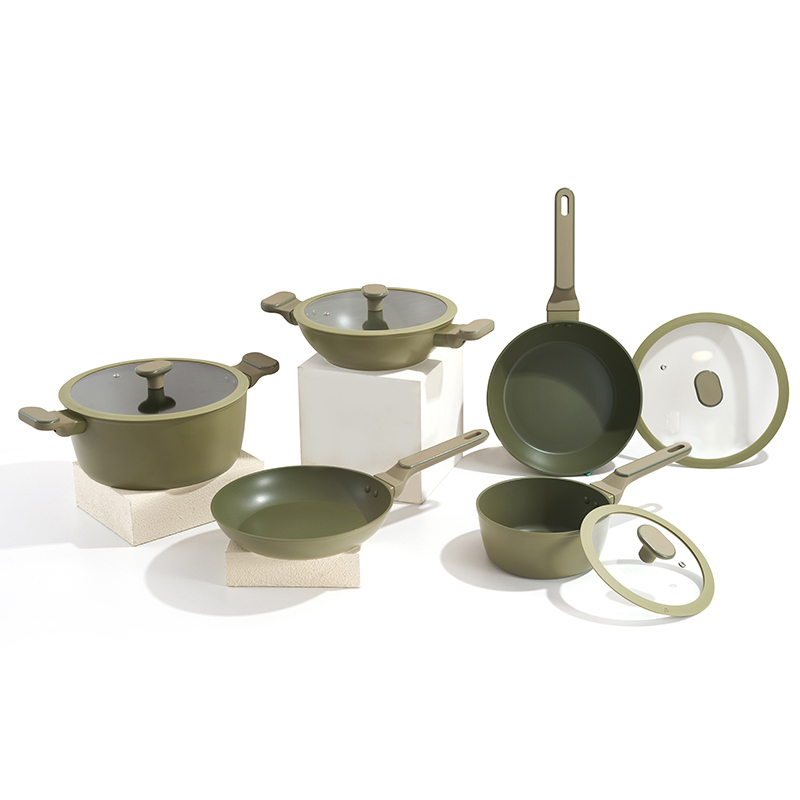
This cookware set features a non-stick coating, even heat conduction, and multi-...
See Details
Honeycomb Stainless Steel Wok: A Durable, Healthy, and Versatile Choice for Modern Kitchens
Date:Aug 28, 2026
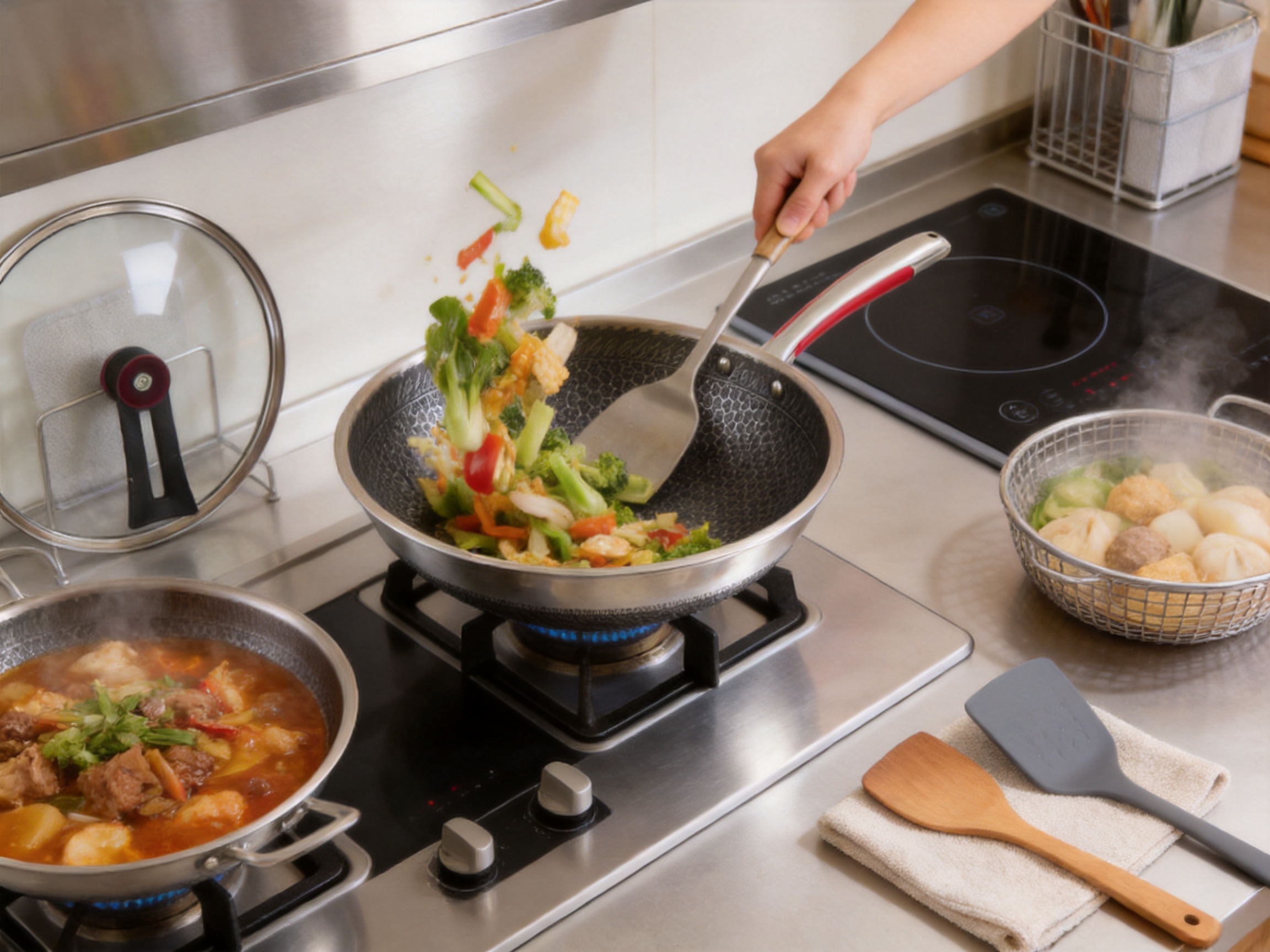
As home cooking continues to become more intentional, consumers are looking for cookware that combines long-term durability, healthy food preparation, convenient maintenance, and broad stovetop compatibility. The Honeycomb Stainless Steel Wok is designed to meet these expectations with a practical construction that brings together food-grade stainless steel, an aluminum heat-distribution layer, and a honeycomb-textured cooking surface.
With a 32-centimeter diameter, a 9-centimeter height, and a balanced 2.3-millimeter multilayer body, this wok is suitable for stir-frying, sautéing, steaming, braising, searing, and everyday family meals. Its silver finish, professional appearance, and ergonomic handle make it appropriate for both domestic kitchens and food-service environments.
More importantly, the product responds to several common weaknesses found in conventional cookware. It is designed to provide the cooking benefits associated with a non-stick surface while avoiding dependence on a traditional chemical coating. Its stainless steel exterior supports strength and compatibility with multiple cooking surfaces, while the aluminum core helps spread heat more evenly than a single-layer stainless steel pan.
This article examines the wok’s construction, cooking performance, health-oriented design, manufacturing strengths, commercial value, care requirements, and suitability for importers, distributors, retailers, and home users.
1. Why the Modern Wok Requires More Than a Simple Metal Pan
The wok is one of the most versatile pieces of cookware in the world. Its curved profile allows food to be moved quickly between hotter and cooler areas, making it useful for high-temperature stir-frying as well as slower cooking methods. However, not every wok delivers the same combination of heat control, durability, ease of cleaning, and user comfort.
Traditional single-layer stainless steel cookware can be durable, but it may develop uneven hot spots when the material is too thin or when heat distribution is poorly controlled. Some pans use conventional non-stick coatings that offer easy release but may become vulnerable to scratching, peeling, or deterioration if exposed to sharp tools, excessive heat, or unsuitable cleaning methods. Carbon steel and cast iron woks can deliver excellent high-heat performance, yet they usually require seasoning and careful moisture management to limit rust.
The Honeycomb Stainless Steel Wok takes a different approach. Its design combines a food-grade stainless steel cooking environment with a textured honeycomb structure and a three-layer body. This arrangement is intended to balance the advantages of stainless steel, aluminum heat conduction, and physical surface protection.
For consumers, this means a wok that can support a broad range of recipes without requiring the specialized maintenance associated with traditional carbon steel or cast iron. For cookware buyers and distributors, it offers a marketable combination of modern appearance, practical performance, compatibility with all major stovetops, and a healthier positioning based on physical non-stick technology.
2. Product Overview and Core Specifications
The product is a silver Honeycomb Stainless Steel Wok identified by SKU SXT01. It has a 32-centimeter cooking diameter and a 9-centimeter height, giving it enough capacity for family-sized portions while remaining manageable for everyday use.
| Specification | Details |
|---|---|
| Product type | Honeycomb stainless steel wok |
| Category | Stainless steel cookware |
| SKU | SXT01 |
| Color | Silver |
| Material thickness | 2.3 millimeters |
| Material structure | 0.4 millimeter stainless steel 304, 1.3 millimeter aluminum, and 0.6 millimeter stainless steel 430 |
| Diameter | 32 centimeters |
| Height | 9 centimeters |
| Stovetop compatibility | Gas, induction, and other common stovetops |
| Carton quantity | 6 units |
| Carton dimensions | 55 by 35 by 40 centimeters |
| Carton volume | 0.077 cubic meters |
| Carton weight | 16 kilograms |
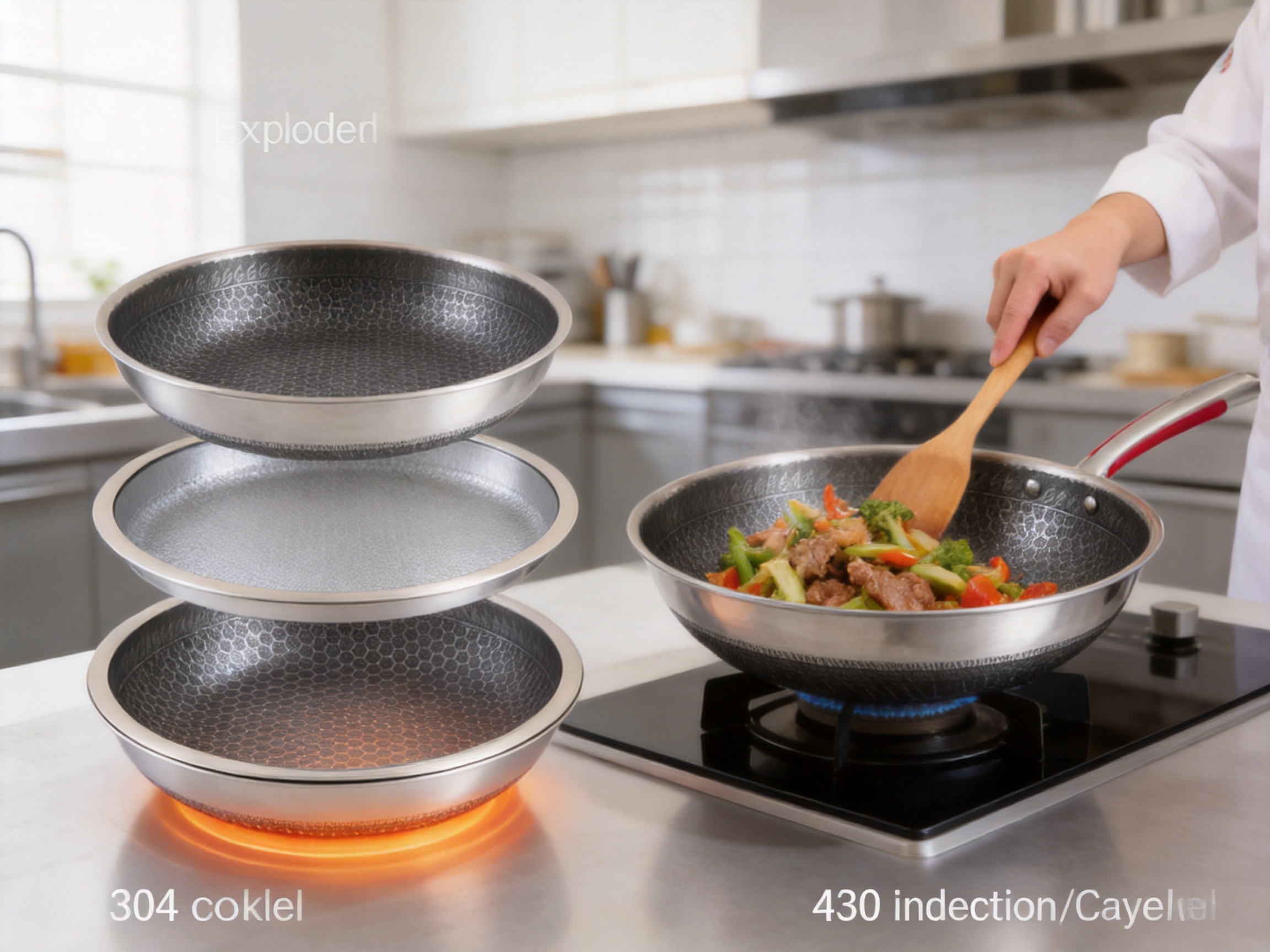
The material arrangement is one of the most important aspects of the product. The 0.4-millimeter stainless steel 304 layer is associated with a food-contact cooking surface, while the 1.3-millimeter aluminum center is intended to improve thermal conductivity. The 0.6-millimeter stainless steel 430 layer provides a durable outer structure and supports induction compatibility.
A total thickness of 2.3 millimeters gives the wok a substantial feel without making it excessively heavy for normal household use. Thickness alone does not determine cookware quality, but it can contribute to stability, resistance to warping, and more controlled heat response when combined with appropriate material selection and bonding.
3. The Three-Layer Construction Advantage
3.1 Stainless Steel 304 Cooking Surface
Stainless steel 304 is widely used in food-contact applications because of its corrosion resistance, clean appearance, and suitability for kitchen environments. As the inner cooking layer, it provides a hygienic surface that does not require seasoning in the same way as carbon steel or cast iron.
The stainless steel interior also supports a professional visual impression. It is easy to inspect, does not depend on a colored coating to create its finish, and can retain its appearance when cleaned according to the recommended instructions. For commercial purchasers, the recognizable stainless steel construction can be an important selling point because it communicates durability and practical food preparation.
3.2 Aluminum Heat-Distribution Core
Aluminum is used in the central layer because it transfers heat more efficiently than stainless steel. In a multilayer structure, the aluminum core can help distribute heat across a wider portion of the base and sidewall. This is particularly valuable for a wok, where ingredients may be moved between different areas of the cooking surface during rapid preparation.
A well-designed aluminum core can reduce the likelihood of severe localized hot spots. More even heat distribution may help users brown food more consistently, reduce the risk of burning small ingredients, and improve the repeatability of cooking results. It can also make the pan more responsive than a heavy, slow-heating solid mass.
3.3 Stainless Steel 430 Exterior
The outer 0.6-millimeter stainless steel 430 layer is especially relevant to induction use. Stainless steel 430 is commonly selected for its magnetic properties and its suitability for cookware exteriors. In this product, it contributes to the wok’s compatibility with induction cookers while adding structural protection to the aluminum core.
The exterior layer also helps create a durable base that can withstand normal contact with stovetops. By combining an induction-friendly stainless steel exterior with an aluminum heat-conducting core and a stainless steel interior, the product is designed as a practical all-rounder rather than a wok limited to one cooking technology.
3.4 Balanced Material Engineering
The primary advantage of the three-layer body is balance. A single material rarely provides every desired property. Stainless steel is strong and hygienic but comparatively less conductive than aluminum. Aluminum distributes heat well but requires additional protection and is not naturally ideal for every cooking environment. The multilayer approach assigns each material a specific role.
This type of construction can be more valuable than simply increasing the thickness of one metal. It supports a combination of thermal performance, durability, induction compatibility, and a refined appearance. For buyers comparing products in the same price category, the material structure provides a clear technical feature that can be communicated to customers through packaging, product pages, and sales training.
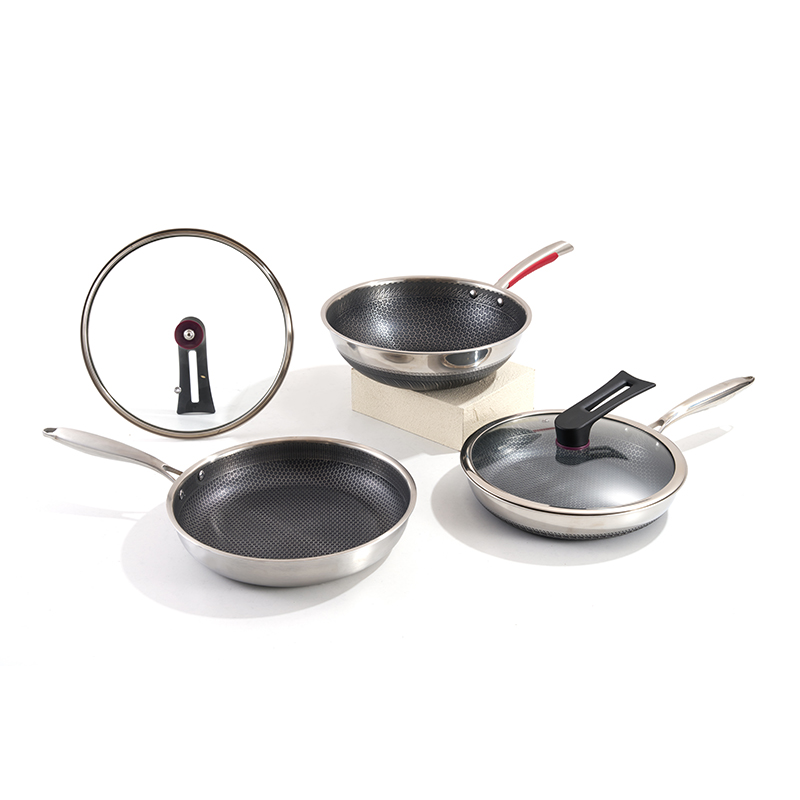
Honeycomb Stainless Steel Wok
4. Honeycomb Physical Non-Stick Technology
The cooking surface features a honeycomb texture intended to support physical non-stick performance. Instead of relying exclusively on a conventional chemical coating, the textured design creates a protective pattern across the stainless steel cooking surface. This approach is designed to reduce direct abrasion and support smoother food release when the wok is used correctly.
The honeycomb pattern can also help protect the underlying cooking surface from everyday wear. The raised structure may reduce the area of direct contact between cooking tools and the flatter portions of the surface, helping the wok remain functional through repeated use. This is particularly attractive to users who prefer the cleanability of a non-stick-style pan but want a more durable stainless steel construction.
It is important to understand that physical non-stick technology does not mean that the wok can never require oil or that food will release under every condition. Cooking temperature, preheating, ingredient moisture, oil quantity, and user technique all affect release performance. Protein-rich foods, sugary sauces, and starchy ingredients may still adhere if the pan is overheated, insufficiently oiled, or left undisturbed for too long.
Nevertheless, the honeycomb structure offers a meaningful advantage over a flat stainless steel interior. It is designed to make stainless steel cooking more approachable, particularly for users who may not have extensive experience with temperature control. It also provides a product story that is easy for retailers to explain: stainless steel durability combined with a textured surface intended to support easier cooking and cleaning.
4.1 Reduced Dependence on Traditional Coatings
Traditional coated cookware can provide excellent initial food release, but its service life may be affected by scratches, peeling, improper heating, and unsuitable tools. Once a coating becomes visibly damaged, consumers may question whether the pan should continue to be used.
The Honeycomb Stainless Steel Wok is positioned as an alternative for buyers who are concerned about coating wear. Its physical surface design is intended to eliminate concerns associated with a conventional coating peeling away from the cooking surface. This does not make the wok indestructible, and users should still follow the care instructions, but the stainless steel-based construction provides a different long-term ownership experience.
4.2 Compatibility with Practical Cooking Tools
The product information highlights scratch resistance and durability, making the wok suitable for regular kitchen work. However, the care instructions also recommend wooden, nylon, or non-stick cooking utensils and advise against metal or sharp tools. This recommendation should be followed because even durable textured surfaces can be damaged by aggressive scraping, pointed edges, or repeated impact.
For retail communication, the correct message is that the wok is designed for durable everyday use, not that it is immune to all forms of abuse. Clear guidance protects the product’s appearance and helps customers achieve better long-term results.
5. Cooking Performance Across Different Methods
5.1 Stir-Frying
Stir-frying is the wok’s most obvious application. The 32-centimeter size gives users room to move vegetables, meat, seafood, noodles, and sauces without immediately overcrowding the pan. The curved form encourages ingredients to collect toward the center while allowing the cook to push finished food up the sides.
The multilayer body supports more consistent heating across the cooking area. This can be helpful when cooking ingredients in stages. For example, aromatics may be briefly heated in oil, followed by meat or tofu, then vegetables and sauce. The user can adjust the heat and move the food according to its cooking speed.
For best stir-frying results, ingredients should be prepared before the wok is placed on the heat. Food should be cut into similarly sized pieces, moisture should be controlled, and sauces should be measured in advance. Adding too much cold food at once can reduce the cooking temperature and produce steaming instead of browning.
5.2 Sautéing and Pan-Frying
The wok can also be used for sautéing onions, garlic, mushrooms, greens, potatoes, and other ingredients. Its depth helps reduce splattering compared with a shallow skillet, while the broad upper opening provides convenient access for stirring.
When pan-frying, users should allow the oil and cooking surface to reach an appropriate temperature before adding food. Ingredients should not be moved too frequently during the first moments of cooking because a stable contact period can help develop color and release the food naturally.
5.3 Braising and Simmering
The 9-centimeter height offers useful capacity for saucy dishes, braised vegetables, curries, and one-pan meals. The stainless steel interior is suitable for cooking foods with liquid, provided the pan is used within normal stovetop conditions and cleaned after use.
Although a wok is not a substitute for every specialized pot, its shape allows a household to prepare multiple types of dishes with one central piece of cookware. This versatility is valuable in smaller kitchens, rental properties, student accommodation, and homes where buyers prefer to reduce the number of pans they own.
5.4 Steaming and Shallow Boiling
With appropriate accessories, the wok shape can support steaming. Its depth allows water to be placed below a rack or basket while keeping food above the water line. It can also be used for shallow boiling, blanching, and reheating meals.
Users should always ensure that the selected accessory fits securely and does not scratch the cooking surface. The wok should not be filled beyond a safe level, and hot water should be handled carefully to reduce the risk of splashing.
6. Compatibility with Gas, Induction, and Other Stovetops
One of the product’s strongest commercial and practical advantages is broad stovetop compatibility. The wok is suitable for gas and induction cookers, as well as other common stovetop formats when used according to the appliance manufacturer’s instructions.
Gas cooking provides rapid visual heat adjustment and works naturally with wok-style food preparation. The user can raise or lower the flame quickly and position the wok to control the intensity of heat. The base should remain properly centered over the burner, and the flame should not extend beyond the base.
Induction cooking requires a magnetic-compatible base. The stainless steel 430 exterior is designed to support this requirement. Induction users benefit from fast heating, precise electronic control, and efficient energy transfer. The wok should be placed flat and centrally on the induction zone for stable operation.
Compatibility with several stovetop types expands the product’s addressable market. Retailers do not need to classify it as a gas-only or induction-only product. Distributors can offer the same core model to households with different kitchen systems, simplifying inventory management and product education.
Users should still confirm the dimensions and operating requirements of their specific cooker. A wok that is too large for a small induction zone may not heat evenly, while a gas burner that is too small may require more time to bring the cooking area to temperature.
7. Ergonomic Handle and Everyday Handling
A wok’s performance depends not only on its metal body but also on how comfortably it can be lifted, stirred, and moved. The Honeycomb Stainless Steel Wok includes an ergonomic handle designed to provide heat-resistant comfort during normal cooking.
An ergonomic handle can reduce strain during repeated stirring and help the user maintain a stable grip while transferring the wok from the stovetop to a serving area. Comfort is particularly important when preparing meals that require frequent movement, such as fried rice, noodles, mixed vegetables, and seafood.
Heat resistance should not be interpreted as a guarantee that the handle will remain cool under every circumstance. Heat can travel through metal components, especially during prolonged cooking or when the handle is positioned close to a burner flame. Users should handle the wok carefully and use suitable protection when necessary.
The handle design also contributes to the product’s professional appearance. A comfortable, visually balanced handle can make the wok more appealing in showrooms, online listings, and kitchenware displays. It reinforces the idea that the product is intended for serious home cooks as well as routine meal preparation.
8. Advantages Over Common Competing Cookware Types
8.1 Compared with Conventional Coated Woks
Conventional coated woks are often selected for easy food release, especially by inexperienced cooks. However, the coating may be vulnerable to scratches, peeling, and degradation caused by overheating or unsuitable utensils. The Honeycomb Stainless Steel Wok offers a different value proposition by combining a stainless steel cooking structure with a physical textured surface.
Its advantage is not simply that it is easy to clean. It is also positioned as a longer-term option for buyers who want to reduce concerns about coating damage. A retailer can present it as a durable alternative for customers who want non-stick-style convenience without depending entirely on a traditional applied coating.
8.2 Compared with Single-Layer Stainless Steel Woks
Single-layer stainless steel is strong and hygienic, but heat distribution may be less uniform than in a multilayer body. The aluminum core in this wok is intended to improve thermal performance and make cooking more consistent across the base.
The honeycomb texture also distinguishes the product from a plain stainless steel surface. For consumers who find ordinary stainless steel cookware difficult to use, the textured design may provide a more forgiving cooking experience when combined with appropriate heat and oil control.
8.3 Compared with Carbon Steel Woks
Carbon steel woks are valued for high-heat cooking and their ability to develop a seasoned surface. However, they generally require seasoning, drying, and careful storage. Poor maintenance can lead to rust, while acidic ingredients may affect the seasoning layer.
The stainless steel construction of this wok offers a simpler maintenance routine. Users do not need to build and maintain a seasoning layer as part of ordinary ownership. This may appeal to busy households, first-time wok buyers, and commercial customers seeking easier staff training.
8.4 Compared with Cast Iron Woks
Cast iron provides excellent heat retention, but it is heavy and can be slow to respond to temperature changes. Moving a full cast iron wok may also be difficult for some users.
The 2.3-millimeter multilayer stainless steel design aims to provide durability and stable heating with more practical everyday handling. It is suitable for consumers who appreciate substantial cookware but do not want the weight and maintenance demands associated with cast iron.
8.5 Compared with Aluminum Woks
Aluminum cookware heats quickly and is relatively lightweight, but unprotected aluminum may be less resistant to scratching, staining, or reaction with certain foods. The stainless steel layers in this product provide a more durable and food-oriented exterior and interior environment, while the aluminum center retains the benefit of improved heat conduction.
| Cookware type | Main strength | Common limitation | Positioning of the honeycomb stainless steel wok |
|---|---|---|---|
| Traditional coated wok | Easy initial food release | Coating may scratch or peel | Physical textured surface with stainless steel construction |
| Single-layer stainless steel wok | Durability and hygienic appearance | May develop uneven hot spots | Multilayer body with an aluminum heat-distribution core |
| Carbon steel wok | High-heat performance | Requires seasoning and rust prevention | Simpler stainless steel maintenance routine |
| Cast iron wok | Heat retention | Heavy and slower to adjust | More manageable multilayer construction |
| Aluminum wok | Fast heating and light weight | May need additional surface protection | Aluminum core protected by stainless steel layers |
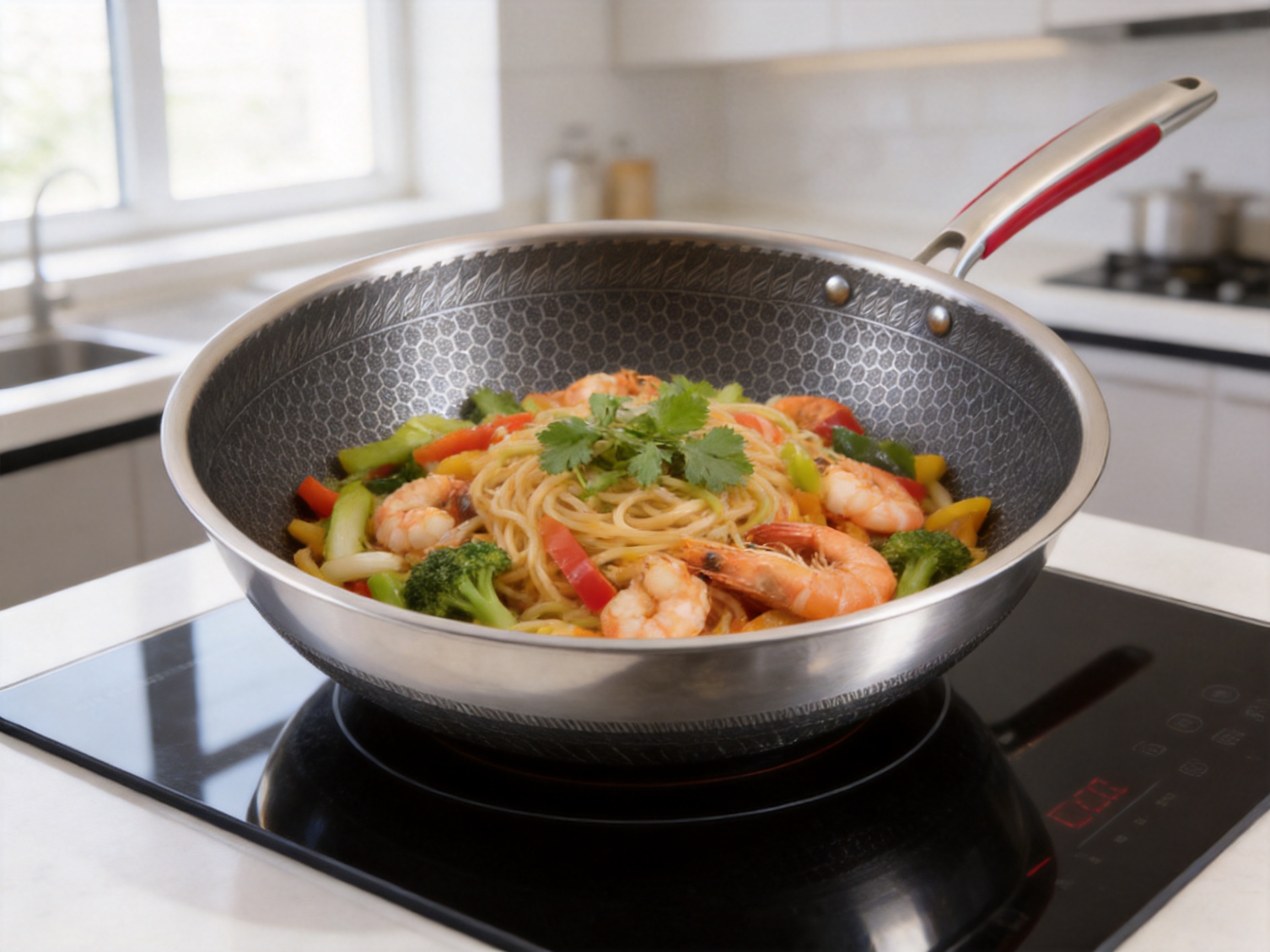
9. Manufacturing Strengths and Product Development Capability
The product is supplied by Zhejiang Echo Industry And Trade Co., Ltd., a kitchenware company based in Zhejiang, China. The company focuses on aluminum cookware, stainless steel cookware, cast iron cookware, and kitchen utensils, allowing it to support buyers who need more than one product category.
This broad product coverage is important for importers and distributors. Instead of sourcing a single wok from one supplier and other cookware from separate factories, buyers may be able to coordinate a wider assortment through one kitchenware partner. A broader supplier relationship can simplify communication, sampling, packaging coordination, and replenishment planning.
9.1 Material-Oriented Product Engineering
The wok demonstrates a product development approach based on functional material selection. The use of stainless steel 304, aluminum, and stainless steel 430 is not merely decorative. Each layer addresses a specific performance requirement: food-contact suitability, heat distribution, and induction-oriented exterior compatibility.
This kind of construction requires attention to layer alignment, bonding, forming, finishing, and dimensional consistency. A multilayer pan must be produced with careful control because the materials have different thermal and mechanical properties. The final product must remain stable during heating and cooling while maintaining a usable cooking surface.
Although the available product information does not specify individual factory machines or process parameters, the construction itself indicates the importance of controlled manufacturing across several stages. These stages typically include material preparation, layer assembly, forming, surface treatment, handle installation, inspection, cleaning, and packing.
9.2 Honeycomb Surface Development
The honeycomb cooking surface is another sign of application-focused design. The surface pattern must be formed consistently so that the product delivers a uniform appearance and predictable contact behavior. Consistency matters not only for cooking performance but also for quality control, product photography, retail presentation, and customer confidence.
A supplier offering this type of product must pay attention to the relationship between surface texture and cleaning requirements. The texture should be practical rather than excessively deep or difficult to maintain. It should also remain visually clear after normal use when customers follow the recommended care instructions.
9.3 Quality Control Considerations
For multilayer cookware, quality control should cover dimensions, flatness, material appearance, layer integrity, handle attachment, surface uniformity, and compatibility with intended stovetops. Carton-level checks are also important because the product is shipped in quantities of six units per carton.
Importers may request product samples, inspection standards, packaging specifications, and pre-shipment quality checks before placing larger orders. A professional supplier should be able to discuss acceptable visual tolerances, packaging protection, labeling, and documentation requirements according to the buyer’s market.
The product’s stated carton size of 55 by 35 by 40 centimeters and carton weight of 16 kilograms provide a starting point for logistics planning. Buyers can use these figures to estimate warehouse space, pallet configuration, freight requirements, and landed cost. Final shipping calculations should always be confirmed against the actual packed order.
9.4 OEM, ODM, and Sourcing Support
The company presents itself as a one-stop cookware supplier offering product variety, ODM and OEM customization, product certification assistance, flexible minimum order quantities, and sustainable and healthy product development. These services can be valuable for buyers building a private-label cookware line or testing a new assortment.
OEM support may include customer-specific branding, packaging, labeling, and presentation. ODM cooperation can involve adjustments to product design, handle style, dimensions, finishes, or combinations within the supplier’s development capabilities. Each requirement should be confirmed in writing, including tooling costs, sample charges, lead times, minimum quantities, and approval procedures.
Flexible minimum order quantities can be particularly useful for small and medium-sized buyers. A lower initial commitment may allow a distributor to test demand before investing in a large inventory position. At the same time, buyers should balance low volume with packaging efficiency, manufacturing costs, and freight economics.
10. The Role of a Zhejiang-Based Kitchenware Supplier
Zhejiang is widely recognized as an important manufacturing and export region in China. Its industrial ecosystem includes companies involved in metal products, kitchenware, hardware, packaging, logistics, and international trade. A supplier based in this environment can benefit from access to supporting industries and export-oriented business infrastructure.
For overseas buyers, location is not a substitute for product quality, but it can support efficient coordination. Access to nearby component and packaging resources may help with product development, sampling, and order consolidation. It may also make it easier to source complementary cookware and kitchen accessories for a complete collection.
The company’s stated mission is to help Zhejiang-made products reach international markets while developing into an R&D-driven supply chain partner for small and medium-sized kitchenware buyers. This positioning is relevant to customers who need ongoing product development rather than one-time order processing.
A supply chain partner should contribute more than a quotation. Buyers benefit from assistance with product selection, market positioning, packaging, compliance documentation, sample review, production follow-up, and shipment preparation. The Honeycomb Stainless Steel Wok can serve as an anchor product within a broader line of cookware designed around healthy cooking, durability, and practical multi-stovetop use.
11. Healthy Cooking and Responsible Product Positioning
Consumers increasingly ask how cookware surfaces are made and how they behave over time. The Honeycomb Stainless Steel Wok addresses this interest through food-grade stainless steel and physical non-stick technology. The product is designed to reduce concerns about the peeling of a conventional chemical coating.
Healthy cooking also depends on user behavior. A durable pan cannot compensate for severely overheated oil, burned food, poor ventilation, or unsafe handling. The best product positioning combines the wok’s material advantages with clear instructions on heat control, cleaning, and utensil selection.
The stainless steel interior is also visually reassuring because it allows users to observe the condition of the cooking surface. Unlike a dark coating that may conceal certain forms of residue, a silver stainless steel surface makes food buildup easier to identify during cleaning.
Responsible product communication should avoid exaggerated claims. The wok should be described as designed for healthier cooking and as an alternative to conventional coated cookware, rather than as a guarantee of perfect food release or a complete solution for every dietary concern. Honest explanations tend to create stronger long-term customer trust.
12. Care and Maintenance Instructions
12.1 Before First Use
The wok should be washed before its first use. This removes dust, handling residue, and packaging particles that may remain after manufacturing and transportation. A thorough wash with hot, soapy water and a soft cloth or sponge is recommended.
After washing, the surface should be rinsed and dried. Drying helps prevent water spots and prepares the wok for controlled preheating. Users should read any supplied packaging instructions before cooking.
12.2 Choosing Cooking Utensils
Wooden, nylon, or non-stick cooking utensils are recommended. These materials are less likely to damage the honeycomb surface than pointed or sharp tools. Even though the wok is designed to be scratch-resistant and durable, careful utensil selection helps preserve its appearance and performance.
Metal utensils should be avoided, especially those with sharp corners or rough edges. Do not cut food directly inside the wok with a knife. Avoid dragging heavy cookware accessories across the surface.
12.3 Controlling Heat
The wok should not be overheated while empty. Excessive empty heating can place unnecessary stress on the materials, affect the appearance of the surface, and increase the risk of damage to the cookware or stovetop.
Users should select a heat level appropriate for the recipe and the cooking appliance. High heat may be suitable for short stir-frying, but it should not be maintained unnecessarily. On gas stoves, the flame must remain beneath the base rather than extending beyond the sides.
If the wok severely overheats, users should turn off the cooker and leave the pan in place until it has cooled completely. The pan should not be touched immediately, moved while dangerously hot, or placed under cold water. Sudden temperature changes may cause thermal stress and create a safety risk.
12.4 Cleaning
For routine cleaning, use hot, soapy water with a soft cloth or sponge. Allow the wok to cool before washing. Washing a very hot pan immediately with cold water can create thermal shock and should be avoided.
Food residue should be softened with warm water rather than removed through aggressive scraping. Abrasive pads, sharp tools, harsh scouring powders, and unsuitable cleaning chemicals may affect the surface finish. Hand washing is recommended to preserve the appearance of the cookware.
After washing, rinse the wok thoroughly and dry it with a soft towel. Proper drying helps maintain a clean silver appearance and reduces water marks during storage.
12.5 Storage
The wok should be stored in a dry location. If it is stacked with other cookware, place a soft protective layer between items where possible. Avoid storing sharp tools inside the wok, as repeated contact can cause unnecessary scratches.
The handle and body should be checked periodically for signs of looseness or damage. If any component becomes unstable, the wok should not be used until it has been inspected or repaired appropriately.
13. Commercial Opportunities for Importers and Retailers
The Honeycomb Stainless Steel Wok is suitable for several sales channels. It can be offered through cookware stores, department stores, kitchen specialty shops, online marketplaces, hospitality suppliers, and private-label homeware brands.
Its strongest retail messages are easy to communicate. These include food-grade stainless steel, honeycomb physical non-stick technology, a multilayer body, induction compatibility, all-stovetop use, scratch resistance, professional appearance, and broad cooking versatility.
Online product pages should explain the three-layer structure clearly. Consumers may not immediately understand why stainless steel and aluminum are combined. A simple diagram or concise specification panel can show the function of each layer without making unsupported technical claims.
Retailers should also explain care requirements in a positive way. Advising customers to use wooden or nylon tools does not weaken the product’s positioning. Instead, it demonstrates that the seller is committed to helping customers preserve their investment.
The six-unit carton quantity may suit small wholesale orders, trial shipments, and mixed-container assortments. Buyers can combine the wok with other cookware categories, such as aluminum pans, stainless steel pots, cast iron products, and kitchen utensils, depending on their market strategy.
14. Packaging, Logistics, and Inventory Planning
Efficient logistics are essential for cookware because metal products are durable but can still be scratched, dented, or cosmetically damaged during transportation. The stated carton dimensions and weight provide useful planning data, but importers should confirm the internal packaging structure before shipment.
Protective packaging should keep each wok separated and prevent handles from striking neighboring units. The honeycomb surface should be protected from abrasion, while the silver exterior should be shielded from scuffing. Carton strength should be appropriate for stacking and repeated handling through warehouses and distribution centers.
Because the carton contains six units, buyers can calculate approximate unit logistics by dividing the carton volume and weight across the quantity. The stated carton volume is 0.077 cubic meters, and the stated carton weight is 16 kilograms. Actual net weight, gross weight, packaging materials, and shipping measurements should be verified with the supplier before freight booking.
For online retailers, packaging may need additional protection because parcels can experience more individual handling than palletized wholesale shipments. Buyers should consider whether the standard export package is sufficient for direct-to-consumer delivery or whether an upgraded package is necessary.
15. Recommended Cooking Practices
To achieve the best performance, begin with a clean and dry wok. Preheat it gradually rather than placing an empty wok over maximum heat. Add a suitable amount of cooking oil once the pan is warm, then introduce ingredients according to the recipe.
Do not overload the wok. Cooking in smaller batches may produce better browning and prevent excessive moisture from accumulating. When preparing meat or seafood, allow the surface to develop color before turning the pieces. When cooking vegetables, add firm ingredients before delicate greens.
For sauces, reduce the heat when necessary and stir with an appropriate utensil. Sugary or thick sauces can caramelize quickly, so they should not be left unattended. If residue develops, remove the wok from the heat and allow it to cool before beginning the cleaning process.
Induction users should select a cooking zone that matches the base size as closely as possible. Gas users should keep the flame beneath the base. On any stovetop, the wok should be centered and placed on a stable surface.
16. Frequently Asked Questions
Q1: What is the main advantage of the Honeycomb Stainless Steel Wok?
The main advantage is its combination of a stainless steel cooking surface, honeycomb physical non-stick technology, and a multilayer body. It is designed to offer durability, easier food release, improved heat distribution, and compatibility with multiple stovetops.
Q2: Does the wok use a traditional chemical non-stick coating?
The product is described as using honeycomb physical non-stick technology rather than relying on a conventional chemical coating. This design is intended to reduce concerns about coating peeling while supporting more convenient cooking.
Q3: What are the three material layers?
The stated structure consists of 0.4 millimeter stainless steel 304, 1.3 millimeter aluminum, and 0.6 millimeter stainless steel 430. The stainless steel layers provide a durable structure, while the aluminum layer is intended to improve heat distribution.
Q4: Can the wok be used on an induction cooker?
Yes. The wok is designed for use on induction cookers as well as gas and other common stovetops. It should be centered correctly on the cooking zone, and users should follow their appliance instructions.
Q5: Can metal utensils be used?
Metal or sharp cooking utensils are not recommended. Wooden, nylon, or non-stick cooking utensils should be used to help protect the honeycomb cooking surface.
Q6: Is the wok dishwasher safe?
The supplied care instructions recommend hand washing to preserve the appearance of the cookware. Clean the cooled wok with hot, soapy water and a soft cloth or sponge.
Q7: What should be done if the wok overheats?
Turn off the cooker and leave the wok to cool completely. Do not touch or move a severely overheated wok immediately, and do not cool it suddenly with cold water.
Q8: Can the wok be used in a microwave?
No. The wok should not be used in a microwave.
Q9: What is the product size?
The wok has a diameter of 32 centimeters and a height of 9 centimeters. This size is suitable for many family meals and provides useful capacity for stir-frying, sautéing, braising, and other cooking methods.
Q10: What is the carton quantity?
Each carton contains six units. The stated carton size is 55 by 35 by 40 centimeters, with a volume of 0.077 cubic meters and a weight of 16 kilograms.
Q11: Is the wok suitable for professional kitchens?
Its stainless steel construction, versatile size, multilayer body, and professional appearance make it suitable for consideration by professional and institutional buyers. Commercial users should evaluate cooking volume, local safety requirements, handling practices, and cleaning procedures before purchase.
Q12: Can the supplier support private-label projects?
The company states that it provides ODM and OEM customization, flexible minimum order quantities, product variety, certification assistance, and one-stop cookware solutions. Specific customization options, quantities, costs, and lead times should be confirmed directly for each project.
17. Why This Wok Is a Strong Product for Modern Cookware Collections
The Honeycomb Stainless Steel Wok occupies a useful position between conventional coated cookware and traditional uncoated metal woks. It is designed for consumers who want a practical cooking surface, but who also value the durability and clean appearance of stainless steel.
Its three-layer structure gives buyers a clear technical reason to choose it. Stainless steel 304 supports the food-contact interior, aluminum contributes to heat distribution, and stainless steel 430 helps support induction use. The honeycomb surface adds a visual and functional distinction that separates the product from plain stainless steel cookware.
The product also benefits from broad usability. It can be used on gas and induction cookers, supports many cooking methods, and has a size that is appropriate for ordinary household meals. The ergonomic handle contributes to comfort, while the silver finish supports a professional and modern kitchen aesthetic.
From a supplier perspective, the product is supported by a company offering a wider cookware portfolio and development services. This creates opportunities for buyers seeking coordinated sourcing, private-label collections, customized packaging, or broader kitchenware programs.
18. Final Assessment
The Honeycomb Stainless Steel Wok is a carefully positioned piece of cookware built around durability, versatility, and healthier surface technology. Its food-grade stainless steel construction provides a dependable foundation, while the aluminum center layer is designed to improve heat distribution. The stainless steel 430 exterior supports induction compatibility, expanding its usefulness across different kitchen environments.
The honeycomb physical non-stick surface is the product’s defining feature. It offers an alternative to traditional coatings and is intended to support easier food release while reducing concerns about peeling. Proper cooking technique remains important, but the textured design gives users a more convenient entry point into stainless steel cooking.
Compared with conventional coated, single-layer stainless steel, carbon steel, cast iron, and aluminum woks, this product offers a balanced combination of performance characteristics. It does not attempt to replace every specialized pan. Instead, it provides a practical all-purpose solution for households, retailers, food-service buyers, and private-label cookware brands.
The supplier’s product range, OEM and ODM capabilities, flexible sourcing approach, and focus on one-stop cookware solutions further strengthen the product’s commercial potential. For buyers seeking a modern wok with a durable construction, wide compatibility, professional appearance, and a clear technical story, the Honeycomb Stainless Steel Wok is a compelling option.
References
1. Product specification sheet for Honeycomb Stainless Steel Wok, SKU SXT01.
2. Product care and handling instructions supplied for the Honeycomb Stainless Steel Wok.
3. General technical references concerning stainless steel 304 in food-contact kitchenware.
4. General technical references concerning stainless steel 430 and induction-compatible cookware bases.
5. General material references concerning aluminum heat conduction in multilayer cookware.
6. General cookware guidance concerning stovetop heat control, utensil selection, and hand washing.
7. Supplier information concerning aluminum cookware, stainless steel cookware, cast iron cookware, kitchen utensils, OEM services, ODM services, and one-stop kitchenware sourcing.
Product: Honeycomb Stainless Steel Wok
Recommended Articles
Product Category
Related products
-
-
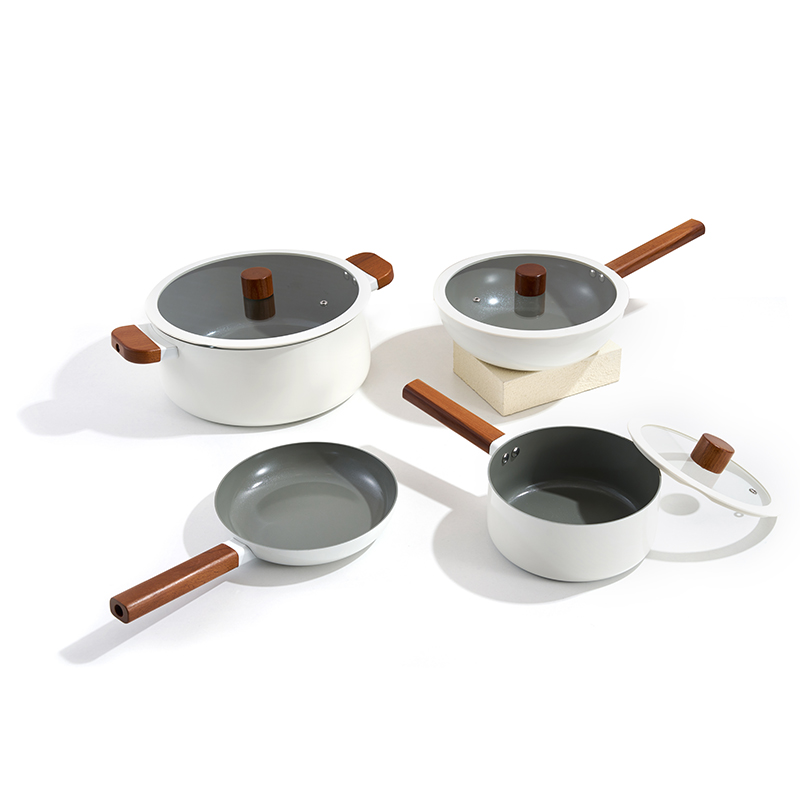
This cookware set has a ceramic non-stick inner liner, a heat-resistant wooden h...
See Details -
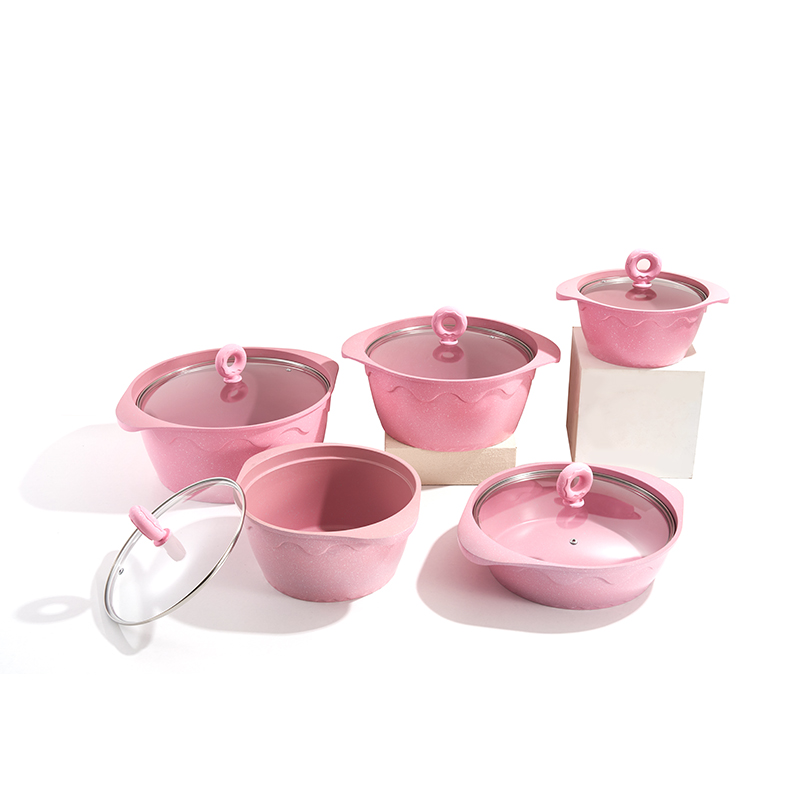
This cookware set is made of food-grade non-stick material, with a unique eye-ca...
See Details -
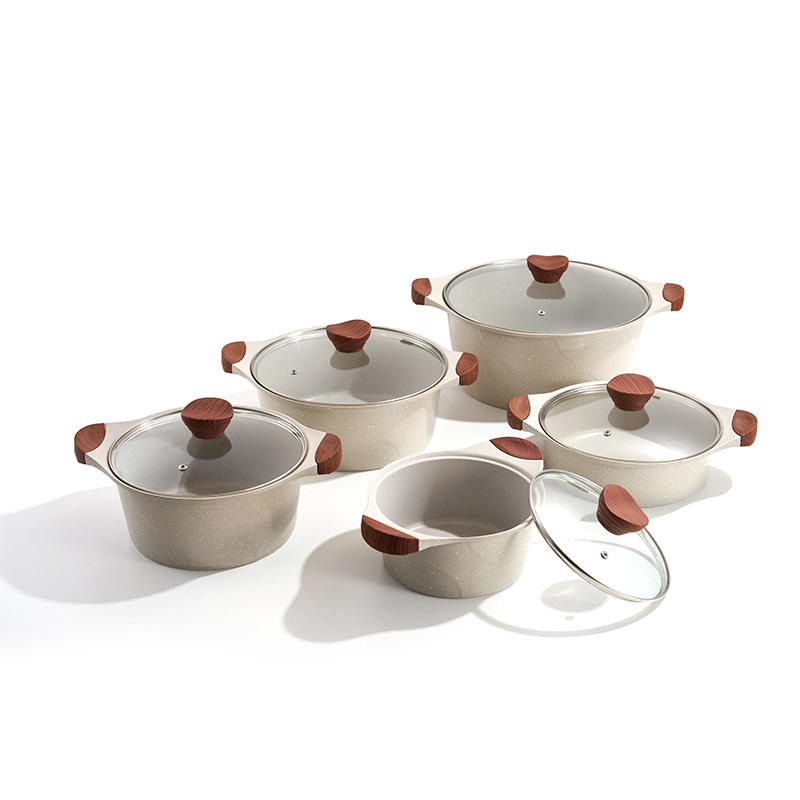
This off-white cookware set is made of wear-resistant non-stick material, with w...
See Details
Whether you're looking for bulk purchases or have any custom requirements, We are here to offer the best
solutions for you.
tiffany.zhong@echocn-trading.com
PHONE
+86-19561173975
+86-19557020621 (Hazel Wu)
ADD
Room 301, Unit 3014, No. 175 Qifeng Avenue, Wenqiao Town, Taizhou, Zhejiang, China
Fill Out the Form for More Information
Copyright © Zhejiang Echo Industry And Trade Co., Ltd.
All Rights Reserved.

China Cookware Set Manufacturer